Without Backup Plans, Global IT Outages Will Happen Again

The "2038 Problem" underscores the growing complexity of technological infrastructure due to increased reliance on interconnected systems (Shutterstock).
TT

Without Backup Plans, Global IT Outages Will Happen Again

The "2038 Problem" underscores the growing complexity of technological infrastructure due to increased reliance on interconnected systems (Shutterstock).

Elements of Friday’s global IT outage, which grounded planes and hit services from banking to healthcare, have occurred before and until more contingencies are built into networks, and organizations put better back-up plans in place, it will happen again.
Friday’s outage was caused by an update that US cybersecurity firm CrowdStrike pushed to its clients early on Friday morning which conflicted with Microsoft’s Windows operating system, rendering devices around the world inoperable, reported Reuters.
CrowdStrike has one of the largest shares of the highly competitive cybersecurity market that provides such tools, leading some industry analysts to question whether control over such operationally critical software should remain in the hands of just a handful of companies.
But the outage has also raised concerns among experts that many organizations are not well-prepared to implement contingency plans when a single point of failure such as an IT system, or a piece of software within it, goes down.
At the same time there are also more solvable digital disasters looming on the horizon, with perhaps the biggest global IT challenge since the Millennium Bug, the “2038 Problem”, just under 14 years away - and, this time, the world is infinitely more dependent on computers.
“It’s easy to jump at the idea that this is disastrous and therefore suggest there must be a more diverse market and, in an ideal world, that’s what we’d have,” said Ciaran Martin, former head of Britain’s National Cyber Security Centre (NCSC), part of the country's GCHQ intelligence agency.
“We're actually good at managing the safety aspects of tech when it comes to cars, trains, planes, and machines. What we're bad at is then providing services,” he added.
“Look at what happened to the London health system a few weeks ago - they were hacked, and that led to loads of canceled operations, which is physically dangerous,” he said, referring to a recent ransomware incident which affected Britain’s National Health Service (NHS).
Organizations need to look around their IT systems, Martin said, and ensure there are enough failsafes and redundancies in those systems to stay operational in the event of an outage.
Friday’s outage happened amid a perfect storm, with both Microsoft and CrowdStrike owning huge shares of a market which relies on both of their products.
“I'm sure the regulators globally are looking at this. There is limited competition globally for operating systems, for example, and also for the large scale cybersecurity products like the ones CrowdStrike provides,” said Nigel Phair, a cybersecurity professor at Australia’s Monash University.
Friday's outage hit airlines particularly hard, as many scrambled to check in and board passengers who relied upon digital tickets to fly. Some travelers posted photos on social media of hand-written boarding cards provided by airline staff. Others were only able to fly if they had printed out their ticket.
“I think it's very important for organizations of all shapes and sizes to really look at their risk management and look at an all-hazards approach,” Phair said.
EPOCHALYPSE NOW
Friday’s outage will not be the last time the world is reminded of its dependency on computers and IT products for basic services to function. In about 14 years' time, the world will be faced with a time-based computer issue similar to the Millennium Bug called the “2038 Problem”.
The Millennium Bug, or “Y2K” happened because early computers saved expensive memory space by only counting the last two digits of the year, meaning many systems were unable to distinguish between the year 1900 and 2000, leading to critical errors.
The cost to mitigate the problem in the years before 2000 ran up a global bill of hundreds of billions of dollars.
The 2038 problem, or "Epochalypse", which begins at 0314 GMT on Jan. 19, 2038, is, in essence, the same problem.
Many computers count the passage of time by measuring the number of seconds since midnight on Jan. 1, 1970, also known as the “Epoch”.
Those seconds are stored as a finite sequence of zeros and ones, or “bits” but for many computers, the number of bits that can be stored reaches its maximum value in 2038.
“We currently have a situation where there's huge global disruption, because we cannot cope administratively,” said Ciaran Martin, the former NCSC head.
“We can cope in terms of safety, but we can't cope in terms of service provision when key networks go down”.



India Clears Way for Self-driving, Safety Car Tech to Reduce Road Deaths

A woman crosses street through a dust storm accompanied by rain in Jammu, India, Thursday, June 11, 2026.(AP Photo/Channi Anand)
TT

India Clears Way for Self-driving, Safety Car Tech to Reduce Road Deaths

A woman crosses street through a dust storm accompanied by rain in Jammu, India, Thursday, June 11, 2026.(AP Photo/Channi Anand)

India has scrapped a license requirement for radar sensors, freeing automakers to adopt technology that helps cars avoid crashes and drive themselves by sensing surrounding objects, in a bid to make some of the world's deadliest roads safer.

The world's third largest car market, India reported more than 177,000 deaths in nearly half a million ⁠road accidents in 2024, the ⁠latest figures show, according to Reuters.

In a notice on Thursday, the government waived the license requirement for radar sensors operating in the frequency band from 77GHz to 81 GHz. That lets companies ⁠enable the technology without the government having to separately assign the airwaves.

Automakers Maruti Suzuki, Tata Motors and Mahindra & Mahindra, stand to benefit from the change, as well the suppliers behind them, such as Germany's Bosch and Continental.

The radar sensors let a car gauge safe distances, and drive features such as emergency braking, adaptive cruise ⁠control ⁠and blindspot warnings, to form a basis for autonomous driving.

The change brings India in line with the United States, the European Union and a global telecoms standard, all of which dedicate the same frequency band to vehicle radar.

That lets carmakers and suppliers tap into the same off-the-shelf hardware worldwide, rather than having to build an India-specific version.


AI Robot Cleaners Leave the Lab for China's Living Rooms

The service is a baby step towards a future in which robots increasingly take over manual labor from humans. WANG Zhao / AFP
TT

AI Robot Cleaners Leave the Lab for China's Living Rooms

The service is a baby step towards a future in which robots increasingly take over manual labor from humans. WANG Zhao / AFP

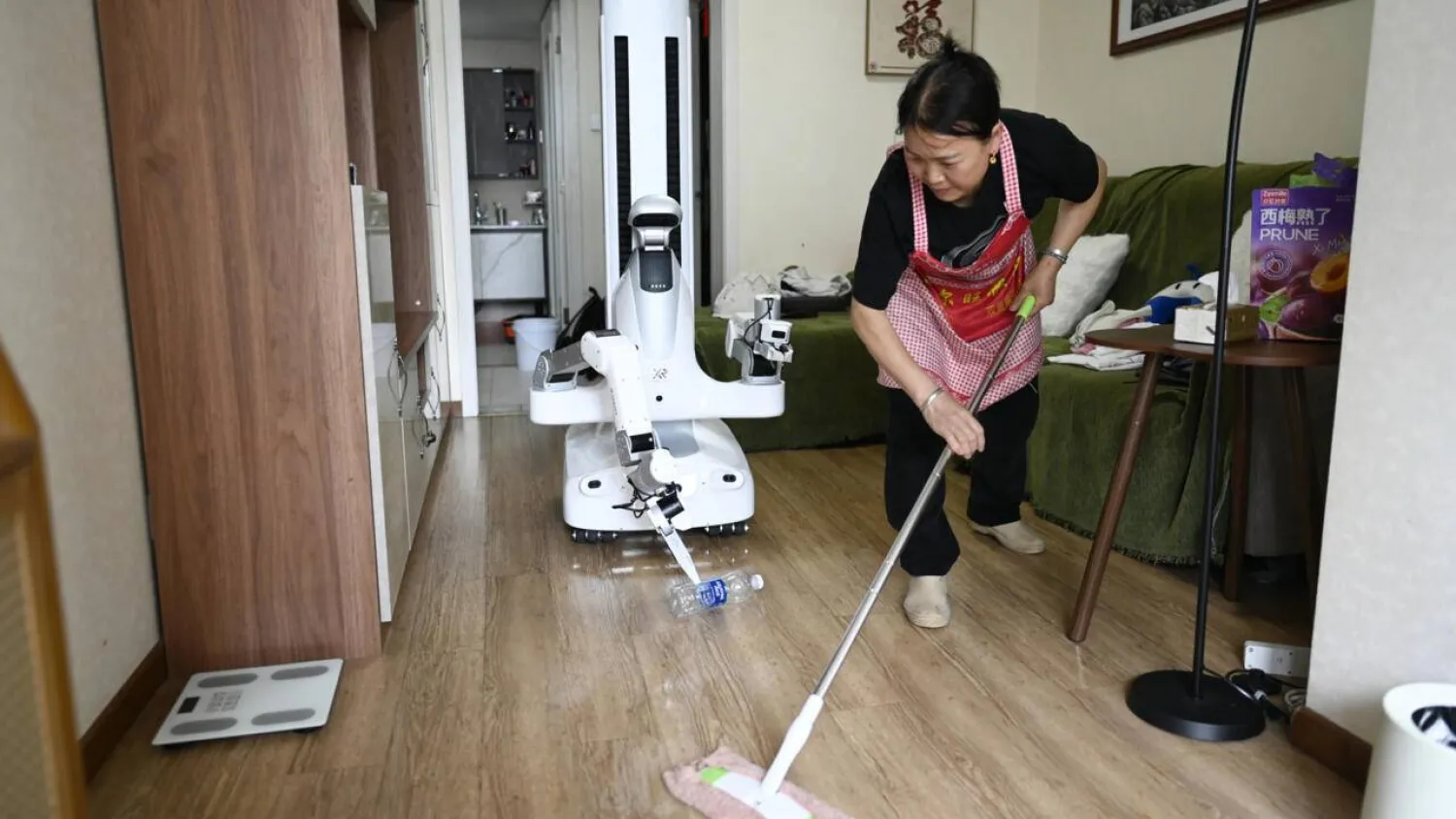
Beijing cleaner Lin Meiqiong found her work a little easier the day she was paired with an unlikely new colleague -- a tall, wheeled robot with AI-powered tidying skills.

The 56-year-old and her white-and-silver partner, fitted with cameras and two mechanical claws, are part of a new human-robot cleaning service offered by Chinese household help platform 58.com.

It's a baby step towards a future espoused by tech evangelists in which robots increasingly take over manual labor from humans -- though at the moment, such services are largely a data-gathering exercise for companies and a novelty for curious customers.

"It's definitely different," Lin told AFP in between cleaning the kitchen and wiping down windows.

"I used to have to do everything myself," she said. "It's reduced the workload a bit."

The cleaning service, a collaboration between 58.com and Chinese robotics company X Square, costs 149 yuan ($22) for three hours and is available in Beijing and tech hub Shenzhen.

Helped into the apartment by an X Square engineer, the AI-operated Quanta X1 Pro robot uses its cameras to identify areas it could spruce up.

As Lin scrubbed the floor on her knees, it picked up rubbish and folded clothes strewn across a sofa.

Grasping a pair of dark grey trousers, it raised its upper body to stretch the fabric taut, before laying it flat and arranging it into neat halves.

The process took several minutes and resembled a child learning to fold clothes for the first time.

Future iterations of the robot will respond to voice commands and even be able to chat, said the engineer, Hu Bowen.

- 'Better than a lab' -

Around 200 households have booked the service since it was rolled out in March.

Tan Pei, who works in advertising and booked the robot to clean her Beijing flat, said she had chosen the service because she was interested to "see what it could do".

"Even though it's not that perfect, there are still parts of it that surprised me," such as folding a pair of trousers "quite well", she said.

China's robots have wowed audiences with fluid dancing and set-piece martial arts displays onstage, but their application and performance in real-life settings remains limited.

For companies like X Square, the logic of launching an imperfect service lies in data collection for so-called embodied artificial intelligence.

Unlike large language models trained on vast quantities of internet content, robots lack comparable real-world datasets.

"We don't have a robot internet yet," Christoforos Mavrogiannis from the University of Michigan told AFP.

"It is much more informative to put the robot out there and study what happens than staying forever in the lab."

X Square engineer Hu said he sends his robots to work in a "completely unfamiliar environment".

"That is very challenging, but this unfamiliar data is also very helpful for the robot's growth."

As investment into embodied AI booms, similar trials in China include robots directing traffic in cities like Hangzhou or working on factory floors.

On the domestic help front, firm GigaAI also plans to deploy 100 humanoid robots into households in central Wuhan this autumn for free home-service trials.

Investors have poured more than 57.7 billion yuan ($8.5 billion) into China's embodied AI industry so far this year, already soaring past the total for last year as a whole, according to business database ITjuzi.

- 'Very elementary stage' -

But a myriad of hurdles stand in the way of widespread deployment.

As the Quanta X1 Pro's clothes folding demonstrated, robots still can't match human dexterity.

"Even though many companies are working on building better hands and building autonomy for hands, we don't have that yet," the University of Michigan's Mavrogiannis said.

There are multiple regulatory issues even once the physical capability is there.

Privacy will become a big issue, as robots would have access to huge amounts of personal data.

"We don't know where that data is going, where it's located... who is looking at that information," said Valeria Alessandra Macalupu Chira from Queensland University of Technology.

The safety of clients and their homes is another unresolved issue.

"I think we are still at a very elementary stage," said Yang Jianfei from Singapore's Nanyang Technological University.

Robots currently require supervision by humans who can activate emergency stop functions, he noted, and there are not yet recognized industry-wide safety standards.

Experts agree broad adoption seems a long way off.

Asked whether she thought robots would revolutionize her industry, cleaner Lin did not seem too concerned.

"Compared with people, it's obviously still not quite there," she said. "After all, it's a robot."


Saudi Arabia Participates in GPAI Paris Meeting for First Time as Member

Saudi Arabia Participates in GPAI Paris Meeting for First Time as Member
TT

Saudi Arabia Participates in GPAI Paris Meeting for First Time as Member

Saudi Arabia Participates in GPAI Paris Meeting for First Time as Member

Saudi Arabia, represented by the Saudi Data and Artificial Intelligence Authority (SDAIA), participated for the first time as a member of the Global Partnership on Artificial Intelligence (GPAI) during the partnership’s fifth plenary meeting, held at the Organization for Economic Co-operation and Development (OECD) headquarters in Paris from June 9–11, the Saudi Press Agency said on Thursday.

The event brought together member countries, experts, and AI policymakers from around the world to discuss the future of artificial intelligence and international cooperation in the field.

The Kingdom was represented at the meeting by Rehab Alarfaj, General Manager of Strategic Partnerships and Indices at SDAIA, who participated in sessions and discussions focused on AI governance, the implementation of the OECD AI Principles, and the future direction of the GPAI’s work.

Alarfaj stressed the importance of developing practical tools to translate AI principles into actionable, real-world applications. These tools should account for differences in national priorities and levels of institutional maturity among countries, while ensuring the principles remain globally consistent and locally applicable.