


China’s Premier Li Proposes Global AI Cooperation Organization

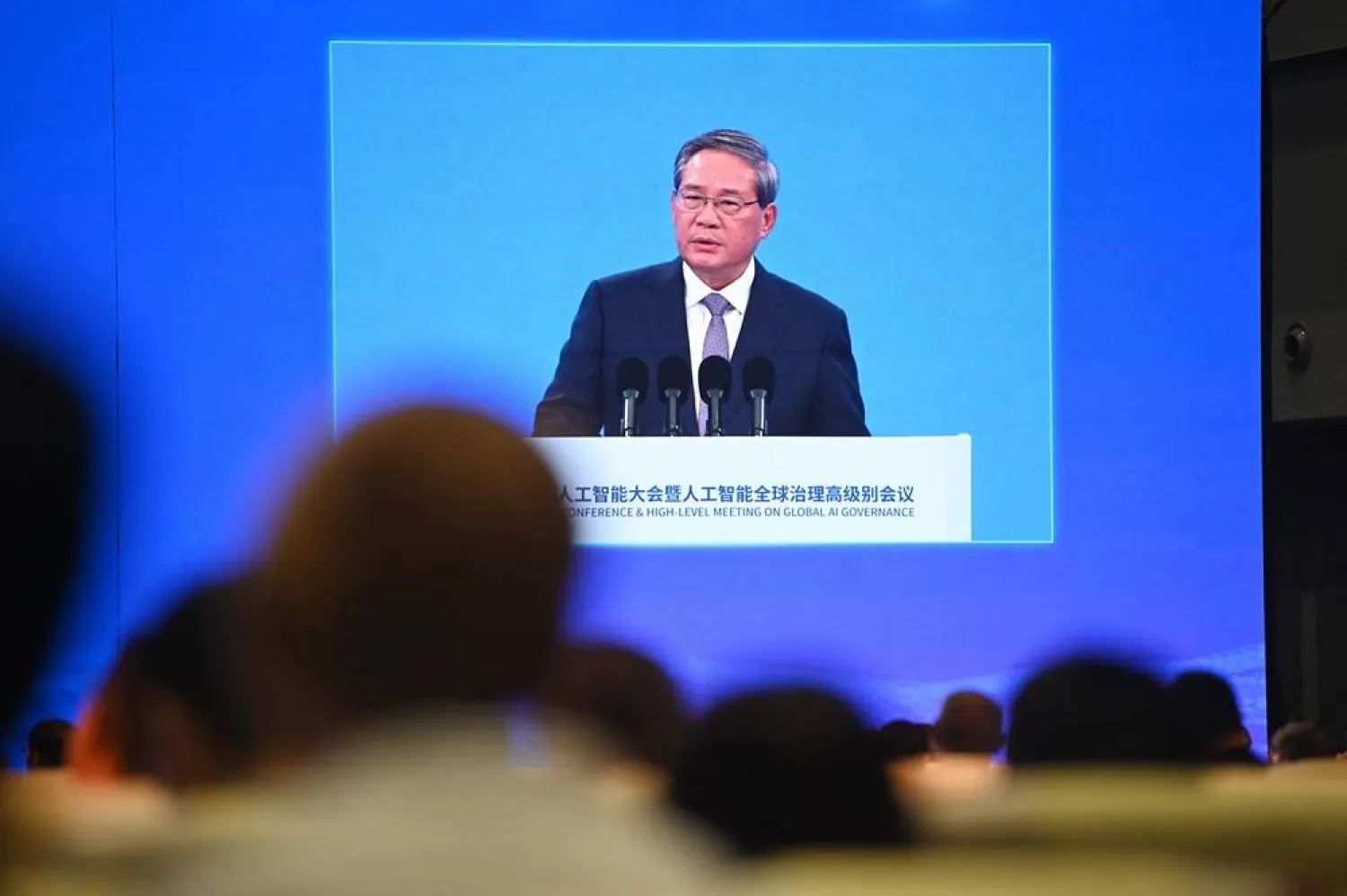
Chinese Premier Li Qiang is seen on a screen as he speaks at the opening ceremony of the World Artificial Intelligence Conference in Shanghai on July 26, 2025. (AFP)
TT

China’s Premier Li Proposes Global AI Cooperation Organization

Chinese Premier Li Qiang is seen on a screen as he speaks at the opening ceremony of the World Artificial Intelligence Conference in Shanghai on July 26, 2025. (AFP)

Chinese Premier Li Qiang on Saturday proposed establishing an organization to foster global cooperation on artificial intelligence, calling on countries to coordinate on the development and security of the fast-evolving technology.

Speaking at the opening of the annual World Artificial Intelligence Conference in Shanghai, Li called AI a new engine for growth but said governance is fragmented and emphasizing the need for more coordination between countries to form a globally recognized framework for AI.

The three-day event brings together industry leaders and policymakers at a time of escalating technological competition between China and the United States - the world's two largest economies - with AI emerging as a key battleground.

"Overall global AI governance is still fragmented. Countries have great differences particularly in terms of areas such as regulatory concepts, institutional rules," Li said. "We should strengthen coordination to form a global AI governance framework that has broad consensus as soon as possible."

Washington has imposed export restrictions on advanced technology to China, including the most high-end AI chips made by companies such as Nvidia and chipmaking equipment, citing concerns that the technology could enhance China's military capabilities.

Despite these restrictions, China has continued making AI breakthroughs that have drawn close scrutiny from US officials.

Li did not name the United States in his speech but he warned that AI could become an "exclusive game" for a few countries and companies, adding that challenges included an insufficient supply of AI chips and restrictions on talent exchange.

GOVERNANCE PLAN

China wants to share its development experience and products with other countries, especially those in the Global South, Li said.

Also on Saturday, China released an action plan for global AI governance, in which it invited governments, international organizations, enterprises and research institutions to work together and promote international exchanges including through a cross-border open-source community.

The plan proposes accelerating digital infrastructure such as clean power, new-generation networks and data centers, according to a statement from China's foreign ministry.

The AI conference is an annual government-sponsored event in Shanghai that typically attracts major industry players, government officials, researchers and investors.

Saturday's speakers included Anne Bouverot, the French president's special envoy for AI, computer scientist Geoffrey Hinton, known as "the Godfather of AI", and former Google CEO Eric Schmidt.

Tesla CEO Elon Musk, who has in past years regularly appeared at the opening ceremony in person or by video, did not speak this year.

Besides forums, the conference features exhibitions where companies demonstrate their latest innovations.

This year, more than 800 companies are participating, showcasing more than 3,000 high-tech products, 40 large language models, 50 AI-powered devices and 60 intelligent robots, according to organizers.

The exhibition features predominantly Chinese companies, including tech giants Huawei and Alibaba and startups such as humanoid robot maker Unitree. Western participants include Tesla, Alphabet and Amazon.



OpenAI Seeks to Increase Global AI Use in Everyday Life

The OpenAI logo is seen in this illustration taken May 20, 2024. (Reuters)
TT

OpenAI Seeks to Increase Global AI Use in Everyday Life

The OpenAI logo is seen in this illustration taken May 20, 2024. (Reuters)

OpenAI is expanding its efforts to convince global governments to build more data centers and encourage greater usage of artificial intelligence in areas such as education, health ​and disaster preparedness.

The initiative – called OpenAI for Countries – will expand the reach of its products and help close the gap between countries with broad access to AI technology and nations that do not yet have the capacity, the company said.

OpenAI also hopes to encourage deeper usage of its tools, adding that AI systems are capable of more complex tasks than many ‌people realize.

“Most ‌countries are still operating far short ‌of ⁠what today’s ​AI ‌systems make possible,” the company said in a report shared with Reuters.

OpenAI started the international initiative last year and appointed former British finance minister George Osborne to oversee the project in December. Osborne and Chris Lehane, OpenAI chief global affairs officer, are pitching government officials on the project this week in Davos.

The initiative is part of ⁠a broader strategy that has helped cement ChatGPT creator OpenAI at the vanguard of ‌the modern AI boom. The company was ‍most recently worth $500 billion ‍and is exploring a public offering that could be worth as ‍much as $1 trillion.

Eleven countries have signed up for OpenAI for Countries. Each deal is structured differently.
Estonia, for example, is embedding OpenAI's education tool, ChatGPT Edu, into secondary schools across the country. In Norway, OpenAI is working with other companies to build data centers and become their first customer.

On Wednesday, OpenAI ⁠executives said they were hoping to work with governments in other areas, like disaster planning. In South Korea, OpenAI is exploring a deal with the government’s water authority to build a real-time, water-disaster warning and defense system against water problems driven by climate change.

In its report, OpenAI said its typical “power user” - or those in the 95th percentile - reaches for OpenAI’s advanced reasoning capabilities seven times more often than a typical user. There are also big gaps within countries.

For example, in Singapore, which has broad access to ‌AI tools, people send more than three times more messages about coding than average, the report said.


Beijing Vows to ‘Safeguard’ Rights if EU Bans Telecom Suppliers

21 January 2026, China, Beijing: Guo Jiakun, spokesman for the Chinese Foreign Ministry, answers questions from journalists. (dpa)
TT

Beijing Vows to ‘Safeguard’ Rights if EU Bans Telecom Suppliers

21 January 2026, China, Beijing: Guo Jiakun, spokesman for the Chinese Foreign Ministry, answers questions from journalists. (dpa)

Beijing vowed on Wednesday that it would "safeguard" the rights and interests of Chinese businesses if the European Union pushes on with plans to ban "high-risk" foreign telecoms suppliers, a move seen as targeting China.

Brussels unveiled the proposal on Tuesday as part of plans to revise its cybersecurity rules in a bid to bolster Europe's defenses against a surge in cyber attacks.

It did not name any country or company as a target, but has taken an Increasingly tough stance on trade issues with China, often citing security concerns.

China's foreign ministry spokesman Guo Jiakun told reporters on Wednesday the move amounts to protectionism by the bloc.

"We urge the EU to avoid going further down the wrong path of protectionism, otherwise, China will inevitably take necessary measures to resolutely safeguard the legitimate rights and interests of Chinese enterprises," Guo told a news conference.

The plans would see the European Union block third-country companies from European mobile networks if they are deemed a security risk, building on previous measures in 2023 that saw Chinese companies Huawei and ZTE excluded from networks.

Guo warned that the EU plans would again incur "huge" economic costs.

"It is naked protectionism. Behavior that wantonly interferes in the market and goes against the laws of economics not only fails to achieve so-called security but also incurs huge costs," he said.

Brussels took the new step after the 2023 measures failed to yield enough change across the 27-country bloc.


Saudi Arabia, Japan Explore AI and Digital Government Collaboration

The Saudi Minister of Communications and Information Technology met with Japan's Minister for Digital Transformation in Davos. SPA
TT

Saudi Arabia, Japan Explore AI and Digital Government Collaboration

The Saudi Minister of Communications and Information Technology met with Japan's Minister for Digital Transformation in Davos. SPA

Saudi Minister of Communications and Information Technology Abdullah Alswaha met with Japan's Minister for Digital Transformation Hisashi Matsumoto during the Kingdom's participation in the World Economic Forum (WEF) in Davos.

The meeting focused on expanding the partnership between the two countries in digital government, AI, digital capability development, and the empowerment of entrepreneurship.