Photos of Beijing’s World Humanoid Robot Games Show How a Human Touch Is Still Needed

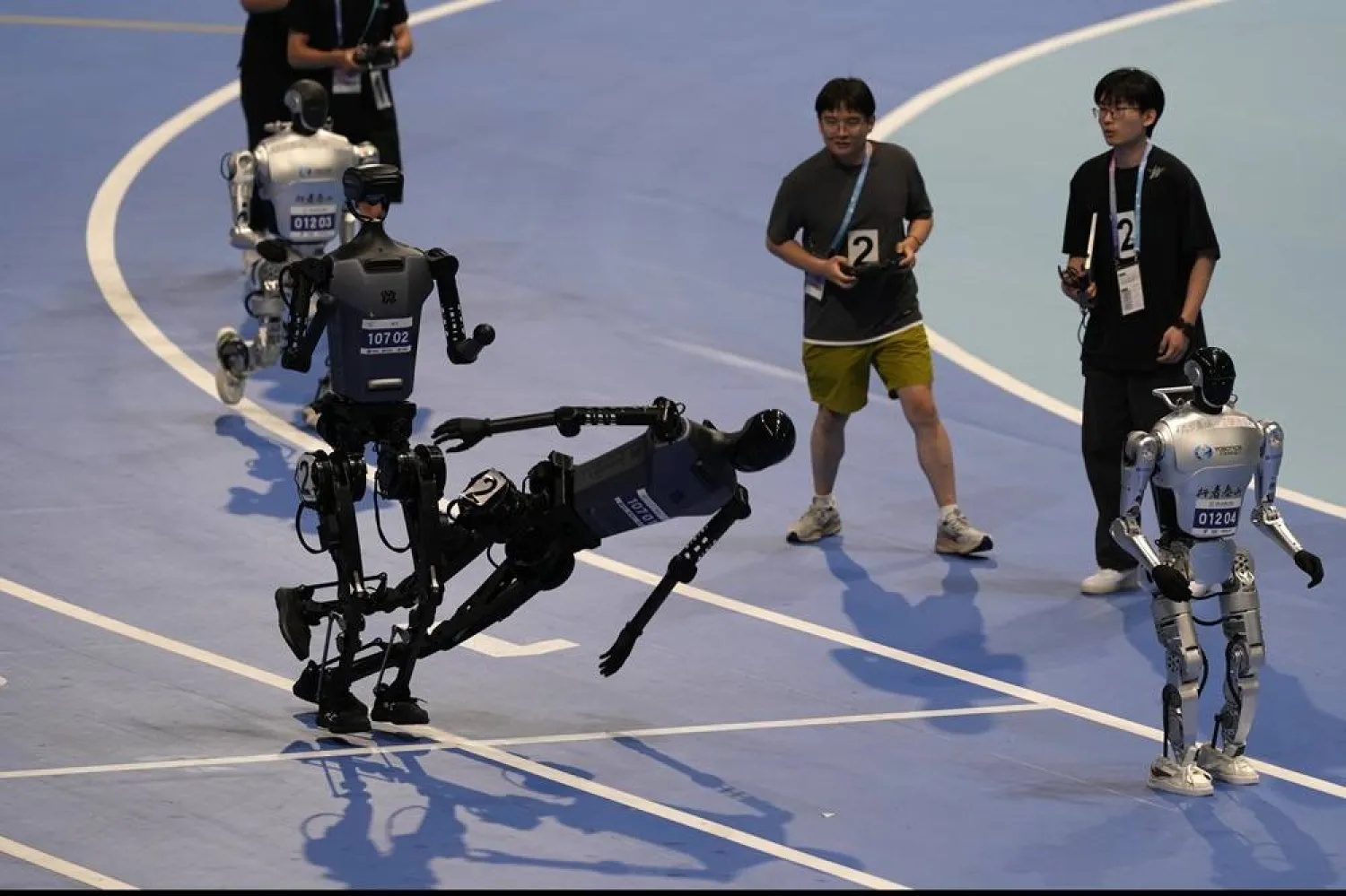
 A robot falls after tagging off to the last leg of its team in the 4x100m final at the World Humanoid Robot Games held in Beijing, China, Sunday, Aug. 17, 2025. (AP)
A robot falls after tagging off to the last leg of its team in the 4x100m final at the World Humanoid Robot Games held in Beijing, China, Sunday, Aug. 17, 2025. (AP)
TT

Photos of Beijing’s World Humanoid Robot Games Show How a Human Touch Is Still Needed

 A robot falls after tagging off to the last leg of its team in the 4x100m final at the World Humanoid Robot Games held in Beijing, China, Sunday, Aug. 17, 2025. (AP)
A robot falls after tagging off to the last leg of its team in the 4x100m final at the World Humanoid Robot Games held in Beijing, China, Sunday, Aug. 17, 2025. (AP)

Humanoid robots raced and punched their way through three days of a multi-sport competition at the World Humanoid Robot Games, wrapping up Sunday in Beijing.

But they also toppled, crashed and collapsed, requiring humans’ help and leading to questions about how far, after all, the robots can go on their own.

The games featured more than 500 humanoids on 280 teams from 16 countries, including the United States, Germany and Japan, that competed in sports such as soccer, running and boxing at the 12,000-seater National Speed Skating Oval, built for the 2022 Winter Olympics.

The event comes as China has stepped up efforts to develop humanoid robots powered by artificial intelligence.

Robots were often seen close to their operators, whether they were controlled remotely, held, lifted, sorted or separated. Batteries needed replacing and limbs tuned.

Although the robots showed off some impressive moves, some tripped and human intervention was never far from the field. One had to be carried out by two people, like an injured athlete, in a display of the limitations the machines are still facing.

Their effect on the audience, however, was not unlike that of real athletes. Cheers erupted when a robot landed a punch, scored a goal, or won a game, showing that viewers were genuinely invested in the machines’ endeavors.

AI-powered robots are expected to be increasingly used in industrial settings.


What to Expect from CES 2026, the Annual Show of All Things Tech?

DeCloak security privacy software is demonstrated on a California Robotics robot during CES Unveiled ahead of the Consumer Electronics Show (CES) in Las Vegas, Nevada on January 4, 2026. (Photo by Patrick T. Fallon / AFP)
TT

What to Expect from CES 2026, the Annual Show of All Things Tech?

DeCloak security privacy software is demonstrated on a California Robotics robot during CES Unveiled ahead of the Consumer Electronics Show (CES) in Las Vegas, Nevada on January 4, 2026. (Photo by Patrick T. Fallon / AFP)

With the start of the New Year squarely behind us, it's once again time for the annual CES trade show to shine a spotlight on the latest tech companies plan on offering in 2026.

The multi-day event, organized by the Consumer Technology Association, kicks off this week in Las Vegas, where advances across industries like robotics, healthcare, vehicles, wearables, gaming and more are set to be on display.

Artificial intelligence will be anchored in nearly everything, again, as the tech industry explores offerings consumers will want to buy. AI industry heavyweight Jensen Huang will be taking the stage to showcase Nvidia's latest productivity solutions, and AMD CEO Lisa Su will keynote to “share her vision for delivering future AI solutions.” Expect AI to come up in other keynotes, like from Lenovo's CEO, Yuanqing Yang.

The AI industry is out in full force tackling issues in healthcare, with a particular emphasis on changing individual health habits to treat conditions — such as Beyond Medicine's prescription app focused on a particular jaw disorder — or addressing data shortages in subjects such as breast milk production.

Expect more unveils around domestic robots too. Korean tech giant LG already has announced it will show off a helper bot named “ CLOiD,” which allegedly will handle a range of household tasks. Hyundai also is announcing a major push on robotics and manufacturing advancements. Extended reality, basically a virtual training ground for robots and other physical AI, is also in the buzz around CES.

In 2025, more than 141,000 attendees from over 150 countries, regions, and territories attended the CES. Organizers expect around the same numbers for this year’s show, with more than 3,500 exhibitors across the floor space this week.

The AP spoke with CTA Executive Chair and CEO Gary Shapiro about what to expect for CES 2026. The conversation has been edited for clarity and length.

What are the main themes we can expect this week? Well, we have a lot at this year's show.

Obviously, using AI in a way that makes sense for people. We’re seeing a lot in robotics. More robots and humanoid-looking robots than we’ve ever had before.

We also see longevity in health, there’s a lot of focus on that. All sorts of wearable devices for almost every part of the body. Technology is answering healthcare’s gaps very quickly and that’s great for everyone.

Mobility is big with not only self-driving vehicles but also with boats and drones and all sorts of other ways of getting around. That’s very important.

And of course, content creation is always very big.

Is 2026 the year we finally see humanoid robots in people’s homes? You are seeing humanoid robots right now. It sometimes works, sometimes doesn’t.

But yes, there are more and more humanoid robots. And when we talk about CES 5, 10, 15, 20 years now, we’re going to see an even larger range of humanoid robots.

Obviously, last year we saw a great interest in them. The number one product of the show was a little robotic dog that seems so life-like and fun, and affectionate for people that need that type of affection.

But of course, the humanoid robots are just one aspect of that industry. There’s a lot of specialization in robot creation, depending on what you want the robot to do. And robots can do many things that humans can’t.

Will we start seeing more innovative use of AI tools in entertainment? AI is the future of creativity.

Certainly AI itself may be arguably creative, but the human mind is so unique that you definitely get new ideas that way. So I think the future is more of a hybrid approach, where content creators are working with AI to craft variations on a theme or to better monetize what they have to a broader audience.

Any interesting AI-powered devices or services that consumers will want to buy? We’re seeing all sorts of different devices that are implementing AI. But we have a special focus at this show, for the first time, on the disability community. Verizon set this whole stage up where we have all different ways of taking this technology and having it help people with disabilities and older people.

Are you concerned about a potential AI bubble? Well, there’s definitely no bubble when it comes to what AI can do. And what AI can do is perform miracles and solve fundamental human problems in food production and clean air and clean water.

Obviously in healthcare, it’s gonna be overwhelming.

But this was like the internet itself. There was a lot of talk about a bubble, and there actually was a bubble. The difference is that in late 1990s there were basically were no revenue models. Companies were raising a lot of money with no plans for revenue.

These AI companies have significant revenues today, and companies are investing in it.

What I’m more concerned about, honestly, is not Wall Street and a bubble. Others can be concerned about that. I’m concerned about getting enough energy to process all that AI. And at this show, for the first time, we have a Korean company showing the first ever small-scale nuclear-powered energy creation device. We expect more and more of these people rushing to fill this gap because we need the energy, we need it clean and we need a kind of all-of-the-above solution.


Samsung Electronics Says Customers Praised Competitiveness of HBM4 Chip

FILE PHOTO: A Samsung Electronics logo and a computer motherboard appear in this illustration taken August 25, 2025. REUTERS/Dado Ruvic/Illustration/File Photo
TT

Samsung Electronics Says Customers Praised Competitiveness of HBM4 Chip

FILE PHOTO: A Samsung Electronics logo and a computer motherboard appear in this illustration taken August 25, 2025. REUTERS/Dado Ruvic/Illustration/File Photo

Samsung Electronics customers have praised the differentiated competitiveness of its next-generation high-bandwidth memory (HBM) chips, or HBM4, saying "Samsung is back", co-CEO and chip chief Jun Young-hyun said in a New Year address.

In October, Samsung said it was in "close discussion" to supply its HBM4 to US artificial intelligence leader Nvidia , as the South Korean chipmaker scrambles to catch rivals including compatriot SK Hynix in AI chips.

"On HBM4 in particular, customers have even ‌stated that 'Samsung ‌is back'," Jun said in remarks reviewed ‌by ⁠Reuters, adding that ‌the company still had work to do to further improve competitiveness.

SK Hynix CEO Kwak Noh-Jung said in New Year remarks reviewed by Reuters that the company benefited from favorable external conditions as demand for artificial-intelligence chips materialized faster than expected.

He said competition was intensifying rapidly, noting that AI demand was now a given rather than an upside surprise, and that the business environment ⁠in 2026 would be tougher than last year, while stressing that the need for ‌continued bolder investment and effort to prepare for ‍the future.

SK Hynix was the ‍leading player in the HBM market in the third quarter of 2025 ‍with a 53% share, followed by Samsung at 35% and Micron at 11%, data from Counterpoint Research showed.

Shares of Samsung Electronics and SK Hynix ended up 7.2% and 4%, respectively, on the first trading day of the year, hitting record highs and outperforming the benchmark KOSPI’s 2.3% gain.

Turning to the foundry business, which manufactures chips designed by customers, Samsung's ⁠Jun said recent supply deals with major global customers had left the foundry business "primed for a great leap forward."

In July, Samsung Electronics signed a $16.5 billion deal with Tesla.

In a separate address, Samsung Electronics' co-CEO TM Roh, who also heads the company's device experience division overseeing its mobile phone, TV and home appliance businesses, said 2026 was likely to bring greater uncertainty and risks, citing rising component prices and global tariff barriers.

"To position ourselves to maintain a competitive advantage in any situation, we will reinforce our core competitiveness through proactive supply chain diversification and optimization of global operations to ‌address issues like component sourcing and pricing, and global tariff risks," Roh said.


Foundation Stone Laid for World’s Largest Government Data Center in Riyadh

Officials are seen at Thursday's ceremony. (SPA)
TT

Foundation Stone Laid for World’s Largest Government Data Center in Riyadh

Officials are seen at Thursday's ceremony. (SPA)

The foundation stone was laid in Riyadh Thursday for the Saudi Data and Artificial Intelligence Authority (SDAIA) “Hexagon” Data Center, the world’s largest government data center by megawatt capacity.

Classified as Tier IV and holding the highest data center rating by the global Uptime Institute, the facility will have a total capacity of 480 megawatts and will be built on an area exceeding 30 million square feet in the Saudi capital.

Designed to the highest international standards, the center will provide maximum availability, security, and operational readiness for government data centers. It will meet the growing needs of government entities and support the increasing reliance on electronic services.

The project will contribute to strengthening the national economy and reinforce the Kingdom’s position as a key player in the future of the global digital economy.

A ceremony was held on the occasion, attended by senior officials from various government entities. They were received at the venue by President of SDAIA Dr. Abdullah bin Sharaf Alghamdi and SDAIA officials.

Director of the National Information Center at SDAIA Dr. Issam bin Abdullah Alwagait outlined the project’s details, technical and engineering specifications, and the operational architecture ensuring the highest levels of readiness and availability.

He also reviewed the international accreditations obtained for the center’s solutions and engineering design in line with recognized global standards.

In a press statement, SDAIA President Dr. Abdullah bin Sharaf Alghamdi said the landmark national project comes as part of the continued support of Prince Mohammed bin Salman bin Abdulaziz Al Saud, Crown Prince, Prime Minister and Chairman of SDAIA’s Board of Directors.

This support enables the authority, as the Kingdom’s competent body for data, including big data, and artificial intelligence and the national reference for their regulation, development, and use, to contribute to advancing the Kingdom toward leadership among data- and AI-driven economies, he noted.

The Kingdom will continue to strengthen its presence in advanced technologies with the ongoing support of the Crown Prince, he stressed.

SDAIA will pursue pioneering projects that reflect its ambitious path toward building an integrated digital ecosystem, strengthening national enablers in data and artificial intelligence, and developing world-class technical infrastructure that boosts the competitiveness of the national economy and attracts investment. This aligns with Saudi Vision 2030’s objectives of building a sustainable knowledge-based economy and achieving global leadership in advanced technologies.