


AMD Signs AI Chip-Supply Deal with OpenAI, Gives It Option to Take a 10% Stake 

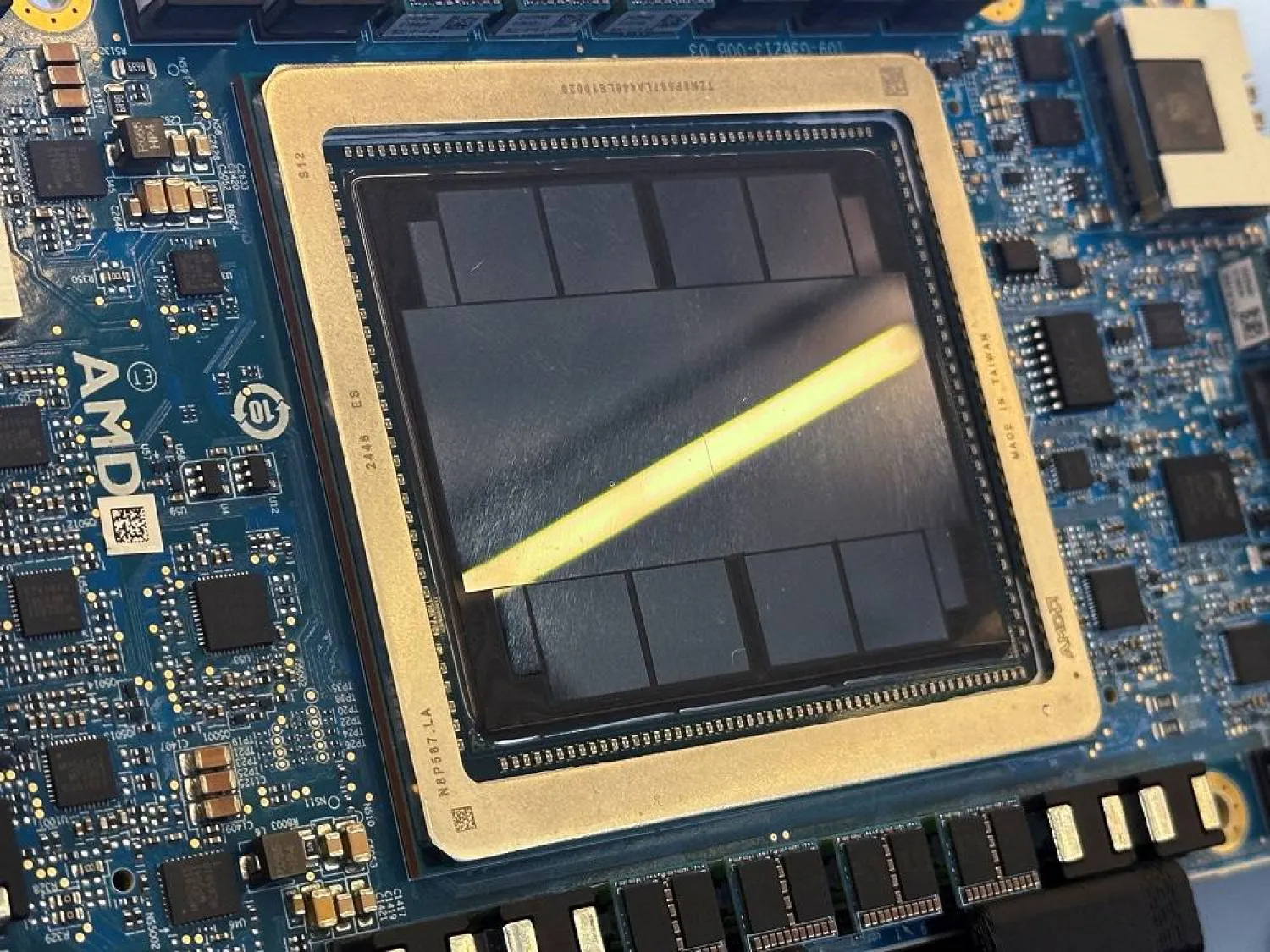
An Advanced Micro Devices (AMD) MI350 series artificial intelligence chip is displayed at the San Jose McEnery Convention Center, in San Jose, California, US, June 12, 2025. (Reuters) 
TT

AMD Signs AI Chip-Supply Deal with OpenAI, Gives It Option to Take a 10% Stake 

An Advanced Micro Devices (AMD) MI350 series artificial intelligence chip is displayed at the San Jose McEnery Convention Center, in San Jose, California, US, June 12, 2025. (Reuters) 

AMD said on Monday it will supply artificial intelligence chips to OpenAI in a multi-year deal that would bring in tens of billions of dollars in annual revenue and give the ChatGPT creator the option to buy up to roughly 10% of the chipmaker.

The deal offers OpenAI an opportunity to take a stake in one of Nvidia's most formidable rivals and is a powerful endorsement of Advanced Micro Devices' (AMD's) AI chips and software.

Shares of AMD jumped more than 23% in premarket trading.

"We view this deal as certainly transformative, not just for AMD, but for the dynamics of the industry," AMD executive vice president Forrest Norrod told Reuters on Sunday.

The agreement covers the deployment of hundreds of thousands of AMD's AI chips, or graphics processing units (GPUs), equivalent to six gigawatts, over several years beginning in the second half of 2026.

AMD said OpenAI would build a one-gigawatt facility based on its forthcoming MI450 series of chips beginning next year, and that it would begin to recognize revenue then.

AMD executives expect the deal to net tens of billions of dollars in annual revenue. Because of the ripple effect of the agreement, AMD expects to receive more than $100 billion in new revenue over four years from OpenAI and other customers, they said.

"Other people are going to come along with it because this is really the pioneer, a pioneer in the industry that has a lot of influence over the broader ecosystem," AMD strategy chief Mat Hein said.

The deal with AMD will help OpenAI build enough AI infrastructure to meet its needs, OpenAI CEO Sam Altman said in a statement.

Analysts, on average, estimate AMD will generate revenue of $32.78 billion this year, according to LSEG data.

As part of the arrangement, AMD issued a warrant that gives OpenAI the ability to buy up to 160 million shares of AMD for 1 cent each over the course of the chips deal. The warrant vests in tranches based on milestones that the two companies have agreed on.

The first tranche will vest after the initial shipment of MI450 chips set for the second half of 2026. The remaining milestones include specific AMD stock price targets that escalate to $600 a share for the final installment of stock to unlock.

AMD has 1.62 billion shares outstanding and is valued at $267.23 billion, according to LSEG data. Its shares closed on Friday at $164.67.

OpenAI has a valuation of $500 billion.

OPENAI WANTS MORE GPUs

OpenAI has worked with AMD for years, providing inputs on the design of older generations of AI chips such as the MI300X.

The San Francisco-based AI company has been taking a number of steps to ensure it has the chips needed for its future needs.

In September, Nvidia announced an investment of up to $100 billion in OpenAI that included a plan to supply at least 10 gigawatts worth of Nvidia systems. The plan includes OpenAI deploying a gigawatt of Nvidia's next-generation Vera Rubin chips in late 2026.

In addition to using Nvidia hardware, cloud computing giants such as Alphabet's Google and Amazon build their own in-house processors. Similarly, OpenAI is in the process of developing its own silicon for AI use and has partnered with Broadcom, Reuters reported last year.

OpenAI and its main backer Microsoft also announced last month that they had signed a non-binding agreement to restructure OpenAI into a for-profit entity, signaling further changes in the governance of the fast-growing AI company.

A person familiar with the matter said the deal with AMD does not change any of OpenAI's ongoing compute plans, including that effort or its partnership with Microsoft.



DeepSeek Researcher Pessimistic over AI's Impact in Startup's First Public Appearance since Success

The Deepseek logo is seen in this illustration taken on January 29, 2025. REUTERS/Dado Ruvic/Illustration/File Photo
TT

DeepSeek Researcher Pessimistic over AI's Impact in Startup's First Public Appearance since Success

The Deepseek logo is seen in this illustration taken on January 29, 2025. REUTERS/Dado Ruvic/Illustration/File Photo

Chinese artificial intelligence (AI) developer DeepSeek made its first public appearance in almost a year after it became a global sensation, fielding a senior researcher who told a government-organized internet conference that he was pessimistic about AI's future impact on humanity.

Chen Deli took the stage alongside the chief executives of five other companies including Unitree and BrainCo at the World Internet Conference in the city of Wuzhen, in the eastern province of Zhejiang. The six companies together are known in China as "six little dragons" for AI, Reuters said.

Asked about DeepSeek's global success and how its open-source approach would encourage the progress of AI, Chen said he believed that AI could be a great aid to humans as it improved over the short term, but that it could threaten job losses in 5-10 years as it becomes good enough to take over some of the work humans perform. AI firms needed to be aware of these risks, he said.

"In the next 10-20 years, AI could take over the rest of work (humans perform) and society could face a massive challenge, so at the time tech companies need to take the role of 'defender'," he said.

"I'm extremely positive about the technology but I view the impact it could have on society negatively."

Since it made global headlines in January after releasing a low-cost AI model that outperformed leading US models, DeepSeek representatives have only made one public appearance when its founder and CEO Liang Wenfeng met Chinese President Xi Jinping at a televised meeting with local entrepreneurs in February.

Neither Liang or the company have commented publicly on their success and they have skipped major Chinese technology conferences in the country in the months since.

Since the company's stunning breakout, the Chinese government has positioned DeepSeek as a symbol of the country's technological capabilities and resilience against US sanctions, as the technology rivalry between the two nations intensifies.

While DeepSeek has not released a major model upgrade since January, the company's subsequent announcements have continued to draw significant attention.

In September, it unveiled an upgrade to its V3 model, which it described as its latest "experimental" version that is more efficient to train and better at processing long sequences of text than previous iterations.

The company has also emerged as a key player in China's efforts to build its own AI ecosystem and advance the domestic chip sector.

Chinese AI chip companies including Cambricon and Huawei have developed hardware compatible with DeepSeek's models.

In August, DeepSeek's announcement of an upgraded model optimized for Chinese-made chips prompted a surge in domestic chip stock prices.


Musk Plans Tesla Mega AI Chip Fab, Mulls Potential Intel Partnership 

Tesla CEO Elon Musk speaks at the 27th annual Milken Institute Global Conference at the Beverly Hilton in Los Angeles on May 6, 2024. (AFP)
TT

Musk Plans Tesla Mega AI Chip Fab, Mulls Potential Intel Partnership 

Tesla CEO Elon Musk speaks at the 27th annual Milken Institute Global Conference at the Beverly Hilton in Los Angeles on May 6, 2024. (AFP)

CEO Elon Musk on Thursday said Tesla probably will have to build "a gigantic chip fab" to make artificial intelligence chips and publicly mused the EV maker could work with Intel.

Tesla is designing its fifth-generation AI chip to power its autonomous ambitions, and Musk at the company's annual meeting laid out potential manufacturing plans.

"You know, maybe we'll, we'll do something with Intel," Musk said to a cheering crowd of Tesla shareholders. "We haven't signed any deal, but it's probably worth having discussions with Intel."

Struggling US chipmaker Intel has its own chipmaking factories, but has lagged far behind Nvidia in the AI chip race. The US government recently took a 10% stake in Intel, which needs to find an external customer for its newest manufacturing technology. Intel shares popped 4% in after-hours trading on Musk's remarks.

Intel declined to comment.

Musk scored an important victory on Thursday as shareholders approved a $1 trillion pay package over the next decade, endorsing his vision of morphing the EV maker into an AI and robotics juggernaut.

Musk has teased the AI5 chip before and reiterated that Tesla was also partnering with Taiwan's TSMC and South Korea's Samsung. The AI chips power Tesla's autonomous driving systems, including the Full Self-Driving software. Tesla is currently on its fourth-generation chip.

A small number of AI5 units would be produced in 2026, with high volume production only possible in 2027, Musk said in an X post on Tuesday, adding that AI6 will use the same fabs but achieve roughly twice the performance with volume production mid-2028.

"Even when we extrapolate the best-case scenario for chip production from our suppliers, it's still not enough," he said on Thursday.

"So I think we may have to do a Tesla terafab. It's like giga but way bigger. I can't see any other way to get to the volume of chips that we're looking for. So I think we're probably going to have to build a gigantic chip fab. It's got to be done," he said.

Musk, who often talks about his vision for the company in abstract terms, did not offer details of how such a fab would be built, but he said that it would make at least 100,000 wafer starts per month. A wafer start is the measurement of the output of a semiconductor wafer plant.

He did say the chip would be inexpensive, power-efficient and optimized for Tesla's own software. This chip would probably consume about a third of the power used by Nvidia's flagship Blackwell chip, at 10% of the cost to make, Musk said.

"I'm super hardcore on chips right now as you may be able to tell," he said. "I have chips on the brain."


Royal Commission for AlUla Participates in AO4ELT Conference in Chile

The participation reflects RCU's ongoing commitment to enhancing international scientific cooperation in line with the objectives of Saudi Vision 2030 - SPA
TT

Royal Commission for AlUla Participates in AO4ELT Conference in Chile

The participation reflects RCU's ongoing commitment to enhancing international scientific cooperation in line with the objectives of Saudi Vision 2030 - SPA

The Royal Commission for AlUla (RCU), through AlUla Manara, participated in the 8th edition of the Adaptive Optics for Extremely Large Telescopes (AO4ELT8) conference, held in Chile from October 27 to 31, 2025, with the participation of leading scientists, engineers, and research institutions from around the world to discuss the latest developments in astronomy, telescope design, and optical innovation.

This participation marked AlUla Manara's first international scientific appearance, offering an opportunity to strengthen AlUla's presence within the global astronomical community and to establish channels of communication and knowledge exchange with experts and specialized research centers, SPA reported.

The participation reflects RCU's ongoing commitment to enhancing international scientific cooperation and supporting the development of science, education, and sustainable tourism, in line with the objectives of Saudi Vision 2030.

The AO4ELT conference is considered one of the world's leading scientific gatherings in the field of astronomical optics, bringing together top scientists and specialists from observatories and research centers worldwide to discuss the latest technologies and innovations in telescope development.

Through such international engagements, the Royal Commission for AlUla continues to cement AlUla's position as a global center that unites heritage, innovation, and sustainability, inspiring future generations in the pursuit of science and discovery, and reinforcing AlUla's growing role as an international destination for astronomy and natural sciences, a place where knowledge, culture, and exploration converge.