


China Is Closing in on US Technology Lead Despite Constraints, AI Researchers Say

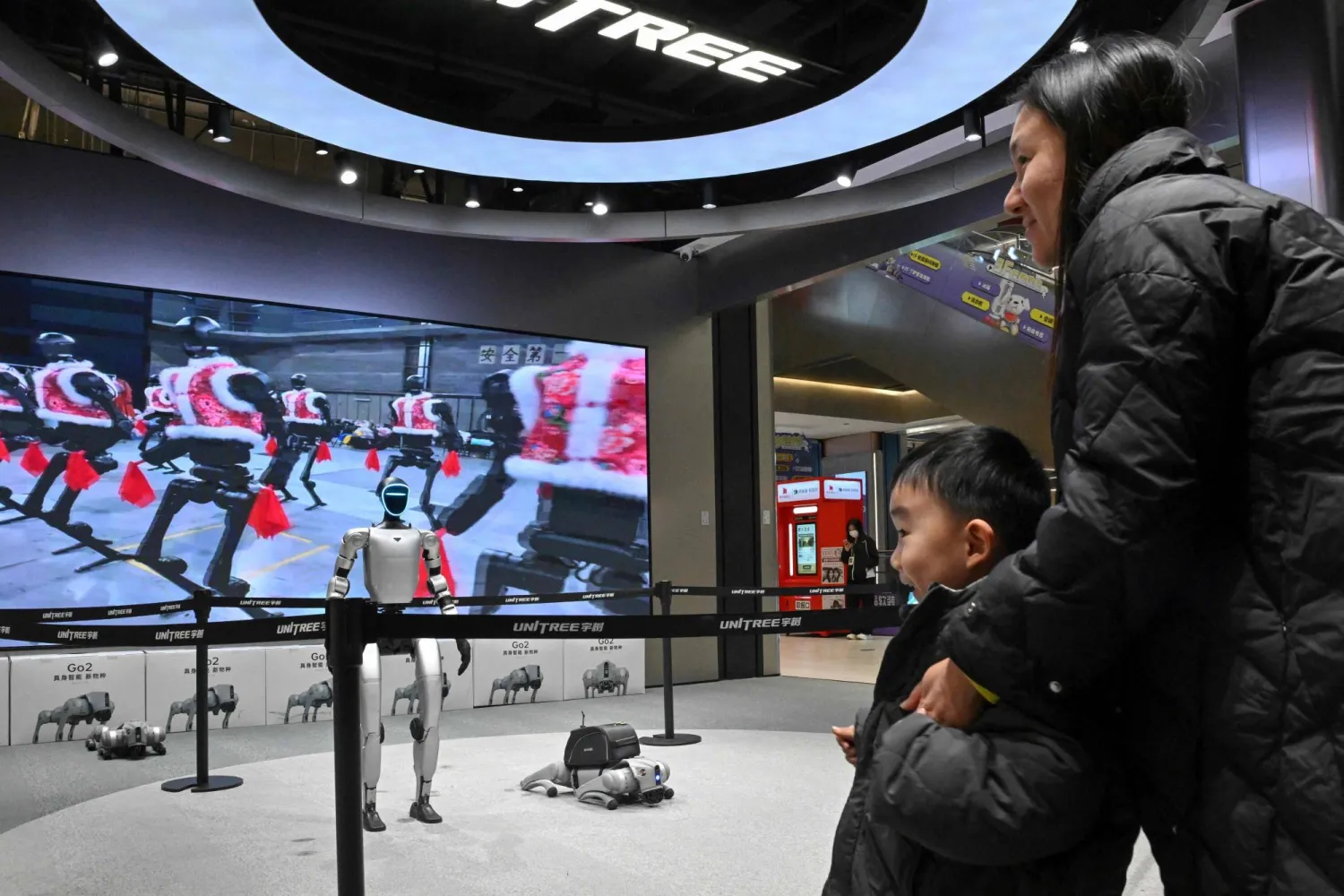
 Visitors look at robots on display at robotics company Unitree's first retail store in Beijing in January 9, 2026. (AFP)
Visitors look at robots on display at robotics company Unitree's first retail store in Beijing in January 9, 2026. (AFP)
TT

China Is Closing in on US Technology Lead Despite Constraints, AI Researchers Say

 Visitors look at robots on display at robotics company Unitree's first retail store in Beijing in January 9, 2026. (AFP)
Visitors look at robots on display at robotics company Unitree's first retail store in Beijing in January 9, 2026. (AFP)

China can narrow its technological gap with the US driven by growing risk-taking and innovation, though the lack of advanced chipmaking tools is hobbling the sector, the country's leading artificial intelligence researchers said on Saturday.

China's so-called "AI tiger" startups MiniMax and Zhipu AI had strong debuts on the Hong Kong Stock Exchange this week, reflecting growing confidence in the sector as Beijing fast-tracks AI and chip listings to bolster domestic alternatives to advanced US technology.

Yao Shunyu, a former senior researcher at ChatGPT maker OpenAI ‌who was named ‌technology giant Tencent's chief AI scientist in December, ‌said ⁠there was a ‌high likelihood of a Chinese firm becoming the world's leading AI company in the next three to five years but said the lack of advanced chipmaking machines was the main technical hurdle.

"Currently, we have a significant advantage in electricity and infrastructure. The main bottlenecks are production capacity, including lithography machines, and the software ecosystem," Yao said at an AI conference in Beijing.

China has completed a working prototype of an extreme-ultraviolet lithography ⁠machine potentially capable of producing cutting-edge semiconductor chips that rival the West's, Reuters reported last month. However, the ‌machine has not yet produced working chips and may ‍not do so until 2030, people with ‍knowledge of the matter told Reuters.

MIND THE INVESTMENT GAP

Yao and other ‍Chinese industry leaders at the Beijing conference on Saturday also acknowledged that the US maintains an advantage in computing power due to its hefty investments in infrastructure.

"The US computer infrastructure is likely one to two orders of magnitude larger than ours. But I see that whether it's OpenAI or other platforms, they're investing heavily in next-generation research," said Lin Junyang, technical lead for Alibaba's flagship Qwen large language model.

"We, ⁠on the other hand, are relatively strapped for cash; delivery alone likely consumes the majority of our computer infrastructure," Lin said during a panel discussion at the AGI-Next Frontier Summit held by the Beijing Key Laboratory of Foundational Models at Tsinghua University.

Lin said China's limited resources have spurred its researchers to be innovative, particularly through algorithm-hardware co-design, which enables AI firms to run large models on smaller, inexpensive hardware.

Tang Jie, founder of Zhipu AI which raised HK$4.35 billion in its IPO, also highlighted the willingness of younger Chinese AI entrepreneurs to embrace high-risk ventures - a trait traditionally associated with Silicon Valley - as a positive development.

"I think if we can improve this environment, ‌allowing more time for these risk-taking, intelligent individuals to engage in innovative endeavors ... this is something our government and the country can help improve," said Tang.



‘Stealth Hit’ Pokemon Game Sends Nintendo Shares Soaring

Japan's Nintendo has enjoyed bumper sales for its latest Switch 2 console. (AFP)
TT

‘Stealth Hit’ Pokemon Game Sends Nintendo Shares Soaring

Japan's Nintendo has enjoyed bumper sales for its latest Switch 2 console. (AFP)

Fan buzz around life-simulation game "Pokemon Pokopia" sent Nintendo shares soaring on Wednesday, with some hailing the new title as a welcome antidote to global conflicts.

Japan's Nintendo has enjoyed bumper sales for its latest Switch 2 console, but some have called the line-up of new games for the device lackluster.

So early success for "Pokemon Pokopia", released on March 5 to rave reviews and reports of store sell-outs around the world, has relieved investors.

"Pokemon Pokopia" launched as a Switch 2 exclusive, "immediately becoming a viral stealth hit", analyst Atul Goyal from investment bank Jefferies said.

"The title successfully bridges the gap between core gamers and casual audiences," Goyal said.

The new Pokemon game has an aggregated review score of 89 on Metacritic, which Goyal described as a high for the three-decade-old video game franchise.

Nintendo shares were up nine percent in mid-morning trade on Wednesday, also likely boosted by the release of the final trailer for the star-studded upcoming "Super Mario" movie sequel.

Players have compared the game, in which they control a human-like character to rejuvenate a village, to "Animal Crossing" -- another Nintendo life-sim that became a hit during the pandemic.

"If you're looking for a mental break from the world def get Pokopia, it's like therapy," US-based influencer Ashley Duncan wrote on X.

"For Covid we had Animal Crossing. For WW3 we have Pokopia. Thank you for the distractions, Nintendo," said another X post from fan account Pokemon Daily Post, which has nearly 90 million followers.

The basic premise of Pokemon, inspired by the Japanese summer childhood tradition of bug-collecting, is to catch and train in battle hundreds of round-eyed "pocket monsters".

The phenomenon has evolved since the first 1996 game release with anime series, movies, a trading card game and the augmented reality smartphone app "Pokemon Go".

Nintendo's Switch 2, the world's fastest-selling games console, launched in June 2025 as the successor to the first Switch.

The original is now the second top-selling console of all time after Sony's PlayStation 2, boosted by the popularity of games including "Animal Crossing".


AI Offers Hope for Young Filmmakers Dreaming of an Oscar

Chinese USC student SiJia Zheng speaks about how he used artificial intelligence to modify his face and make him into all the different characters of his short film 'Torment'. Frederic J. BROWN / AFP
TT

AI Offers Hope for Young Filmmakers Dreaming of an Oscar

Chinese USC student SiJia Zheng speaks about how he used artificial intelligence to modify his face and make him into all the different characters of his short film 'Torment'. Frederic J. BROWN / AFP

Studying at the film school where Oscar-nominated "Sinners" director Ryan Coogler honed his craft, SiJia Zheng dreams of winning an Academy Award.

Now with the recent developments in artificial intelligence, he can see a shortcut to achieving his ambition.3

"That's a chance for beginners like me who can use AI to just make a film and to announce to the world that I have the ability to be a director," he told AFP.

Zheng, 29, who hails from China, is one of a burgeoning class of students at USC's School of Cinematic Arts, studying animation in a place that has long been a training ground for future Pixar and DreamWorks talent.

He has used his time at the Los Angeles university to learn about the emerging field of AI animation.

That has included producing his seven-minute short film "Torment" about a masked killer terrorizing a high school.

The film, which was recognized at the LA Shorts festival, was generated entirely by AI -- in just one week.

Zheng recorded himself in front of a green screen and then asked the software to modify his face to make him into all the different characters in the movie.

The technology also allowed him to set his story in an Asian school and have scenes in a swimming pool -- two things that would have cost a fortune if he had filmed them traditionally.

"As a student, it's impossible to have that much money" to produce a film, he said.

- 'Tool' -

Not everyone in Hollywood feels so positively about AI.

The technology was one of the key sticking points in the writers' and actors' strikes that paralyzed Hollywood in 2023.

Guillermo del Toro, the director of "Frankenstein," which will compete for the best picture Oscar on Sunday, is notoriously anti-AI, insisting he would "rather die" than use it.

Zheng said he had been impressed by the Mexican director's "amazing" film, particularly the opening scene where the monster attacks a 19th-century three-masted ship, which del Toro's prop department constructed specially for the movie.

But "when I watched the film...I was just thinking: 'Oh, using AI to do that would be much cheaper and...make something pretty similar.'"

He insists, however, that it doesn't replace the filmmaking spark.

"AI is just a tool, and people can use it to become even better."

The Academy of Motion Picture Arts and Sciences, the body that will hand out the Oscars in Hollywood on March 15, seems to agree -- last year the body updated its rules to say it was neutral on the technology.

"Generative Artificial Intelligence and other digital tools...neither help nor harm the chances of achieving a nomination," it said last April.

- 'Ethical' use -

At the University of Southern California (USC), teachers like Debra Isaac are trying to navigate the ethics around the emerging technology of AI.

The animation professor said she was shocked by an AI video that rocketed around the internet in recent weeks.

The short sequence, created by Seedance -- the AI generation model developed by TikTok's parent company, Bytedance -- shows an ersatz fight between Brad Pitt and Tom Cruise. Neither star was compensated.

But, used properly, AI does not need to be exploitative, and is not a lazy way to make films, Isaac said.

"It's not just about, 'Hey, I have a prompt, and I'm just gonna type a few words and I'll get my image, and I'll get my animation, and I'm done,'" she said.

"Some of these tools are not ethically dubious at all. They're trained by people that are using their own work," she added.

That's precisely what Xindi Zhang, a recent graduate of the program and winner of a Student Academy Award for her short film "The Song of Drifters," did.

For the mini-documentary about the difficulty of feeling at home anywhere, the 29-year-old artist fed the AI dozens of her drawings.

The database then served as graphic inspiration, allowing the computer to stylize the shots of the cities where the film takes place, accelerating production that would otherwise have taken years.

Even with the help of AI, she spent nearly a month perfecting certain shots.

It's "a craft that nobody really appreciates right now," she says.

But anyone who looks at the use of AI will soon find it's not a compromise-free shortcut to perfection.

"Good, cheap and fast will never happen, no matter what tool you use," Zhang said.


Saudi Arabia Leads Globally in Women’s AI Empowerment with Groundbreaking Initiatives

Saudi Arabia Leads Globally in Women’s AI Empowerment with Groundbreaking Initiatives
TT

Saudi Arabia Leads Globally in Women’s AI Empowerment with Groundbreaking Initiatives

Saudi Arabia Leads Globally in Women’s AI Empowerment with Groundbreaking Initiatives

The Kingdom of Saudi Arabia has made significant strides in empowering women in the data and artificial intelligence (AI) sectors, aiming to elevate their global competitiveness as part of Saudi Vision 2030.

Numerous initiatives have increased the participation of Saudi women in advanced technologies, with the Saudi Data and Artificial Intelligence Authority (SDAIA) offering specialized programs and workshops in partnership with global technology leaders, SPA reported.

In just one year, over 666,000 Saudi women received training in data and AI, positioning the Kingdom first globally in women’s AI empowerment, according to the 2025 AI Index by Stanford University. Key initiatives include the Artificial Intelligence Academy with Microsoft, the Generative AI Academy with NVIDIA, the "SAMAI" initiative (targeting one million Saudis in AI), and the development of a national data and AI curriculum for university students.

These programs have enhanced women's skills and facilitated their contributions to crucial sectors such as health, energy, and education.

SDAIA has created a supportive work environment for women through flexible digital infrastructure, enabling remote work and work-life balance. This commitment reflects the Kingdom's dedication to building a sustainable, data-driven economy, with Saudi women now playing vital roles in shaping the future of advanced technologies.