


Musk's Starlink Leads Bezos’ Amazon as Airlines Rush to Boost In-Flight Wi-Fi

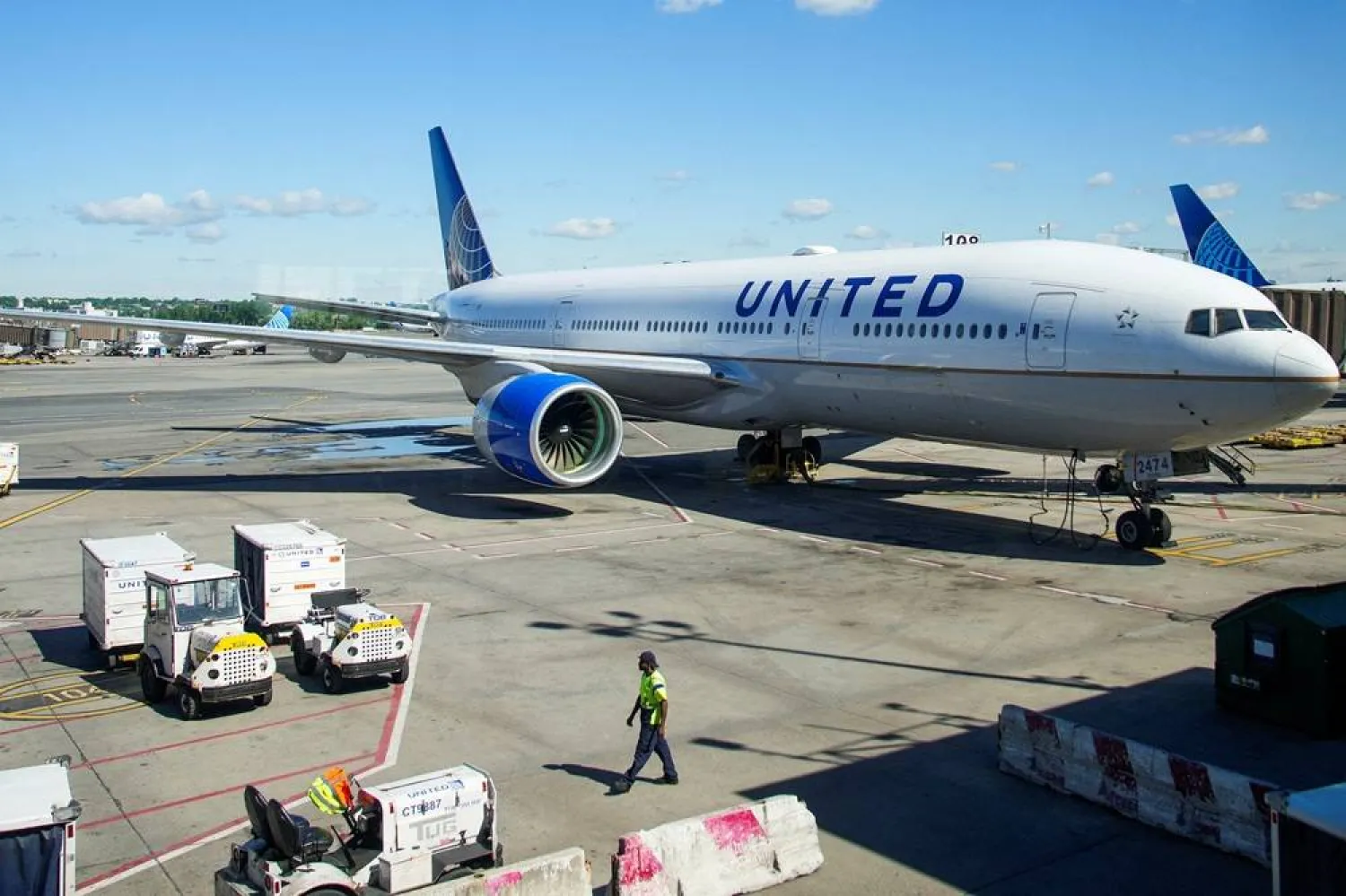
United Airlines planes are seen at the tarmac at Newark International Airport in Newark, New Jersey, US, May 7, 2025. (Reuters)
TT

Musk's Starlink Leads Bezos’ Amazon as Airlines Rush to Boost In-Flight Wi-Fi

United Airlines planes are seen at the tarmac at Newark International Airport in Newark, New Jersey, US, May 7, 2025. (Reuters)

Global airlines' push to attract premium customers is making fast in-flight Wi-Fi an increasingly important perk, turning a once-patchy paid service into an emerging battleground between Elon Musk's Starlink and Jeff Bezos' Amazon Leo satellite network.

Starlink, which operates around two-thirds of all satellites in space and is the major driver of revenue for SpaceX, has signed up 11 new airline customers globally so far in 2026, after 22 in 2025 and eight in 2024, compared with three in 2022, according to Valour Consultancy, an aviation intelligence firm.

Amazon, which is still building out its Leo satellite constellation, faces a potential setback after a Blue Origin rocket failure last month. It has signed up its first customers, securing deals with Delta Air Lines and JetBlue Airways .

Installing Starlink or Amazon's satellite broadband is a significant investment for airlines, running into the hundreds of millions of dollars for large fleets. But as carriers increasingly rely on premium products to boost margins, they are likely to commit more heavily in the coming years, said Decius Valmorbida, president of travel at Amadeus, a travel technology company, ‌describing the technology ‌as a "game changer."

"It's going to become a necessity that every airline will rush to have its ‌own ⁠version of. It ⁠is becoming a must-have," Valmorbida told Reuters.

Starlink, which uses thousands of low-Earth-orbit satellites rather than larger, slower geostationary satellites, is multiple times faster than legacy systems, according to Ookla, a broadband analytics firm.

In a sign of demand across the airline spectrum, Southwest Airlines said it chose Starlink for its "speed to market," but has not ruled out Amazon's Leo as it pushes for industry-leading Wi-Fi.

"There's multiple ways to get there," Tony Roach, Southwest's chief customer and brand officer, told Reuters.

American Airlines said in late May it would equip more than 500 narrowbody aircraft with Starlink starting in early 2027.

RYANAIR REJECTS STARLINK ON COSTS

Not everyone is convinced. Ryanair CEO Michael O'Leary has ruled out adopting Starlink, citing costs and fuel burn from the antennas, prompting a fiery dispute with Musk.

Jefferies ⁠analysts estimate American Airlines' Starlink rollout could cost $150 million to $250 million for equipment and installation, based on ‌its fleet, before annual service fees that could exceed $60 million.

Reuters could not identify equivalent public ‌estimates for airline deployments of Amazon's Leo.

MUSK'S STARLINK VS BEZOS' AMAZON LEO

Lluc Palerm, research director at Analysys Mason, said airline Wi-Fi "will become a battleground" between ‌Starlink and Amazon Leo, though Amazon remains limited as its satellite constellation is in its infancy.

SpaceX now holds Starlink contracts covering more than ‌7,000 aircraft, cementing an "undeniable" lead, said Daniel Welch, a senior consultant at Valour Consultancy.

Palerm said Starlink's early gains are meaningful because switching providers is costly: aircraft must be taken out of service for installations, onboard equipment is provider-specific and contracts typically run for years.

The airline sales come as SpaceX's upcoming record-breaking public listing has sharpened investor focus on Starlink's expansion beyond consumer broadband.

Starlink generated $11.4 billion of SpaceX's $18.67 billion revenue in 2025, according to SpaceX's IPO filing, making it by far ‌the company's largest revenue source.

Starlink is emphasizing speed and installation simplicity, while Amazon is pitching a broader technology ecosystem, including cloud computing, entertainment and retail links that it says can help airlines serve passengers ⁠beyond basic connectivity.

Delta's choice of Amazon ⁠Leo illustrates that distinction. The carrier selected Amazon Leo for an initial 500 aircraft beginning in 2028, building on its Amazon Web Services relationship.

Legacy in-flight Wi-Fi providers including Viasat, Intelsat, Panasonic Avionics and Hughes remain embedded across large fleets, with multi-orbit backup offerings and coverage in markets where newer Leo providers still face regulatory hurdles.

FAST WI-FI HELPS AIRLINES TAP OTHER REVENUE

For airlines, faster Wi-Fi is about more than keeping passengers entertained. It gives carriers another way to draw customers into loyalty programs and market flights, upgrades and credit cards after the trip ends.

A 2025 Journal of Air Transport Management study found Wi-Fi availability was linked to higher passenger share on routes studied.

At Southwest, the first Starlink-equipped aircraft is expected to be serviceable later this month and the airline has targeted more than 300 conversions by year-end, though executives said the pace depends on how fast Starlink can supply equipment.

"I want to give you fewer and fewer reasons to book another airline or feel like you need to travel on another airline," Southwest's CEO, Bob Jordan, said.

Delta has said more than 163 million SkyMiles members have used its free Wi-Fi since 2023, showing the scale of passenger engagement airlines are building around onboard connectivity.

United Airlines says free Starlink Wi-Fi for MileagePlus members now covers more than 25% of its daily flights, with full fleet coverage expected by end-2027.

"That is going to be a differentiator versus every other airline," United CEO Scott Kirby said.



China's DeepSeek to Raise Fresh Capital at $74 Billion Valuation Ahead of Onshore IPO

FILE PHOTO: A DeepSeek AI sign is seen at a building where the Chinese start-up's office is located in Beijing, China, February 19, 2025. REUTERS/Florence Lo/File Photo
TT

China's DeepSeek to Raise Fresh Capital at $74 Billion Valuation Ahead of Onshore IPO

FILE PHOTO: A DeepSeek AI sign is seen at a building where the Chinese start-up's office is located in Beijing, China, February 19, 2025. REUTERS/Florence Lo/File Photo

Chinese AI startup DeepSeek is planning to launch a fresh fundraising round at a valuation of about 500 billion yuan ($74 billion) ahead of a potential mainland initial public offering, two people with knowledge of the matter said.

The plan comes just weeks after the Hangzhou-based company, which drew global attention with its low-cost AI models in 2025, raised about $7.4 billion in June a post-money valuation of about 450 billion yuan, the people said.

The back-to-back fundraising plans underscore strong investor appetite for one of China's most closely watched AI companies, but also point to the rising costs of competing in AI, which requires large amounts of computing power, data-center capacity and engineering talent.

DeepSeek is looking to raise as much as 50 billion yuan in the new funding round, according to a third person briefed on the ⁠matter.

It has also started ⁠early deliberations on a potential IPO on Shanghai's Nasdaq-style STAR Market, the three sources and two other people with knowledge of the plan said.

The company has set an internal target to complete an IPO filing this year, one of them told Reuters.

All the people declined to be identified because the information is not public. The fundraising and IPO plans are at early stages and terms and timetable may change, they said.

DeepSeek did not immediately respond to a request for comment.

Bloomberg News first reported on Tuesday ⁠that DeepSeek was preparing for a possible IPO filing, while the Financial Times reported that the company was weighing a fresh fundraising round at a valuation of at least 480 billion yuan.

DeepSeek shook global technology markets last year after releasing models that appeared to rival leading US systems at lower training and operating costs.

Soon after its maiden fundraising round in June, DeepSeek said it planned to double staff across departments, including in areas such as data centers and AI agents, systems capable of performing tasks with limited prompting.

Some of those initiatives will require significant capital expenditure. Reuters reported earlier this month that DeepSeek was looking to develop its own AI inference chip and had discreetly increased hiring of chip-design engineers for the project.

DeepSeek had long stood out in China's AI sector for rejecting outside ⁠funding. Founder Liang Wenfeng ⁠had largely bankrolled the company using his quantitative hedge fund High-Flyer before its recent external financing, sources previously told Reuters.

But the cost of staying at the frontier of AI has risen sharply, forcing a change in strategy.

DeepSeek has in the past year faced stiff competition at home from tech giants including ByteDance and Alibaba, as well as well-funded AI startups such as Z.ai, Moonshot, and MiniMax.

In the June funding round, DeepSeek founder Liang personally committed 20 billion yuan, while Tencent Holdings and battery giant CATL chipped in 10 billion yuan and 5 billion yuan respectively to become the largest external shareholders, Reuters reported at the time.

Other investors include China's national AI fund, gaming developer NetEase and e-commerce giant JD.com , as well as investment firms IDG Capital, Loyal Valley Capital, Monolith Management and Shixiang Capital, according to sources and media reports.

The participation of the state-backed AI fund highlighted DeepSeek's strategic importance to Beijing's efforts to build domestic AI champions and reduce reliance on foreign technology.


Generative AI’s Power Sparks Fears of Dumbing Humans Down

An AI sign is seen at the World Artificial Intelligence Conference in Shanghai, China July 6, 2023. (Reuters)
TT

Generative AI’s Power Sparks Fears of Dumbing Humans Down

An AI sign is seen at the World Artificial Intelligence Conference in Shanghai, China July 6, 2023. (Reuters)

Generative AI chatbots capable of writing emails and computer code, translating, organizing a trip or coming up with gift ideas are now readily available, prompting some to ask whether human brainpower could suffer for lack of use.

A simple natural-language prompt is usually enough to draw a useable response from a service like ChatGPT or Claude, with the effects making themselves felt in schools and universities, workplaces from offices to courtrooms and our personal lives.

Recent scientific studies suggest there could be harmful consequences to farming out cognitive tasks to AI.

They highlight memory, decision-making and critical thinking as particularly at risk.

One American-British study of 1,222 people, still under peer review, found that using AI tools to solve arithmetic or reading comprehension exercises improved participants' performance in the short term, but in the long run diminished their results and their willingness to keep trying when the tools were unavailable.

"These findings are particularly concerning because persistence is foundational to skill acquisition and is one of the strongest predictors of long-term learning," the authors wrote.

AI's ability to conjure up speedy responses to all kinds of questions "removes learning opportunities" from users, said Carnegie Mellon University doctoral student Grace Liu, the article's main author.

"What makes AI particularly concerning is that it's not a tool designated for one specific kind of activity. It's something that can be used across pretty much any intellectual, reasoning, and cognitive activity."

The technology's adaptability to different kinds of problems sets it apart from previous waves of computerized aids.

Electronic calculators, for instance, may have helped users solve equations, but left the method and reasoning process in human hands.

- Saving energy -

One 2025 MIT study went viral for its finding that students using generative AI to write essays displayed less critical thinking capability.

Other research has pointed the same way, highlighting what has come to be called "cognitive offloading" -- or even "cognitive surrender".

"Human beings have a strong tendency to save energy," said Johann Chevalere, a researcher in social and cognitive psychology at France's publicly-funded CNRS institution.

"In daily life, we often use strategies that get us to the heart of the matter quicker, without necessarily taking the time to study in depth the information we need to process, as this can be cognitively costly," he added.

Generative AI use could strengthen this tendency, Chevalere said.

"If there are activities you never do, the brain -- which works by saving energy -- won't go to the trouble of maintaining connections that aren't being used."

- Encouraging reflection -

Under pressure from critics, generative AI developers have begun building so-called "Socratic" functions into their models, which for now remain mostly aimed at students.

In this mode, chatbots do not simply provide the answer, instead offering hints and asking questions to stimulate users' thinking.

Examples include the "study mode" built into OpenAI's ChatGPT, or "guided learning" in Google's Gemini.

US software giant Microsoft told AFP it had built warnings about the risk of mistakes into its Copilot models.

The AI also reminds users to check the information it provides, just one of several measures designed to keep them actively and critically engaged with its responses.

"The risk of excessive cognitive offloading is real, especially if AI is used to automate tasks that are also valuable for developing skills," Microsoft said, adding that users have to be trained to use the tools correctly.

For now, there is a lack of large-scale, long-term studies to judge the true impact of the new technology on human brains, researchers agreed.

Until they are available, "it's up to us to use AI in a smart way," Chevalere said.

"We'll adapt to this technological revolution just as we have to the previous ones."


Meta Employees Allege Discriminatory AI-driven Layoffs

FILE PHOTO: The logo of Meta at the Meta Lab in Los Angeles, California, US, May 20, 2026. REUTERS/Daniel Cole/File Photo
TT

Meta Employees Allege Discriminatory AI-driven Layoffs

FILE PHOTO: The logo of Meta at the Meta Lab in Los Angeles, California, US, May 20, 2026. REUTERS/Daniel Cole/File Photo

Twenty-six Meta employees have filed a lawsuit accusing the tech giant of using artificial intelligence to select workers for mass layoffs, a claim strongly denied by the trillion dollar company.

They are among the 8,000 employees -- some 10 percent of the workforce -- Meta said it would lay off in Spring, as it pushes to redirect resources toward an ambitious AI agenda.

According to the lawsuit, filed in Oakland, California on Monday Meta used AI systems to "score, rank, and select employees" to be laid off rather than "the considered judgement of managers who knew the work" while disproportionately targeting those on medical or family leave.

The AI systems relied on "performance ratings, calibration scores, productivity and output metrics" -- markers that cannot be accumulated by an employee on medical or family leave and may be reduced for people with disabilities.

Meta "did not pause the system for the individualized, leave- and accommodation-neutral review that the law requires," AFP quoted the 71-page complaint as saying.

All 26 employees took or requested protected leave, or requested or received a reasonable accommodation for disability, it noted.

"Workforce management and organizational decisions were and are made by people, not AI," a Meta spokesperson was quoted saying by multiple US outlets including CNBC and the Verge.

A Meta spokesperson told CNBC in an email that the "claims lack merit and are not based on facts."

Meta did not immediately respond to AFP's request for comment.

Meta's cuts are funding a massive race for infrastructure, with the company planning to spend up to $145 billion on AI investments this year, nearly twice last year's figure.