

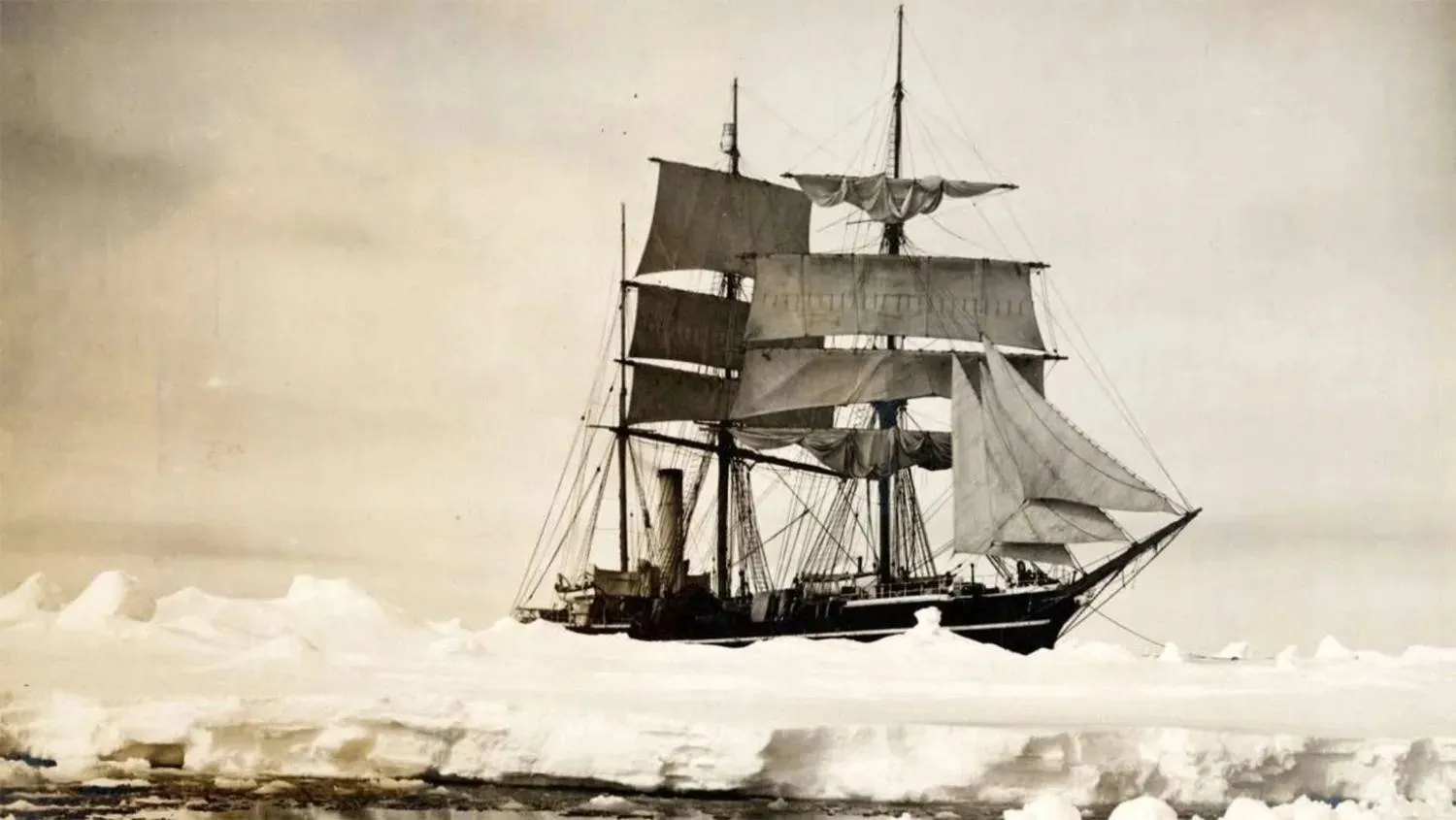

Photos of Captain Scott’s Famous Polar Shipwreck as Never Seen Before

The Terra Nova is forever entwined in the tragic tale of Captain Scott and his men. (Getty Images)
TT

Photos of Captain Scott’s Famous Polar Shipwreck as Never Seen Before

The Terra Nova is forever entwined in the tragic tale of Captain Scott and his men. (Getty Images)

One of the most famous polar shipwrecks has been filmed in detail on the sea floor for the first time.

The Terra Nova carried Captain Scott and his men on their doomed expedition to reach the South Pole more than a century ago.

The British party lost the race to the pole and died on their return journey in 1912.

The footage shows the Terra Nova colonized with sea life, but key features of the wooden ship are still visible including its wheel, winch and mast, according to BBC.

The wreck lies 170m down off the coast of Greenland. After the polar expedition with Scott, the ship continued in service and eventually sank in 1943 while carrying supplies to US bases during World War Two.

The Terra Nova was discovered in 2012 by the Schmidt Ocean Institute, but the new expedition has been the first opportunity to record extensive footage of the wreck.

“To be able to see these significant parts of the wreck, it was truly awe inspiring,” said Leighton Rolley, Science Systems Manager at REV Ocean. “The wheel was sat there perfectly intact amongst the debris of the aft section of the wreck.”

He said, “When you think of the people who have stood there, maneuvered the Terra Nova through ice, like Captain Scott... It was like, wow, if that ship's wheel could talk, it could tell an amazing history.”

The Terra Nova was one of the finest polar vessels of its time and sailed for 60 years.

The ship was 57m long with a wooden hull that was a meter thick in places to help it break through the sea ice.

Captain Scott's men embarked to Antarctica in 1910. A comprehensive scientific program was planned for the Terra Nova expedition - along with the goal of being the first to reach the South Pole.

Scott, along with Edward Wilson, Henry Bowers, Lawrence Oates and Edgar Evans, were attempting to make history.

After trekking hundreds of miles, the British party reached the pole in January 1912, but they found they had been beaten by a Norwegian team led by Roald Amundsen.

A black flag, planted by Amundsen, is now on display at the Scott Polar Research Institute (SPRI) in Cambridge along with other items from the Terra Nova.

“Their hearts must have sunk seeing this black flag against the whiteness of Antarctica,” said David Waterhouse, curator of the polar museum at SPRI.

The deflated British party began their arduous return journey to their base. But they encountered unusually bad weather, and Edgar Evans died after falling while descending a glacier.

Several weeks later Captain Oates left the men's tent. His last words were recorded in Scott's journal: “I'm just going outside and may be some time.” He was never seen again.

Scott, Bowers and Wilson continued on and made a final camp, but trapped by a freezing blizzard with dwindling supplies, all three perished.

A search expedition discovered their last camp just 11 miles from a resupply depot that would have provided them with food and fuel.

The Terra Nova played a crucial role in breaking the news of their death.

“In January 1913, the Terra Nova arrived at Cape Evans in the Antarctic to pick up the shore party, and they were expecting to pick up Captain Scott and his pole party at the same time,” explained Naomi Boneham, an archivist at SPRI.

“But when they arrived they found out the sad news.”

The ship's log records that the men had died from “exposure and want.”

The vessel sailed on to New Zealand, where the tragic end of the Terra Nova expedition was announced to the world.




Chile Fights Wildfires that Killed 19 and Left 1,500 Homeless

Mirtza Aguilera, right, and her daughter embrace in front of their home burned by wildfires in Tome, Chile, Monday, Jan. 19, 2026. (AP Photo/Javier Torres)
TT

Chile Fights Wildfires that Killed 19 and Left 1,500 Homeless

Mirtza Aguilera, right, and her daughter embrace in front of their home burned by wildfires in Tome, Chile, Monday, Jan. 19, 2026. (AP Photo/Javier Torres)

Firefighters in Chile are battling forest fires that started on Sunday and have killed at least 19 people and left around 1,500 homeless as they swept through thousands of acres in the center and south of the country, officials said.

Five large wildfires were still active Monday in the South American nation, with temperatures higher than usual due to a summer heatwave, said the National Service for the Prevention of Disasters, The AP news reported.

Chilean President Gabriel Boric declared a state of catastrophe in the central Biobio and neighboring Ñuble regions on Sunday. The emergency designation allows greater coordination with the military to rein wildfires.

Boric said on his X account on Monday morning that weather conditions are adverse, which means some of the fires could reignite.

Wildfires are common in Chile during the summer due to high temperatures and dry weather. The current outbreak of fires in central and southern Chile is one of the deadliest in recent years.

In 2024, massive fires ripping across Chile’s central coastline killed at least 130 people, becoming the nation’s deadliest natural disaster since a devastating 2010 earthquake.


Nepal Halts Search after Guide Killed, Iranian Climber Missing

A tourist looks at a view of Mt. Everest from the hills of Syangboche in Nepal December 3, 2009. REUTERS/Gopal Chitrakar
TT

Nepal Halts Search after Guide Killed, Iranian Climber Missing

A tourist looks at a view of Mt. Everest from the hills of Syangboche in Nepal December 3, 2009. REUTERS/Gopal Chitrakar

Bad weather forced Nepali rescuers to suspend the search Monday for an Iranian climber missing for four days after an accident which killed a Nepali team member, expedition organizers said.

Extreme conditions, including fierce winds, made rescue efforts impossible on the 8,481-meter (27,825-feet) high Mount Makalu, the world's fifth highest mountain.

Iranian climber Abolfazl Gozali, 42, and Nepali guide Phurba Ongel Sherpa, 44, were part of a rare winter expedition on the peak.

The four-member team successfully summited on Thursday, but during the descent the guide fell to his death.

Team lead Sanu Sherpa, who has climbed all 14 highest peaks in the world at least twice, and Lakpa Rinji Sherpa went to his aid but found that he had fallen hundreds of meters and did not survive.

When they returned to where they had left Gozali, he was no longer there.

"A team of eight experienced climbers have been sent but the wind has been very strong and affected the search," Madan Lamsal of expedition organizer Makalu Adventure told AFP.

"We hope to resume soon."

Lamsal said the rescuers intend to find Gozali, as well as recover the guide's body.

Phurba Ongel Sherpa was a highly experienced mountaineering guide with multiple summits of Everest and other major peaks.

Gozali is also an accomplished climber, who has climbed two of world's highest peaks and completed the "snow-leopard peaks" -- the five mountains of over 7,000 meters between Tajikistan and Kyrgyzstan.

This was his second attempt to summit Makalu in winter. Last year, freezing temperatures and high winds forced the team to turn back, just 800 meters short of the summit.

Nepal is home to eight of the world's 10 highest peaks, including Mount Everest, and welcomes hundreds of climbers every year during the spring and autumn climbing seasons.

Dangerous terrain and extreme weather can make winter expeditions particularly risky.


Shark Mauls Surfer in Sydney, 3rd Attack in Two Days

People stand next to warning signs in place, and beaches are closed after a surfer suffered a shark attack at Dee Why Beach in Sydney, Australia, January 19, 2026. REUTERS/Jeremy Piper
TT

Shark Mauls Surfer in Sydney, 3rd Attack in Two Days

People stand next to warning signs in place, and beaches are closed after a surfer suffered a shark attack at Dee Why Beach in Sydney, Australia, January 19, 2026. REUTERS/Jeremy Piper

A shark mauled a surfer off an ocean beach in Sydney on Monday in the Australian city's third shark attack in two days, authorities said.

The surfer, believed to be in his 20s, was in a critical condition in hospital with serious leg injuries after the attack at a northern Sydney beach, police said.

"The man was pulled from the water by members of the public who commenced first aid before the arrival of emergency services," New South Wales state police said in a statement.

All of Sydney's northern beaches were closed until further notice.

The attack at North Steyne Beach in the suburb of Manly came hours after a shark bit a large chunk out of a young surfer's board about 4 kilometers (2.5 miles) north along the coast at Dee Why Point.

That surfer, reportedly a boy aged about 11, was uninjured but the beach was closed immediately, AFP reported.

On Sunday, a large shark bit a 12-year-old boy in the legs as he played with friends at a beach in Sydney harbor, leaving him fighting for survival in hospital.

The boy and his friends were jumping from a six-meter (20-foot) rock into the water off Shark Beach in the eastern suburb of Vaucluse when the predator struck, police said.

"It was a horrendous scene at the time when police attended. We believe it was something like a bull shark that attacked the lower limbs of that boy," said Superintendent Joseph McNulty, New South Wales marine area police commander.

"That boy is fighting for his life now," he told reporters on Monday.

Recent heavy rain had drained into the harbor, and authorities believed the combination of the brackish seawater and the children's splashing created a "perfect storm" for a shark attack, McNulty said.

He warned people not to go swimming in the harbor or other river systems in New South Wales because of the risks.

He praised the boy's "brave" young friends for pulling him out of the water on Sunday.

Officers put the unconscious child in a police boat and gave him first aid, applying two tourniquets to stem the bleeding from his legs, McNulty said.

They tried to resuscitate the boy as they sped across the harbor to a wharf where ambulance paramedics were waiting.

The child, confirmed by police to be 12 years old, was in intensive care at Sydney Children's Hospital surrounded by family and friends, McNulty said.