

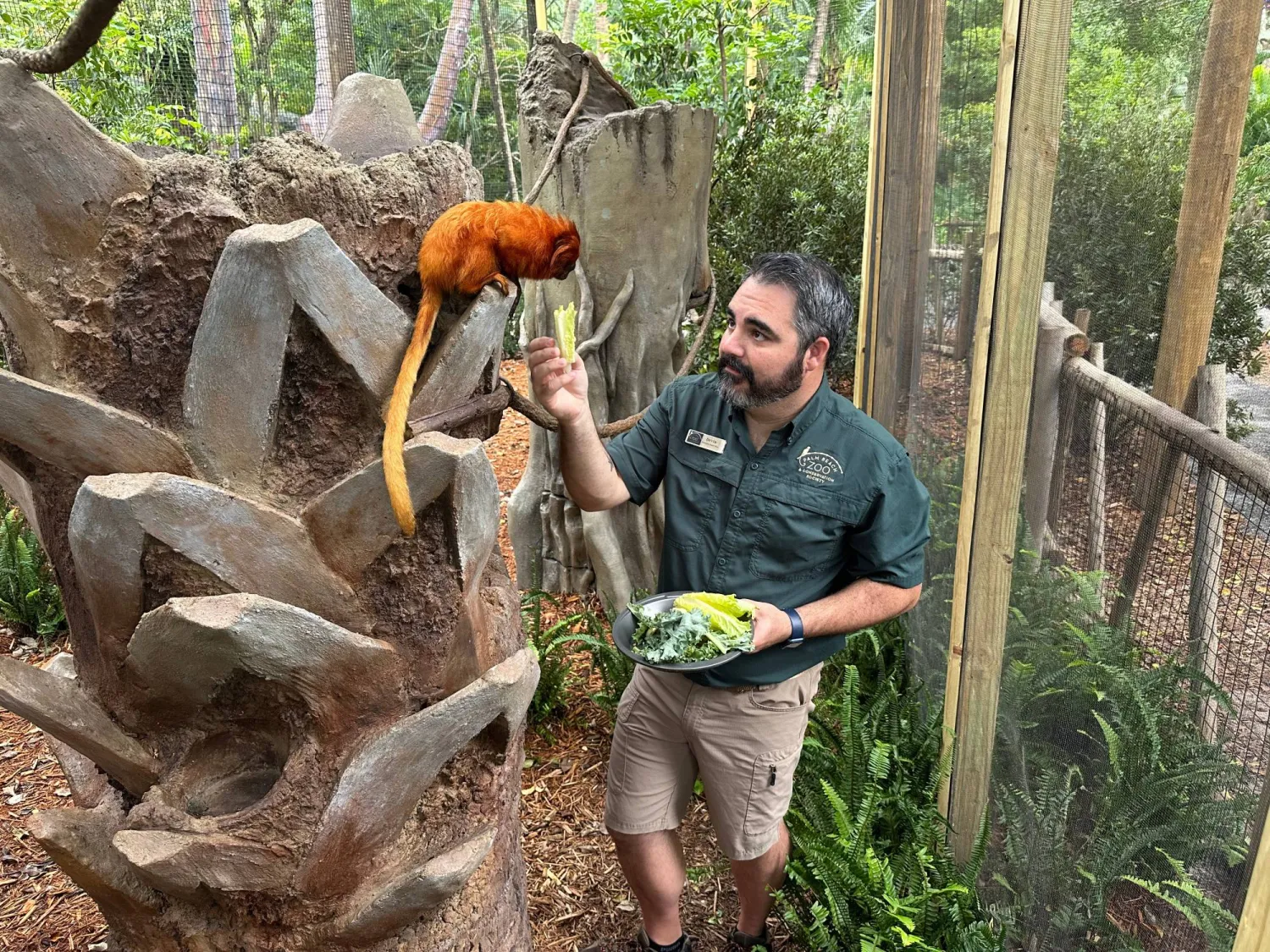

Golden Lion Tamarins, Sloths Become Unlikely Roommates at Palm Beach Zoo

A golden lion tamarin is fed by Devin Clarke inside its new habitat at the Palm Beach Zoo Conservation Society on Thursday, Sept. 18, 2025 in West Palm Beach, Fla. (AP Photo/Cody Jackson)
TT

Golden Lion Tamarins, Sloths Become Unlikely Roommates at Palm Beach Zoo

A golden lion tamarin is fed by Devin Clarke inside its new habitat at the Palm Beach Zoo Conservation Society on Thursday, Sept. 18, 2025 in West Palm Beach, Fla. (AP Photo/Cody Jackson)

Golden lion tamarins and Hoffman's two-toed sloths have become unlikely roommates in a brand new habitat at the Palm Beach Zoo and Conservation Society in Florida.

Both species are native to the forests of South America, which is why the new habitat features a thick canopy of trees. The golden tamarins, with their distinct orange mane, love frolicking in the treetops, while the sloths are perfectly happy hanging from the trees.

“Maybe the golden tamarins think of the sloth as more furniture because they don’t really do too much. They’re more sedentary,” said Devin Clarke, a senior supervisor at the zoo. "They like to sleep during the day, a little bit more active at night. So just watching, you know, like their couch walking around at night isn’t too scary for them.”

The habitat, which opened in late August, offers the sloths and tamarins a unique space to interact with one another — or mind their own business, The Associated Press reported. The space features a network of vines, ropes and tunnels that encourages exploration, zoo officials said.

“Just being able to see them up close and personal is really a way to inspire connection,” Clarke said. “And once people start really having that connection and harboring that connection with the wild animal, they’re able to look at their lives and say, ‘What can I do differently to help these animals’ wild counterparts down in Brazil and Central America thrive?’”

He said that in the 1970s, there were less than 200 golden tamarinds in the wild. Some 40 zoos accredited through the Association of Zoos and Aquariums put together a plan to rerelease the species into the wild. Their numbers topped 5,000 as of last year, he said.

The previous tamarin habitat at the zoo was a little smaller, Clarke said.

“We wanted to be able to give them a better well-being, so enhancing their lives with enrichment, with space, so they can act a little bit more natural,” he added.

Conservation is part of the Palm Beach Zoo's identity, so native Florida plants are part of the new habitat.

“Planting those Florida native plants within that habitat is a great way to highlight something we can do at our own homes,” Clarke said. “Even if you have an apartment, just putting out a potted plant that’s a Florida native plant helps kind of revitalize the ecosystem that we have here in South Florida.”

The new habitat provides an opportunity for visitors to have get a closer view of the two species, said Margo McKnight, the zoo's president and CEO.

“We hope to foster a love for wildlife in wild places, including our own backyards. We hope every person leaves inspired to be a wildlife hero in their own community,” she said.



Mummified Cheetahs Found in Saudi Caves Shed Light on Lost Populations

This undated image provided by Communications Earth and Environment shows the mummified remains of a cheetah. (Ahmed Boug/Communications Earth and Environment via AP)
TT

Mummified Cheetahs Found in Saudi Caves Shed Light on Lost Populations

This undated image provided by Communications Earth and Environment shows the mummified remains of a cheetah. (Ahmed Boug/Communications Earth and Environment via AP)

Scientists have uncovered the mummified remains of cheetahs from caves in northern Saudi Arabia.

The remains range from 130 years old to over 1,800 years old. Researchers excavated seven mummies along with the bones of 54 other cheetahs from a site near the city of Arar.

Mummification prevents decay by preserving dead bodies. Egypt's mummies are the most well-known, but the process can also happen naturally in places like glacier ice, desert sands and bog sludge.

The new large cat mummies have cloudy eyes and shriveled limbs, resembling dried-out husks.

“It’s something that I’ve never seen before,” said Joan Madurell-Malapeira with the University of Florence in Italy, who was not involved with the discovery.

Researchers aren’t sure how exactly these new cats got mummified, but the caves’ dry conditions and stable temperature could have played a role, according to the new study published Thursday in the journal Communications Earth and Environment.

They also don't know why so many cheetahs were in the caves. It could have been a denning site where mothers birthed and raised their young.

Scientists have uncovered the rare mummified remains of other large cats, including a saber-toothed cat cub in Russia.

It's uncommon for large mammals to be preserved to this degree. Besides being in the right environment, the carcasses also have to avoid becoming a snack for hungry scavengers like birds and hyenas.

Cheetahs once roamed across most of Africa and parts of Asia, but now live in just 9% of their previous range and haven't been spotted across the Arabian Peninsula for decades. That’s likely due to habitat loss, unregulated hunting and lack of prey, among other factors.

In a first for naturally mummified large cats, scientists were also able to peek at the cheetahs' genes and found that the remains were most similar to modern-day cheetahs from Asia and northwest Africa. That information could help with future efforts to reintroduce the cats to places they no longer live.


Vonn Launches Social Media Search Mission After Ski Pole Goes Missing

 US' Lindsey Vonn crosses the finish line to win the Women's Downhill event of the FIS Alpine Ski World Cup in Altenmarkt Zauchensee, Austria, on January 10, 2026. (AFP)
US' Lindsey Vonn crosses the finish line to win the Women's Downhill event of the FIS Alpine Ski World Cup in Altenmarkt Zauchensee, Austria, on January 10, 2026. (AFP)
TT

Vonn Launches Social Media Search Mission After Ski Pole Goes Missing

 US' Lindsey Vonn crosses the finish line to win the Women's Downhill event of the FIS Alpine Ski World Cup in Altenmarkt Zauchensee, Austria, on January 10, 2026. (AFP)
US' Lindsey Vonn crosses the finish line to win the Women's Downhill event of the FIS Alpine Ski World Cup in Altenmarkt Zauchensee, Austria, on January 10, 2026. (AFP)

Lindsey Vonn may be dominating World Cup downhills at 41, but even the US speed queen is not immune to missing equipment.

Vonn took to social media on Thursday with an unusual plea after losing a ski pole in Tarvisio, Italy, ahead of this weekend's World Cup event.

"Someone took ‌my pole ‌in the parking ‌lot ⁠today in ‌Tarvisio. If you have seen it, please respond to this. Thank you," Vonn wrote on X, posting a photo of the matching pole complete with her initials on the ⁠hand strap.

Vonn, a favorite for the speed events ‌at next month's Milano-Cortina ‍Olympics, retired ‍from the sport in 2019 and ‍had a partial knee replacement in April 2024 but returned to competition later that year and has been enjoying a fairy-tale comeback that has defied age and expectation.

Already the oldest ⁠World Cup winner of all time, Vonn continued her astonishing, age-defying form with a downhill victory in Zauchensee, Austria last week.

That triumph marked Vonn's fourth podium from four downhills this season, cementing her lead in the World Cup standings and her status as the woman to ‌beat at next month's Olympics.


ISS Crew Splashes Down on Earth After Medical Evacuation

FILE - This photo provided by NASA shows the Moon's shadow covering portions of Canada and the US during a total solar eclipse as seen from the International Space Station on Monday, Aug. 8, 2024. (NASA via AP, File)
TT

ISS Crew Splashes Down on Earth After Medical Evacuation

FILE - This photo provided by NASA shows the Moon's shadow covering portions of Canada and the US during a total solar eclipse as seen from the International Space Station on Monday, Aug. 8, 2024. (NASA via AP, File)

Four International Space Station (ISS) crewmembers splashed down in the Pacific Ocean early Thursday, video footage from NASA showed, after a medical issue prompted their mission to be cut short.

American astronauts Mike Fincke and Zena Cardman, Russian cosmonaut Oleg Platonov and Japan's Kimiya Yui landed off the coast of San Diego about 12:41 am (0841 GMT), marking the first-ever medical evacuation from the ISS.