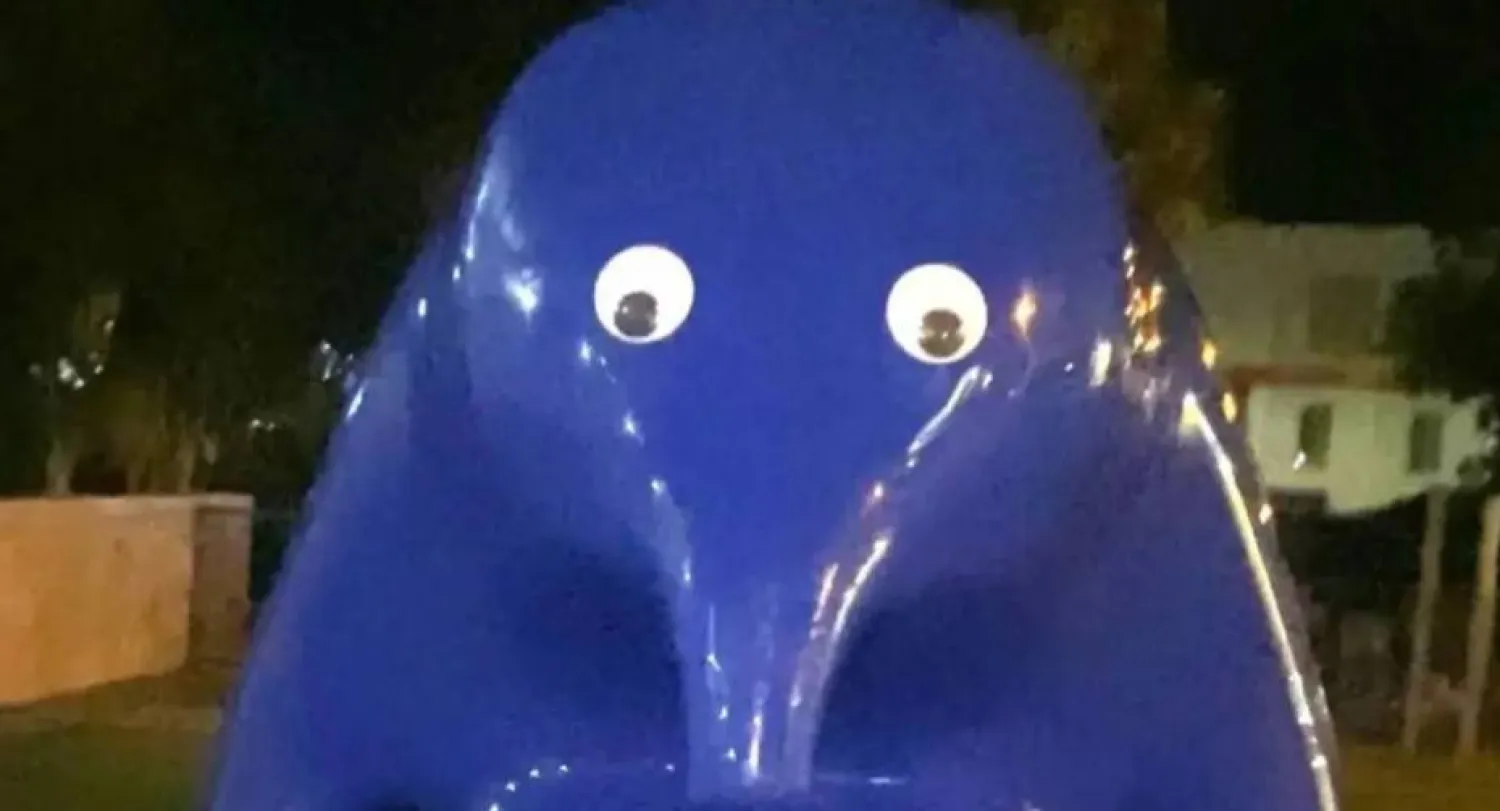
Australian Teen Charged Over Sticking Eyes on Artwork

The local council said they could not remove the eyes without damaging the artwork (Facebook/Amelia Vanderhorst)
TT

Australian Teen Charged Over Sticking Eyes on Artwork

The local council said they could not remove the eyes without damaging the artwork (Facebook/Amelia Vanderhorst)

An Australian teenager has faced court for allegedly defacing a large blue sculpture of a mythical creature by sticking googly eyes on it.

Amelia Vanderhorst, 19, appeared via phone at Mount Gambier Magistrates Court in South Australia on Tuesday charged with one count of property damage.

In a statement at the time of the September incident, the local council said Closed Circuit Television (CCTV) footage showed a person putting artificial eyes on the artwork which locals have nicknamed the “Blue Blob.”

Vanderhorst did not enter a plea and told the court she was ill, according to the Australian Broadcasting Corporation (ABC), with the magistrate advising her to find a lawyer before her next court date in December.

A day after the alleged incident, the local mayor said repairs to the much-loved public artwork would be costly as the stickers could not be removed without damaging the sculpture.

“This willful damage to a valued public artwork is inappropriate and disrespectful,” City of Mount Gambier mayor Lynette Martin said in mid-September.

“It is not harmless fun, it is costly - it is also frustrating to those members of our community who have embraced Cast in Blue.”

She said the council would pursue the “significant” repair costs from those responsible for the damage.

When the sculpture was first proposed, it drew mixed reactions from the local community due to its price tag and design.

Costing 136,000 Australian dollar ($89,000), the artwork represents a mythical megafauna, with the sculpture's designers inspired by an ancient marsupial ant-eater found in local caves that was “massive, lumbering and fascinating.”


Saudi Arabia: KAUST Study Reveals How Plants Protect Photosynthesis During Extreme Heat

The research team identified a protective mechanism within chloroplasts. SPA
TT

Saudi Arabia: KAUST Study Reveals How Plants Protect Photosynthesis During Extreme Heat

The research team identified a protective mechanism within chloroplasts. SPA

King Abdullah University of Science and Technology (KAUST) has completed a research study identifying how plants protect photosynthesis under high temperatures, an outcome that could support the development of more resilient crops in desert climates.

The research team identified a protective mechanism within chloroplasts, lead researcher Professor Monika Chodasiewicz said, noting that it helps preserve and restore the plant’s ability to convert sunlight into chemical energy.

The findings are particularly significant, as heat is one of the main threats to plant productivity, and protecting photosynthesis is essential for sustaining plant growth and crop yields, Chodasiewicz added.

She explained that the chlorophyll protein forms protective granules, revealing their previously unclear functional significance. The findings provide new insights that could be applied for future crop breeding and biotechnology, Chodasiewicz said.

The results also contribute to the emerging field of phase-separated biomolecular condensates in plant biology, while supporting broader priorities related to sustainable agriculture, climate adaptation, and food security.


With the Stroke of a Brush… Paint Could Cool Your Home, Harvest Water from Air

The researchers tested four painted panels in black and white over three months, tracking temperature, atmospheric conditions, and other variables on a University of Syndey rooftop (Dewpoint Innovations)
TT

With the Stroke of a Brush… Paint Could Cool Your Home, Harvest Water from Air

The researchers tested four painted panels in black and white over three months, tracking temperature, atmospheric conditions, and other variables on a University of Syndey rooftop (Dewpoint Innovations)

As global temperatures rise and water scarcity worsens, a nanoengineered paint developed by researchers in Australia aims to tackle both — with the stroke of a brush.

For University of Sydney scientists Chiara Neto and Ming Chiu, these growing pressures sparked an idea: a rooftop coating that could cool buildings and harvest water from the air, according to CNN.

That work evolved into startup Dewpoint Innovations, founded in 2022 with ambitions beyond cooling paint to a broader rethink of how infrastructure is designed: If rooftops across a city could reflect heat and collect water, they could become part of the climate solution.

In a warming world, cities are becoming heat traps. Concrete and rooftops absorb the sun’s energy, raising temperatures, leading to what’s known as the urban heat island effect — where cities experience higher temperatures.

That is the first challenge Dewpoint Innovations is targeting: “Our paint will significantly reduce the heat load the sun puts on cities,” said Chiu, co-inventor and chief technology officer at Dewpoint Innovations.

To achieve that effect, the specially engineered nanomaterials use a process called passive radiative cooling to reflect most of the sun’s energy and release heat back into the sky — allowing roof surfaces to stay cooler than the surrounding air without using energy.

Typical commercial white paint reflects around 70% to 80% of incoming sunlight, said Distinguished Professor Baohua Jia, a nanotech expert at RMIT University in Melbourne, Australia, who is unaffiliated with Dewpoint Innovations.

Dewpoint’s coating demonstrated solar reflectance of up to 96% in a six-month outdoor trial reported in 2025.

That higher reflectivity means less heat was absorbed, keeping roof surfaces up to 6 degrees Celsius cooler than the surrounding air and


UK: Driver Punished for Carrying Football Goal Net on Car Roof

A photo shows the unsecured football net on top of the British driver’s car (Hertfordshire Police)
TT

UK: Driver Punished for Carrying Football Goal Net on Car Roof

A photo shows the unsecured football net on top of the British driver’s car (Hertfordshire Police)

Hertfordshire Police shared a video on social media of a driver who could have caused a collision after placing an unsecured football net on top of his car.

The video showed the incident, where the driver pulls out of a junction with the goal fully assembled on top of the vehicle.

The car is seen pulling over quickly after the police approach, with the frame visibly not properly secured.

In the UK, driving with an insecure load is illegal and classed as dangerous, Hertfordshire Police noted on social media. Serious cases can lead to prison, according to Sky News.

The police said the driver was docked three points from their license and ordered to pay a £120 fine and a £48 victim surcharge.

A spokesperson for Hertfordshire Police told The Sun that the incident took place on May 12 last year, at around 6.08pm in Borehamwood.

They added that the driver “recently attended court” where they were given the penalty.

The police said on social media: “While this clip may have made you laugh (or gasp!), there's a serious side. The goal was not secured properly and could have easily caused a collision.”