

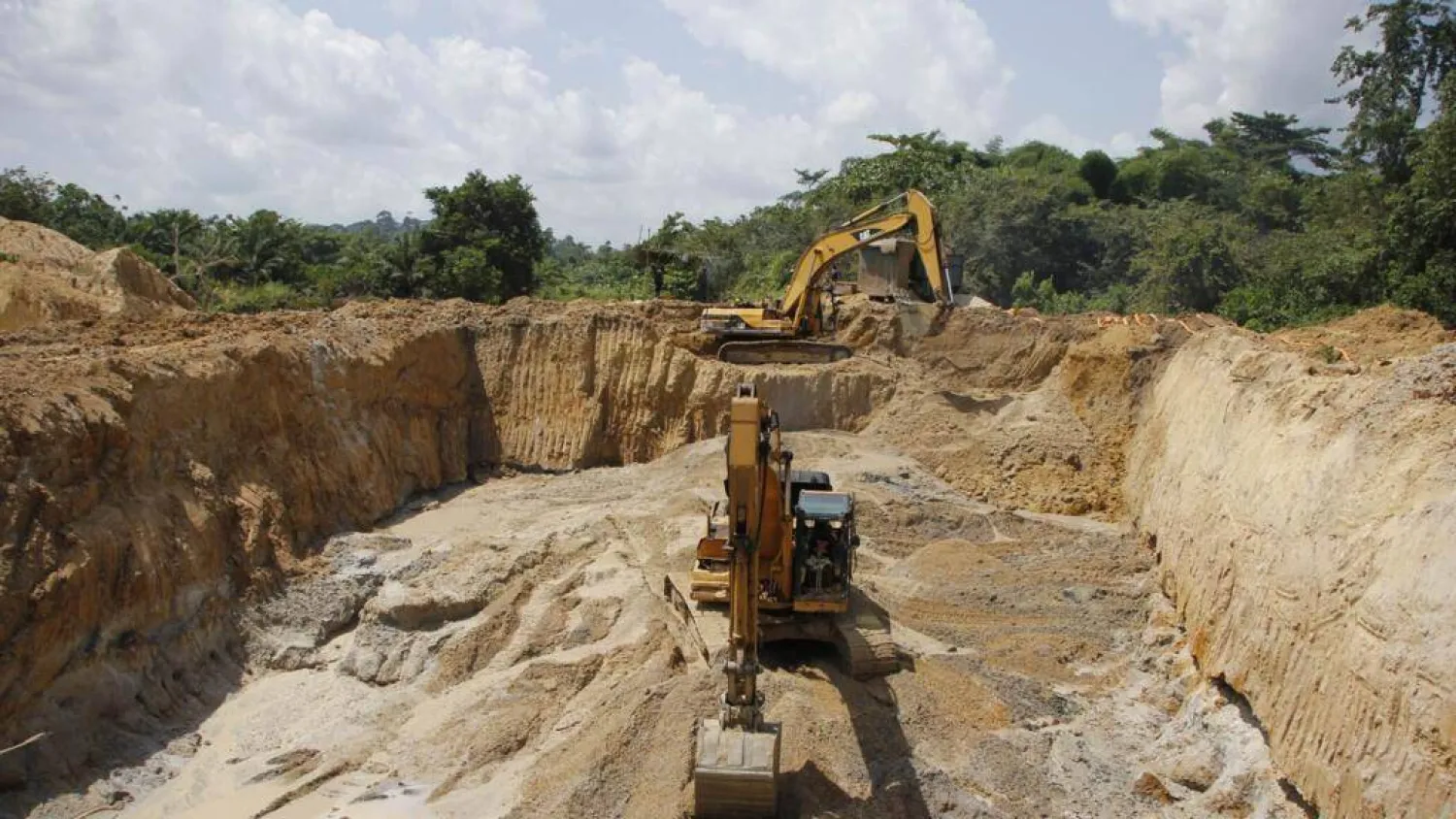

Ghana Moves to Rewrite Mining Laws for Bigger Share of Gold Revenues

As the price of gold soars, Accra plans to revise its mining code to increase state revenue from the sector. Chris Stein / AFP/File
TT

Ghana Moves to Rewrite Mining Laws for Bigger Share of Gold Revenues

As the price of gold soars, Accra plans to revise its mining code to increase state revenue from the sector. Chris Stein / AFP/File

Ghana is preparing to overhaul its mining laws to increase its share of the revenues generated by the surge in the precious metal's price, sparking concern among foreign mining companies in Africa's top gold producer.

By revising its mining code, which currently offers foreign mining firms favorable tax and royalty terms, leaving the state with a limited stake, Ghana is following in the footsteps of other African countries, reported AFP.

They are looking to tighten control over natural resources as global demand for gold and critical minerals such as cobalt soars.

Among those that have recently introduced new mining laws are the Democratic Republic of Congo, Mali and Tanzania.

Gold prices have skyrocketed recently, jumping more than 65 percent in 2025, climbing to fresh records above $5,100 on Monday.

"What we have since 2014 is a policy that has not been reviewed," Isaac Andrews Tandoh, acting chief executive officer of the Minerals Commission, told AFP.

"We had to do something to bridge this gap."

In Ghana, the world's sixth-largest gold producer, gold production is largely dominated by foreign companies such as the US's Newmont, South Africa's Gold Fields and AngloGold Ashanti and Australia's Perseus Mining.

Under proposed reforms expected to be presented to parliament by March, mining royalties would jump from the current three to five percent range to between nine and 12 percent, depending on global gold prices, Tandoh said.

Ghana's mining agreements typically freeze fiscal terms for between five and 15 years in exchange for investments that can exceed $500 million to build or expand mines.

But regulators say some companies renege on their commitments.

"We have seen companies with development agreements that refuse to develop the mine and instead use revenues from Ghana to acquire assets elsewhere," Tandoh said.

The reforms would scrap development agreements entirely and review stability clauses that shield investors from future policy changes, a move authorities say reflects Ghana's growing experience in managing the sector.

'Double-edged knife'

As African governments increasingly seek a bigger share of mining revenues amid a surge in commodity prices, officials acknowledge the challenge of balancing investor confidence with national benefit.

Mining policy strategist Ing. Wisdom Gomashie said Ghana currently captures only about 10 percent of total mineral value through royalties, dividends and taxes.

"The thinking of government is right," Gomashie said. "But the approach should not be draconian."

He warned that stability agreements, while open to reform, are crucial for protecting long-term investments and securing external financing, particularly in countries perceived as politically risky.

"Scrapping them outright, while simultaneously increasing royalties, could become a double-edged knife," Gomashie said.

Industry groups have also voiced concern.

Ghana Chamber of Mines CEO Kenneth Ashigbey said miners were not opposed to the state seeking higher returns but warned that the current proposals risk undermining competitiveness.

"What we are advocating for is a sweet spot, one where government secures sustainable revenues while the industry can expand, reinvest and take advantage of high gold prices," Ashigbey told AFP.

Large-scale mining firms in Ghana already face a high tax burden, including a five percent royalty on gross revenue and a 35 percent corporate income tax, the chamber said.

Alongside fiscal reforms, Ghana has tightened gold trading rules, particularly in the small-scale sector, to curb smuggling and improve transparency.

Ghana's Gold Board spokesman, Prince Minkah said new licensing and tracking systems have helped formalize the trade and boost foreign exchange earnings.

"We now have the data to track when, where and how traders operate," Minkah told AFP.

Ghana recorded about $10.5 billion in gold export earnings last year.

The country's proposed mining reforms come as the country faces rising fiscal pressure.

It ended 2025 as Africa's fourth-largest IMF debtor, with $4.1 billion outstanding, and recently received a further $365 million under a bailout program.

Public debt stood at 684.6 billion cedis ($55.1 billion) in September, intensifying the push for domestic revenue and economic stabilization.



Turaif Hosts Falcon Festival with Over 700 Participants

The event features over 700 participants, including professional, elite, and international falcon owners, as well as local amateurs - SPA
TT

Turaif Hosts Falcon Festival with Over 700 Participants

The event features over 700 participants, including professional, elite, and international falcon owners, as well as local amateurs - SPA

The tenth edition of Northern Borders Falcon Festival commenced today in Turaif Governorate, in collaboration with the Saudi Falcons Club.

The event features over 700 participants, including professional, elite, and international falcon owners, as well as local amateurs.

The competition consists of 18 rounds, with total financial prizes exceeding SAR1 million, according to SPA.

The five-day festival includes various activities, including entertainment, cultural, and educational programs. It also features sections for families involved in the cottage industry, poetry evenings, and musical performances, with participation from several government agencies.


Mali's Troubled Tourism Sector Crosses Fingers for Comeback

People replastered the Great Mosque of Djenne, one of Mali's major tourist draws, in June 2025. OUSMANE MAKAVELI / AFP/File
TT

Mali's Troubled Tourism Sector Crosses Fingers for Comeback

People replastered the Great Mosque of Djenne, one of Mali's major tourist draws, in June 2025. OUSMANE MAKAVELI / AFP/File

Oumar Cisse used to lead tours of Djenne, an ancient, fabled city in central Mali known for its towering mud-brick mosque, but he now ekes out a living driving an old motorcycle taxi in Bamako.

Mali's once robust tourism sector has dried up in recent years after an iron-fisted junta came to power in back-to-back coups in 2020 and 2021 and as Al-Qaeda-linked extremists waged a campaign of attacks.

"Under my fingernails, it's no longer the sacred earth of Djenne, but engine grease," Cisse told AFP, overcome with nostalgia for his former life.

Cisse left after the security situation deteriorated in the city, which is listed as a UNESCO World Heritage site and is home to the Great Mosque of Djenne, the largest mud-brick structure in the world.

He is now focused on feeding his children, hopeful that they will remember that their father was once "a guide, a man of culture".

"I could talk to you for three hours about the family lineages, the mosques' minarets and why the mud-brick walls never collapse in the rain," he told AFP.

"The tourists listened to me with wide eyes, they wrote everything down in their little notebooks," he said.

Out of favor

Since 2012, Mali has faced a profound security crisis, fueled by attacks not just from Al-Qaeda-linked extremists, but also those with ties to the ISIS group, as well criminal networks.

The country, which has four UNESCO World Heritage sites, was long a major destination for those interested in west African culture, before gradually falling out of favor with foreign tourists.

The sites range from the historic city of Timbuktu to the mud-brick Tomb of Askia in Gao, which UNESCO says "bears testimony to the power and riches" of an empire that flourished in the 15th and 16th centuries through control of trans-Saharan trade.

However, tourists have been missing from the UNESCO sites and many other landmarks for more than a decade now.

"Westerners used to visit Timbuktu and the sand dunes. Now there's nothing," said Sidy Keita, director of Mali Tourism, the national tourism promotion agency.

Mali's security crisis has led to the "abandonment of destinations, the closure of some tourism establishments and destruction of others, and the dismissal or temporary layoff of employees", according to the Mali Tourism website.

Meanwhile, "many hotels have closed due to a lack of customers. Worse, the owners are in debt", a member of the Malian Association of Hoteliers told AFP.

According to Mali Tourism, between 200,000 and 300,000 tourists visited Mali each year during its peak tourism era, generating annual revenue of around 120 billion CFA francs ($215 million).

The sector, which previously accounted for nearly three percent of GDP, now accounts for only one percent, Mali Tourism Minister Mamou Daffe said in July on public television.

- Local tourists -

Mali has tried to revive its tourism industry in recent years by focusing on domestic travelers.

Programs have encouraged civil servants and the public to explore their own country, with subsidized tours in the capital Bamako and the regions.

In December, foreign tourists were able to visit Timbuktu for the first time in a decade after extremists rendered it too dangerous.

They came for the Mali Cultural and Artistic Biennial, which was hosted by the city.

There were "strict security protocols in place with all foreigners required to have a police escort", said Ulf Laessing, head of the regional Sahel program at the Konrad Adenauer Foundation, who was present for the biennial.

Private airline Sky Mali said it transported nearly 1,000 passengers to Timbuktu for the biennial aboard 12 regular flights plus two additional chartered ones, just after Western embassies told their citizens to leave Mali amid an extremist fuel blockade.

Meanwhile, according to Keita, the director of Mali Tourism, about 100 Russian tourists visited for the biennial in Timbuktu.

"Hope is being rekindled," he said, adding that "this is a new clientele. We hope there will be more, that this will be the relaunch of the tourism industry."

Mali's military regime has turned its back on its former colonial power France, drawing closer to Russia, now one of its biggest allies and a partner in the energy, defense and higher education sectors.

The authorities recently announced their intention to develop "joint tourism" within the framework of the Alliance of Sahel States (AES), a confederation that brings together junta-run Mali, Burkina Faso and Niger.


VAST CEO Announces Plan to Launch First Commercial Space Station in 2027

Chief Executive Officer of VAST Space Max Haot speaks at the Space Debris Conference 2026 in Riyadh. (SPA)
TT

VAST CEO Announces Plan to Launch First Commercial Space Station in 2027

Chief Executive Officer of VAST Space Max Haot speaks at the Space Debris Conference 2026 in Riyadh. (SPA)

Chief Executive Officer of VAST Space Max Haot announced on Tuesday the company’s plan to launch the first commercial space station for astronauts, Haven-1, in the first quarter of 2027.

He made the announcement at the Space Debris Conference 2026 in Riyadh. The announcement reflects the rapid pace of innovation in commercial space infrastructure and supports a sustainable human presence in low Earth orbit.

Haot explained that Haven-1 represents the first phase of a long-term vision to develop commercial space stations, in line with the global transition toward commercial operating models as the International Space Station approaches the end of its operational life later this decade.

The station is designed to host a crew of four astronauts on short-duration missions, while supporting scientific research, technology demonstrations, and commercial applications in a microgravity environment, he revealed.

The station’s design places strong emphasis on safety and space sustainability, including the integration of space-debris protection systems, as well as dedicated systems for safe deorbiting at the end of its operational life, helping to mitigate risks associated with space debris, he added.

Haot said the company aims to achieve operational revenues through four crewed missions, supported by scientific and commercial payloads and strategic partnerships, during the period from 2027 to 2030.

The project has made significant progress following the success of the Haven Demo mission, an experimental mission launched by the company in 2025 to test key technologies and systems in orbit, marking the project’s transition from development to operational validation, he stressed.

Tuesday's announcement underscores the growing role of the commercial sector in building safe and sustainable space infrastructure and supporting international efforts to ensure the responsible use of low Earth orbit in the coming phase.