

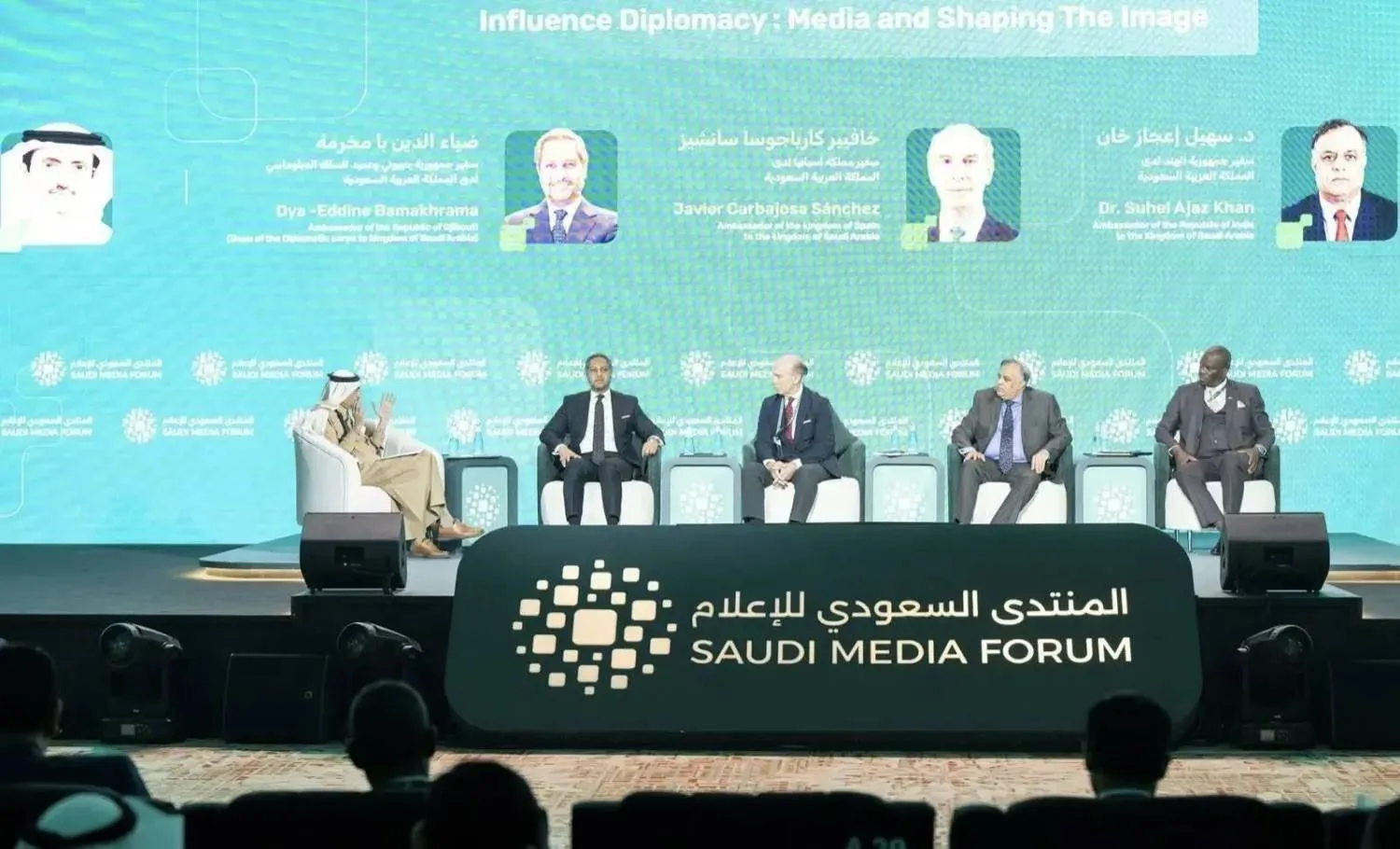

Saudi Media Forum Discusses State of Arab Media, Global Ambitions

Diplomats and media industry experts highlighted the key dimensions of “soft power.” (SPA)
TT

Saudi Media Forum Discusses State of Arab Media, Global Ambitions

Diplomats and media industry experts highlighted the key dimensions of “soft power.” (SPA)

Diplomats and media industry experts shed light on “soft power” and how it can be leveraged to build national reputations and shape public awareness of contemporary international issues, as the Saudi Media Forum hosted candid discussions on the reality of the Arab media sector and the requirements for elevating its global impact.

During the second day of the forum, held in Riyadh, participants offered frank assessments of the challenges facing Arab media and the steps needed for it to meet the demands of the current phase and extend its influence internationally.

Panels and workshops explored a wide range of topics, including the role of citizen journalism in shaping the news agenda, the challenges of keeping pace with digital infrastructure amid rapid content industry transformations, and the craft of producing high-quality journalistic storytelling in an era of technological abundance and fragmented content trends.

Confronting Fake News and Disinformation

A session titled “Diplomacy of Influence: Media and Image-Making” examined the role of media in shaping perceptions and enhancing states’ soft power, with the participation of several ambassadors accredited to Saudi Arabia.

Diaa Al-Din Bamakhrama, Djibouti’s Ambassador and Dean of the Diplomatic Corps in the Kingdom, said Saudi Arabia offers a prominent model of influence diplomacy through its hosting of international forums and its investment in culture and sports, particularly football, which has helped project Saudi presence across the globe.

“In an increasingly interconnected world that has become a small village, false and fabricated narratives fall quickly and cannot withstand the flow of information and facts,” Bamakhrama said, noting that digital media has made exposing falsehoods faster, and that only truthful narratives can build lasting trust with public opinion.

Spain’s Ambassador to the Kingdom Javier Carbajosa Sánchez stressed that the relationship between media and diplomacy is historic and has grown more complex and influential in the age of modern communications and social media.

Media, he said, has never been merely a transmitter, but an active and influential force, adding that political work cannot be separated from managing media presence.

For his part, Dr. Suhel Ajaz Khan, the Indian Ambassador to Saudi Arabia, said that image-building and perception management lie at the heart of public and cultural diplomacy.

He explained that delivering the right message to the right audience is the key to influence, with art and national cuisine among the most effective soft-power tools.

He added that cultural diplomacy relies on activating soft-power instruments such as arts, music, cinema, and cuisine to enhance human connection and build bridges between peoples.

In Saudi Arabia, he noted, the Indian community, alongside Indian cinema and food culture, plays a major role in shaping perceptions and strengthening partnerships—sometimes with an impact exceeding that of formal diplomatic efforts.

In confronting fake news and digital disinformation, Khan stressed the need for swift, honest, and direct diplomacy to present facts before rumors spread.

South African Ambassador Mogobo David Magabe highlighted mutual respect and dialogue as fundamental pillars of diplomacy, pointing out that the main challenges today are the spread of disinformation and the accelerated pace of modern media, which contrasts with diplomacy’s traditionally gradual, long-term relationship-building approach.

A Candid Look at Arab Media

In a separate dialogue session on the realities of Arab media and the requirements for expanding its global reach, Saudi journalist Jameel Altheyabi said local Arab media is largely inward-looking, driven by a mindset focused on domestic audiences with limited consideration for the global sphere.

He described Arab media as often emotional, with varying approaches to content and engagement across the region.

Writer and journalist Mamoun Fandy said that stories produced in the Arab world are viewed internationally through the lens of their origin and nature, as global audiences apply their own standards of credibility, accuracy, and sourcing.

He added that the Arab world can generate distinctive journalistic stories capable of shaping global discourse through exclusivity and originality, expressing regret that many official Arab institutions still prefer foreign outlets to convey their narratives to the world.



NASA Moves its Artemis II Moon Rocket off the Launch Pad for More Repairs

Esta imagen proporcionada por la NASA muestra el cohete lunar de la NASA en la plataforma del Centro Espacial Kennedy en Florida el jueves 19 de febrero de 2026. (NASA vía AP)
TT

NASA Moves its Artemis II Moon Rocket off the Launch Pad for More Repairs

Esta imagen proporcionada por la NASA muestra el cohete lunar de la NASA en la plataforma del Centro Espacial Kennedy en Florida el jueves 19 de febrero de 2026. (NASA vía AP)

NASA moved its grounded Artemis moon rocket from the launch pad back to its hangar Wednesday for more repairs.

The slow-motion trek at Florida’s Kennedy Space Center was expected to take all day. The 322-foot (98-meter) Space Launch System rocket had spent a month at the pad ready for potential liftoff, but encountered a series of problems serious enough to require a return to the Vehicle Assembly Building, about 4 miles (6.4 kilometers) away, The AP news reported.

Managers ordered the rollback over the weekend after the rocket’s helium pressurization system malfunctioned. Already delayed a month by hydrogen fuel leaks, the launch team had been targeting March for astronauts' first trip to the moon in decades. But now the Artemis II lunar fly-around by a US-Canadian crew is off until at least April.

All four astronauts were at the US Capitol on Tuesday night for President Donald Trump's State of the Union address as invited guests, since the flight delay means they no longer need to quarantine.


Ice Melt Threatens Emperor Penguins During Annual Molt, Say Researchers 

View of a chinstrap (Pygoscelis antarcticus) and gentoo (Pygoscelis papua) penguins at the Gerlache Strait, which separates the Palmer Archipelago from the Antarctic Peninsula, on January 15, 2024. (AFP)
TT

Ice Melt Threatens Emperor Penguins During Annual Molt, Say Researchers 

View of a chinstrap (Pygoscelis antarcticus) and gentoo (Pygoscelis papua) penguins at the Gerlache Strait, which separates the Palmer Archipelago from the Antarctic Peninsula, on January 15, 2024. (AFP)

Emperor penguins shed all their feathers once a year, a precarious ritual that may have become deadly as climate change pushes them into shrinking patches of Antarctic sea ice, researchers said Wednesday.

The flightless birds molt during summer, relying on stored fat to survive for several weeks until their waterproof coat grows back so they can swim and hunt in icy waters again.

Researchers from the British Antarctic Survey, analyzing seven years of satellite images, accidentally discovered several molting colonies along the extremely remote coastline of an area known as Marie Byrd Land.

As sea ice melted, the penguins were forced onto smaller spaces in increasingly large and tightly packed groups, the UK polar research organization said in a statement.

In 2025, only 25 small groups of penguins were visible in the satellite images, it said. Prior to 2022, more than 100 groups had been spotted in the same region.

"While we don't know for sure what happened to those penguins, we know they can find new suitable breeding sites after ice loss, so it's possible they have established new molting sites elsewhere," said Peter Fretwell, lead author and mapping expert at the British Antarctic Survey.

"But also it's possible that huge numbers of penguins perished after entering the Southern Ocean before they had replaced their waterproof feathers," Fretwell said.

"If this has happened, the situation for emperors as a species is even worse than we thought."

The researchers said that if emperor penguins are forced into the ocean before their feathers are replaced, they face exhaustion from increased energy use, hypothermia and increased risk from predators.

- Ice at record low -

Emperor penguin populations have shrunk by almost a quarter as global warming transforms their icy habitat, the British Antarctic Survey said in research published last year.

During the January-March Antarctic summer, emperor penguins from the Ross Sea in West Antarctica migrate as much as 1,000 kilometers (620 miles) to Marie Byrd Land to molt on stable sea ice, the researchers said Wednesday.

It is one of the few areas that historically retains its fast ice -- sea ice attached to the coast -- throughout the year.

The molting process takes about four to five weeks and the penguins cannot go in the freezing water during that time.

The extent of Antarctic Sea ice fell to record lows between 2022 and 2024, accompanied by a drastic decrease in fast ice, the British Antarctic Survey said.

In the region they observed, sea ice coverage fell from a 50-year average of 500,000 square kilometers -- roughly the size of Spain -- to 100,000 square kilometers in 2023. Only 2,000 square kilometers of fast ice were left near the coast.

During those years, the sea ice broke before the penguins had finished molting, raising fears that many may not have survived, the scientists said.

The survey's previous study found that some emperor penguin colonies lost all their chicks in recent years as the ice broke, plunging hatchlings into the sea before they were old enough to cope with the freezing ocean.

At current rates of warming, there is a 45 percent chance the species will become extinct by the turn of the century, the survey said.


Are Expensive Shampoos Worth it? Here's what the Experts Have to Say

FILE - Shampoo sits on a shelf at a store in Pittsburgh, Jan. 26, 2023. (AP Photo/Gene J. Puskar, File)
TT

Are Expensive Shampoos Worth it? Here's what the Experts Have to Say

FILE - Shampoo sits on a shelf at a store in Pittsburgh, Jan. 26, 2023. (AP Photo/Gene J. Puskar, File)

Ornate packaging paired with enticing advertisements that claim expensive shampoos are elixirs to all hair woes can leave one wondering: Are the higher prices really worth it? Should I abandon my $8 drugstore mainstay for a $42 premium brand?

Experts say affordable shampoos and conditioners found in grocery stores and pharmacies can do the job as well as the pricey versions with tempting messaging and testimonials on social media. They advise consumers to evaluate the ingredients in products, their own scalp and hair concerns, and their entire hair care routine — and to check with a doctor when in doubt.

Premium brands can work well, and some have active ingredients that cost more, according to dermatologists. Other factors influencing the price include the size of the company and whether it has invested in organic ingredients, sustainable agriculture and recycled materials.

Dr. Crystal Aguh, dermatologist and director of the Ethnic Skin Program at Johns Hopkins School of Medicine, said she generally categorizes people into two hair types: damage-prone and damage-resistant.

Damage-prone includes people with very curly hair, people who chemically treat their hair and those who use hot tools to style it. She said damage-resistant attributes include oily hair and straight hair, The Associated Press reported.

People with damage-prone hair should avoid shampoos that have sodium lauryl sulfate as the main ingredient, Aguh said. It removes a lot of sebum, a natural oil that coats and protects hair. Without sebum, hair could feel very dry and break easily.

For curly or dyed hair, Aguh recommends washing less frequently to avoid removing too much sebum. She said people with tightly curled or coily hair should only wash their hair once a week. People with wavy hair that is dyed might find it best to wash every two to three days.

Damage-resistant hair that is oily and straight can be washed every day.

Expensive shampoos and conditioners can work well, but there are affordable products that perform just as well, Aguh said. She tells patients that “it’s not the products, it’s the process” that affects hair health the most, including how often hair is washed, dyed or treated with heat.

“Instead of spending hundreds of dollars thinking, 'If I just find the right shampoo, right conditioner, all of my troubles will go away,' you also have to just look at what your process looks like ... because that will often do the trick,” she said.

She said it is fine to mix high-end and mass market products and that people shouldn’t feel compelled to buy an entire line of expensive products.

Aguh said some common brands are more affordable because they are made by large corporations that can achieve economies of scale. Sometimes expensive brands have a smaller team and lack the workforce and resources to reach those same cost advantages.

When treating dandruff, for example, Aguh often recommends over-the-counter shampoos instead of prescription formulas. But she added people should see a doctor for lingering dandruff problems.

Shampoo is skincare for the scalp Dr. Joe Tung, a dermatologist at the University of Pittsburgh Medical Center, said people should think of shampoo as skincare for the scalp, not just a cosmetic product.

“Hair itself is biologically inactive once it grows out, but underneath the surface of the skin on the scalp is a full ecosystem with stem cells, immune cells, oil glands, nerve endings," he said. “When that ecosystem is balanced, the scalp feels comfortable and hair grows optimally; when it is disrupted, people can experience itching, flaking, excess oil, or hair loss.”

Tung said people should consider what their scalp needs when choosing shampoo, and a conditioner should be chosen based on hair texture and damage level. He said dandruff and itchiness benefit from shampoos that address inflammation and microbial imbalance, whereas dry or chemically treated hair could benefit from a gentle cleanser with a rich conditioner.

Tung said expensive shampoos and conditioners are sometimes worth the price, but a product's effectiveness is determined by active ingredients and not branding. "An antifungal ingredient works because of its molecular activity, not because it comes in a luxury bottle or from a prestigious brand," he said.

Expensive shampoos typically rely on more refined conditioning agents and soothing ingredients that may make frequent hair washing more comfortable, Tung said. But some luxury products contain fragrances or botanical extracts that can irritate sensitive skin, he said. Simpler formulas are often better tolerated by people with sensitive skin.

Hair products with a sustainability focus MOKO Organic Beauty Studio in Philadelphia stocks organic shampoos and conditioners that cost from $24 to $45. Owner Monique Mason said it is the salon's mission to provide products that are good for scalps and the planet.

Ingredients are the biggest of many factors influencing price, Mason said. Organic products typically avoid inexpensive sulfates, synthetic fragrances and parabens that are widely used in the personal care industry, she said. Mason said she also researches how the brands she sells manufacture their products to ensure their sustainability claims can be verified.

“I get to know them, whether they’re family-owned, how they farm, how they source their ingredients," she said.