

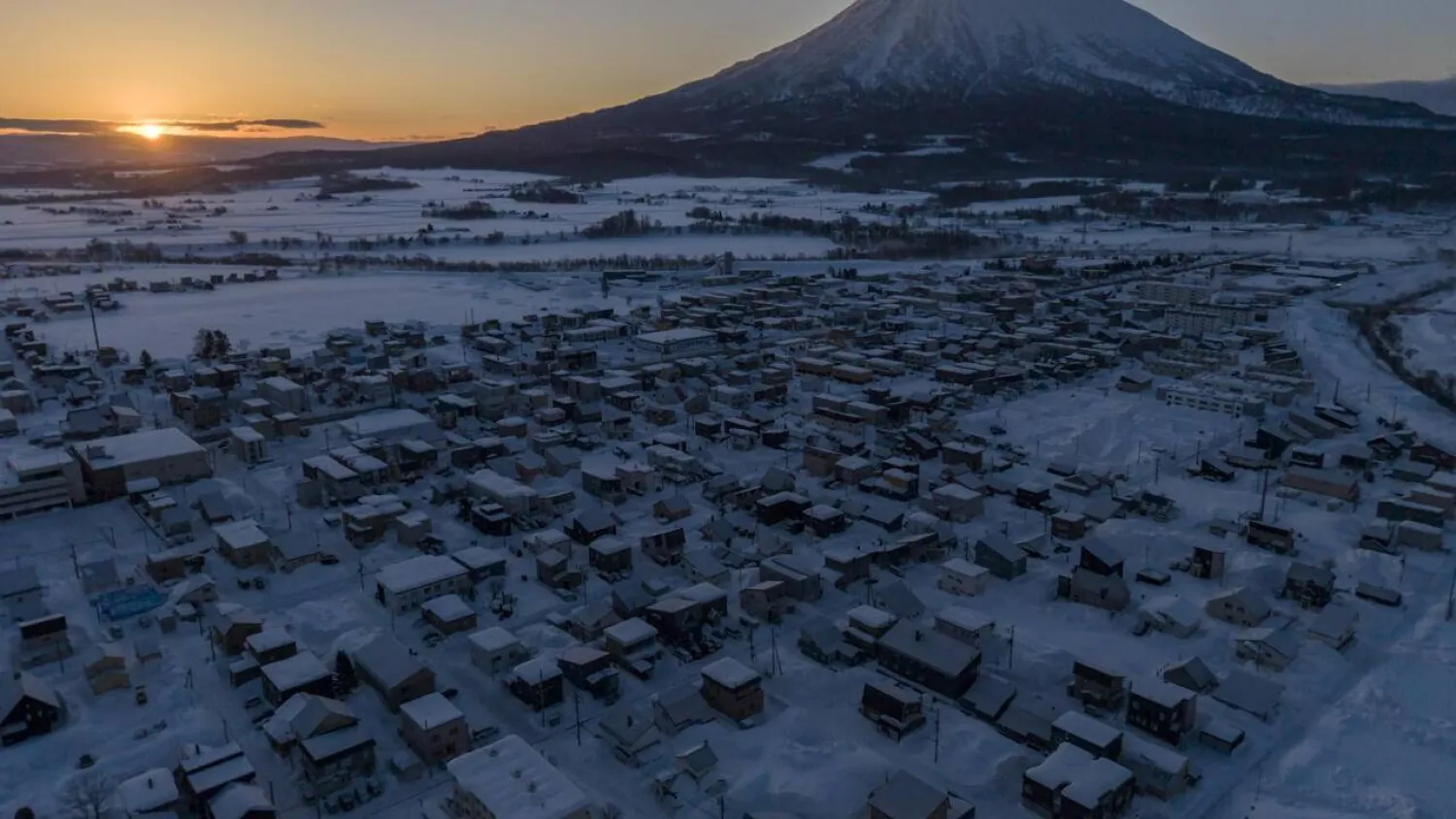

Japan Ski Paradise Faces Strains of Global Acclaim

The scenic ski resorts in Kutchan, Hokkaido have become a flashpoint for immigration after an influx of foreign workers. Yuichi YAMAZAKI / AFP
TT

Japan Ski Paradise Faces Strains of Global Acclaim

The scenic ski resorts in Kutchan, Hokkaido have become a flashpoint for immigration after an influx of foreign workers. Yuichi YAMAZAKI / AFP

Beneath the powder snow at internationally popular Japanese ski resort Niseko, anxiety is mounting among residents over soaring prices and a massive influx of overseas workers.

At a time when Prime Minister Sanae Takaichi is talking tough on immigration, upscale Niseko has never been more popular with seasonal workers, investors and skiers from across the globe.

The snow "is the best in the world", said Gideon Masters, a 29-year-old Australian tourist.

"It's just soft, powder fluff. You can pick it up with your bare hands, it doesn't even feel cold... It's just a shame that it's become so populated," he told AFP at the foot of the slopes, snowboard in hand.

Built in the 1960s on the northern island of Hokkaido, the resort began attracting foreigners, mainly Australians, in the 1990s and became a popular destination after the 9/11 terrorist attacks in 2001 for those wanting to avoid the United States.

They gradually opened more shops and acquired property, and were later joined by Asian investors from Hong Kong, Malaysia and Singapore, among others, pushing land prices ever higher.

In Hirafu, one of the four resorts that make up Niseko, land prices jumped 70 percent between 2020 and 2025.

"If ski resorts in Japan had stayed the way they used to be, they would never have gained such worldwide renown," said Hiroshi Hasegawa, director of a local real estate agency.

"It's thanks to the taste and sensibilities of Australians and New Zealanders that this town has grown."

They are no longer alone, with "funds based in tax havens and all kinds of investors (who) have started pouring money in. Hollywood stars and artists come here, and owners of multinationals are buying second homes," he added.

"All of this is driving prices up even further," a trend that will likely continue, according to the agent.

- Unaffordable for locals -

For residents, inflated property prices and living costs are leaving a bitter taste.

"Land is being sold at prices that are no longer affordable for locals," explained 42-year-old Masatoshi Saito, who runs a painting company.

"In the supermarket, you find luxury products, sea urchins or Dom Perignon champagne, and vegetables have become extremely expensive," pushing some people to do their shopping in a neighboring town.

To attract staff, hotels and restaurants are raising wages, but local businesses are struggling to keep up.

"In construction, paying that much is very difficult because market prices are fixed. Raising wages is a huge risk for bosses," Saito said.

Meanwhile, "care workers sometimes prefer jobs in hotels," which pay better, creating a risk of labor shortages in social services", warned Hasegawa.

Driven by tourist demand, the region sees thousands of seasonal workers arrive each year, most of them foreigners.

In Kutchan, a large town in the area, the non-Japanese population doubles in winter to 3,000 people from 70 countries, making up nearly 20 percent of residents.

"Young people in their twenties come here from all over the world (...), which creates a very lively atmosphere," but also causes problems with neighbors, admitted Kutchan Mayor Kazushi Monji.

Saito and other residents, meanwhile, have complained about littering.

A plan to build housing for 1,200 foreign workers that was approved last autumn sparked outcry among locals.

"Cultures are different, not to mention the language barrier," the mayor said, urging "mutual support and consideration".

- 'Harmonious coexistence' -

Reflecting growing anti-immigration sentiment, the far-right "Japanese First" Sanseito party made gains in February's general election.

Prime Minister Takaichi, meanwhile, has promised tougher rules for foreigners in the name of "harmonious coexistence" between communities.

Her government is proposing stricter checks on foreigners entering the country, lengths of stay and illegal work.

It also wants to revise rules on land purchases by foreigners for "national security" reasons.

While acknowledging the need to adapt legislation to current realities, Monji rejects "the somewhat extreme view" that foreigners could "take over".

The interest Niseko is generating "boosts the economy and greatly contributes to the town's development", Kutchan's mayor said.

And with births falling again in 2025 for the tenth year in a row in Japan, the country desperately needs foreign workers.

Hokkaido is experiencing extreme polarization, hosting both the localities that saw the sharpest land-price increases in the country last year due to tourism and foreign investment, and those where prices fell the most, due to population decline.

"If we want to share the beauty of this region with the whole world, we must move beyond nationality divides," Monji said.



Mounted New York Police Officer and His Horse Corner Suspected Purse Snatcher in Manhattan

A view shows the downtown Manhattan skyline in New York City, US, July 22, 2025. (Reuters)
TT

Mounted New York Police Officer and His Horse Corner Suspected Purse Snatcher in Manhattan

A view shows the downtown Manhattan skyline in New York City, US, July 22, 2025. (Reuters)

A New York City police officer on horseback nabbed a suspected purse snatcher after chasing her through the streets of Manhattan at full gallop — a wild scene evoking the clip-clopping past of a city where lights, sirens and squad cars are the norm.

The late Wednesday morning pursuit began when the victim reported the theft. The officer — whose name has not been released — and his horse quickly took up the chase that was captured on his bodycam and also by a television news crew that happened to be in the area for an unrelated story.

The officer repeatedly screamed at the suspect to stop running, but she refused while denying she had taken the purse.

The brief hoof chase went along sidewalks, under scaffolding, between parked cars and across streets before the woman was stopped by a pedestrian and then detained by the officer.

The woman was charged with larceny and providing false information. Authorities said she had been convicted of murder in the April 2000 fatal shooting of a cab driver and had served time in prison before being released. She is currently on lifetime parole.

No injuries were reported in the chase.


Back on Earth, Artemis II Crew Still Finding their Footing

HOUSTON, TEXAS - APRIL 16: Artemis II Commander Reid Wiseman, Pilot Victor Glover, Mission Specialist Christina Koch, and Mission Specialist Jeremy Hansen speak during a press conference at the NASA Johnson Space Center on April 16, 2026 in Houston, Texas. Danielle Villasana/Getty Images/AFP
TT

Back on Earth, Artemis II Crew Still Finding their Footing

HOUSTON, TEXAS - APRIL 16: Artemis II Commander Reid Wiseman, Pilot Victor Glover, Mission Specialist Christina Koch, and Mission Specialist Jeremy Hansen speak during a press conference at the NASA Johnson Space Center on April 16, 2026 in Houston, Texas. Danielle Villasana/Getty Images/AFP

Nearly a week after their Pacific splashdown, the astronauts who crewed the Artemis II mission that flew around the Moon told reporters Thursday they have yet to fully grasp the magnitude of the moment.

"It's been a week of medical testing, physical testing, doctors, science objectives," mission commander Reid Wiseman said during a press conference at NASA's Johnson Space Center in Houston.

"We have not had that decompression," he added.

The 50-year-old led fellow Americans Victor Glover and Christina Koch, and Canadian crewmate Jeremy Hansen, on a mission that took them farther into space than anyone has ever gone before.

Adjusting to life on Earth is taking a beat, AFP reported.

"Tomorrow will be one week, and I just was trying to live in a little hole for one week, been off social media, not on the news. So, no, I don't know," Glover, who piloted the mission, told reporters.

Nonetheless, he said his children and neighbors have clued him in to the excitement.

Artemis II was the first crewed mission to venture to the Moon's orbit since 1972, and the only one in history to include a woman, or a Black astronaut, or a non-American. Their voyage was broadcast live by US space agency NASA, and the media coverage of the launch and return to Earth was watched by millions of people.

For Koch, waking up to the reality means remembering gravity has taken hold.

"In the first few days, I thought I was floating. I truly thought I was floating, and I had to convince myself I wasn't," Koch said.

Their mission lasted almost 10 days, but NASA has ambitions to return to the Moon for longer visits to establish a base in preparation for future missions to Mars.

The United States is targeting a lunar landing in 2028, before the end of President Donald Trump's term and a deadline set by rivals in China.


Hidden Cave, Hippo Bones Under Welsh Castle May Rewrite History

Previous small-scale excavations at Pembroke Castle have already uncovered evidence of early humans and animals. PHOTO: UNIVERSITY OF ABERDEEN
TT

Hidden Cave, Hippo Bones Under Welsh Castle May Rewrite History

Previous small-scale excavations at Pembroke Castle have already uncovered evidence of early humans and animals. PHOTO: UNIVERSITY OF ABERDEEN

A prehistoric hidden cave and hippo bones found beneath a Welsh castle could transform understanding of ancient life in Britain, researchers said Thursday, calling the site a "once-in-a-lifetime discovery".

Previous small-scale excavations at Pembroke Castle have already uncovered evidence of early humans and animals, including a now extinct hippopotamus that roamed Wales 120,000 years ago.

A major five-year archaeological project led by the University of Aberdeen will investigate the "enormous" cave, accessed via a spiral staircase from the 11th Century castle, AFP reported.

"There is no other site like it in Britain -- it is a once-in-a-lifetime discovery," said Rob Dinnis, who will lead the project.

The cave, previously thought to have been emptied by the Victorians, is now described as "one of the most important prehistoric archives in Britain".

"Despite the limited work done so far, we can already say that Wogan Cavern is a truly remarkable site," Dinnis said in a statement.

"Not only is there extremely rare evidence for early Homo sapiens, there are also hints at even earlier human occupation, probably by Neanderthals."

"We have also found hippo bones, which probably date to the last interglacial period, around 120,000 years ago," he added.

Earlier finds have revealed bones of mammoth, woolly rhinoceros, reindeer and wild horse, alongside stone tools and evidence of human occupation across multiple periods.

With larger-scale excavation due to resume in May, the researchers hope to gain "insights into past climate change, extinct species, and the multiple periods when humans called the cave their home".

They said the site could chart a long sequence of human activity, from hunter-gatherers after the last Ice Age around 11,500 years ago to some of Britain's earliest Homo sapiens between 45,000 and 35,000 years ago, and possibly even earlier Neanderthal presence.

"Wogan Cavern provides a unique chance to use all the scientific techniques now available to archaeologists," said professor Kate Britton of the University of Aberdeen.

"Because the bones are well preserved, we can learn a lot about past environments and ecosystems," she added.

At Pembroke Castle, staff say the discovery adds a new dimension to the site's long history as a medieval fortress and birthplace of Henry VII in 1457.

"This is incredibly exciting news for everyone at the castle," said castle manager Jon Williams.

"We are thrilled that work on this wonderful cave will continue."