

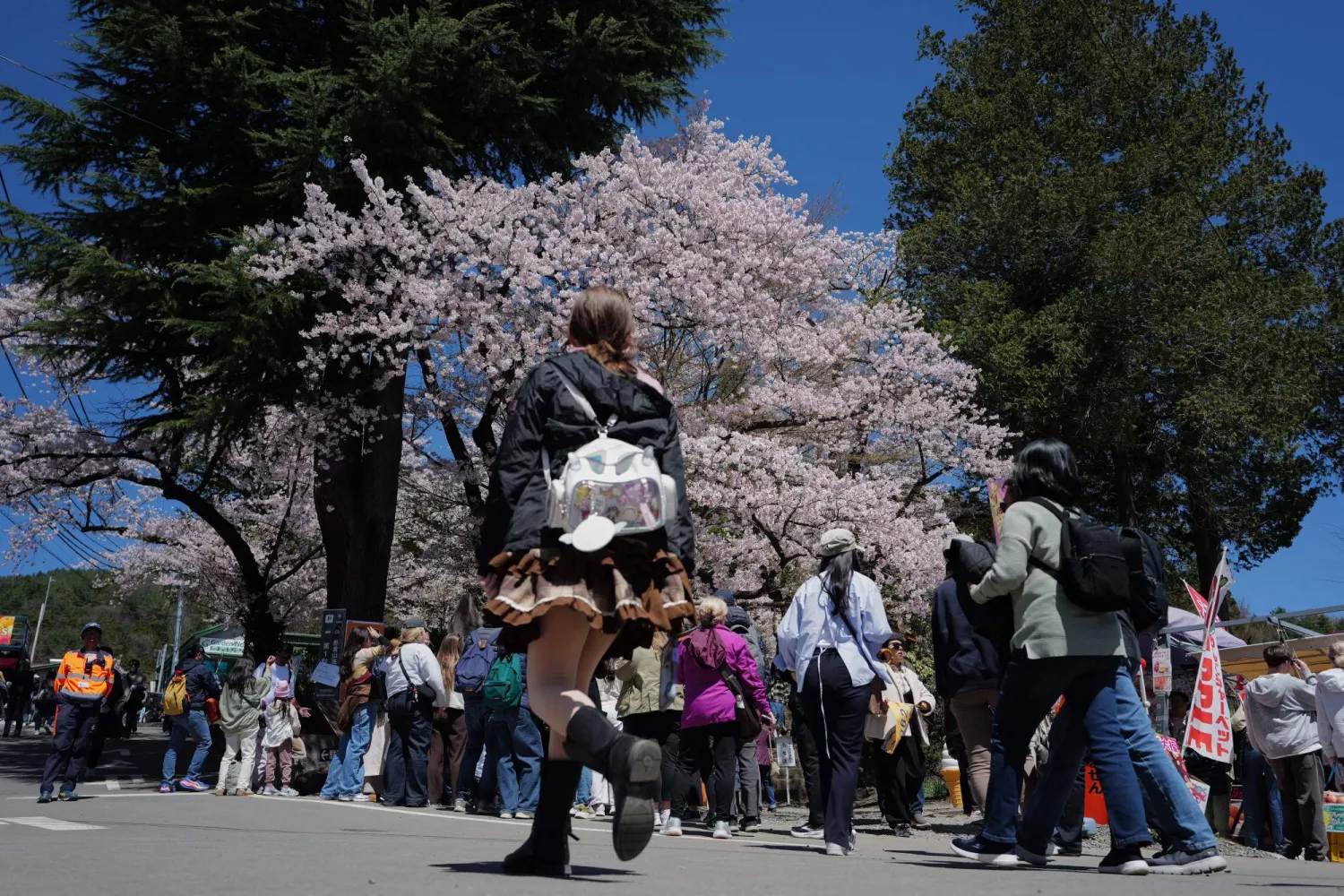

Japanese Town Sours on the Crowds Coming to See Cherry Blossoms and Mount Fuji

Foreign and Japanese visitors arrive at the entrance of Arakurayama Sengen Park Wednesday, April 8, 2026, in Fujiyoshida, Yamanashi Prefecture, west of Tokyo. (AP Photo/Eugene Hoshiko)
TT

Japanese Town Sours on the Crowds Coming to See Cherry Blossoms and Mount Fuji

Foreign and Japanese visitors arrive at the entrance of Arakurayama Sengen Park Wednesday, April 8, 2026, in Fujiyoshida, Yamanashi Prefecture, west of Tokyo. (AP Photo/Eugene Hoshiko)

The trouble started with a beautiful photo.

Social media was soon awash with the lovely view of Japan's snow-capped Mount Fuji looming over a red pagoda and the short-lived cherry blossoms that herald the approach of spring.

Tourists wanting a similar shot soon packed this peaceful town at the foot of the mountain. The complaints were not far behind: chronic traffic jams; piles of litter; ill-mannered foreigners knocking on doors of private homes to borrow toilets; tourists relieving themselves in front yards.

It got so bad officials in Fujiyoshida announced in February that they were canceling this year’s annual cherry blossom festival, which started as a way to promote tourism a decade ago.

What locals are calling “tourism pollution” has illuminated a broader problem for Japan: As the country's economic malaise deepens, officials are eager for the economic boost of increased tourism, even as local communities find themselves entirely unprepared for what a small army of foreign visitors means for their communities.

10,000 tourists a day 'threaten residents' daily lives' “This area is primarily an ordinary residential neighborhood, where balancing (tourism) with the safety of people's living environment has become difficult,” Masatoshi Hada, manager of the Fujiyoshida Economics and Environment Department, told The Associated Press. “We decided not to promote a festival that would invite more visitors.”

Even without the festival, foreign tourists packed the area on a sunny day in early April when cherry blossoms reached their prime. The narrow streets up to the popular Arakurayama Sengen Park were filled as the visitors lined up for a chance film the world-famous panoramic views.

In recent years, foreign tourists have exceeded 10,000 per day in the area, something that has “threatened residents’ daily lives,” the city said in a statement in February.

‘Tourism pollution’ across Japan Overtourism has also been seen in other popular destinations in Japan, like Kyoto and Kamakura. In Kyoto, locals complain of tourists with large suitcases clogging city buses.

“Tourism pollution” comes as Japan confronts a rapidly growing population of foreign workers brought in as the country's population dwindles and ages. The combination has led to xenophobia, and Prime Minister Sanae Takaichi ’s nationalistic government has proposed tougher rules on foreigners.

Even as it promises to address overtourism concerns, the government wants to boost the current level of 40 million inbound tourists to 60 million visitors by 2030.

Locals find the tourism ‘good but annoying’ Beginning April 1, at the start of the region’s cherry blossom season, Fujiyoshida increased its security guards and restricted entry of tour buses and vehicles into the scenic neighborhood, requiring visitors to reach the park on foot.

On a recent day, security guard Hiroaki Nagayama gestured to passersby so they would stay out of busy areas. He asked tourists to throw cigarette butts in designated places and tried to help the lost.

“I’m struggling. I cannot communicate with them in Japanese. Some people buy food at stalls and leave litter behind,” Nagayama says. “I think what’s happening here is a typical example of overtourism.”

Sitting on a bench outside his house just a couple of blocks away, Hitoshi Mori, 93, says having many visitors is “good but annoying.”

“It’s too crowded outside so I can only get groceries once a week and stock up on food,” he says.

Tourists enjoy the view and culture, despite crowds Tourists, meanwhile, seem delighted by the spectacular view, despite many signs popping up that order them to behave better. There are also hours-long lines to get to cherished scenic spots.

“It’s pretty (well) organized. When they let you come in, you have like five minutes to take as many pictures as you can, and it was amazing,” said Lisa Goerdert from Paris.

Vicky Tran, who came from Melbourne, Australia, with her family and friends, said they could not go all the way up to see the pagoda with Mount Fuji and the cherry blossoms, because it was too crowded. Still, she said she enjoyed the view and the neighborhood.

Overtourism dividing residents The overtourism has opened divisions between residents who want quiet and those who have started businesses using their yards to operate toll parking or setting up new shops or food stalls.

In a nearby shopping arcade that once had many closed mom-and-pop shops, business has picked up after another viral social media shot showed Mount Fuji looming over the street.
Throngs of tourists stand in the street to take photos of Mount Fuji, often blocking traffic, with frustrated vehicles honking.

The sudden flood of visitors is a huge change “for people like us who are used to a quiet suburban lifestyle,” says Masami Nakamura, who runs a decades-old school uniform shop with her husband. “I only hope the tourists respect our rules and manners.”

The crowds are a big change even for those who are seeing increased business.

“I once almost hit a tourist who jumped into the street without looking,” said Kyoko Funakubo, a 60-year-old employee at a local hotel and a part-time vendor selling Fuji-themed souvenirs. “This place used to be almost abandoned, with many shuttered shops. But now, with many stores reopened or new shops that have opened, I feel good seeing this area come alive again.”



Boat Carrying Stranded Whale 'Timmy' Reaches Denmark

Aerial photo taken on April 29, 2026 shows the rescued humpback whale in a special barge along the Danish coastline enroute back to the North Sea after it beached on a sandbank near the city of Luebeck, in late March. (Photo by Philip Dulian / dpa / AFP)
TT

Boat Carrying Stranded Whale 'Timmy' Reaches Denmark

Aerial photo taken on April 29, 2026 shows the rescued humpback whale in a special barge along the Danish coastline enroute back to the North Sea after it beached on a sandbank near the city of Luebeck, in late March. (Photo by Philip Dulian / dpa / AFP)

A special barge carrying a humpback whale that was stranded in Germany had entered Danish waters by Wednesday afternoon and is expected to reach the North Sea in two days, local officials said.

The whale, dubbed "Timmy" by German media, was coaxed into the vessel in a last-ditch rescue attempt on Tuesday after a weeks-long struggle for survival on the Baltic Sea coast.

The ship Fortuna B, which is towing the barge, was located between the islands of Langeland and Lolland in southeastern Denmark at around 1400 GMT, according to the VesselFinder website.

"If everything goes well, he'll be in the North Sea in two days. The very worst is already behind him now," Till Backhaus, environment minister for the state of Mecklenburg-Western Pomerania, told the Bild daily.

Speaking to reporters on the island of Poel, where the whale was most recently stranded, Backhaus said the animal was "doing well" and had made sounds during the night, AFP reported.

Backhaus thanked rescuers for their "wonderful" effort in "an exceptional situation that is hardly comparable anywhere in the world in this form".

The whale had been struggling for more than a month around the German coast, getting stuck on sandbanks and then managing to free itself again several times.

At the start of April, officials gave up on trying to rescue the animal, saying they believed it could not be saved.

But this triggered an outcry and authorities were persuaded to approve a privately financed rescue plan proposed by two wealthy entrepreneurs.

The barge idea was hatched after their initial attempt to save the whale with inflatable cushions and pontoons was unsuccessful.

The rescue effort was seen as a long shot and criticized by experts who said it would only cause the animal more distress.

The whale's ordeal has sparked a media frenzy -- with non-stop coverage from TV channels, online outlets and social media influencers -- but has also led to angry spats and conspiracy theories.


Dragon Diplomacy: Indonesia Lends Komodo Lizard Pair to Japan Zoo

A delegation from Japan's iZoo inspects the Komodo dragon enclosure at Surabaya Zoo in Surabaya on April 29, 2026. (Photo by JUNI KRISWANTO / AFP)
TT

Dragon Diplomacy: Indonesia Lends Komodo Lizard Pair to Japan Zoo

A delegation from Japan's iZoo inspects the Komodo dragon enclosure at Surabaya Zoo in Surabaya on April 29, 2026. (Photo by JUNI KRISWANTO / AFP)

Indonesia will lend a breeding pair of endangered Komodo dragons to Japan under an agreement signed Wednesday between zoos from the two countries that emphasized the project's conservation merits.

The five-year renewable deal, criticized by animal rights group PETA, will in turn see Indonesia's Surabaya Zoo receive a pair of red pandas, a pair of giraffes, four Aldabra giant tortoises and two female Japanese macaques from iZoo in Kawazu in Japan's Shizuoka prefecture, officials said.

"This is not just animal exchange. This is a bridge between our two countries, Japan and Indonesia," iZoo director Tsuyoshi Shirawa said at the signing ceremony.

Indonesia's environment ministry said in a statement this month the program's main objective was "long-term conservation".

PETA Asia has expressed concern that any dragon offspring born in Japan will be "condemned to a lifetime of confinement".

"True conservation protects Komodo dragons where they belong -- in their natural habitats -- not by exporting them for political optics or public relations gains," PETA Asia president Jason Baker said in a statement.

The ministry said conservation of the dragons in their natural habitat remained "the main priority".

"Through this cooperation, it is hoped there will be more Japanese people and tourists coming to Indonesia, particularly to the Komodo National Park... to witness Komodos in their natural habitat," Indonesian forestry official Ahmad Munawir said at Wednesday's event, according to AFP.

Under the rules of the CITES pact that governs international trade in endangered species, transfers like this one are allowed for non-commercial breeding programs.

The zoo in Surabaya, Indonesia's second-largest city over 700 kilometers (434 miles) from the dragon's natural habitat, has bred dozens of the dragons in recent years in conditions that mimic their natural home.

In the wild, the world's largest living lizards are found only in the World Heritage-listed Komodo National Park and on neighboring Flores island.

According to the International Union for Protection of Nature, the global population was about 3,458 adult and juvenile Komodo dragons at the last count in 2019.

The fearsome reptiles, which can grow to three meters (10 feet) in length and weigh up to 90 kilograms (200 pounds), are threatened by human activity and climate change destroying their habitat.

In some places, they are losing natural prey to human hunters, and they sometimes die in conflict with humans over livestock.

Some are captured and illicitly traded to zoos or as pets.

There have been legal transfers of Komodos to other zoos in the past, including London and Singapore.

The Indonesian and Japanese governments signed a Memorandum of Understanding last month to make the exchange with Japan possible.


French Teen in Straw Licking Case Allowed to Leave Singapore

French teenager Didier Gaspard Owen Maximilien arrives for an application to leave jurisdiction, for the court's permission to leave Singapore, at the State Courts in Singapore on April 29, 2026. (Photo by Roslan RAHMAN / AFP)
TT

French Teen in Straw Licking Case Allowed to Leave Singapore

French teenager Didier Gaspard Owen Maximilien arrives for an application to leave jurisdiction, for the court's permission to leave Singapore, at the State Courts in Singapore on April 29, 2026. (Photo by Roslan RAHMAN / AFP)

A French teen facing criminal charges in Singapore for a straw licking stunt was granted permission on Wednesday to leave the country for three weeks on pledges to return.

The 18-year-old is accused of posting to social media a video of himself putting the straw he licked back into the dispenser on an orange juice vending machine.

Didier Gaspard Owen Maximilien's clip went viral and triggered a backlash that led to his arrest in Singapore, which has a reputation for not tolerating bad behavior.

The teen's lawyer sought permission from a judge for him to travel to Manila from May 2-25 for an internship, a key requirement for him to graduate, AFP reported.

The judge granted the request after the prosecution posed no objection, but asked that he must remain contactable while overseas and required a SG$5,000 ($3,900) bond.

His next appearance in the Singapore court was also rescheduled from May 22 to May 29.

The teen, who is studying in Singapore and is out on bail, was charged last Friday over the straw stunt.

He uploaded the video on Instagram knowing that it "would or would probably cause annoyance to the public", according to court documents.

The public nuisance offence carries a jail term of up to three months and a fine.

A second charge of committing mischief said Maximilien knew that he was "likely to cause wrongful loss or damage" to iJooz, the company operating the vending machine which had to replace all 500 straws in the dispenser.

The mischief offence carries a punishment of up to two years in jail on conviction and a fine, according to the charge sheet.

Both offences were allegedly committed on March 12.

The Straits Times newspaper said the video "quickly went viral, sparking shock and concern among netizens".