


Trump's Massive July 4 Firework Show Raises Health Alarms

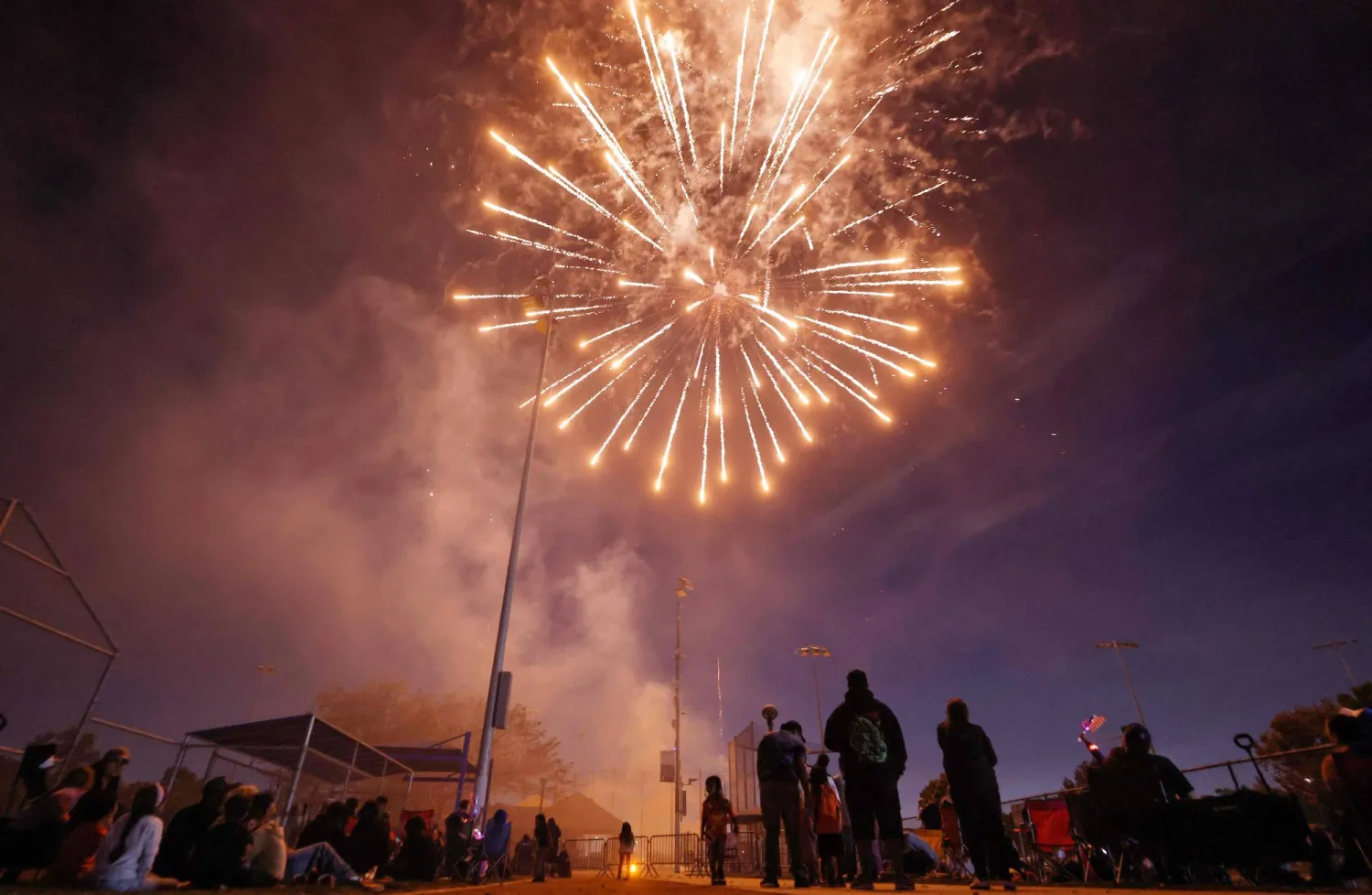
LYNWOOD, CALIFORNIA - JULY 03: People watch fireworks explode during the annual Independence Day Celebration in the predominantly Latino community of Lynwood on July 3, 2026 in Lynwood, California. Mario Tama/Getty Images/AFP
TT

Trump's Massive July 4 Firework Show Raises Health Alarms

LYNWOOD, CALIFORNIA - JULY 03: People watch fireworks explode during the annual Independence Day Celebration in the predominantly Latino community of Lynwood on July 3, 2026 in Lynwood, California. Mario Tama/Getty Images/AFP

An "unforgettable" tribute to America, or a health hazard that will terrorize animals and pollute the environment?

That's the question as Washington prepares to break the record for the world's largest fireworks display on the United States' 250th birthday on Saturday.

The Trump administration's "Freedom250" project has hired Pennsylvania-based Pyrotecnico to launch more than 850,000 fireworks shells across 10 sites around the Lincoln Memorial and Potomac River, starting at 10:30 pm and lasting 40 minutes.

That is around 40,000 more than the current Guinness World Record, set in Bocaue, Philippines in 2016, and roughly 50 times more than Washington's usual annual show.

"Freedom250" has billed it as the "unforgettable" capstone for a day of performances, flyovers and acrobatics displays at the National Mall, claiming it will bring hundreds of thousands of visitors and calling it a generational event.

They haven't however disclosed the bill for the affair and did not respond to a request seeking the sum.

- 'Frightening' numbers -

"Fireworks are a tried-and-true American tradition," Jodi Dague, Pyrotecnico's director of marketing, told AFP. "They bring back childhood memories and allow families to create new ones. It's a reason to gather and celebrate."

Not everyone is convinced.

"First let me say, I like fireworks -- I think they're fun," Russell Dickerson, a professor of atmospheric chemistry at the University of Maryland told AFP, but said the number in question was "frightening."

"In my professional opinion, it's probably ill-advised to try to set off 850,000 fireworks... on a hot, stagnant, already polluted day. I'm not going down to the Mall and I certainly would not bring my grandchildren there."

The biggest concern is fine particulate matter, he explained -- particles 2.5 micrometers or smaller that can penetrate deep into the lungs, enter the bloodstream and even cross the blood-brain barrier.

The EPA's 24-hour standard caps exposure at 35 micrograms per cubic meter. After a fireworks show, "it dissipates substantially in a few hours, but in those few hours, people are going to be exposed to huge amounts," Dickerson said, adding that the smoke could cut visibility to a few hundred yards.

Making matters worse is a heat wave gripping the East Coast, with firework smoke and pollution liable to last longer without rain to clear it, and hot weather itself increasing background levels of pollution as the power grid strains under increased demand for cooling and as vehicles emit more.

"The amount of pollution that we produce is apocalyptic during this one particular day," Glory Dolphin Hammes, CEO of IQAir's North American division, told AFP.

Data compiled by the Swiss-based company from public and private sources showed that hourly PM2.5 in Washington peaked at 11 pm on July Fourth, last year at 133 micrograms per cubic meter. The Air Quality Index peaked at 208, levels more commonly associated with South Asian cities.

Epidemiologically, PM2.5 spikes are linked to a rise in emergency room visits, Hammes said, with longer-term impacts on heart and lung health from chronic exposure. Beyond particulate matter, fireworks contain trace metals that produce their bright colors, and burning fireworks releases harmful volatile organic compounds.

- Sounds of freedom -

Fireworks are also traumatizing for pets, particularly dogs, which tremble and even bolt from their homes in fear.

Adrian Aceves, a physician living in downtown Washington, said he'd be staying in with his five-year-old mutt Rosy, "trying to distract her with treats and toys, and I will medicate her."

Then there's wildlife: a recent European study found Arctic migratory geese flew away from their sleeping sites in response to New Year's Eve fireworks and never returned.

And a 2016 US government study found perchlorate, an oxidizing agent used in fireworks, had made its way into groundwater and surface water around Mount Rushmore National Memorial, which holds annual July 4 shows.

But Erica Walker, an assistant professor of epidemiology at Brown University School of Public Health, said the harms of fireworks need to be weighed against the joy they bring, drawing a distinction between ongoing sources of noise and pollution and those confined to a single day.

"As an American who has ancestors here who descended from slavery, Independence Day for me is incredibly relevant," she said. "I think for me those are the sounds of independence... it's also the sound of freedom, without trying to sound all corny."



‘Once-in-a-Generation’ Expedition Launched to Survey Shipwrecks of Two Polar Heroes

Ship trapped in ice during an expedition to the Antarctic. (Getty Images)
TT

‘Once-in-a-Generation’ Expedition Launched to Survey Shipwrecks of Two Polar Heroes

Ship trapped in ice during an expedition to the Antarctic. (Getty Images)

A “once-in-a-generation” expedition will be launched this month to survey the last ships of legendary polar explorers Sir Ernest Shackleton and Captain Robert Falcon Scott.

The ships Quest and Terra Nova are the last link to Shackleton and Scott, who competed to reach the South Pole in the early 1900s before each died during an expedition, according to The Independent.

Now, The Woods Hole Oceanographic Institution (WHOI) and the Royal Canadian Geographical Society (RCGS) will conduct the first comprehensive visual survey of both Quest and Terra Nova to produce digital twins of the wrecks.

Their expedition on research vessel will map the shipwrecks and debris fields around their hulls using a combination of high-definition 5.2K video cameras and advanced Canadian “Voyis” photogrammetric technology.

Quest is the ship of Irish-born British explorer Shackleton, who died in 1922.

Its wreck was discovered in 2024, sitting on its keel under 390m (1,280ft) of frigid water off the coast of Labrador in Canada, 62 years after it went missing.

Shackleton’s death aboard the ship in 1922 marked the end of what historians call the “heroic age” of Antarctic exploration.

"The discovery of Quest in 2024 was only the beginning," said John Geiger, expedition leader and chief of the RCGS.

Terra Nova, Scott’s final ship, was first discovered by the Schmidt Ocean Institute in 2012.
Scott and his entire party had frozen to death on their return journey.

The vessel had sunk off the coast of Greenland in 1943 and was located using modern echo sounders.


Drones Spot Sharks 73 Times in Two Days off Sydney Beaches

This underwater photograph shows a tiger shark at a depth of 20 meters off Providencia Island, in the Colombian Caribbean Sea, on November 17, 2025. (AFP)
TT

Drones Spot Sharks 73 Times in Two Days off Sydney Beaches

This underwater photograph shows a tiger shark at a depth of 20 meters off Providencia Island, in the Colombian Caribbean Sea, on November 17, 2025. (AFP)

New dawn-to-dusk drone patrols of Sydney's beaches spotted sharks 73 times in the first two days, forcing multiple closures, data obtained by AFP showed on Friday.

Authorities launched the expanded drone program on Wednesday to protect beachgoers after a spate of shark attacks in Sydney and further across New South Wales.

Data from Surf Life Saving NSW, which runs the program, showed 73 shark sightings in greater Sydney by drone pilots on Wednesday and Thursday, with the greatest concentration at beaches north of the city, where 67 reports were made.

The drones only report bull, tiger and white sharks, species considered most likely to attack humans.

Lifesavers say it is likely some sharks are being spotted multiple times as they move through the ocean. But one group of 13 sharks swimming together was reported at a single beach at northern Sydney's South Narrabeen on Wednesday.

"Having so many drones out all day, they are picking up everything," said Surf Life Saving New South Wales spokeswoman Donna Wishart.

- 'Scared and paranoid' -

At northern Sydney's Dee Why Salty Surf School, owner Dan O'Connell was 15 minutes into a surf lesson on Friday when a drone spotted a shark near the beach and lifesavers evacuated the water for the second time that day.

O'Connell had just succeeded in coaxing his students into the ocean by telling them a shark was unlikely to venture near the knee-high water where they were practicing board moves.

"They were already scared and paranoid because the beach had been closed," he told AFP.

Drones made three shark sightings on Thursday at Dee Why Beach, with another sighting on Friday morning closing the beach for an hour before it reopened, only to close again.

Expecting beach closures will increase, O'Connell is diversifying his business to offer skateboarding lessons at the nearby carpark.

- 'Fairweather surfers' -

School groups had cancelled surf lessons after a child was killed by a shark in Sydney Harbour in January, and a woman was mauled at popular Coogee Beach last month.

"It has been really hard," he said.

"We will lose a percentage of fairweather surfers because they will feel paranoia more than the enjoyment they get from the ocean."

Northern Beaches Mayor Sue Heins told AFP millions of visitors are attracted to Sydney's coast each year, and the drones support safety.

"Naturally, increased surveillance will mean increased sightings," she said.

A surfer was killed by a shark on a northern Sydney beach in September.

New South Wales Premier Chris Minns said on Sunday that swimmers and surfers "will have to get used to" leaving the water as the world's biggest drone surveillance program ramps up.

"It is almost certain that sharks have always been present," said shark expert Daryl McPhee, an associate professor of environmental science at Bond University, who expects the high number of beach closures to continue for several weeks.

White sharks roam large distances but may "take up residence" where prey is abundant, he said, noting an increase in humpback whale populations and salmon.

"The sightings over the last couple of days have increased due to the increased drone spotting effort which is occurring at a time when conditions are right for coastal food resources of white sharks to be abundant."

There have been nearly 1,300 shark incidents around Australia since 1791, of which more than 260 resulted in death, according to a database of shark encounters with humans.


France Deaths Rose by 30% During Heatwave

This photograph shows a fire in mountain ranges during a wildfire in Pouzols-Minervois, southwestern France on July 2, 2026. (AFP)
TT

France Deaths Rose by 30% During Heatwave

This photograph shows a fire in mountain ranges during a wildfire in Pouzols-Minervois, southwestern France on July 2, 2026. (AFP)

France endured a rise of nearly 30 percent in the number of deaths recorded during the week of June 22, the peak of a record-breaking heatwave that battered the country, the public health authority said Friday.

Public Health France said in a new report there had been "an increase of 29.1 percent, corresponding to 2,025 additional deaths compared with the previous week" while noting that the figure was probably "an underestimate".

The number of deaths increased by 62 percent in the Paris region during the week starting 22 June, the report said. A similar spike has been reported in the Pays de la Loire region.

Some French politicians have denounced what they call the authorities' inadequate measures to help France face rising temperatures. The Greens on Thursday filed a no-confidence motion against the government of Sebastien Lecornu.

In June, France experienced a record-breaking heatwave which lasted around 11 days and saw temperatures climb above 40C in many places.

Around 15,000 people died in France during a severe heatwave in 2003, with many elderly people dying in nursing homes.

The June heatwave is considered more intense, but authorities say its consequences have been less severe.

"It will probably not be comparable," Health Minister Stephanie Rist said on Friday.

Nicolas Revel, director general of the Paris public hospital system, has said he expected the death toll from the June heatwave to be lower than that of 2003, but "probably" higher than an episode last year that claimed 5,700 lives.