New Mural Recreates Famous Japanese Wave Painting

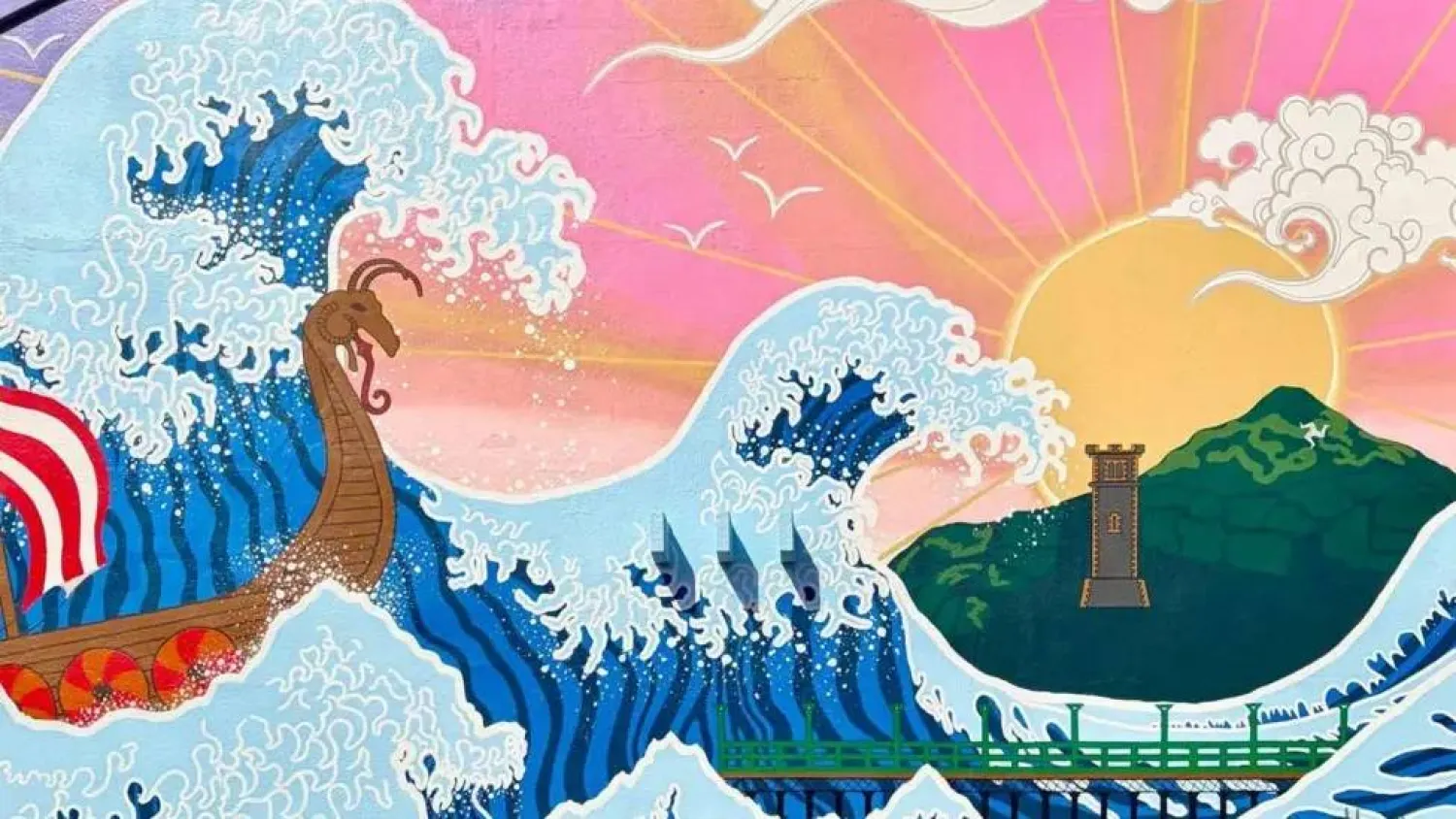
The artist said he wanted to reinterpret the world-famous artwork through a distinctly Manx setting (The artist's Facebook page)
TT

New Mural Recreates Famous Japanese Wave Painting

The artist said he wanted to reinterpret the world-famous artwork through a distinctly Manx setting (The artist's Facebook page)

Manx artist David Britton has unveiled what is believed to be the Isle of Man's largest mural - inspired by a famous Japanese artwork, the BBC reported.

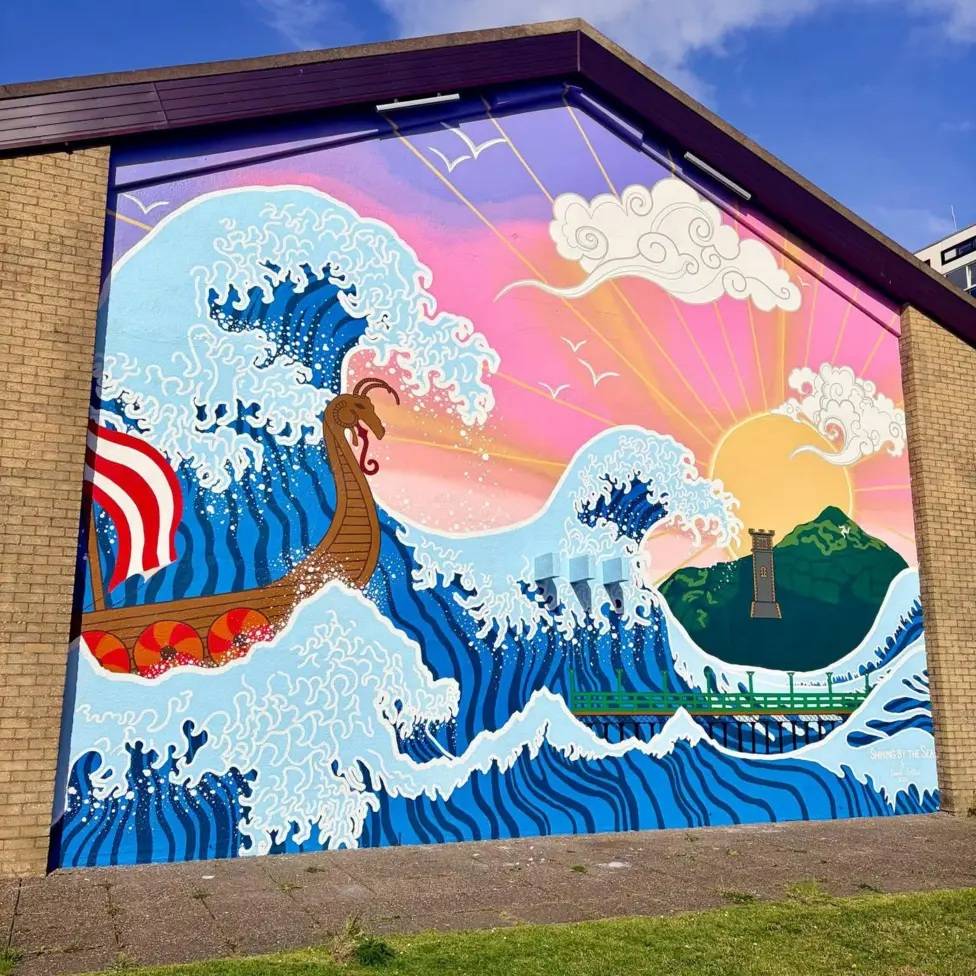
The mural, entitled Shining by The Sea, has been painted on the rear of Ramsey's bowling alley near St Paul's Square.

Inspired by the instantly-recognizable Great Wave off Kanagawa, it was commissioned by Ramsey Town Commissioners as part of efforts to brighten up the town and support local artists.

The mural re-imagines Katsushika Hokusai's work by placing its familiar wave image in Ramsey Bay with a Viking longboat riding the swell, as the sun rises behind familiar Manx landmarks.

For Britton, the project marked the largest mural he has undertaken, the BBC reported.

He said he wanted to take the dramatic Japanese work and create "a more hopeful scene", using brighter colors and depicting the Viking boat riding above the waves rather than being overwhelmed by them.


Another view of the artwork at the rear of the town's bowling alley (The artist's Facebook page)

Britton said working on the mural had given him the opportunity to meet residents and visitors who regularly stopped to watch its progress and discuss the artwork.

He also thanked his sister, Rachael Britton, along with fellow artists Andrew Kaighen and Loki Stonehouse for helping complete the project.

Funding for the mural came from the Department for Enterprise's Local Economy Fund.

The Commissioners said the mural formed part of a wider program of public art across Ramsey and hoped it would add to the town's appeal.


Prince Harry to Visit London without Wife, Children

FILE PHOTO: Britain's Prince Harry and Meghan, the Duke and Duchess of Sussex, arrive at Rushcutters Bay following a sail on Sydney Harbour with veterans from the Invictus Australia community, in Sydney, Australia, April 17, 2026. REUTERS/Hollie Adams/File Photo
TT

Prince Harry to Visit London without Wife, Children

FILE PHOTO: Britain's Prince Harry and Meghan, the Duke and Duchess of Sussex, arrive at Rushcutters Bay following a sail on Sydney Harbour with veterans from the Invictus Australia community, in Sydney, Australia, April 17, 2026. REUTERS/Hollie Adams/File Photo

Prince Harry will stay in London without his wife Meghan and their two children while visiting the UK in July, a source close to him told AFP Saturday.

The prince had previously been expected to make his first family trip back to the UK in four years, but the source close to the Duke of Sussex said his wife, son Archie and daughter Lilibet would not accompany him on the London part of the trip, with the rest of the trip still under consideration.

According to Reuters, Harry has repeatedly expressed a desire to bring his children to Britain, which they have not visited ⁠for several years, but has said concerns about security ‌have complicated those plans.

"The Duke continues ‌to explore every available option to enable the ​visit to proceed safely and ‌to give his children the opportunity to enjoy the UK," his spokesperson ‌said earlier this week.

The prince has long argued that security concerns put his family at risk when visiting Britain.

Last year he lost a legal challenge against a government decision to remove the automatic police protection afforded to him after ‌he stepped down from royal duties in 2020 and moved to the United States with Meghan.

The planned ⁠visit had raised ⁠the prospect of a rare meeting between Archie and Lilibet and their grandfather, King Charles, who has seen little of the children in recent years as relations between Harry and the royal family remain strained.

Harry said in a BBC interview last year that he wanted a reconciliation with his family after years of public disputes, including criticism of royal life in television interviews and in his memoir, "Spare".

His trip next week also coincides with a closely watched court ruling in his privacy claim against Associated Newspapers, publisher of the Daily Mail.


New Species of Ghost Shark May Have Been Found in Costa Rica

This image shows a partial view of the newly discovered Costa Rican ghost shark (Rhinochimaera costaricana) at the Museum of Zoology of the University of Costa Rica's Center for Research in Biodiversity and Tropical Ecology in San Jose, Costa Rica, on July 3, 2026. (Photo by Ezequiel BECERRA / AFP)
TT

New Species of Ghost Shark May Have Been Found in Costa Rica

This image shows a partial view of the newly discovered Costa Rican ghost shark (Rhinochimaera costaricana) at the Museum of Zoology of the University of Costa Rica's Center for Research in Biodiversity and Tropical Ecology in San Jose, Costa Rica, on July 3, 2026. (Photo by Ezequiel BECERRA / AFP)

Costa Rican scientists may have discovered a new species of ghost shark in Pacific waters near Cabo Blanco and Cano Island.

The latest discovery has a "shorter" snout, a "darker coloration pattern" and a "much longer spine on its dorsal fin," according to Arturo Angulo Sibaja, a biology professor at the University of Costa Rica.

The discovery marks the only such species "known for the Central American coast," Sibaja said, adding genetic analysis indicates the new species has "no reproductive contact" with other ghost sharks.

But earlier specimens collected "near Peru and Chile are very similar to the species" from Costa Rica, so scientists are still comparing the specimens before finalizing the conclusion, AFP quoted him as saying.

Three species of ghost shark -- a type of fish that is related to sharks -- have been discovered elsewhere, in waters off South Africa, Taiwan, Australia, Japan and in the Atlantic between Greenland and Brazil.

Ghost sharks belong to a group of cartilaginous fish called Rinochimaera that is related to sharks but genetically diverged from them nearly 400 million years ago.

Sibaja said it's "most likely" the new species "has broader distribution along the (Pacific) coast of Central and South America."


Australia Welcomes Draft UNESCO Decision to Keep Great Barrier Reef Off Danger List

(FILES) In this underwater photo taken on April 5, 2024, marine biologist Anne Hoggett snorkels to inspect and record bleached and dead coral around Lizard Island on the Great Barrier Reef, located 270 kilometres (167 miles) north of the city of Cairns. (Photo by DAVID GRAY / AFP)
TT

Australia Welcomes Draft UNESCO Decision to Keep Great Barrier Reef Off Danger List

(FILES) In this underwater photo taken on April 5, 2024, marine biologist Anne Hoggett snorkels to inspect and record bleached and dead coral around Lizard Island on the Great Barrier Reef, located 270 kilometres (167 miles) north of the city of Cairns. (Photo by DAVID GRAY / AFP)

Australia welcomed a draft UNESCO decision not to list the Great Barrier Reef as an endangered site, its assistant tourism minister said on Saturday, despite ongoing struggles of the world's biggest coral reef ecosystem with coral bleaching.

The reef, which has suffered several mass coral bleaching events in recent years, is not currently on the United Nations Educational, Scientific and Cultural Organization (UNESCO) list of world heritage sites that are in danger, although UN scientists have previously ⁠recommended that it ⁠should be added.

Australia's government has lobbied for years to keep the reef - which contributes more than A$9.0 billion ($6.25 billion) to the economy annually - off the list, as it could damage tourism at the site, which receives more than ⁠2 million visitors each year.

Assistant Tourism Minister Nita Green said the decision overnight by the UNESCO World Heritage Centre "recognizes Australia's continued efforts to protect and manage this important icon,” Reuters reported.

"Australia welcomes UNESCO's decision to not list the reef as endangered, and recognize all of the work that's been going into protecting the reef," Green said in televised remarks from the capital Canberra.

The reef, home to 400 ⁠types ⁠of coral and 1,500 species of fish, stretches for some 2,400 km (1,500 miles) off the coast of the northern state of Queensland.

Since 2016, it has experienced five summers of mass coral bleaching, when large sections of the reef turn white due to heat stress, putting them at greater risk of death. Climate change is a primary driver of rising sea temperatures which cause coral bleaching, according to the Queensland government.