


In Message to Russia, G7 Unveils Long-Term Security Pledge for Ukraine

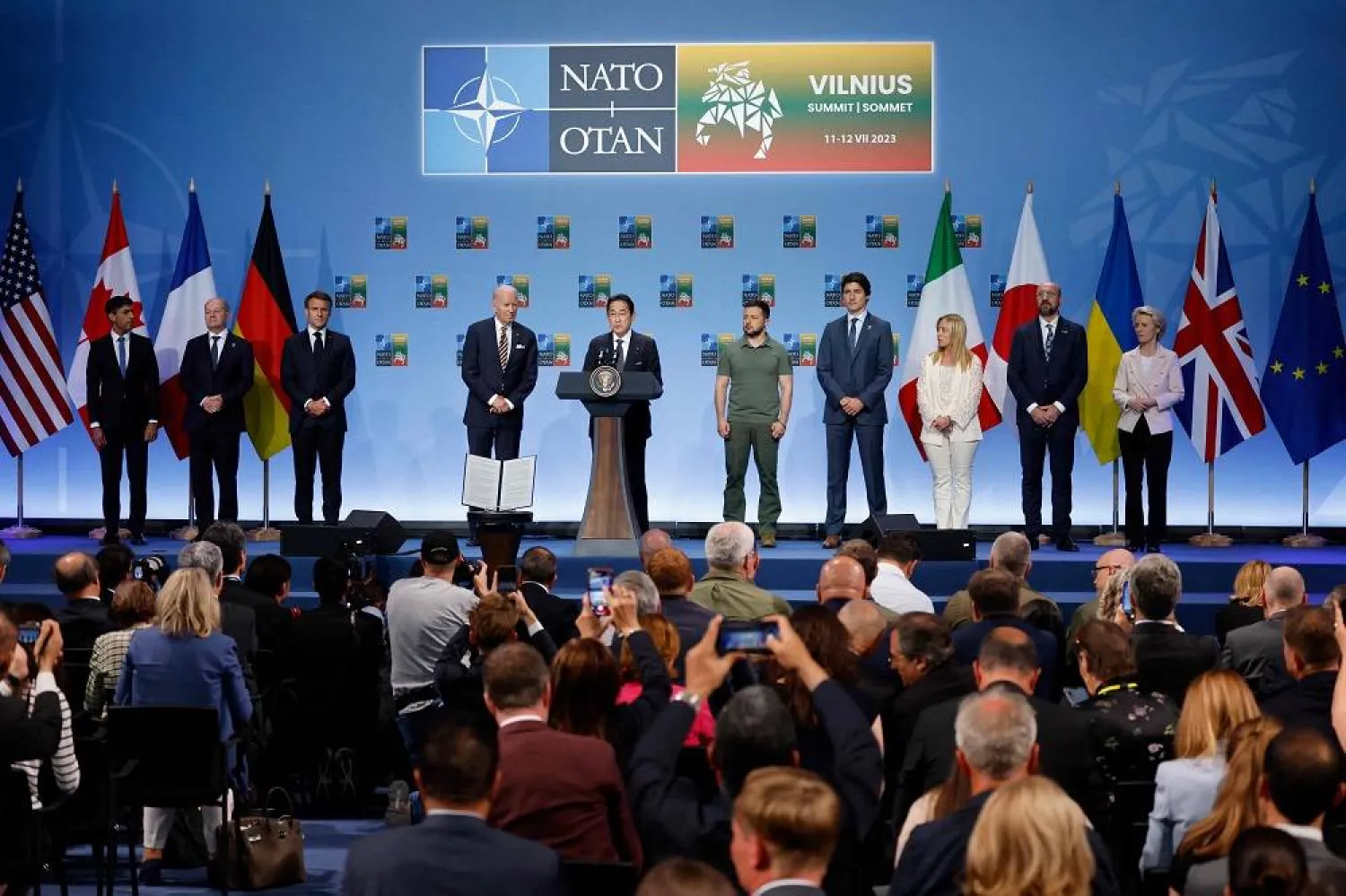
(L to R) Britain's Prime Minister Rishi Sunak, Germany's Chancellor Olaf Scholz, France's President Emmanuel Macron, US President Joe Biden, Japan's Prime Minster Fumio Kishida, Ukraine's President Volodymyr Zelenskiy, Canada's Prime Minister Justin Trudeau, Italy's Prime Minister Giorgia Meloni, European Council President Charles Michel and President of the European Commission Ursula von der Leyen attend an event to announce a Joint Declaration of Support for Ukraine during the NATO summit, in Vilnius on July 12, 2023. (AFP)
TT

In Message to Russia, G7 Unveils Long-Term Security Pledge for Ukraine

(L to R) Britain's Prime Minister Rishi Sunak, Germany's Chancellor Olaf Scholz, France's President Emmanuel Macron, US President Joe Biden, Japan's Prime Minster Fumio Kishida, Ukraine's President Volodymyr Zelenskiy, Canada's Prime Minister Justin Trudeau, Italy's Prime Minister Giorgia Meloni, European Council President Charles Michel and President of the European Commission Ursula von der Leyen attend an event to announce a Joint Declaration of Support for Ukraine during the NATO summit, in Vilnius on July 12, 2023. (AFP)

G7 countries on Wednesday unveiled an international framework for the long-term security of Ukraine to boost its defenses against Russia and deter Moscow from future aggression, officials said.

Ukrainian President Volodymyr Zelenskiy was meeting leaders of NATO at a summit of the 31-member Western alliance, a day after they declared that Ukraine's future lay inside NATO but rebuffed his call for a timeline for membership.

Unable to join NATO while the war with Russia continues - given that NATO's Article 5, stipulating that an attack on one member is an attack on all, could push it into war with Russia - Ukraine nevertheless reaped rewards in the form of current and long-term security commitments it has lobbied for.

NATO has pointedly refrained from giving military assistance to Ukraine as an organization, to avoid entering a direct conflict with Russia, and is keen to continue leaving that to member states and others.

Britain, France, Germany and the United States have been negotiating with Kyiv for weeks over a multilateral text to create a broad international framework, encompassing elements including advanced military equipment, such as fighter jets, as well as training, intelligence-sharing and cyberdefense.

The Group of Seven major industrialized countries said in a statement: "Today we are launching negotiations with Ukraine to formalize - through bilateral security commitments and arrangements aligned with this multilateral framework, in accordance with our respective legal and constitutional requirements - our enduring support to Ukraine as it defends its sovereignty and territorial integrity."

US President Joe Biden said at the signing ceremony for the plan that it was "a powerful statement of our commitment to Ukraine".

Zelenskiy said: "Today there are security guarantees for Ukraine on the way to NATO...that shall be further extended through arrangements with our key partners.

"(Our) delegation is bringing home significant a security victory for Ukraine," he added.

Kremlin spokesman Dmitry Peskov called the G7 move misguided and "potentially very dangerous" for the West to give Ukraine security guarantees, which it said would infringe on Russia's own security.

Moscow has cited NATO's eastern enlargement towards its borders as a factor in its decision last year to invade Western-leaning Ukraine, which was once part of the old Russian-dominated Soviet Union.

The G7, which comprises the United States, Germany, Japan, France, Canada, Italy and Britain, as well as the European Union, said other countries could also sign on to make their own commitments.

The declaration said the G7 nations would begin bilateral talks with Ukraine immediately.

"The new document should be valid for as long as Ukraine is not in NATO," Zelenskiy told a separate news conference. "Today's declaration opens that possibility with strong bilateral agreements," he went on, adding that the best guarantee was still to be in the alliance itself.

‘Time not on Russian side’

In return, the G7 statement said, Ukraine would promise measures to improve governance, including through judicial and economic reforms and enhanced transparency.

"We will work with Ukraine on an enhanced package of security commitments and arrangements in case of future aggression to enable Ukraine to defend its territory and sovereignty," the G7 said.

"This multilateral declaration will send a significant signal to Russia that time is not on its side," a White House official told reporters.

A US official said Washington would begin its own negotiations with Kyiv soon. President Joe Biden has spoken about using US support for Israel as a possible model.

US military aid for Israel is worth about $3.5 billion a year, but the relationship also entails a great deal of political support.

Germany has already said that it would initially provide 12 billion euros in military support for Ukraine through 2032, including 3.2 billion euros for 2023.

France, which said on Tuesday it would supply long-range cruise missiles to Kyiv for the first time, is also negotiating with Ukraine, but will possibly face tough discussions in parliament as it debates its military budget from 2025 to 2030.

Speaking to reporters, British Defense Secretary Ben Wallace said his country and others envisaged sending personnel to Ukraine after the war to keep training its armed forces.



Netanyahu Warns Iran May Try to Disrupt Election, Says ‘Don’t Test Us’

Rappelling workers hang a large-scale Likud Party election billboard reading "We have one chance to win!" and featuring Israeli Prime Minister Benjamin Netanyahu (L) with US President Donald Trump and fighter jets, in Tel Aviv, Israel, 25 October 2026. (EPA)
TT

Netanyahu Warns Iran May Try to Disrupt Election, Says ‘Don’t Test Us’

Rappelling workers hang a large-scale Likud Party election billboard reading "We have one chance to win!" and featuring Israeli Prime Minister Benjamin Netanyahu (L) with US President Donald Trump and fighter jets, in Tel Aviv, Israel, 25 October 2026. (EPA)

Prime Minister Benjamin Netanyahu said that Iran and its allies might try to disrupt Tuesday's Israeli elections, warning the Islamic republic against any hostile acts.

The premier has campaigned heavily on his security credentials, touting the war he launched against Iran in February alongside the United States and suggesting that he alone can see it through.

"We have intelligence signs that our enemies, Iran and its proxies, could challenge us with attacks in order to disrupt the elections," Netanyahu said in a video released by his office on Sunday.

"Don't test us. You will suffer disproportionate blows," he added, noting the military was ready for both defensive and offensive operations.

Earlier in the day, the premier posted an AI-generated image of a mushroom cloud engulfing Tel Aviv, alongside text attributed to a right-wing political commentator calling Iran an existential threat and arguing that all the other issues discussed this election season were trivial in comparison.

Netanyahu, Israel's longest-serving prime minister, has focused heavily on hawkish national security statements in the final days of the campaign.

On Wednesday, he said he had sent a directive to Israel's security forces to topple Iran's clerical state. A day earlier, he posted a video of himself in front of a fighter jet speaking to US President Donald Trump by phone saying they would "finish the job" together.


Police Made 1,314 Arrests in France’s Protests, Says Govt

A pedestrian walks past a broken window, a day after a demonstration in favor of purchasing power, the protection of public services, and fiscal and social justice, in Paris on October 25, 2026 as part of a nationwide call for mobilization bringing together former members of the Yellow Vest movement, labor unions, high school and university students. (AFP)
TT

Police Made 1,314 Arrests in France’s Protests, Says Govt

A pedestrian walks past a broken window, a day after a demonstration in favor of purchasing power, the protection of public services, and fiscal and social justice, in Paris on October 25, 2026 as part of a nationwide call for mobilization bringing together former members of the Yellow Vest movement, labor unions, high school and university students. (AFP)

Police arrested 1,314 people in weekend protests across France, the interior ministry said Sunday, adding that 53 officers were hurt in clashes.

The arrests occurred as violence broke out on the margins of mass demonstrations in major cities on Saturday over the high cost of living.

It was the second consecutive weekend of unrest in France, which is heading to presidential elections in April and May to choose a successor to Emmanuel Macron, who is reaching his two-term limit.

The interior ministry said police responded to 75 fires during Saturday's protests, adding that 24 shops were looted.

"Several investigations have been opened," it said in a statement, without giving details. It said that the rest of Saturday night, after the clashes had died down, was "calm".

The ministry statement on Sunday did not say how many protesters were hurt.

Late Saturday, Interior Minister Laurent Nunez spoke of two serious injuries among protesters: one in Toulouse and one in Clermont-Ferrand.

- Protesters hurt -

The Toulouse prefecture, which reports to the interior ministry, told AFP that a 20-year-old man was seriously hurt with a wound to his hand.

A street medic who tended demonstrators told AFP, on condition of anonymity, that the man had "several fingers" blown off his right hand.

The prefecture covering Clermont-Ferrand said a man there also had a hand hurt, but did not suffer the loss of any fingers.

A French regional daily, La Nouvelle Republique, reported that a man in Poitiers was hurt in his left eye, showing a photo of a man holding his face.

The newspaper's photographer told AFP he was a 19-year-old who was wounded during a charge by riot police firing stun grenades and tear gas.

There have been several instances in recent weeks, during student protests in France, of people being maimed by police stun grenades or tear gas grenades.

It was not known if the injuries reported from Saturday were from those police weapons. Officials said investigations had been opened in at least some of the cases.


Far-right Leader Le Pen Kicks Off Tilt at French Presidency amid Nationwide Protests

26 September 2026, France, Paris: Jordan Bardella and Marine Le Pen arrive at Place de la Concorde ahead of Pope Leo XIV's Mass in Paris. Photo: Pierre Teyssot / Agf/AGF via ZUMA Press/dpa
TT

Far-right Leader Le Pen Kicks Off Tilt at French Presidency amid Nationwide Protests

26 September 2026, France, Paris: Jordan Bardella and Marine Le Pen arrive at Place de la Concorde ahead of Pope Leo XIV's Mass in Paris. Photo: Pierre Teyssot / Agf/AGF via ZUMA Press/dpa

Marine Le Pen, France's far-right candidate to succeed President Emmanuel Macron in elections in six months, was to give her first campaign speech on Sunday, a day after protests sweeping the country again flared into violence.

Le Pen -- the frontrunner according to surveys -- is seen benefiting from the convulsions France has been going through for weeks, punctuated by mass rallies and violent clashes on Saturday and a week earlier, said AFP.

More than 400,000 people marched in major French cities on Saturday to protest the rising cost of living, with groups of masked youths breaking away to provoke police, who responded with tear gas and water cannon. Police made more than 1,000 arrests.

Officers faced "an extremely elevated level of violence" from black-clad "ultra-left" extremists who had trailed in the demonstrations, Interior Minister Laurent Nunez said late Saturday.

A week earlier, on October 17, similar nationwide marches took place, also against rising inflation sent surging by the war in the Middle East. They, too, degenerated into street violence, with public buildings vandalized and hundreds of shops looted.

The mass rallies were fed by four weeks of student protests across France, over classroom conditions and access to university places, which at times also descended into clashes.

Unions and Yellow Vest protesters have vowed to keep up their street marches in the weeks ahead, pointing to a febrile period as the elections draw near.

- Anger at Macron -

Le Pen, who will address 10,000 members of her National Rally (RN) party in the city of Orleans, has accused Macron's centrist government of being soft on violent protesters and lacking authority.

Police were on Sunday filtering traffic going into Orleans, after thousands of counter-protesters opposed to Le Pen and her anti-immigration, nationalist RN marched in the city on Saturday chanting anti-fascist slogans.

Police put their numbers at 13,000, while organizers estimated the turnout at twice that.

If Le Pen wins the two-stage presidential elections in April and May, she has vowed to cut the cost of living through capped household energy bills, reduced taxes and trimming France's contribution to the European Union.

She is also critical of NATO, and of France's support of Ukraine as it battles Russia's invasion.

The RN, which portrays itself as a party of law and order, has also sided strongly with the police in the current unrest.

The head of Le Pen's party, Jordan Bardella, whom she intends to make prime minister if she becomes president, has visited police stations to underline that credential.

French voters, angry over Macron's perceived detachment over his two terms and his recent orders to curb the protests, are turning to more extremist politics, polling shows.

An Ipsos survey published Saturday suggested Le Pen would score 32 to 34 percent of the vote in the first round of the election, with a far-left rival, Jean-Luc Melenchon, getting 17 percent. Centrist candidates from mainstream parties trailed them.

Asked about the protest violence, a majority of the 1,500 people questioned in the survey -- 58 percent -- said they felt anger.

It found 81 percent believed the government was "responsible for this situation", while 79 percent thought radical political groups were, 62 percent blamed the left, and 52 percent blamed the police.

- No money -

Whoever wins the presidency will find limited room to throw money around to placate various clamoring interest groups.

France's public debt and budget deficit have climbed well beyond the ceilings EU member countries are meant to stick to.

Macron's government is trying to get a cost-cutting budget adopted, but faces headwinds from both the sustained protests demanding more spending and the political jockeying by parties eyeing power.

As Macron sees out the final months of his presidency, he has to tread a line between cracking down on street violence and opening dialogue with unions, students and other groups to attempt to restore order.

Although the French president has not invoked a state of emergency, he has ordered bans on non-union demonstrations deemed "illegitimate", and officials under him have imposed bans on protests in city centers and localized curfews in certain zones.

Many protesters on Saturday raged against the measures, describing them as an assault on the French right to protest.

The Yellow Vest movement, which challenged Macron eight years ago with street disruptions, has called for another day of protests next Saturday.

And the powerful CGT union, prominent in the demonstrations, is urging a campaign of strikes starting from November 5.