


Netanyahu Leaves Hospital as Israel Faces a Key Vote — And a Crisis — Over Divisive Legal Changes 

An aerial view shows right-wing demonstrators backing the Israeli government and its reform plans rallying in Tel Aviv, the epicenter of 29 straight weeks of anti-government protests, on July 23, 2023. (AFP)
TT

Netanyahu Leaves Hospital as Israel Faces a Key Vote — And a Crisis — Over Divisive Legal Changes 

An aerial view shows right-wing demonstrators backing the Israeli government and its reform plans rallying in Tel Aviv, the epicenter of 29 straight weeks of anti-government protests, on July 23, 2023. (AFP)

Israeli Prime Minister Benjamin Netanyahu was released from the hospital Monday after an emergency heart procedure, facing an unprecedented national crisis ahead of parliament’s vote on the first major piece of legislation to remake the country’s justice system.

Demonstrators, many of whom feel the very foundations of their country are being eroded by the government's plan, stepped up their opposition, blocking a road leading up to parliament. Businesses shuttered their doors in protest of the vote.

Driven by a governing coalition made up of ultranationalist and ultra-religious parties, the judicial overhaul has divided Israel, testing the delicate social ties that bind the country, rattling the cohesion of its powerful military and repeatedly drawing concern from even its closest ally, the United States.

Efforts to find a last-ditch compromise were underway, with Israel's President Isaac Herzog shuttling between the sides, including a meeting at the hospital where Netanyahu was treated, to find an agreement over the way forward. But it was unclear whether those would result in a compromise ahead of the vote, expected Monday afternoon.

Early Monday, protesters banging on drums and blowing horns blocked a road leading to the Knesset, and police used water cannons to push them back. The protest movement said one of its leaders was arrested.

“The state of Israel stands before destruction and ruin that is being brought upon it by a gang of extremists and kooks. We must go up to Jerusalem today!” one branch of the protest movement called out to demonstrators on social media.

Israeli media reported that a consortium of businesses announced late Sunday that some of their members wouldn't open on Monday in protest at the government's plans, leading to big mall chains and some gas stations sealing their doors.

The dramatic events were being watched closely in Washington, from where the Biden administration has frequently spoken out against Netanyahu's government and its overhaul plan. In a statement to the news site Axios late Sunday, Biden warned against pushing ahead with the legal changes that were sparking so much division.

“Given the range of threats and challenges confronting Israel right now, it doesn’t make sense for Israeli leaders to rush this — the focus should be on pulling people together and finding consensus,” he told the site.

Netanyahu’s sudden hospitalization for the implant of a pacemaker added another dizzying twist to an already dramatic series of events that have bitterly divided his country and are certain to shape Israel's future.

Netanyahu's doctors said Sunday the procedure had gone smoothly. In a short video statement from the hospital late Sunday, Netanyahu, 73, said he felt fine and thanked his doctors for his treatment and the public for wishing him well.

Wearing a white dress shirt and dark blazer, Netanyahu said he was pursuing a compromise with his opponents while also preparing for a vote on Monday that would enshrine a key piece of the legislation into law.

“I want you to know that tomorrow morning I’m joining my colleagues at the Knesset,” he said.

The overhaul calls for sweeping changes aimed at curbing the powers of the judiciary, from limiting the Supreme Court’s ability to challenge parliamentary decisions to changing the way judges are selected.

Netanyahu and his far-right allies, a collection of ultranationalist and ultra-Orthodox parties, say the changes are needed to curb the powers of unelected judges. Their opponents, coming largely from Israel's professional middle class, say the plan will destroy the country’s fragile system of checks and balances and push Israel toward authoritarian rule.

The plan has triggered seven months of mass protests, drawn harsh criticism from business and medical leaders, and a fast-rising number of military reservists in key units have said they will stop reporting for duty if the plan passes, raising concern that Israel’s security could be threatened.

President Herzog, who returned Sunday from a trip to the White House, immediately rushed to Netanyahu's hospital room.

“This is a time of emergency,” Herzog said. “We have to reach an agreement.”

Herzog held meetings later Sunday with Israel's opposition leader, Yair Lapid, and Benny Gantz, head of National Unity, another opposition party.

As they spoke, tens of thousands of people gathered for mass rallies for and against the plan. Netanyahu's supporters thronged central Tel Aviv — normally the setting for anti-government protests — while his opponents marched on Israel's Knesset, or parliament.

Many of the protesters in Jerusalem had camped out in a nearby park, after completing a four-day march into the city from Tel Aviv on Saturday.

Further ratcheting up the pressure on the Israeli leader, thousands of military reservists have been declaring their refusal to serve under a government taking steps that they see as setting the country on a path to dictatorship. Those moves have prompted fears that the military’s preparedness could be compromised.

“These are dangerous cracks,” military chief Lt. Gen. Herzi Halevi wrote in a letter to soldiers Sunday meant to address the tensions. “If we will not be a strong and cohesive military, if the best do not serve in the IDF, we will no longer be able to exist as a country in the region.”

Despite the attempts to project business as usual, Netanyahu's schedule was disrupted by his hospitalization. His weekly Cabinet meeting scheduled for Sunday morning was postponed. Two upcoming overseas trips, to Cyprus and Türkiye, were being rescheduled, his office said.

In Monday's vote, legislators are to decide on an overhaul measure that would prevent judges from striking down government decisions on the basis that they are “unreasonable.”

Proponents say the current “reasonability” standard gives judges excessive powers over decision-making by elected officials. Critics say removing it would allow the government to pass arbitrary decisions, make improper appointments or firings and open the door to corruption.

Protesters, who come from a wide swath of Israeli society, see the overhaul as a power grab fueled by personal and political grievances of Netanyahu — who is on trial for corruption charges — and his partners who want to deepen Israel’s control of the occupied West Bank and perpetuate controversial draft exemptions for ultra-Orthodox men.

Netanyahu was rushed to the hospital in the middle of the night a week after being hospitalized for what doctors said was dehydration.

The sudden hospitalization for the pacemaker procedure indicated that Netanyahu's health issues were more serious than what he initially said.

Netanyahu and his far-right allies announced the overhaul plan in January, days after taking office.

Netanyahu paused the overhaul in March after intense pressure by protesters and labor strikes that halted outgoing flights and shut down parts of the economy. After talks to find a compromise failed last month, he said his government was pressing on with the overhaul.



Local Government: Thirty Dead in South Ethiopia Floods

Kenyan business owners stand after clearing mud sludge from their damaged shops after floodwaters hit the Grogon garage area in downtown Nairobi, Kenya, 07 March 2026.  EPA/DANIEL IRUNGU
Kenyan business owners stand after clearing mud sludge from their damaged shops after floodwaters hit the Grogon garage area in downtown Nairobi, Kenya, 07 March 2026. EPA/DANIEL IRUNGU
TT

Local Government: Thirty Dead in South Ethiopia Floods

Kenyan business owners stand after clearing mud sludge from their damaged shops after floodwaters hit the Grogon garage area in downtown Nairobi, Kenya, 07 March 2026.  EPA/DANIEL IRUNGU
Kenyan business owners stand after clearing mud sludge from their damaged shops after floodwaters hit the Grogon garage area in downtown Nairobi, Kenya, 07 March 2026. EPA/DANIEL IRUNGU

Thirty people have died in flooding caused by heavy rains in the Gamo area of southern Ethiopia, the local government said.

"Due to the heavy rainfall... especially in Degama areas, the administration of the zone has expressed its grief over the death of 30 people," the communications department for Gamo said in a statement on Facebook late Tuesday.

There has been heavy flooding across east Africa in recent days.

Dozens were killed in neighboring Kenya after torrential rain hit the capital Nairobi and other areas on Friday.

Multiple studies have tracked the increasing frequency of extreme wet and dry periods in east Africa in the last 20 years.

Scientists have long warned that human-driven climate change is increasing the likelihood, length and severity of severe weather events such as torrential downpours.


Russian Drone Strike in Ukraine’s Kharkiv Kills Two, Officials Say

A local man and a rescuer stand near the rubble at the site of a residential building destroyed by a Russian strike on 07 March, in Kharkiv, northeastern Ukraine, 09 March 2026. (EPA)
TT

Russian Drone Strike in Ukraine’s Kharkiv Kills Two, Officials Say

A local man and a rescuer stand near the rubble at the site of a residential building destroyed by a Russian strike on 07 March, in Kharkiv, northeastern Ukraine, 09 March 2026. (EPA)

A Russian drone hit a civilian business in Ukraine's second-largest city of Kharkiv, killing two people and injuring ‌five, local ‌officials said.

"Unfortunately, there ‌is ⁠preliminary information about ⁠two people killed," Mayor Ihor Terekhov said on the Telegram messaging app.

Kharkiv Regional Governor Oleh Syniehubov ⁠said that according to preliminary ‌information ‌all of the wounded ‌were in serious condition ‌and were receiving necessary assistance.

He added that the attack caused a ‌fire at the business.

Kharkiv, located 30 km (18 ⁠miles) ⁠from the Russian border, withstood early advances by Russian forces after their full-scale invasion in February 2022 and has since been a frequent target of Russian air attacks.


Iran Keeps up Pressure on Oil Infrastructure as Concerns of Global Energy Crisis Grow

Rocket trails are seen in the sky above the Israeli center coastal city of Netanya amid a fresh barrage of Iranian missile attacks on March 11, 2026. (AFP)
TT

Iran Keeps up Pressure on Oil Infrastructure as Concerns of Global Energy Crisis Grow

Rocket trails are seen in the sky above the Israeli center coastal city of Netanya amid a fresh barrage of Iranian missile attacks on March 11, 2026. (AFP)

Israel and Iran exchanged fire early Wednesday, with Tehran keeping up pressure on the region's oil industry and targeting infrastructure as global energy concerns mounted and the war in the Middle East showed no signs of abating.

Early Wednesday, a projectile hit a container ship off the coast of Oman in the Strait of Hormuz, setting it ablaze and forcing the crew to abandon the vessel, the British military said. Kuwait said its defenses downed eight Iranian drones and Saudi Arabia said it intercepted five drones heading toward the Kingdom’s Shaybah oil field.

Iran has effectively stopped cargo traffic in the narrow strait through which about a fifth of all oil is shipped from the Gulf toward the Indian Ocean. It has also targeted oil fields and refineries in Gulf Arab nations as part of a strategy apparently aimed at generating enough global economic pain to pressure the United States and Israel to end their strikes.

The UN Security Council was to vote later in the day on a resolution sponsored by the Gulf Cooperation Council demanding Iran stop attacking its Arab neighbors.

Israel said it had renewed attacks on Tehran, following multiple strikes the day before that residents described as some of the heaviest during the war.

Explosions were also heard in Beirut and in southern Lebanon after Israel said it had started a new assault on targets related to the Iran-linked militia Hezbollah.

Israel pounds Lebanon with new wave of attacks

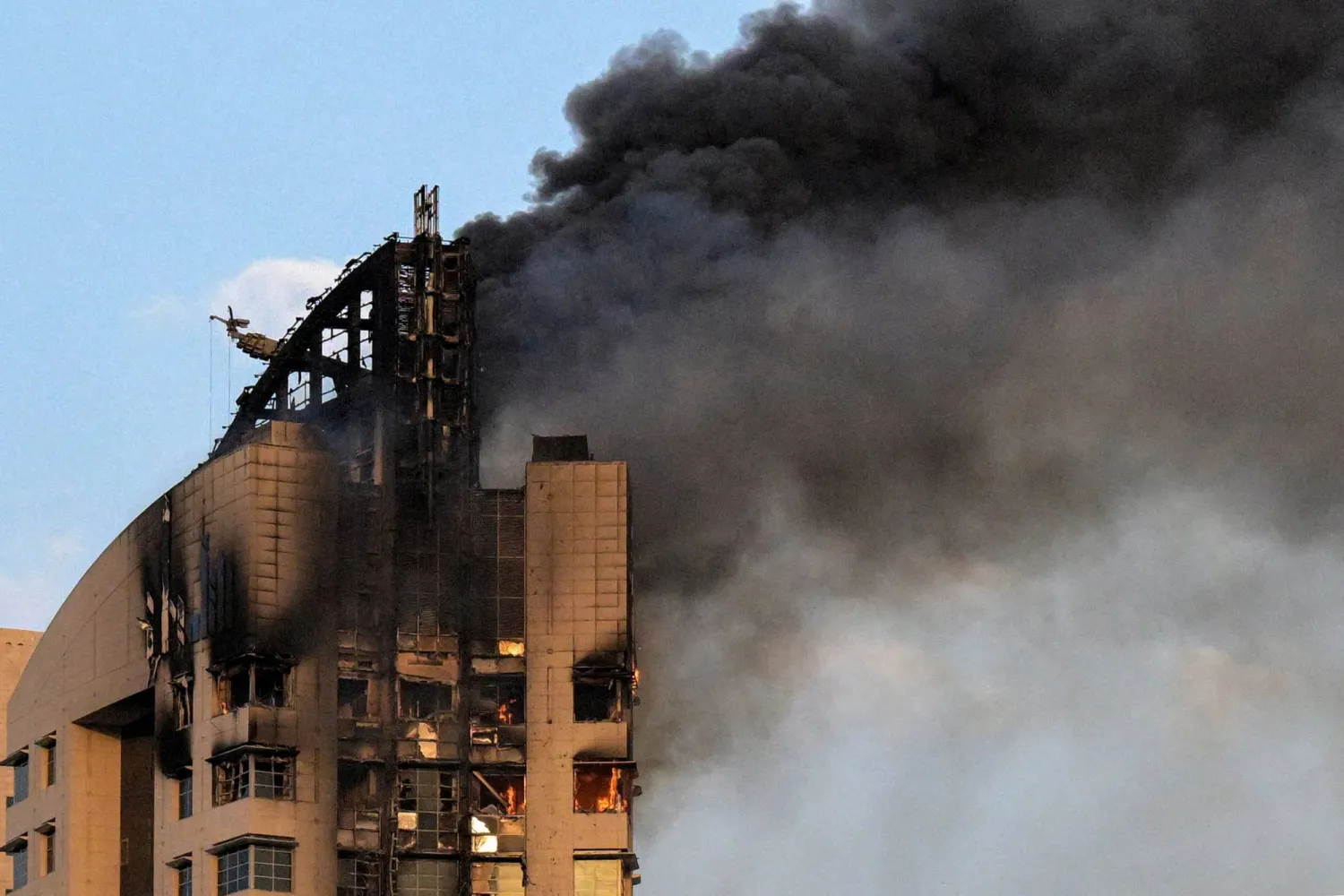
The attacks set a building ablaze in central Beirut in the densely populated Aisha Bakkar area, engulfing the top two floors of the multistory structure. There were no immediate reports of casualties from the strike, which came without warning.

An earlier Israeli strike killed five people in the Nabatieh district in southern Lebanon, while two more were killed in strikes in the Tyre and Bint Jbeil districts, Lebanon's Health Ministry said. A Red Cross worker also died Wednesday of wounds sustained Monday, when his team was hit by an Israeli strike while they were rescuing people from an earlier attack.

Nearly 500 people have been killed so far in Lebanon since Hezbollah triggered the latest round of fighting with Israel when it fired rockets into the country’s north after the American and Israeli attacks on Iran started.

Iran launches multiple salvoes at Israel and Gulf nations

Israel warned of three Iranian attacks early Wednesday, with sirens heard in Tel Aviv and elsewhere but no immediate reports of casualties.

In addition to Iranian attacks targeting Saudi Arabia's oil fields, the Kingdom's defense ministry said it had destroyed six ballistic missiles launched toward Prince Sultan Air Base in eastern Saudi Arabia. The ministry also said it intercepted and destroyed two drones over the eastern city of Hafar al-Batin.

In the Strait of Hormuz north of Oman, a cargo ship was hit with a projectile and set on fire, according to the United Kingdom Maritime Trade Operations center, run by the British military.

Iran did not immediately claim the attack though it has been targeting ships in and around the strait.

The UKMTO earlier reported on another attack targeting a container ship off Ras al-Khaimah in the United Arab Emirates. In that case, it said the “extent of the damage is currently unknown but under investigation by the crew.”

The United Arab Emirates said early Wednesday that its air defenses were working to intercept incoming Iranian fire. The nation said Iranian attacks have killed six people and wounded 122 others there.

Bahrain sounded sirens early Wednesday, warning of an incoming Iranian attack. The warnings came a day after an Iranian attack hit a residential building in the capital, Manama, and killed a 29-year-old woman and wounding eight people.

At the United Nations, the Security Council was to vote Wednesday afternoon on the Gulf Cooperation Council resolution, according to three diplomats speaking on condition of anonymity ahead of an official announcement.

The council, a six-nation regional bloc, said its own facilities were targeted in an Iranian attack last week on Bahrain.

The draft resolution, obtained by The Associated Press, condemns Iran’s attacks on Saudi Arabia, Bahrain, Kuwait, Oman, Qatar, the United Arab Emirates and Jordan. The measure calls for an immediate end to all strikes and threats against neighboring states, including through proxies.

It would be the first Security Council resolution considered since the start of the war.

Oil prices stay high

Oil prices remained well below the peaks Monday but the price of Brent crude, the international standard, was still up some 20% Wednesday from when the war began, and consumers around the world are already feeling the pain at the pump.

The spike in oil prices has been rocking financial markets worldwide because of worries that the war could block the global flow of oil and natural gas for a long time.

The US military said Tuesday it had destroyed 16 Iranian minelayers near the Strait of Hormuz, though US President Donald Trump said in social media posts that there were no reports yet of Iran mining the passage, a prospect that experts warned of preceding the war.

If the strait is mined, it could take at least weeks to clean it up once the conflict is over.

Some tankers, believed linked to Iran, are continuing to get through the strait making so-called “dark” transits -- meaning they aren’t turning on their Automatic Identification System tracks, which show where vessels are. Vessels carrying sanctioned Iranian crude often turn off their AIS trackers.

The security firm Neptune P2P Group said Wednesday there had been seven ships pass through the strait since March 8. Of them, five were linked to Iranian-associated shipping, it said. In ordinary times the strait typically sees 100 ships or more transit daily from the Gulf into the Gulf of Oman.

Meanwhile, the commodity-tracking firm Kpler said Iran has restarted crude exports through its Jask oil terminal on the Gulf of Oman. A tanker loaded roughly 2 million barrels at Jask on March 7, it said.

Foreign nationals flee region as death tolls rise

In addition to the nearly 500 people killed in Lebanon, Iran has said more than 1,300 people have been killed there and Israel has reported 12 people dead.

The US has lost seven soldiers while another eight have suffered severe injuries.

Many foreign nationals have been getting out of the Gulf region since the war began, including over 45,000 UK citizens, the British Foreign Office said. Some 40,000 people returned to the United States, according to the State Department.