


British Lawmakers Urge Govt to Label ‘Revolutionary Guard’ as Terrorist Organization

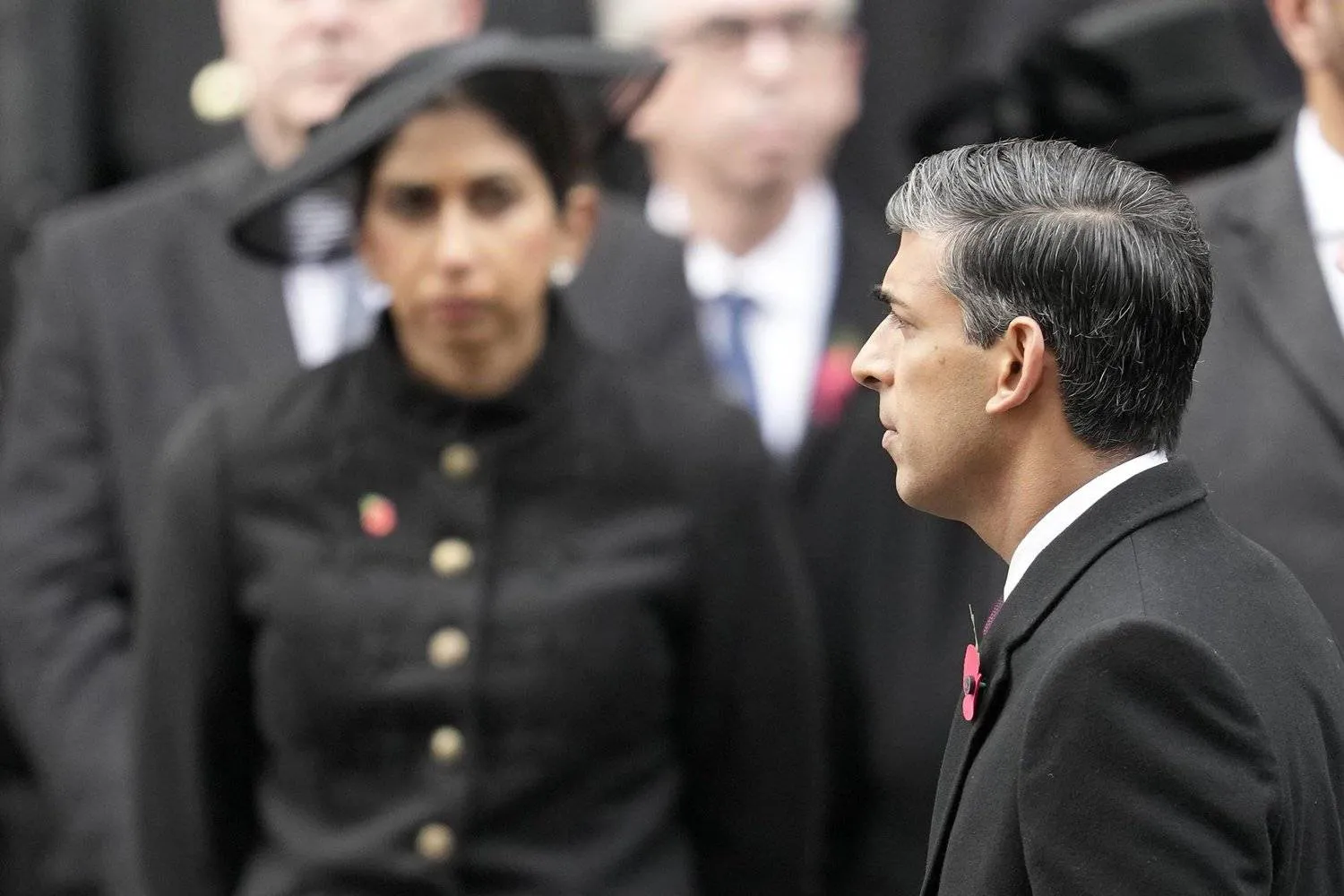
British Prime Minister Rishi Sunak (AP)
TT

British Lawmakers Urge Govt to Label ‘Revolutionary Guard’ as Terrorist Organization

British Prime Minister Rishi Sunak (AP)

British lawmakers and members of the upper house of parliament are exerting pressure on the government of Rishi Sunak to proscribe Iran's Revolutionary Guard Corps as a terrorist organization, saying it would be a step towards restoring stability to the Middle East.

In a letter to the Prime Minister, more than 60 lawmakers from the lower house of parliament and members of the House of Lords said “given the ongoing conflicts in the Middle East, it is now more urgent than ever to proscribe the IRGC,” according to Reuters.

“We call upon our government to recognize the urgency of proscribing the IRGC as a terrorist organization and proceed to do so. Such a decision would constitute a significant step towards peace, stability, and justice in the Middle East and beyond,” read the letter, signed by senior Conservatives such as Iain Duncan Smith, David Davis and David Jones.

Proscribing the IRGC as a terrorist group would mean it would become a criminal offense in Britain to belong to the group, attend its meetings or carry its logo in public.

The IRGC is already subject to British sanctions for violating human rights and for their missile activities, in addition to being responsible for supplying Russia with kamikaze drones that were used in the Ukrainian war.

Last month, British media outlets said British counter-terrorism officers are monitoring closely if Iran will try to exploit the Israel-Hamas war for its own ends in the UK, amid wider anxieties that Tehran is an increasing security menace to dissidents and critics.

The officers are also monitoring more than 10 mosques, groups and educational institutions that are linked to Iran’s IRGC around the country.

In remarks specifically about Iran, Ken McCallum, MI5’s director, said last month that London had “been concerned” about its behavior within Britain “for a long time,” with the current Middle East situation heightening those concerns.

“There clearly is the possibility that profound events in the Middle East will either generate more volume of UK threat and/or change its shape in terms of what is being targeted, in terms of how people are taking inspiration,” McCallum said.

“In particular, the last 18 months or so have been a particularly intensive phase of Iran-generated threat on UK soil,” he added.

Last November, the MI5 director said Iran’s “aggressive intelligence services” were actively targeting Britain and had made “at least 10” attempts to “kidnap or even kill” British or UK-based individuals since January.

By February this year the figure had increased to 15.

In August, a British media report said the British Home Secretary Suella Braverman and her team believe that the Iranian Revolutionary Guards Corps is the biggest threat to the country’s national security.

“The Iranian threat is the one that worries [the UK] the most,” a source close to the home secretary told The Sunday Times. “It’s a big issue because they are getting much more aggressive and their appetite is increasing ... They are very defensive to anyone challenging their regime”, the source added.

In January, a foreign office minister said Britain was actively considering proscribing the IRGC as a terrorist organization but had not reached a final decision.

Last February, The Times reported that the government had “temporarily” halted a plan to classify the Revolutionary Guards on the terrorist list, after the opposition of Foreign Secretary James Cleverly, despite the insistence of the Home Secretary and Security Minister Tom Tugendhat.

Two weeks ago, The Guardian said the Foreign Office believes that the plan would lead to the expulsion of the British ambassador to Tehran and, as a result, the loss of the UK’s remaining influence in Iran.



Iran Reviewing US Proposal as Trump Pressures Tehran for Agreement on Deal to End War

US and Iran flags are seen in this illustration taken June 18, 2025. REUTERS/Dado Ruvic/Illustration/File Photo
TT

Iran Reviewing US Proposal as Trump Pressures Tehran for Agreement on Deal to End War

US and Iran flags are seen in this illustration taken June 18, 2025. REUTERS/Dado Ruvic/Illustration/File Photo

Iran said it was reviewing the latest American proposals to end the war after US President Donald Trump threatened the country with a new wave of bombing unless a deal is reached that includes reopening the crucial Strait of Hormuz to international shipping.

Hope that the two-month conflict could soon be over buoyed international markets Thursday, a day after the US military fired on an Iranian oil tanker attempting to breach the American blockade of Iran’s ports. The developments followed days of mixed messages from the Trump administration over its strategy to end the war, according to The AP news.

Meanwhile, US Secretary of State Marco Rubio discussed peace efforts in the Middle East at the Vatican. Rubio met with Pope Leo XIV, whose opposition to the Iran war has led to open sparring with Trump.

Trump posted on social media Wednesday that ending the war and resuming oil and natural gas shipments disrupted by the conflict depends on Iran accepting an agreement, which he did not detail.

“If they don’t agree, the bombing starts,” Trump wrote.

A fragile ceasefire between the US and Iran has largely held since April 8. But in-person talks between the two countries hosted by Pakistan last month failed to reach an agreement. The war began Feb. 28, when the US and Israel launched strikes against Iran.

Pakistan says it expects a deal soon “We expect an agreement sooner rather than later,” Pakistani Foreign Ministry spokesperson Tahir Andrabi said Thursday.

“We hope the parties will reach a peaceful and sustainable solution that will contribute not only to peace in our region but to international peace as well.” But he declined to give a timeline, saying Pakistan would not disclose details of the ongoing diplomatic efforts.

Asked whether Pakistan was expecting any response from Iran later Thursday, Andrabi said: “I will not comment on specifics or the movement of the messages.”

Pakistani Prime Minister Shehbaz Sharif, speaking in televised remarks, said Islamabad remained in “continuous contact with Iran and the United States, day and night, to stop the war and extend the ceasefire.”


Pakistan Warns of Strong Response to Any Attack on Anniversary of Clash with India

The Pakistani flag is seen in Islamabad. AP file photo
TT

Pakistan Warns of Strong Response to Any Attack on Anniversary of Clash with India

The Pakistani flag is seen in Islamabad. AP file photo

Pakistan’s military warned Thursday it would respond strongly against any attack as it marked the anniversary of last year’s four-day conflict with neighboring India that brought the nuclear-armed rivals to the brink of war before a US-brokered ceasefire halted the fighting.

The military said that any “hostile design” against Pakistan would be countered with “greater strength, precision and resolve” than what India witnessed during the May 2025 conflict, which Islamabad named “Marka-e-Haq,” or “Battle of Truth.”

Pakistan and India had exchanged tit-for-tat strikes following an attack by gunmen in the Indian-controlled part of the disputed Himalayan region of Kashmir that killed 26 people, most of them Hindu tourists. India blamed Pakistan-backed militants for the massacre in the town of Pahalgam, an allegation Islamabad denied while calling for an independent investigation, The AP news reported.

India launched strikes inside Pakistan on May 7, triggering retaliatory attacks by Pakistan that included drone incursions, missile strikes and artillery fire. Dozens of people were killed on both sides before a ceasefire was reached on May 10 following US mediation.

Pakistan at the time claimed it shot down at least seven Indian military aircraft, including a French-made Rafale fighter jet. India acknowledged suffering some losses but did not provide details.

US President Donald Trump has repeatedly taken the credit for helping avert a wider war.

Speaking at a televised news conference, army spokesperson Lt. Gen. Ahmad Sharif Chaudhry said India had blamed Pakistan for the attack on tourists in Kashmir within minutes of the shooting without presenting evidence.

“It has been one year since the Pahalgam incident, yet the questions Pakistan raised remain unanswered,” he said. Chaudhry said Pakistan did not underestimate India’s military capability but was fully prepared to respond to any “misadventure.”

“We are prepared; if anyone wishes to test us, they are more than welcome,” he said alongside Deputy Chief of Naval Staff Rear Adm. Shifaat Ali and Deputy Chief of Air Staff (Projects) Air Vice Marshal Tariq Ghazi. However, Chaudhry added: “We are not seeking conflict, we are not seeking war. But we know how to defend ourselves with honor and dignity.”

Ali said the Indian navy had attempted to deploy vessels in the northern Arabian Sea during the fighting in an effort to target Pakistan’s naval assets and disrupt maritime trade routes. “But due to the effective strategy of the Pakistan Navy, maritime traffic in all our waterways remained uninterrupted,” he said.

At Thursday’s briefing, Ghazi said Pakistan had downed eight Indian fighter jets during the conflict. He added that Pakistan had exercised restraint and that its air force had the capability to inflict greater damage on the enemy.

Pakistan and India have long had strained relations and have fought two of their three wars over Kashmir, which is claimed by both in its entirety.


Pezeshkian Says he Recently Met with the Supreme Leader

Women walk past a banner depicting Iran's current supreme leader Mojtaba Khamenei along a street Tehran on May 6, 2026. (Photo by AFP)
TT

Pezeshkian Says he Recently Met with the Supreme Leader

Women walk past a banner depicting Iran's current supreme leader Mojtaba Khamenei along a street Tehran on May 6, 2026. (Photo by AFP)

Iran’s President Masoud Pezeshkian said he met recently with Supreme Leader Mojtaba Khamenei, state media reported ⁠on Thursday, offering ⁠a first public account of him ⁠meeting Khamenei after the latter suffered severe wounds at the start of the US-Israeli war on Iran.

The ⁠meeting ⁠was marked by a "humble and deeply cordial" atmosphere, Pezeshkian was reported as saying.

Khamenei, reportedly wounded in strikes on the first day of the Middle East war that claimed the life of his father and predecessor Ali Khamenei, has released only written statements since his appointment.

"What struck me most during this meeting was the vision and the humble and sincere approach of the supreme leader of the Islamic revolution," Pezeshkian said in a video broadcast by state television.