Gunmen Kill 15 Police Officers and Several Civilians in Russia's Dagestan

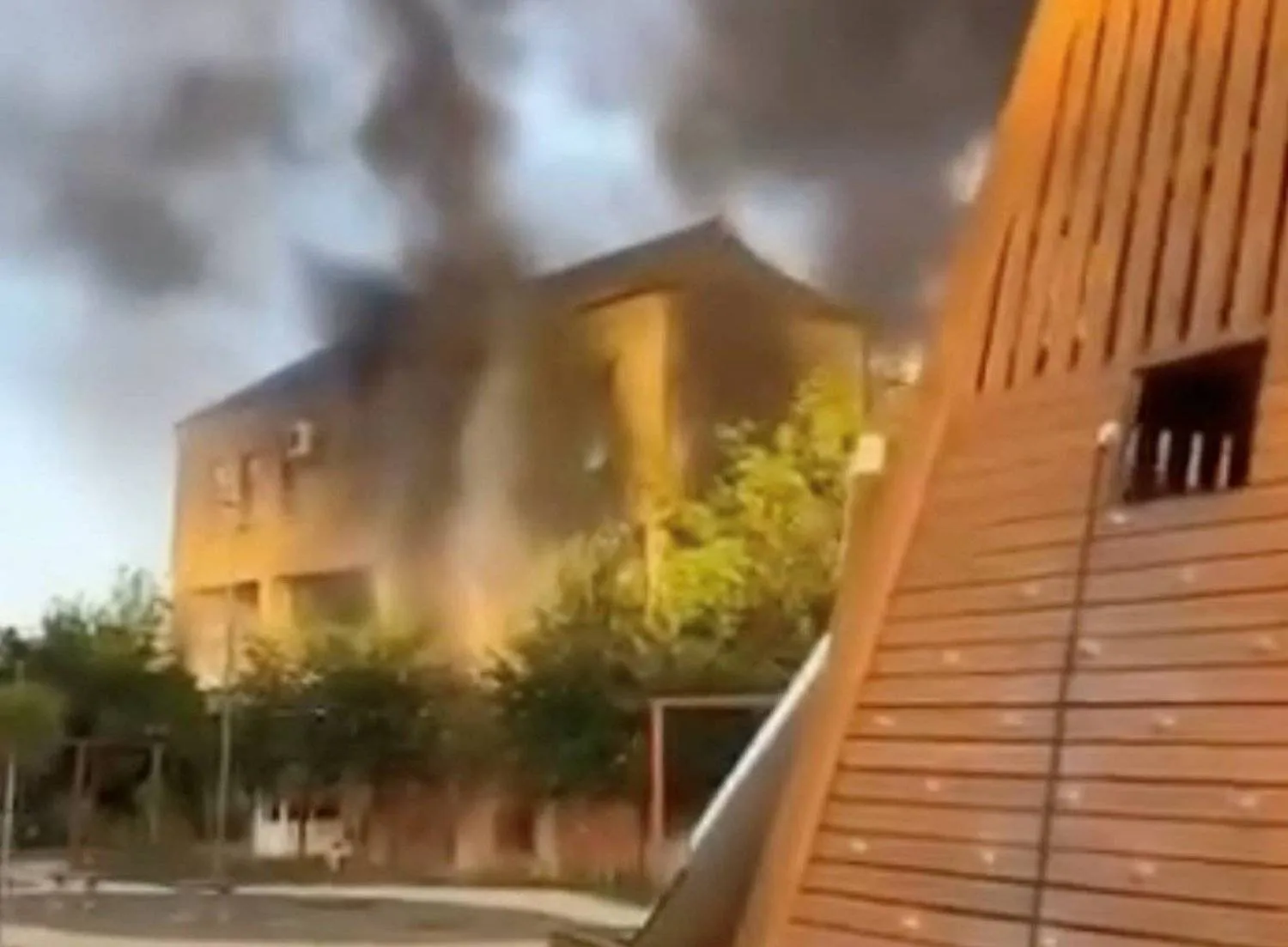
A view shows plumes of smoke rising from building, in Derbent, Russia, June 23, 2024, in this still image obtained from a video. VIDEO OBTAINED BY REUTERS/via REUTERS
TT

Gunmen Kill 15 Police Officers and Several Civilians in Russia's Dagestan

A view shows plumes of smoke rising from building, in Derbent, Russia, June 23, 2024, in this still image obtained from a video. VIDEO OBTAINED BY REUTERS/via REUTERS

More than 15 police officers and several civilians, including an Orthodox priest, were killed by armed militants in Russia’s southern republic of Dagestan on Sunday, its governor Sergei Melikov said in a video statement early Monday.
The gunmen opened fire on two Orthodox churches, a synagogue and a police post in two cities, according to the authorities.
Russia’s National Anti-Terrorist Committee described the attacks as terrorist acts.
Monday, Tuesday and Wednesday were declared days of mourning in the region.
Dagestan's Interior Ministry said a group of armed men shot at a synagogue and a church in the city of Derbent, located on the Caspian Sea. Both the church and the synagogue caught fire, according to state media. Almost simultaneously, reports appeared about an attack on a church and a traffic police post in the Dagestan capital, Makhachkala.
Authorities announced a counter-terrorist operation in the region. The Anti-Terrorist Committee said five gunmen were “eliminated.” The governor said six “bandits” had been “liquidated.” The conflicting numbers couldn't be immediately reconciled and it wasn't clear how many militants were involved in the attacks.
There was no immediate claim of responsibility for the attacks. The authorities launched a criminal investigation on the charge of a terrorist act.
Russian state news agency Tass cited law enforcement sources as saying that a Dagestani official was detained over his sons' involvement in the attacks.
Melikov said in the video statement that the situation in the region was under control of the law enforcement and local authorities, and vowed that the investigation of the attacks will continue until “all the sleeping cells” of the militants are uncovered.
He claimed, without providing evidence, that the attacks might have been prepared from abroad, and referenced what the Kremlin calls “the special military operation” in Ukraine in an apparent attempt to link the attacks to it.



Iran to Hold Funeral for Slain Security Chief as It Vows Vengeance

Then Iranian parliament speaker Ali Larijani attends a news conference in Damascus, Syria February 16, 2020. (Reuters)
TT

Iran to Hold Funeral for Slain Security Chief as It Vows Vengeance

Then Iranian parliament speaker Ali Larijani attends a news conference in Damascus, Syria February 16, 2020. (Reuters)

Iran will hold a funeral Wednesday for its security chief Ali Larijani as it vowed revenge, firing off a wave of missiles at Israel after it killed the powerful figure in an air strike.

A barrage of Iranian missiles killed two people near Israel's commercial hub Tel Aviv, while Gulf nations intercepted rockets and drones headed for targets including US bases in the region.

In Lebanon, pulled into the Middle East war by Iran-backed Hezbollah, Israel conducted a wave of deadly strikes including in central Beirut, with AFPTV's live broadcast showing plumes of smoke rising from one of the targeted areas.

According to Iran's Fars and Tasnim news agencies, funerals for Larijani and another powerful figure killed by Israel, Gholamreza Soleimani, the head of the Basij paramilitary force, will take place from 1030 GMT in Tehran.

Their deaths were announced Tuesday.

Larijani is the most prominent figure of the country killed since Israel and the United States launched their attacks on Iran on February 28, killing supreme leader Ali Khamenei and igniting a war across the Middle East.

Khamenei’s funeral was due to be held days after he was killed, but that was later postponed indefinitely.

"Iran's response to the assassination of the secretary of the Supreme National Security Council will be decisive and regrettable," Iranian army chief Amir Hatami said in a statement.

- 'Only just begun' -

Besides sending missiles and drones into Israel and Gulf nations, Iran has sought to extract a heavy toll on the global economy, including by driving up the cost of oil by all but closing the Strait of Hormuz, a crucial waterway for crude.

With oil still hovering around $100 a barrel, Iranian Foreign Minister Abbas Araghchi warned Wednesday that the global repercussions of the war "has only just begun and will hit all".

As part of an effort to reopen Hormuz, where one-fifth of the world's crude transits, the US military said it brought out some of the heaviest bombs in its arsenal to penetrate adjacent missile sites.

The United States dropped several 5,000-pound (2,250 kg) bombs -- estimated to cost $288,000 each -- on "hardened Iranian missile sites" near the coast that posed a threat to international shipping, Central Command said.

US President Donald Trump earlier Tuesday fumed that American allies, which have largely distanced themselves from his war, were not lining up behind the United States to escort tankers through the Strait of Hormuz.

But Trump also boasted that the US military did not need its allies, writing on his Truth Social platform: "WE DO NOT NEED THE HELP OF ANYONE!"

- 'National awakening' -

Iran's Revolutionary Guards, which said Wednesday they launched missiles at central Israel as retaliation, warned in a statement that Larijani's death would spur further attacks.

The "pure blood of this great martyr... will be a source of honor, power and national awakening against the front of global arrogance," the powerful military force said in a statement.

Türkiye's Foreign Minister Hakan Fidan lashed out at Israel, condemning its "political assassinations" of Tehran's leaders as "illegal activities outside the normal laws of war".

But Israel vowed also to target the new supreme leader, Mojtaba Khamenei, who has not appeared in public since he succeeded his father.

"We will track him down, find him, and neutralize him," military spokesman Brigadier General Effie Defrin told reporters.

Israeli Prime Minister Benjamin Netanyahu again called for the end of the Iranian regime, although he and Trump have stopped short of saying that is their goal in the wider war.

In contrast to Mojtaba Khamenei, Larijani, 68, had walked openly with crowds at a pro-government rally last week in Tehran.

He had "effectively been the figure in charge of the regime's survival, its regional policy and its defense strategy," David Khalfa, co-founder of the Atlantic Middle East Forum, told AFP.

- Deaths in Israel, Lebanon -

In Israel, medics said two people died after an Iranian missile barrage caused extensive damage to a building near the commercial hub Tel Aviv.

Meanwhile Lebanon said Israel struck central Beirut early Wednesday without warning, killing at least six people, as the Israeli military announced it was targeting the country's south.

Lebanon was drawn into the war when Hezbollah launched rockets towards Israel over Ali Khamenei’s death.

Elsewhere, the Saudi Defense Ministry said it had intercepted a ballistic missile near the Prince Sultan Air Base.


Israel Targets Islamic Jihad Leaders in Iran: What We Know

A group of Al-Quds Brigades fighters in Gaza, October 2023 (EPA)
TT

Israel Targets Islamic Jihad Leaders in Iran: What We Know

A group of Al-Quds Brigades fighters in Gaza, October 2023 (EPA)

Israel’s Chief of Staff Eyal Zamir said on Tuesday that Palestinian figures linked to Iran had been killed “inside a safe house they had taken refuge in,” while Israeli military correspondents, citing sources, said the targets were two senior leaders in the Palestinian Islamic Jihad.

The sources identified them as the group’s deputy leader, Mohammad al-Hindi, and the head of its armed wing, the Al-Quds Brigades, Akram al-Ajouri.

Islamic Jihad is the largest faction financially and logistically linked to Iran.

Reports differed on whether both men were targeted or only one of them.

Israel’s Channel 12 said the strike targeted al-Ajouri and several of his aides in the Iranian city of Qom, while Channel 14 reported that al-Hindi was also targeted.

According to Channel 14, the attack, which it said took place four days ago, hit Islamic Jihad leaders in a fortified underground location, with dozens of bombs dropped to ensure the site was destroyed and those inside killed.

Islamic Jihad had not commented on the Israeli reports by midday Tuesday and maintained silence.

However, a source familiar with the group told Asharq Al-Awsat that it was “unlikely that al-Hindi was at the site of the attack or in Iran in general.”

The source said al-Hindi’s movements are kept secret due to repeated targeting attempts, adding that, according to the latest confirmed information within the group’s leadership, he had been in another country, not Iran, days earlier.

Several Islamic Jihad sources said al-Hindi’s visits to Tehran had already been limited even before Oct. 7, 2023, and had declined significantly since then.

Who is Mohammad al-Hindi?

For years, al-Hindi, born in 1955, has been on Israel’s wanted list. Israel attempted to assassinate him several times while he was in Gaza, though such attempts declined after he left the enclave in 2014. He has since been based mainly in Türkiye, traveling to other countries.

Al-Hindi was third in the group’s leadership before Ziyad al-Nakhalah became secretary-general in 2018, following the deterioration of the health of his predecessor Ramadan Shallah, who died in 2020.

Following those changes, al-Hindi became the group’s number two. He is known for his close ties to Hamas and played a key role in improving relations between the two movements. He also built important ties with figures in Türkiye and the Muslim Brotherhood.

Al-Hindi is credited with making the group more open over the past decade to relations with other movements and states, including Qatar, given its role in mediations on the Palestinian cause, as well as building ties with Egyptian officials handling the matter.

Before leaving Gaza, he also supported Egyptian intelligence efforts to contain armed clashes between Fatah and Hamas during the 2006 to 2007 split, leveraging his strong ties with both movements.

Who is Akram al-Ajouri?

Al-Ajouri, believed to be in his sixties, is one of the most influential figures in Islamic Jihad, not only operationally, through his role in arming the Al-Quds Brigades in Gaza, but also through his strong ties with leaders of Hezbollah and, previously, with the government of former Syrian president Bashar al-Assad.

Sources in the group say al-Ajouri is of particular importance to Iran’s Islamic Revolutionary Guards due to his role in executing missions and planning military operations, including weapons transfers to Gaza and other areas, as well as forming multiple militant cells in the West Bank.

He oversees the group’s military portfolio and has long managed its armed wing, including weapons procurement in Gaza and the West Bank, as well as efforts to build up its military presence in Lebanon and Syria.

He has also pushed fighters in both countries to take part in operations launched from Lebanon and to support Hezbollah since Oct. 8, 2023.

Al-Ajouri has survived several assassination attempts, including two in Syria. He escaped one in 2014, while another in 2019 targeted his home, killing his son and others. At the time, estimates suggested he was in Lebanon, where he also survived at least one assassination attempt.

A source in Islamic Jihad said contact with al-Ajouri had been lost since the start of the US-Israeli war against Iran, while another senior source said al-Ajouri had recently communicated electronically with some levels of the group, possibly through intermediaries, adding that “no one knows his location.”

Sources say al-Ajouri had been preparing to leave Lebanon shortly before the war on Iran, but several Arab and Islamic capitals refused to receive him despite efforts by al-Nakhalah. Some countries rejected him due to legal cases filed against him in local courts, while others declined for security reasons. Sources suggested he may be in Iran.

More than a week ago, Israel killed Adham al-Othman, a close associate of al-Ajouri, in a strike on a Hezbollah safe apartment in Beirut’s southern suburbs.


Starmer Tells Zelensky ‘Focus Must Remain on Ukraine’ amid Iran War

 Britain's Prime Minister Keir Starmer meets with Ukrainian President Volodymyr Zelenskyy at 10 Downing Street in London, Tuesday, March 17, 2026.(Suzanne Plunkett, Pool Photo via AP)
Britain's Prime Minister Keir Starmer meets with Ukrainian President Volodymyr Zelenskyy at 10 Downing Street in London, Tuesday, March 17, 2026.(Suzanne Plunkett, Pool Photo via AP)
TT

Starmer Tells Zelensky ‘Focus Must Remain on Ukraine’ amid Iran War

 Britain's Prime Minister Keir Starmer meets with Ukrainian President Volodymyr Zelenskyy at 10 Downing Street in London, Tuesday, March 17, 2026.(Suzanne Plunkett, Pool Photo via AP)
Britain's Prime Minister Keir Starmer meets with Ukrainian President Volodymyr Zelenskyy at 10 Downing Street in London, Tuesday, March 17, 2026.(Suzanne Plunkett, Pool Photo via AP)

UK Prime Minister Keir Starmer told Ukrainian President Volodymyr Zelensky in London on Tuesday that "the focus must remain on Ukraine" despite the US-Israeli war with Iran.

Starmer welcomed Zelensky to his official Downing Street residence for talks after the Ukraine leader met King Charles III at Buckingham Palace.

"I think it's really important that we are clear that the focus must remain on Ukraine," said Starmer.

"There's obviously a conflict in Iran going on, in the Middle East, but we can't lose focus on what's going on in Ukraine and the need for our support," he added.

Washington has partly rolled back sanctions against Moscow to cool oil prices sent soaring by the Middle East war, which appears to have scuttled US-led talks on ending Russia's four-year invasion.

Tuesday's meeting came after Downing Street had earlier announced that Britain and Ukraine are set to sign a defense partnership aimed at addressing the threat of low-cost drones.

Zelensky's visit in London -- ahead of a trip to Spain on Wednesday -- comes as his European allies have vowed to keep up support for Kyiv in the conflict with Russia.

"Our resolve is unbreakable," said Starmer, reiterating the UK's long-standing backing of Ukraine.

Earlier, Zelensky and King Charles shook hands during a private audience at Buckingham Palace.

"I thank His Majesty and the entire Royal Family for their unwavering support and solidarity with Ukraine," Zelensky wrote on X.

The Ukrainian leader was later due to meet NATO chief Mark Rutte in London, his spokesman said.

He was also expected to address members of the UK parliament.