Syria's Sharaa, Shibani Expected at Brussels Donor Summit

A man holds the Syrian opposition flag as they celebrate after Syria's army command notified officers on Sunday that President Bashar al-Assad's 24-year authoritarian rule has ended - Aleppo, Syria - AFP
TT

Syria's Sharaa, Shibani Expected at Brussels Donor Summit

A man holds the Syrian opposition flag as they celebrate after Syria's army command notified officers on Sunday that President Bashar al-Assad's 24-year authoritarian rule has ended - Aleppo, Syria - AFP

Syria's interim president, Ahmed al-Sharaa, is expected to attend an international donor summit for his country in Brussels on March 17, a Syrian source and two diplomats familiar with the trip said.
It will be his first visit to Europe since he was declared interim president following the ouster of Bashar al-Assad in December.

Also, a European official told Reuters on Wednesday that Syria's foreign minister Asaad al-Shibani is also set to attend the donor summit.

The yearly conference, hosted by the European Union, aims to "mobilize international support for an inclusive, peaceful transition" and will be the first time it is held following the ouster of Bashar al-Assad from power in December.

In the past, representatives of Syrian civil society were invited to take part in the summit - but the Syrian state was not.


Iran Revolutionary Guards Say US-Israel Strikes Killed Spokesman

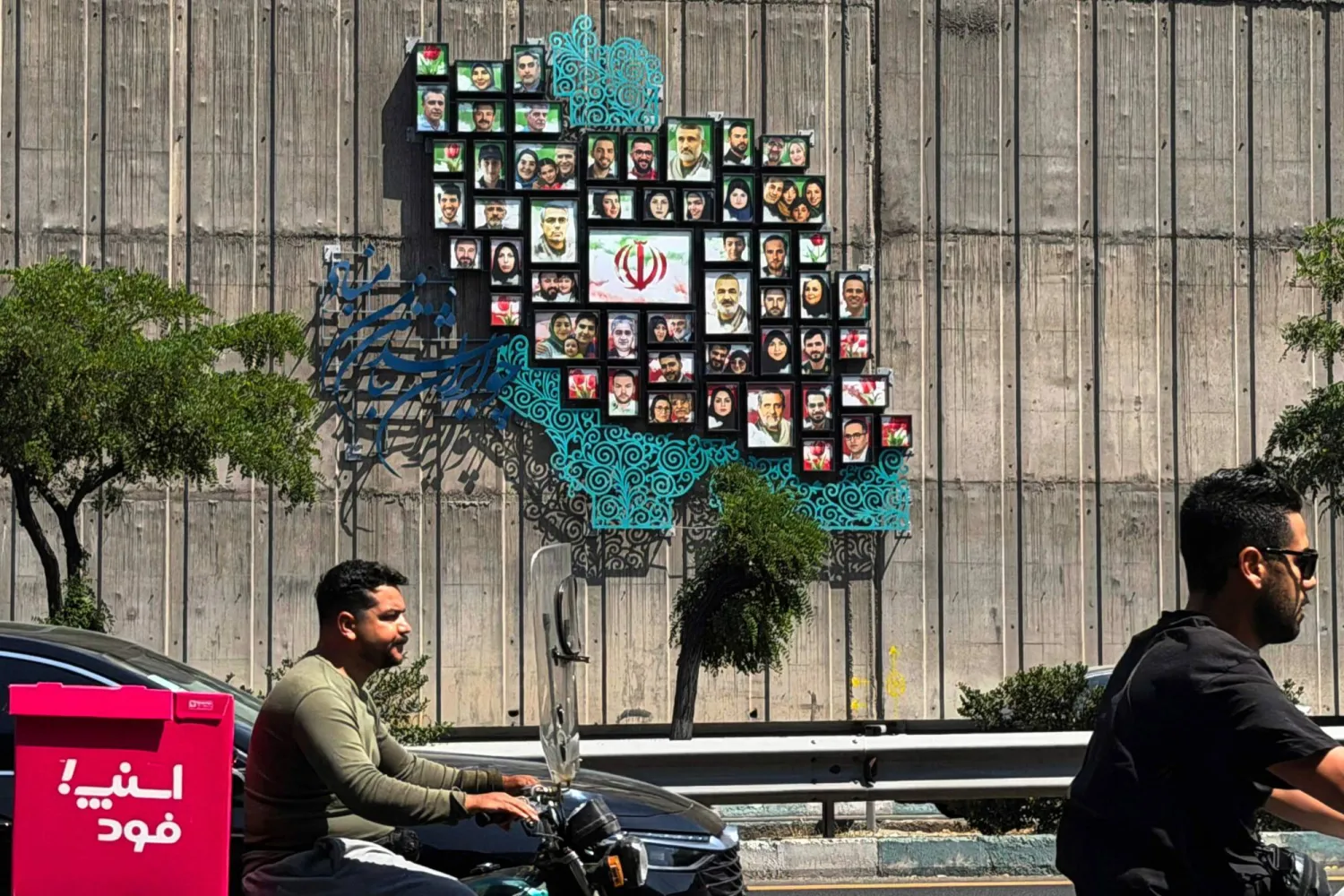
Motorists drive along a street in Tehran on March 14, 2026. (Photo by ATTA KENARE / AFP)
TT

Iran Revolutionary Guards Say US-Israel Strikes Killed Spokesman

Motorists drive along a street in Tehran on March 14, 2026. (Photo by ATTA KENARE / AFP)

Iran's Revolutionary Guards said on Friday that US-Israeli strikes had killed their spokesman Ali Mohammad Naini.

Naini "was martyred in the criminal cowardly terrorist attack by the American-Zionist side at dawn,” the Guards said in a statement on their Sepah News website.

A short time earlier, the spokesman insisted that Tehran was still building missiles, seeking to counter a claim by Israeli Prime Minister Benjamin Netanyahu that it no longer could.

Naini also said the Iran war would go on.

“These people expect the war to continue until the enemy is completely exhausted,” the general said of the Iranian public. “This war must end when the shadow of war is lifted from the country."


Trump's Mideast Muddle Could Play into Xi's Hands at Planned Summit

US President Donald Trump and China's President Xi Jinping are expected to meet to discuss formalizing a truce on tariffs they shook hands on at a meeting in South Korea in October. ADEK BERRY, ANNABELLE GORDON / AFP
TT

Trump's Mideast Muddle Could Play into Xi's Hands at Planned Summit

US President Donald Trump and China's President Xi Jinping are expected to meet to discuss formalizing a truce on tariffs they shook hands on at a meeting in South Korea in October. ADEK BERRY, ANNABELLE GORDON / AFP

China will be in a stronger position to extract concessions from Donald Trump when the US president finally visits Beijing after becoming entangled in his Middle East war, analysts say.

Trump had been due in the Chinese capital at the end of this month for talks with President Xi Jinping, but has delayed his trip by several weeks to deal with the fallout from the war.

His decision last month to join Israel in strikes on Iran has plunged the Middle East into violence, pushed energy prices to years-long highs and seeded fears of global supply shortages due to Iran's effective closure of the Strait of Hormuz.

With Trump struggling to define how the intervention will end and traditional allies reluctant to back him, the US leader may come to China needing a diplomatic win.

"A show of US force that was meant to intimidate Beijing has instead served to puncture the illusion of US omnipotence," said Ali Wyne, a senior adviser focusing on US-China ties at the International Crisis Group think tank.

"Unable to reopen the Strait of Hormuz alone, Washington now needs its principal strategic competitor to help it manage a crisis of its own making," Wyne said.

Trump said on Tuesday he expects to travel to China in "five or six weeks".

The prospective summit would aim to formalize a truce on tariffs that Trump and Xi shook hands on at a meeting in South Korea in October.

But Trump's weakened position could help Beijing argue for deeper tariff cuts and limit Washington's ability to push for change on other trade issues like access to critical minerals.

New leverage

Top Chinese and American trade officials held what they called "constructive" talks in Paris last weekend that were seen as setting the stage for a Xi-Trump summit.

Any chances of major breakthroughs on trade "seem limited", according to Dan Wang, a director on Eurasia Group's China team, with bilateral trust low after years of disputes over trade, technology and rights.

New US trade investigations into excess industrial capacity in 60 economies including China have also drawn Beijing's ire.

The Chinese leader will benefit from more strategic leverage over Trump as the war drags on -- at least in the near term, analysts told AFP.

Beijing has so far ignored Trump's call for help in reopening the Strait of Hormuz, a vital artery for global oil and gas shipments.

Nor has it relaxed its tight control on exports of rare earths, an industry that China dominates and provides certain critical minerals needed in US weaponry.

US military demand for certain "heavy" rare earths far exceed commercial needs, Jason Bedford, visiting senior research scholar at the National University of Singapore's East Asian Institute, told AFP.

They are used for equipment including drones, jet fighters, missile guidance systems and radar, said Bedford.

While the size of US military stockpiles is a "closely guarded secret", he said, "in theory, (China) could certainly disable new weapons production".

The absence of announcements on Hormuz or rare earths suggests "no concrete results were made during the trade talks" in Paris, said Wang of Eurasia Group.

Xi and Trump "have other chances to meet this year", but "the prospects of getting breakthroughs beyond lower tariffs seem limited", she told AFP.

'Not reliable'

China could also calibrate its actions to make Trump's domestic position shakier at a time when a majority of Americans already oppose military action in the Middle East.

Trump and his negotiators "want China to buy US agricultural products, which is important to the midterm elections for the Republicans", said Wu Xinbo, director of the Center for American Studies at Shanghai's Fudan University.

"If you cannot stabilize relations with China, you have to face some big challenges," Wu said.

Any Xi-Trump summit is unlikely to succeed in changing either side's broader geostrategic aims.

On Thursday, the Trump administration announced that it is considering easing certain sanctions targeting Iranian oil to curb rising prices -- a move experts say could benefit China.

China is believed to be the main buyer of sanctioned Iranian oil, making it Tehran's "main economic lifeline", Henry Tugendhat, a China expert at the Washington Institute for Near East Policy, said at a forum on Wednesday.

Beijing also has "no incentive" to stop selling weapons to Iran as long as the United States continues to provide arms to self-ruled Taiwan, Tugendhat said.

On the streets of Beijing this week, locals were circumspect about a visit from the US president.

"Trump's personality is that he changes every day," a 50-year-old IT worker surnamed Huang told AFP.

"Even if he comes, he may have reached agreements with you, but he will change his mind," he said.

"He is not reliable."

Still, Trump's willingness to come to Beijing is a positive sign for 32-year-old finance worker Yang, who said: "I think the United States still hopes to maintain a positive and friendly attitude towards China."


Israel Strikes 'Decimated' Iran as War Roils Markets

Israeli Prime Minister Benjamin Netanyahu said Iran was being "decimated" in the war. Ronen Zvulun / POOL/AFP
TT

Israel Strikes 'Decimated' Iran as War Roils Markets

Israeli Prime Minister Benjamin Netanyahu said Iran was being "decimated" in the war. Ronen Zvulun / POOL/AFP

Israel launched a new wave of strikes on Tehran on Friday after Prime Minister Benjamin Netanyahu said Iran was being "decimated."

The Iranian capital, under near daily bombardment since a joint US-Israeli attack started the war on February 28, was hit by strikes the Israeli military said were "targeting infrastructure of the Iranian terror regime".

The bombardment came shortly after Netanyahu said the Middle East war had eradicated the Iranian republic's capacity to enrich uranium or manufacture ballistic missiles as the conflict heads towards a fourth week.

"We are winning and Iran is being decimated," the Israeli premier said at a press conference.

But Iran has kept up retaliatory fire on Israel and Gulf nations, including attacks on oil and gas facilities that have exacerbated concerns of a global energy supply shock.

Several blasts were heard over Jerusalem on Thursday night as Israel's military said it had identified three rounds of Iranian missile fire, with no reports of casualties.

The United Arab Emirates and Kuwait reported missile attacks, while Saudi Arabia intercepted more than a dozen drones early Friday as Gulf nations began the observation of Eid al-Fitr, the holiday that marks the end of the Islamic fasting month of Ramadan.

The war, which has killed hundreds and displaced thousands, has quickly spread to Lebanon where the Israeli military has carried out regular bombardments in response to rocket fire on Israel by Iran ally Hezbollah.

Lebanon's health ministry said the death toll from Israeli airstrikes on southern and eastern Lebanon as well as on the capital Beirut and its southern suburbs has surpassed 1,000.

Lebanese President Joseph Aoun, during a meeting with French Foreign Minister Jean-Noel Barrot on Thursday, renewed a call for a truce between Israel and Hezbollah and the opening of negotiations that France's president later said depended on Israel agreeing to join.

Netanyahu, enjoying rising popularity at home from a conflict that has drawn attention away from the Gaza war, said Israel was "winning" against Iran.

"I also see this war ending a lot faster than people think," he said, without providing a specific timeframe.

- 'Cracks' in Iran -

Netanyahu said Israel saw "cracks" in the Iranian leadership and was trying to exploit them.

"Mojtaba, the replacement ayatollah, has not shown his face," he said, in a reference to Iran's newly appointed supreme leader, the son of Ali Khamenei who was killed in an Israeli airstrike on the first day of the war.

Fears of energy supply shortages have sent gas prices surging and oil prices sitting around $100 a barrel.

There was slight optimism on Friday as crude prices eased during early Asia trading in response to Netanyahu's remarks suggesting that the war would end earlier than many feared.

Iranians were marking the new year spring festival of Nowruz on Friday, as well as the final day of Ramadan, with state media reporting Iran would observe the Eid holiday on Saturday.

- No timeframe -

US President Donald Trump indicated he did not know in advance about Israel's raid on South Pars, which supplies about 70 percent of Iran's domestic needs.

"We get along great. It's coordinated, but on occasion, he'll do something" that Washington opposes, Trump said.

Netanyahu said Israel acted alone with the strike and it would respect Trump's request to hold off on future attacks on the gas field.

Trump warned that the United States would "blow up" South Pars if Tehran did not stop attacking Qatar but he said there was no current plan to send ground troops into Iran.

Netanyahu indicated that changing the government in Tehran would require "a ground component", without elaborating.

"There are many possibilities for this ground component and I take the liberty of not sharing (those) with you," he said.

As concerns grow over the conflict's economic fallout, President Emmanuel Macron said France planned to talk with permanent members of the UN Security Council about establishing a framework to secure navigation in the Strait of Hormuz -- but only after fighting had stopped.

Pentagon chief Pete Hegseth said there was no clear end in sight for the war.

"We wouldn't want to set a definitive timeframe," he told reporters.

"It will be at the president's choosing, ultimately, where we say, 'Hey, we've achieved what we need to.'"