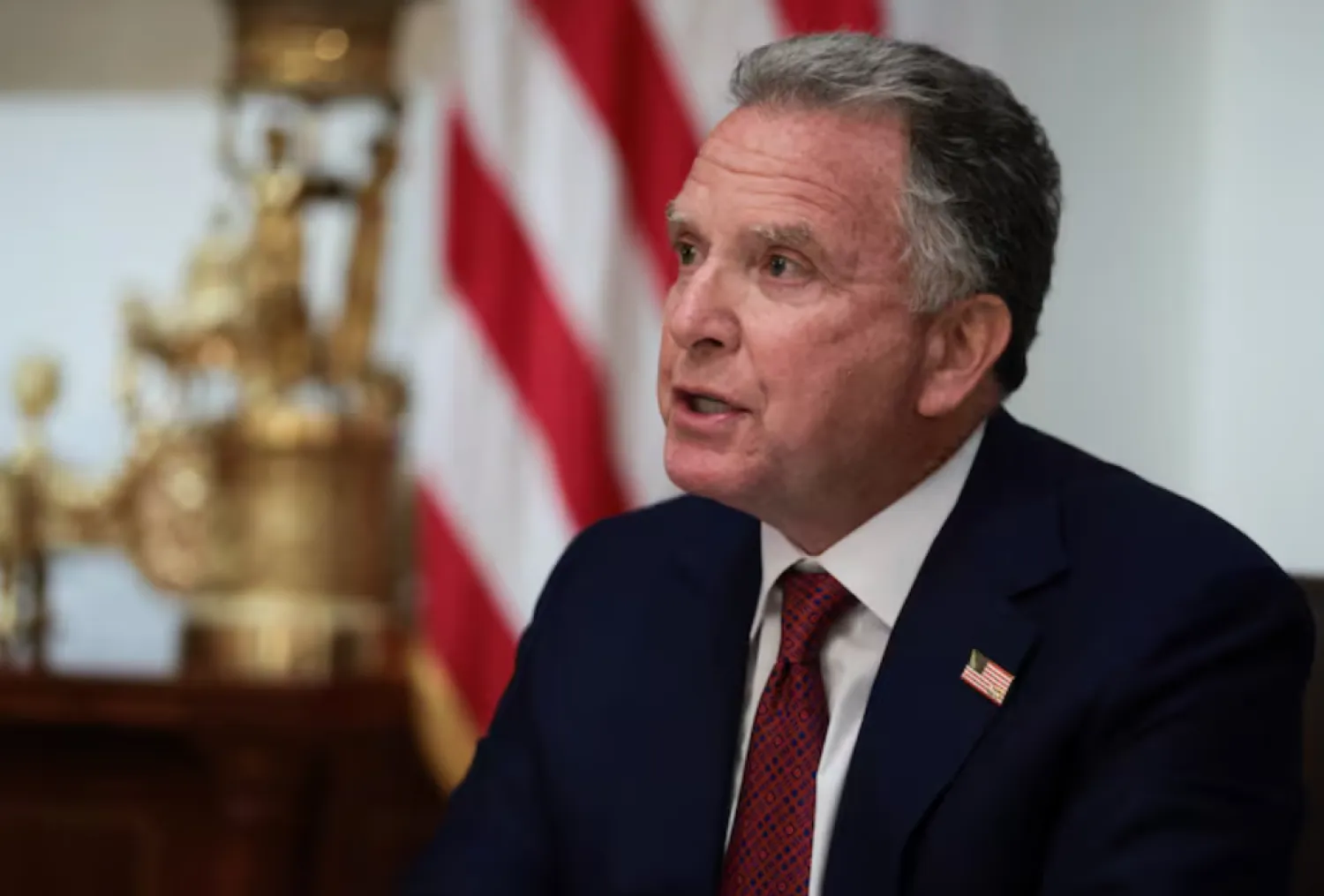
US Defense Secretary Pete Hegseth said Tuesday the Panama Canal faces ongoing threats from China but that together the United States and Panama will keep it secure.
Hegseth's remarks triggered a fiery response from the Chinese government, which said: "Who represents the real threat to the Canal? People will make their own judgement."
Speaking at a ribbon cutting for a new US-financed dock at the Vasco Nuñez de Balboa Naval Base after a meeting with Panama President José Raúl Mulino, Hegseth said the US will not allow China or any other country to threaten the canal's operation.
"To this end, the United States and Panama have done more in recent weeks to strengthen our defense and security cooperation than we have in decades," he said.
Hegseth alluded to ports at either end of the canal that are controlled by a Hong Kong consortium, which is in the process of selling its controlling stake to another consortium including BlackRock Inc.
"China-based companies continue to control critical infrastructure in the canal area," Hegseth said. "That gives China the potential to conduct surveillance activities across Panama. This makes Panama and the United States less secure, less prosperous and less sovereign. And as President Donald Trump has pointed out, that situation is not acceptable."
Hegseth met with Mulino for two hours Tuesday morning before heading to the naval base that previously had been the US Rodman Naval Station.
On the way, Hegseth posted a photo on X of the two men laughing and said it was an honor speaking with Mulino. "You and your country’s hard work is making a difference. Increased security cooperation will make both our nations safer, stronger and more prosperous," he wrote.
Late Tuesday, Mulino and Hegseth released a joint statement.
A vaguely worded portion of the statement suggested the two had discussed the tolls the United States pays for its ships crossing the canal. It said that within the canal’s framework, "the Republic of Panama and the United States of America will work, as established, on a mechanism to compensate for the payment of tolls and charges."
Panama's Foreign Relations Ministry did not immediately answer a request for clarification.
But the Spanish and English versions had at least one significant discrepancy. The Spanish version included that "Secretary Hegseth recognized the leadership and inalienable sovereignty of Panama over the Panama Canal and its adjacent areas." That sentence appeared nowhere in the English version.
The visit comes amid tensions over Trump’s repeated assertions that the US is being overcharged to use the Panama Canal and that China has influence over its operations — allegations that Panama has denied.
Shortly after the meeting, the Chinese Embassy in Panama slammed the American government in a statement on X, saying the US has used "blackmail" to further its own interests and that who Panama carries out business with is a "sovereign decision of Panama ... and something the US doesn't have the right to interfere in."
"The US has carried out a sensationalistic campaign about the ‘theoretical Chinese threat’ in an attempt to sabotage Chinese-Panamanian cooperation, which is all just rooted in the United States' own geopolitical interests," the embassy wrote.
After Hegseth and Mulino spoke by phone in February, the US State Department said that an agreement had been reached to not charge US warships to pass through the canal. Mulino publicly denied there was any such deal.
Trump has gone so far as to suggest the US never should have turned the canal over to Panama and that maybe that it should take the canal back.
The China concern was provoked by the Hong Kong consortium holding a 25-year lease on ports at either end of the canal. The Panamanian government announced that lease was being audited and late Monday concluded that there were irregularities.
The Hong Kong consortium, however, has already announced that CK Hutchison would be selling its controlling stake in the ports to a consortium including BlackRock Inc., effectively putting the ports under American control once the sale is complete.
US Secretary of State Marco Rubio told Mulino during a visit in February that Trump believes China’s presence in the canal area may violate a treaty that led the US to turn the waterway over to Panama in 1999. That treaty calls for the permanent neutrality of the American-built canal.
Mulino has denied that China has any influence in the operations of the canal. In February, he expressed frustration at the persistence of the narrative. "We aren’t going to speak about what is not reality, but rather those issues that interest both countries," he said.
The US built the canal in the early 1900s as it looked for ways to facilitate the transit of commercial and military vessels between its coasts. Washington relinquished control of the waterway to Panama on Dec. 31, 1999, under a treaty signed in 1977 by President Jimmy Carter.
"I want to be very clear, China did not build this canal," Hegseth said Tuesday. "China does not operate this canal and China will not weaponize this canal. Together with Panama in the lead, we will keep the canal secure and available for all nations through the deterrent power of the strongest, most effective and most lethal fighting force in the world."