


Israel Strikes Iran for Second Night, Trump Says It’s Not Too Late for Deal

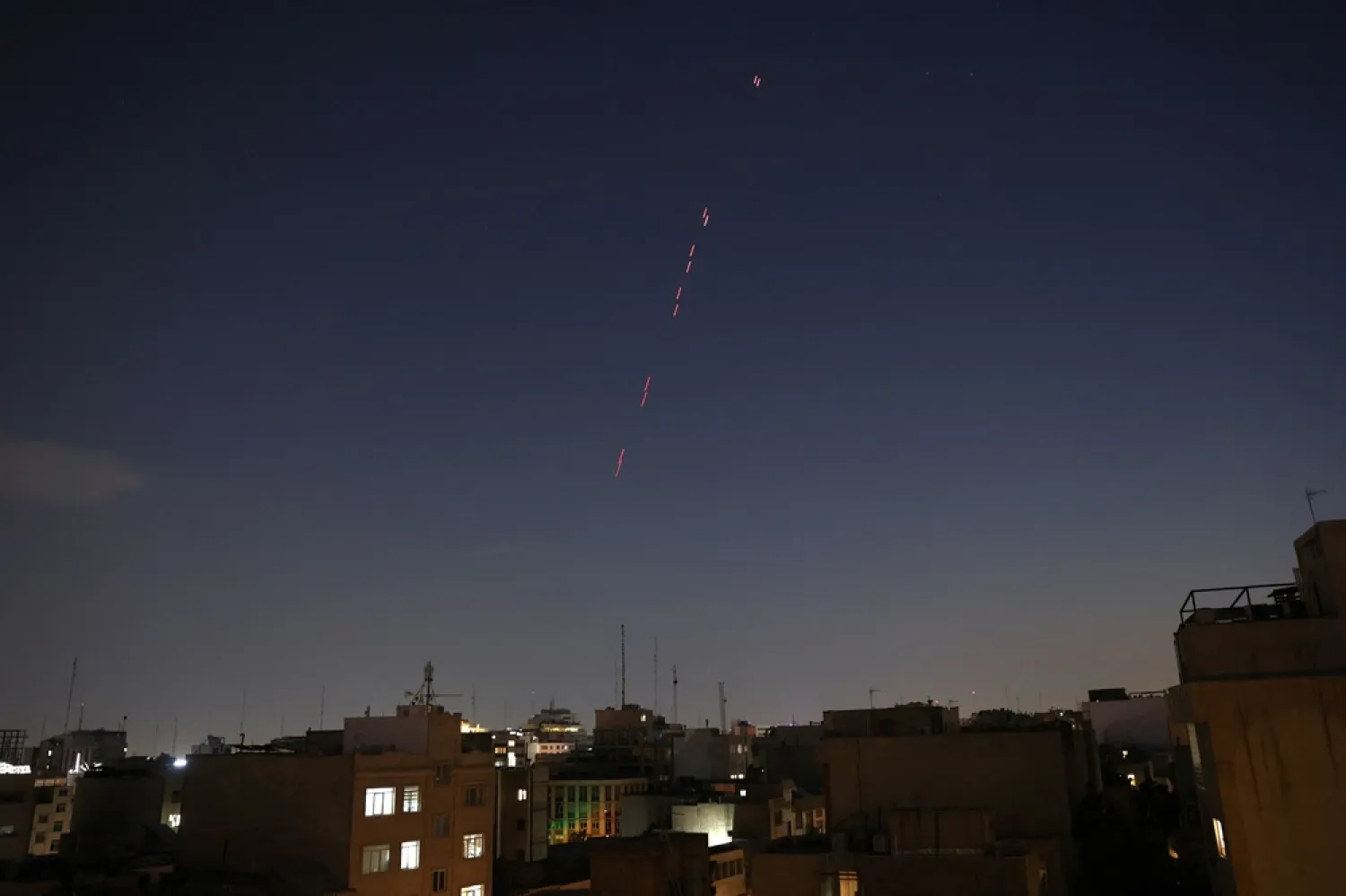
Army air defense firing is seen following the Israeli strike in Tehran, Iran, June 13, 2025. Majid Asgaripour/WANA (West Asia News Agency) via Reuters
TT

Israel Strikes Iran for Second Night, Trump Says It’s Not Too Late for Deal

Army air defense firing is seen following the Israeli strike in Tehran, Iran, June 13, 2025. Majid Asgaripour/WANA (West Asia News Agency) via Reuters

Israel launched renewed attacks on Iran as evening fell on Friday, after its biggest ever attack against its longstanding foe blasted Iran's huge underground nuclear site at Natanz and wiped out its entire top echelon of military commanders. 

Iran said that in retaliation "the gates of hell will open", while Israel said the strikes were only the start of "Operation Rising Lion". US President Donald Trump said it was not too late for Tehran to halt the bombing campaign by reaching a deal on its nuclear program. 

As evening fell on Friday, Iranian media reported explosions on the northern and southern outskirts of Tehran and at Fordow, near the city of Qom, a second nuclear site which had been spared in the first wave of attacks. 

Air defenses were activated across Tehran and explosions could be heard in Isfahan. 

Israel's military said it was striking Iranian missile and drone launching sites, and had struck another nuclear site in Isfahan. 

Israeli Prime Minister Benjamin Netanyahu said the Israeli campaign was aimed at defeating an existential threat from Iran, invoking the failure to halt the Holocaust in World War Two. 

Israel's operation "will continue for as many days as it takes to remove this threat," he said in a TV address. "Generations from now, history will record our generation stood its ground, acted in time and secured our common future." 

Iran's Supreme Leader Ali Khamenei said Israel had "unleashed its wicked and bloody" hand and would suffer "a bitter fate". 

In a phone interview with Reuters, Trump said it was not clear if Iran's nuclear program had survived. He said nuclear talks between Tehran and the United States, scheduled for Sunday, were still on the agenda though he was not sure if they would take place. 

"We knew everything," Trump said of the Israeli attack plans. 

"I tried to save Iran humiliation and death. I tried to save them very hard because I would have loved to have seen a deal worked out," Trump said. "They can still work out a deal, however, it’s not too late." 

Earlier, Trump posted on Truth Social: "Iran must make a deal, before there is nothing left." 

Israel's National Security Adviser Tzachi Hanegbi said military action by itself would not destroy Iran's nuclear program, but could "create the conditions for a long-term deal, led by the United States" to get rid of it. 

DECAPITATION 

Two regional sources said at least 20 Iranian military commanders were killed, a stunning decapitation reminiscent of Israeli attacks that swiftly wiped out the leadership of Lebanon's once-feared Hezbollah group last year. Iran also said six of its top nuclear scientists had been killed. 

Among the generals killed on Friday were the armed forces chief of staff, Major General Mohammad Bagheri, and the Revolutionary Guards chief, Hossein Salami. 

Major General Mohammad Pakpour, swiftly promoted to replace Salami as Guards commander, vowed retaliation in a letter to the Supreme Leader read out on state television: "The gates of hell will open to the child-killing regime." 

Iranians described an atmosphere of fear and anger, with some people rushing to change money and others seeking a way out of the country to safety. 

"People on my street rushed out of their homes in panic, we were all terrified," said Marziyeh, 39, who was awakened by a blast in Natanz. 

While some Iranians quietly hoped the attack would lead to changes in Iran's hardline clerical leadership, others vowed to rally behind the authorities. 

"I will fight and die for our right to a nuclear program. Israel and its ally America cannot take it away from us with these attacks," said Ali, a member of the pro-government Basij militia in Qom. 

Iranian media showed images of destroyed apartment blocks, and said nearly 80 civilians were killed in attacks that targeted nuclear scientists in their beds and wounded more than 300 people. 

Iran's ability to retaliate with weapons fired by its regional proxies has been sharply degraded over the past year, with the downfall of its ally Bashar al-Assad in Syria and the decimation of Hezbollah in Lebanon and Hamas in Gaza. 

Israel said a missile fired from Yemen - whose Houthi militia are one of the last remaining Iranian-aligned groups still able to fire at Israel - had landed in Hebron in the occupied West Bank. The Palestinian Red Crescent said three Palestinian children were wounded by shrapnel there. 

'COWARDLY' 

Israel said that Iran had launched around 100 drones towards Israeli territory on Friday, but Iran denied this and there were no reports of drones reaching Israeli targets. 

The United Nations Security Council was due to meet on Friday at Tehran's request. Iran said in a letter to the Council that it would respond decisively and proportionally to Israel's "unlawful" and "cowardly" acts. 

The price of crude leapt on fears of wider retaliatory attacks across a major oil-producing region, although there were no reports that oil production or storage was damaged. OPEC said the escalation did not justify any immediate changes to oil supply. 

An Israeli security source said Mossad commandos had been operating deep inside the country before the attack, and the Israeli spy agency and military had mounted a series of covert operations against Iran's strategic missile array. 

Israel also established an attack-drone base near Tehran, the source added. The military said it had bombarded Iran's air defenses, destroying "dozens of radars and surface-to-air missile launchers". 

Israeli officials said it may be some time before the extent of damage to the underground nuclear site at Natanz is clear, where Iran has refined uranium to levels Western countries have long said are suitable for a bomb rather than civilian use. 

Iran has long insisted its nuclear program is for civilian purposes only. The UN nuclear watchdog concluded this week that it was in violation of its obligations under the global non-proliferation treaty. 

Tehran had been engaged in talks with the Trump administration on a deal to curb its nuclear program to replace one that Trump abandoned in 2018. Tehran had rejected the last US offer. 


EU Urges Iran to Release Nobel-Prize Winner Mohammadi

A handout photo provided by the Narges Mohammadi Foundation on October 2, 2023 shows an undated, unlocated photo of Iranian rights campaigner Narges Mohammadi. (Narges Mohammadi Foundation/AFP)
TT

EU Urges Iran to Release Nobel-Prize Winner Mohammadi

A handout photo provided by the Narges Mohammadi Foundation on October 2, 2023 shows an undated, unlocated photo of Iranian rights campaigner Narges Mohammadi. (Narges Mohammadi Foundation/AFP)

The European Union called on Saturday for the release of Nobel Peace Prize laureate Narges Mohammadi, who was detained by Iranian security forces along with at least eight other activists.

Brussels described Friday's arrests in the eastern city of Mashhad as "deeply concerning".

"The EU urges Iranian authorities to release Ms. Mohammadi, taking also into account her fragile health condition, as well as all those unjustly arrested in the exercise of their freedom of expression," Anouar El Anouni, a spokesman for the bloc's diplomatic service, said.

Mohammadi, 53, who was last arrested in November 2021, has spent much of the past decade behind bars.

The 2023 Peace Prize laureate was granted temporary leave from prison on health grounds after problems related to her lungs and other issues in December 2024.

On Friday she was detained once again along with eight other activists at a ceremony for lawyer Khosrow Alikordi, who was found dead in his office last week, her foundation said.

Within Iran, the Mehr news agency cited the Mashhad governor Hassan Hosseini as saying individuals held at the ceremony had chanted "slogans deemed contrary to public norms" but did not name them.

"Mohammadi, who already had to endure years in prison because of her advocacy, bravely continues to use her voice to defend human dignity and the fundamental rights of Iranians, including freedom of expression, which must be respected at all times," El Anouni said.

Alikordi, 45, was a lawyer who had defended clients in sensitive cases, including people arrested in a crackdown on nationwide protests that erupted in 2022.

His body was found on December 5, with rights groups calling for an investigation into his death, which Norway-based NGO Iran Human Rights said "had very serious suspicion of a state murder".


US, Ukraine to Discuss Ceasefire in Berlin Ahead of European Summit

Anti-drone nets hang taut along a road near the city of Izyum of Kharkiv region, northeastern Ukraine, 12 December 2025. (EPA)
TT

US, Ukraine to Discuss Ceasefire in Berlin Ahead of European Summit

Anti-drone nets hang taut along a road near the city of Izyum of Kharkiv region, northeastern Ukraine, 12 December 2025. (EPA)

Germany will host US and Ukrainian delegations over the weekend for talks on a ceasefire in Ukraine, ahead of a summit with European leaders and President Volodymyr Zelenskiy in Berlin on Monday, a German official said on Saturday.

A US official said overnight that President Donald Trump's envoy Steve Witkoff and son-in-law Jared Kushner were travelling to Germany for talks involving Ukrainians and Europeans.

The choice to send Witkoff, who has led negotiations with Ukraine and Russia regarding a US peace proposal, appeared to be a signal that Washington saw a chance of progress. The White House had said on Thursday Trump would send an official to talks only if he felt there was enough progress to be made.

"Talks on a possible ceasefire in Ukraine are taking place in Berlin this weekend between foreign policy advisors from, among others, the US and Ukraine," said a German government source when asked about the meetings.

On Monday, Merz is hosting Zelenskiy and European leaders for a summit in Berlin, the latest in a series of public shows of support for the Ukrainian leader from allies across Europe as Kyiv faces pressure from Washington to sign up to a peace plan that initially backed Moscow's main demands.

Britain, France and Germany have been working in the last few weeks to refine the US proposals, which, in a draft disclosed last month, called for Kyiv to cede more territory, abandon its ambition to join NATO and accept limits on its armed forces.


Germany to Send Soldiers to Fortify Poland Border

A border guard officer stands guard at the Polish-Belarusian border, in Polowce, Poland. (AP file photo)
TT

Germany to Send Soldiers to Fortify Poland Border

A border guard officer stands guard at the Polish-Belarusian border, in Polowce, Poland. (AP file photo)

Germany has said it will send a group of soldiers to Poland to help with a project to fortify the country's eastern border as worries mount about the threat from Russia.

Poland, a strong supporter of Ukraine in its fight against Moscow, announced plans in May last year to bolster a long stretch of its border that includes Belarus and the Russian exclave of Kaliningrad.

The main task of the German soldiers in Poland will be "engineering activities," a spokesman for the defense ministry in Berlin said late Friday.

This could include "constructing fortifications, digging trenches, laying barbed wire, or erecting tank barriers," he said.

"The support provided by German soldiers as part of (the operation) is limited to these engineering activities."

The spokesman did not specify the exact number of troops involved, saying only it would be a "mid-range two-digit number".

They are expected to participate in the project from the second quarter of 2026 until the end of 2027.

The spokesman stressed that parliamentary approval was not needed for the deployment as "there is no immediate danger to the soldiers from military conflicts".

Except for certain exceptional cases, the German parliament has to approve the deployment of the country's armed forces overseas.

Since Russia's full-scale invasion of Ukraine in 2022, Warsaw has staunchly backed Kyiv and been a transit route for arms being supplied by Ukraine's Western allies.

Warsaw has also modernized its army and hiked defense spending.

Germany is Ukraine's second-biggest supplier of military aid after the United States and has sent Kyiv a huge quantity of equipment ranging from air defence systems to armored vehicles.
