

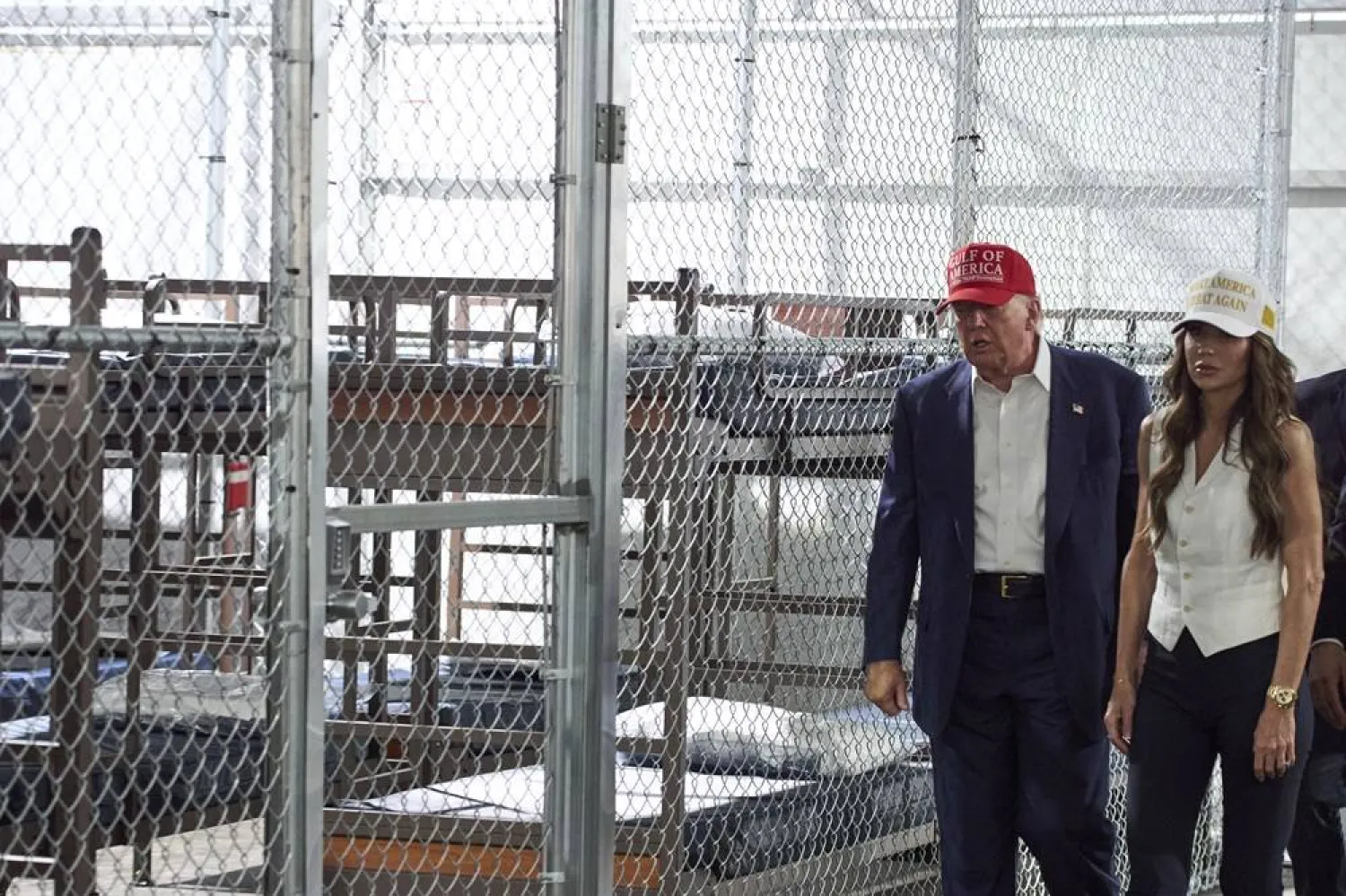

Trump Tours ‘Alligator Alcatraz’ as He Pushes for More Deportations

 President Donald Trump tours "Alligator Alcatraz," a new migrant detention facility at Dade-Collier Training and Transition facility, Tuesday, July 1, 2025, in Ochopee, Fla. (AP)
President Donald Trump tours "Alligator Alcatraz," a new migrant detention facility at Dade-Collier Training and Transition facility, Tuesday, July 1, 2025, in Ochopee, Fla. (AP)
TT

Trump Tours ‘Alligator Alcatraz’ as He Pushes for More Deportations

 President Donald Trump tours "Alligator Alcatraz," a new migrant detention facility at Dade-Collier Training and Transition facility, Tuesday, July 1, 2025, in Ochopee, Fla. (AP)
President Donald Trump tours "Alligator Alcatraz," a new migrant detention facility at Dade-Collier Training and Transition facility, Tuesday, July 1, 2025, in Ochopee, Fla. (AP)

US President Donald Trump on Tuesday toured a remote migrant detention center in the Florida Everglades dubbed "Alligator Alcatraz" as his Republican allies advanced a sweeping spending bill that could ramp up deportations.

The facility sits some 37 miles (60 km) from Miami in a vast subtropical wetland teeming with alligators, crocodiles and pythons, fearsome imagery the White House has leveraged to show its determination to purge migrants it says were wrongly allowed to stay in the country under former President Joe Biden's administration.

Trump raved about the facility's quick construction as he scanned rows of dozens of empty bunk beds enclosed in cages and warned about the threatening conditions surrounding the facility.

"I looked outside and that's not a place I want to go hiking anytime soon," Trump said at a roundtable event after his tour. "We're surrounded by miles of treacherous swampland and the only way out is really deportation."

The complex in southern Florida at the Miami-Dade Collier Training and Transition Airport is estimated to cost $450 million annually and could house some 5,000 people, officials estimate.

Florida Governor Ron DeSantis has said he will send 100 National Guard troops there and that people could start arriving at the facility as soon as Wednesday.

In promoting the opening of the facility, US officials posted on social media images of alligators wearing Immigration and Customs Enforcement hats. The Florida Republican Party is selling gator-themed clothing.

Two environmental groups filed a legal motion last week seeking to block further construction of the detention site, saying it violated federal, state and local environmental laws. The lawsuit, filed in US district court, said construction will lead to traffic, artificial light and the use of large power generators, all of which would "significantly impact" the environment.

The groups, Friends of the Everglades and Center for Biological Diversity, said the site is located at or near the Big Cypress National Preserve, a protected area that is a habitat for endangered Florida panthers and other animals.

"Putting aside whether intractable political gridlock over immigration reform constitutes an 'emergency,' it does not give license to the state and federal governments to simply disregard the laws that govern federal projects affecting environmentally sensitive lands, essential waterways, national parks and preserves, and endangered species," the groups wrote.

Some local leaders, including from the nearby Miccosukee and Seminole tribes, have objected to the facility's construction and the construction has drawn crowds of demonstrators.

Trump dismissed environmental concerns on Tuesday, saying in wide-ranging remarks that the wetlands' wildlife would outlast the human species. He said the detention facility was a template for what he'd like to do nationwide.

"We'd like to see them in many states," Trump said.

HARDLINE POLICIES

The Republican-controlled US Senate voted on Tuesday to pass a bill that adds tens of billions of dollars for immigration enforcement alongside several of the president's other tax-and-spending plans.

Trump has lobbied fiercely to have the bill passed before the July 4 Independence Day holiday, and the measure still needs a final sign-off from the House of Representatives.

The Republican president, who maintains a home in Florida, has for a decade made hardline border policies central to his political agenda.

One in eight 2024 US election voters said immigration was the most important issue. But Trump's campaign pledges to deport as many as 1 million people per year have run up against protests by the affected communities, legal challenges, employer demands for cheap labor and a funding crunch for a government running chronic deficits.

Lawyers for some of the detained migrants have challenged the legality of the deportations and criticized the conditions in temporary detention facilities.

The numbers in federal immigration detention have risen sharply to 56,000 by June 15, from 39,000 when Trump took office, government data show, and his administration has pushed to find more space.

The White House has said the detentions are a necessary public safety measure, and some of the detained migrants have criminal records, though US Immigration and Customs Enforcement detention statistics also show an eight-fold increase in arrests of people charged only with immigration violations.

Trump has spoken admiringly of vast, isolated prisons built by El Salvador and his administration has held some migrants at the Guantanamo Bay naval base, in Cuba, best known for housing foreign terrorism suspects following the September 11, 2001, attacks on the United States.

US Representative Debbie Wasserman Schultz, a Democrat who represents a district near the Florida facility, said in an emailed statement that “Trump and Republicans badly need this wasteful, dangerous, mass misery distraction” from a bill that would cause state residents to lose their health care benefits.



Israel Bombs Central Tehran; Trump Gives Iran 48 Hours to Open Strait of Hormuz

People on motorcycles ride past a large billboard with images of Iranian missiles, amid the US-Israeli conflict with Iran, in Tehran, Iran, March 15, 2026. REUTERS/Alaa Al-Marjani
TT

Israel Bombs Central Tehran; Trump Gives Iran 48 Hours to Open Strait of Hormuz

People on motorcycles ride past a large billboard with images of Iranian missiles, amid the US-Israeli conflict with Iran, in Tehran, Iran, March 15, 2026. REUTERS/Alaa Al-Marjani

President Donald Trump warned the US will “obliterate” power plants in Iran if the Iranian Republic doesn’t fully open the Strait of Hormuz within 48 hours, while Iranian missiles struck two communities not far from Israel’s main nuclear research center late Saturday, leaving buildings shattered and dozens injured in the attacks.

The developments signaled the war was moving in a dangerous new direction at the start of its fourth week, The Associated Press said.

Trump, who issued the ultimatum in a social media post while he spent the weekend at his Florida home, said he’s giving Iran 48 hours to open the vital waterway or face a new round of attacks. He said the US would destroy “various POWER PLANTS, STARTING WITH THE BIGGEST ONE FIRST!”

Iran warned early Sunday that any strike on its energy facilities would prompt attacks on US and Israeli energy and infrastructure assets in the region, according to a statement citing an Iranian military spokesperson carried by state media and semiofficial outlets.

The Strait of Hormuz, which connects the Arabian Gulf to the rest of the globe’s oceans, is a critical pathway for the world’s flow of oil. Attacks on commercial ships and threats of further strikes have stopped nearly all tankers from carrying oil, gas and other goods through the passage, leading to cuts in output from some of the world’s largest oil producers, because their crude has nowhere to go.

Iran strikes area near Israeli nuclear site

Israel’s military said it was not able to intercept missiles that hit the southern cities of Dimona and Arad, the largest near the center in Israel’s sparsely populated Negev desert. It was the first time Iranian missiles penetrated Israel’s air defense systems in the area around the nuclear site.

“If the Israeli regime is unable to intercept missiles in the heavily protected Dimona area, it is, operationally, a sign of entering a new phase of the battle,” Iran’s Parliament Speaker Mohammad Bagher Ghalibaf said on X before word of the Arad strike spread.

Rescue workers said the direct hit in Arad caused widespread damage across at least 10 apartment buildings, three of them badly damaged and in danger of collapsing. At least 64 people were taken to hospitals.

Dimona is about 20 kilometers (12 miles) west of the nuclear research center and Arad around 35 kilometers (22 miles) north.

Israel is believed to be the only Middle East nation with nuclear weapons, though its leaders refuse to confirm or deny their existence. The UN nuclear watchdog said on X it had not received reports of damage to the Israeli center or abnormal radiation levels.

The Iranian strikes in Israel came after Tehran’s main nuclear enrichment site at Natanz was hit earlier in the day.

Israel denies responsibility for attack on Natanz

Israel earlier Saturday denied responsibility for the strike on Natanz, nearly 220 kilometers (135 miles) southeast of Tehran. The Iranian judiciary’s official news agency, Mizan, said there was no leakage.

The International Atomic Energy Agency has said the bulk of Iran’s estimated 970 pounds (440 kilograms) of enriched uranium is elsewhere, beneath the rubble at its Isfahan facility. It said on X it was looking into the strike.

The Pentagon declined to comment on the strike on Natanz, which was also hit in the first week of the war and in the 12-day war last June. Russian Foreign Ministry spokesperson Maria Zakharova said such strikes posed a “real risk of catastrophic disaster throughout the Middle East.”

The US and Israel have offered shifting rationales for the war, from hoping to foment an uprising that topples Iran’s leadership to eliminating its nuclear and missile programs and its support for armed proxies. There have been no signs of an uprising, while internet restrictions limit information from Iran.

The war’s effects are felt far beyond the Middle East, raising food and fuel prices.


US Says ‘Took Out’ Iran Base Threatening Blocked Hormuz Oil Route

18 August 2022, Strait of Hormuz: A satellite image, captured by NASA, shows the Strait of Hormuz. (NASA/dpa)
TT

US Says ‘Took Out’ Iran Base Threatening Blocked Hormuz Oil Route

18 August 2022, Strait of Hormuz: A satellite image, captured by NASA, shows the Strait of Hormuz. (NASA/dpa)

The US military declared on Saturday it had taken out an Iranian bunker housing weapons threatening oil and gas shipments in the Strait of Hormuz.

The US statement appeared designed to calm the concerns of energy markets and of Washington's skeptical international allies, more than 20 of whom issued a statement vowing to back efforts to re-open the key sea lane.

Admiral Brad Cooper, head of US Central Command, said US war planes had dropped 5,000-pound bombs on an underground facility on Iran's coast that was storing anti-ship cruise missiles, mobile launchers and other equipment.

"We not only took out the facility, but also destroyed intelligence support sites and missile radar relays that were used to monitor ship movements," Cooper said in a video statement, revealing details of a strike first announced on Tuesday.

A statement from the leaders of mainly European countries, including the UK, France, Italy and Germany, but also South Korea, Australia, the UAE and Bahrain, condemned the "de facto closure of the Strait of Hormuz by Iranian forces".

"We express our readiness to contribute to appropriate efforts to ensure safe passage through the Strait. We welcome the commitment of nations who are engaging in preliminary planning," they said.

As consumers count the cost of attacks on energy facilities in the Gulf, including the world's largest gas hub, US President Donald Trump has slammed NATO allies as "cowards" and urged them to secure the strait.

Iran has choked the channel, through which around a fifth of the world's crude oil and liquefied natural gas passes during peacetime.

Foreign Minister Abbas Araghchi said Tehran had only imposed restrictions on vessels from countries involved in attacks against Iran, and would offer assistance to others that stayed out of the conflict.

Iran also denies claims -- cited in the 20-country joint statement -- that it has deployed mines in the channel.

The standoff has sent crude oil prices soaring, with a barrel of North Sea Brent crude up more than 50 percent over the past month and now comfortably more than $105.

Meanwhile, Tehran marked the end of Ramadan as the war entered its fourth week.

Iran's supreme leader traditionally leads Eid al-Fitr prayers, but Mojtaba Khamenei, who came to power earlier this month after his father was killed in US-Israeli strikes, has remained out of the public eye.

Instead, the head of the judiciary, Gholam Hossein Mohseni Ejei, attended prayers at central Tehran's Imam Khomeini grand mosque, which was overflowing, with worshippers flooding the streets outside.

The previous evening, airstrikes had darkened the mood as the city celebrated Nowruz, the Persian New Year.

Iran's ally Russian President Vladimir Putin sent greetings to Khamenei, saying he "wished the Iranian people strength on overcoming these severe trials and emphasized that during this difficult time, Moscow remained a loyal friend".


Iran ‘Unsuccessfully’ Targeted Diego Garcia Base, Reveals Source

 US Military personnel take away Joint Direct Attack Munitions (JDAMs), removed from a US Air Force B-1 Lancer bomber at RAF Fairford in southwest England on March 15, 2026. (AFP)
US Military personnel take away Joint Direct Attack Munitions (JDAMs), removed from a US Air Force B-1 Lancer bomber at RAF Fairford in southwest England on March 15, 2026. (AFP)
TT

Iran ‘Unsuccessfully’ Targeted Diego Garcia Base, Reveals Source

 US Military personnel take away Joint Direct Attack Munitions (JDAMs), removed from a US Air Force B-1 Lancer bomber at RAF Fairford in southwest England on March 15, 2026. (AFP)
US Military personnel take away Joint Direct Attack Munitions (JDAMs), removed from a US Air Force B-1 Lancer bomber at RAF Fairford in southwest England on March 15, 2026. (AFP)

Iran was "unsuccessful" in targeting the joint UK-US Indian Ocean military base at Diego Garcia, a UK official source confirmed to AFP on Saturday, after the Wall Street Journal reported Tehran fired two ballistic missiles at it.

Diego Garcia, which is around 2,500 miles (4,000 kilometers) from Iranian territory, is one of the two bases the UK has allowed the United States to use for "defensive operations" in its war against Iran.

On Friday, the UK government said it would allow Washington to use its bases in Diego Garcia and Fairford in southwest England to target Iranian "missile sites and capabilities being used to attack ships in the Strait of Hormuz".

The UK official source confirmed that Iran's "unsuccessful targeting of Diego Garcia" took place before Friday's announcement.

The source did not confirm additional details about the attack.

The Wall Street Journal reported Friday, citing US officials, that while neither of the two ballistic missiles hit their target, the launch suggests that Tehran has missiles with longer ranges than previously thought.

The Pentagon declined to comment.

One of the missiles failed in flight, and the other was targeted by an interceptor fired from a US warship, though it was not clear if the missile was hit, the WSJ reported.

"Iran's reckless attacks, lashing out across the region and holding hostage the Strait of Hormuz, are a threat to British interests and British allies," a UK Ministry of Defense spokesperson said Saturday.

"This government has given permission to the US to use British bases for specific and limited defensive operations."

Iran has "always had missiles of that sort of range that we've known about, maybe not declared", former UK Royal Navy commander and defense expert Tom Sharpe told AFP.

The attack "shows that they can still move these mobile launchers around, undetected, spin up and fire without being struck", said Sharpe, adding however that they would not be a "game changer" in the war.

- 'Strategic messaging' -

"Depending on the weight of the warhead, Iran can increase the range of some of its missiles," explained Ali Vaez, Iran project director at the Crisis Group.

"But this was less about battlefield utility than strategic messaging -- signaling to the United States and Israel that misreading Iran's resolve and capabilities could prove a costly mistake," said Vaez.

US President Donald Trump has been critical of UK Prime Minister Keir Starmer's response to the war against Iran, initially refusing to be involved before allowing Washington limited use of the two bases.

American forces have stationed bombers and other equipment at Diego Garcia, a key hub for Asia operations, including the US bombing campaigns in Afghanistan and Iraq.

Trump has also slammed Britain's decision to hand back the Chagos Islands to Mauritius after holding it since the 1960s. Under that agreement, the UK would maintain a lease for the base on Diego Garcia, the largest of the islands.

Iranian Foreign Minister Abbas Araghchi told his UK counterpart Yvette Cooper on a Thursday phone call that any US use of British bases would be considered "participation in aggression", according to Tehran's foreign ministry.

In turn, Cooper warned Araghchi "against targeting UK bases, territory or interests directly", according to a UK foreign office statement.