

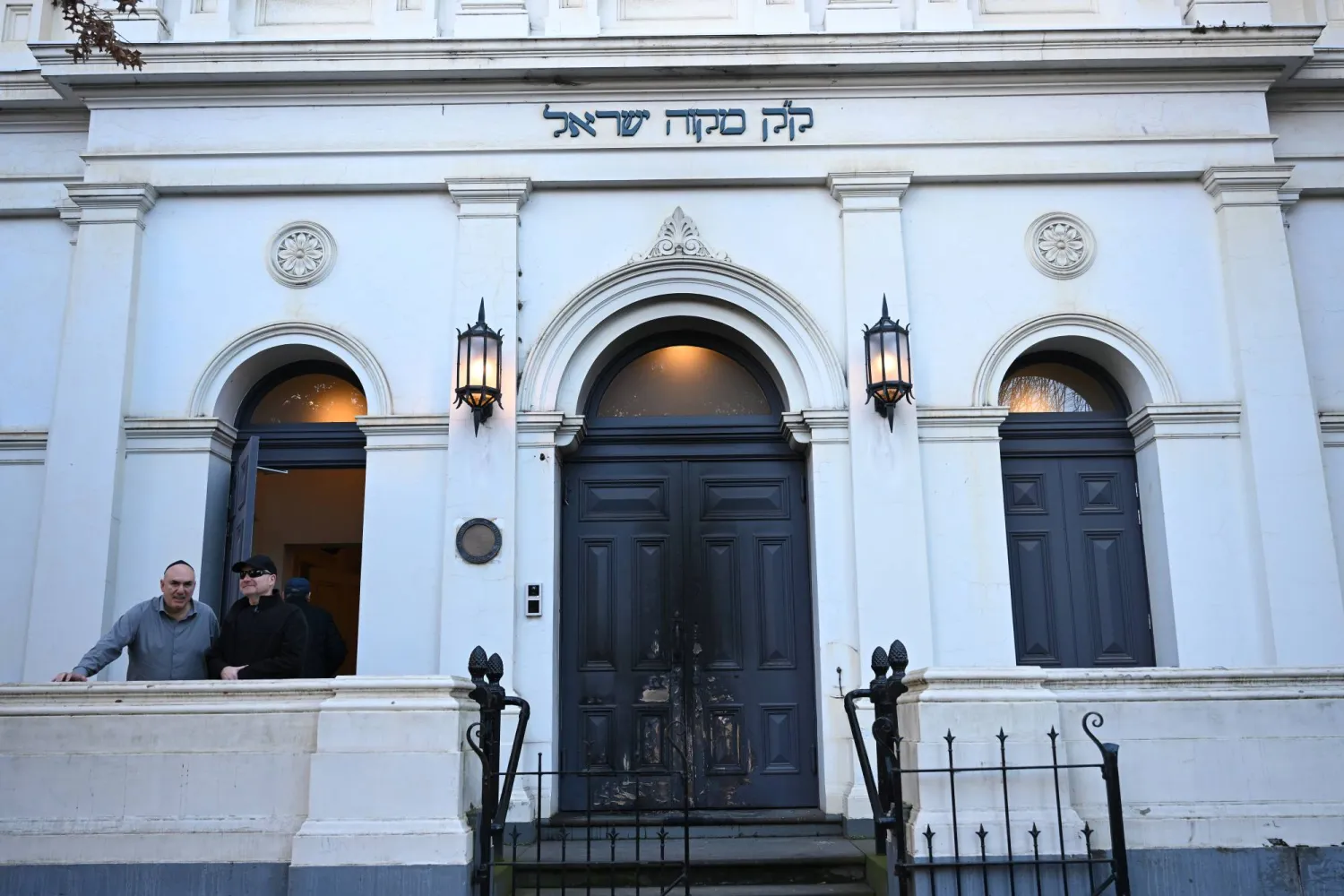

Congregation Flees after Arsonist Sets Fire to an Australian Synagogue Door

05 July 2025, Australia, Melbourne: Damage is seen on the exterior of the East Melbourne Hebrew Congregation in Melbourne. Photo: James Ross/AAP/dpa
TT

Congregation Flees after Arsonist Sets Fire to an Australian Synagogue Door

05 July 2025, Australia, Melbourne: Damage is seen on the exterior of the East Melbourne Hebrew Congregation in Melbourne. Photo: James Ross/AAP/dpa

An arsonist set fire to the door of a Melbourne synagogue and forced the congregation to flee on Friday, seven months after criminals destroyed a synagogue in the same Australian city with an accelerant-fueled blaze that left a worshipper injured.

A man doused the double front doors of the downtown East Melbourne Hebrew Congregation and set it alight around 8 p.m., a police statement said on Saturday. Around 20 worshippers sharing a meal to mark the Shabbat Jewish day of rest evacuated through a rear door and no one was injured, police said.

Fire fighters extinguished the blaze which was contained to the front entrance, police said.

Victoria Premier Jacinta Allan said both incidents were designed to “traumatize Jewish families.”

“Any attack on a place of worship is an act of hate, and any attack on a Jewish place of worship is an act of antisemitism,” she said in a statement.

Antisemitic attacks roil Australia since 2023 A wave of antisemitic attacks has roiled Australia since the Oct. 7, 2023, Hamas assault on Israel triggered the war in Gaza.

Jewish and Muslim organizations and hate researchers have recorded drastic spikes in hate-fueled incidents on both groups. The Australian government last year appointed special envoys to combat antisemitism and Islamophobia in the community.

Last December, two masked men struck the Adass Israel Synagogue in Melbourne’s southeast. They caused extensive damage by spreading a liquid accelerant with brooms throughout the building before igniting it. A worshipper sustained minor burns.

No charges have been laid for that attack, which Prime Minister Anthony Albanese blamed on antisemitism.

The Victorian Joint Counter-Terrorism Team, which includes Victoria state police, federal police and Australia’s main domestic spy agency, said the fire was likely a politically-motivated attack.

Police say synagogue attack is a serious crime

Acting Victoria Police Commander Zorka Dunstan described the latest synagogue fire as a serious crime. Police released a CCTV image of a suspect.

“I’d like to make it very clear that we do recognize that these crimes are disgusting and abhorrent. But at this stage, we are not declaring this a terrorist incident,” Dunstan told reporters.

“In the course of our investigation, we will examine the intent and the ideology of the persons involved, or person, to determine if this is in fact terrorism. At the moment, we are categorizing it as a serious criminal incident and responding accordingly,” she added.

A terrorism declaration opens the investigation to more resourcing and can result in charges that carry longer prison sentences.

The synagogue’s president, Danny Segal, called for the wider Australian community to stand with his congregation.

“We’re here to be in peace, you know, we’re here for everybody to live together and we’ve got a fresh start in Australia, such a beautiful country, and what they're doing is just not fair and not right, and as Australians, we should stand up and everybody should stand up,” Segal told reporters.

Protesters harass diners in Israeli-owned restaurant

Also in downtown Melbourne on Friday night, around 20 masked protesters harassed diners in an Israeli-owned restaurant. A Miznon restaurant window was broken. A 28-year-old woman was arrested for hindering police.

Anti-Defamation Commission chair Dvir Abramovich, a leading opponent of antisemitism in Australia, said diners were terrorized as the group chanted “Death to the IDF,” referring to the Israeli army.

“Melbourne, for one night, stopped being a safe place for Jews,” Abramovich said.

Melbourne Lord Mayor Nicholas Reece condemned both the synagogue and restaurant incidents.

“These criminal acts against a Melbourne synagogue and an Israeli business are absolutely shocking,” Reece said. “All of us as a community need to stand up against it.”

Israel’s deputy foreign minister condemned the attacks, saying it was “yet another reminder of how far racist, antisemitic hate crimes have spread in the heart of Australia,” in a statement on X.

Sharren Haskel expressed her full solidarity with the Jewish community in Melbourne, “Israel stands with you,” she said in the statement.



Erdogan Warns Black Sea Should Not Be 'Area of Confrontation' after Strikes

Turkish President Recep Erdogan addresses the media after the conclusion on the G20 Summit held at the Nasrec Expo Center in Johannesburg, South Africa, 23 November 2025. EPA/HALDEN KROG
TT

Erdogan Warns Black Sea Should Not Be 'Area of Confrontation' after Strikes

Turkish President Recep Erdogan addresses the media after the conclusion on the G20 Summit held at the Nasrec Expo Center in Johannesburg, South Africa, 23 November 2025. EPA/HALDEN KROG

Turkish President Recep Tayyip Erdogan on Saturday warned that the Black Sea should not turn into an "area of confrontation" between Russia and Ukraine, after several strikes in recent weeks.

"The Black Sea should not be seen as an area of confrontation. This would not benefit Russia or Ukraine. Everyone needs safe navigation in the Black Sea," he was quoted as telling reporters aboard his plane, according to the official Anadolu news agency.


Indonesia Flood Death Toll Passes 1,000

The deadly torrential rains are one of the worst recent disasters to strike Sumatra. (AFP)
TT

Indonesia Flood Death Toll Passes 1,000

The deadly torrential rains are one of the worst recent disasters to strike Sumatra. (AFP)

Devastating floods and landslides have killed 1,003 people in Indonesia, rescuers said Saturday as the Southeast Asian nation grapples with relief efforts.

The disaster, which has hit the northwestern island of Sumatra over the past fortnight, has also injured more than 5,400, the National Disaster Mitigation Agency said in its latest toll.

The deadly torrential rains are one of the worst recent disasters to strike Sumatra, where a tsunami wreaked havoc in 2004 in Aceh province, which lies at the northern tip of the island.

The final toll is expected to rise, with the disaster agency reporting 218 people are still missing.

With vast tracts of territory hit, 1.2 million residents have been forced to take refuge in temporary shelters.

Frustration has grown among flood victims, who have complained about the pace of relief efforts.

President Prabowo Subianto said Saturday the situation has improved, with several areas which had been cut off now accessible.

"Here and there, due to natural and physical conditions, there have been slight delays, but I checked all the evacuation sites: their conditions are good, services for them are adequate, and food supplies are sufficient," Prabowo said after visiting Langkat in North Sumatra province.

Costs to rebuild after the disaster could reach 51.82 trillion rupiah ($3.1 billion) and the Indonesian government has so far shrugged off suggestions that it call for international assistance.


Moscow, Tehran ‘Working Closely’ on Nuclear Program

Russian President Vladimir Putin and Iranian President Masoud Pezeshkian on the sidelines of the Peace Summit in Ashgabat, Turkmenistan, on Friday (Tasnim). 
TT

Moscow, Tehran ‘Working Closely’ on Nuclear Program

Russian President Vladimir Putin and Iranian President Masoud Pezeshkian on the sidelines of the Peace Summit in Ashgabat, Turkmenistan, on Friday (Tasnim). 

Russian President Vladimir Putin said on Friday that relations between Moscow and Tehran are “developing very positively,” stressing that the two countries are working in close coordination at the United Nations on Iran’s nuclear program.

He made the remarks during talks with Iranian President Masoud Pezeshkian on the sidelines of the International Peace and Trust Summit in Ashgabat.

According to Russian media, Putin said Russia is cooperating with Iran at the Bushehr nuclear power plant and on major infrastructure projects, including the North–South Transport Corridor.

He added that the two sides are also exploring cooperation in the gas and electricity sectors.

Pezeshkian, quoted by Iranian and Russian media, reaffirmed Tehran’s commitment to implementing the comprehensive strategic partnership agreement with Moscow.

He said Iran is “determined to activate the agreement” and expects Russia to accelerate implementation of joint understandings, particularly in energy, transport and strategic transit corridors.

The Iranian president said Iran would complete its share of the groundwork for the North–South Corridor by the end of the year, noting growing economic and trade cooperation between the two countries.

He also called for strengthening multilateral partnerships within frameworks such as the Shanghai Cooperation Organization and BRICS to counter what he described as “unilateralism.”

Russia and Iran aim to expand economic ties through projects such as the International North–South Transport Corridor, a multimodal route linking northern and southern Asia via sea, rail and road networks.

The corridor is intended to speed up cargo transport between Russia and India through Iran and other countries while reducing costs compared with traditional routes. The project is seen as part of Moscow’s efforts to deepen trade links with Central Asia and Europe and to lessen reliance on longer maritime routes.

Putin said bilateral trade between Russia and Iran increased by 13 percent last year and by 8 percent in the first nine months of the current year, underscoring continued cooperation in energy and infrastructure. He added that coordination between Moscow and Tehran on international issues remains “close and ongoing.”

On the sidelines of the summit, Pezeshkian also met Pakistani Prime Minister Shehbaz Sharif, with both sides agreeing on the need to accelerate implementation of bilateral agreements and enhance cooperation in transport, transit, energy and border infrastructure, according to Iran’s Mehr News Agency.