


Iran Rejects Return to Negotiations Unless Other Side Ready for ‘Fair Deal’

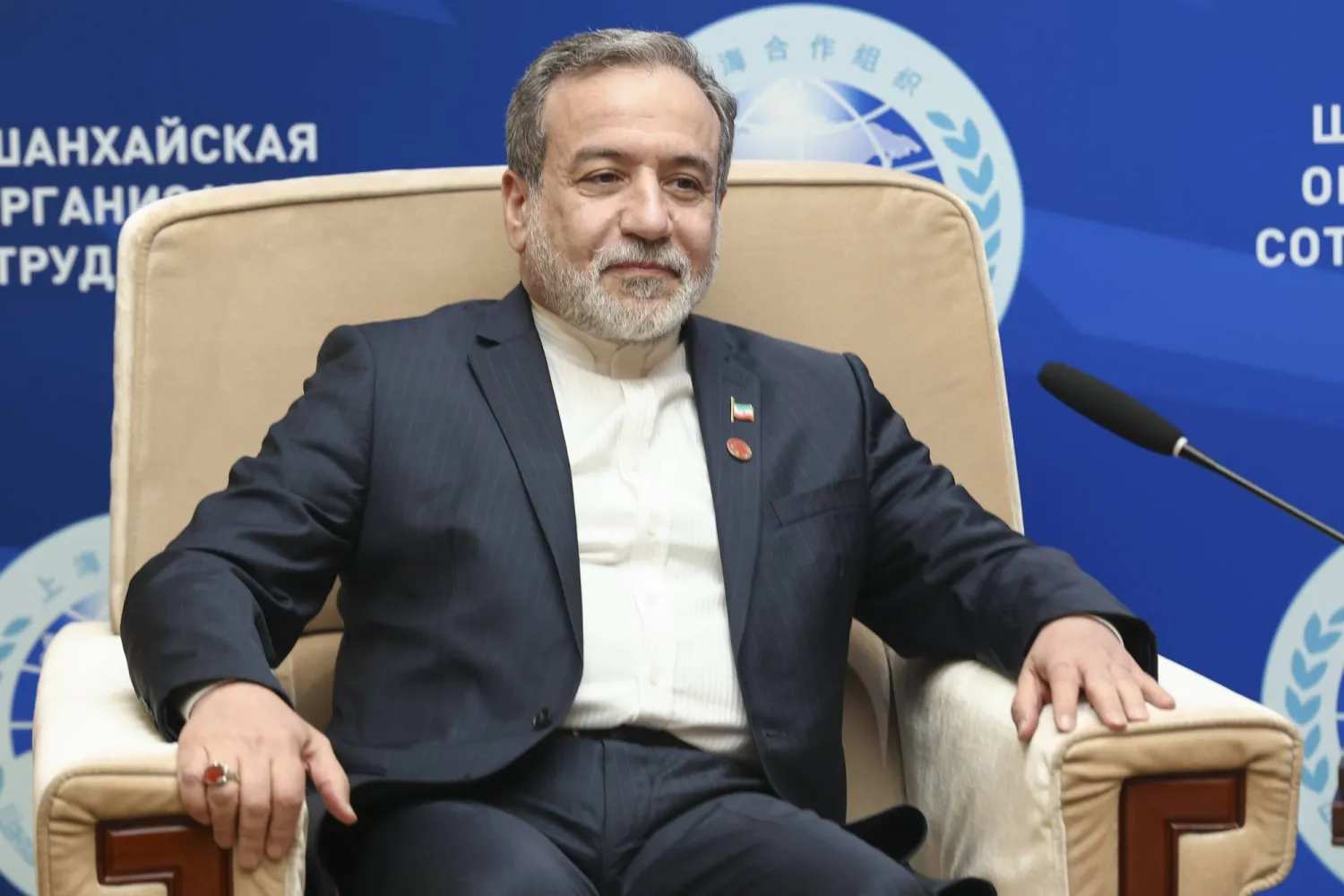
A handout photo made available by the Russian Foreign Ministry Press Service shows Iran's Foreign Minister Abbas Araghchi during his meeting with Russian Foreign Minister Sergey Lavrov (not pictured) on the sidelines of the Shanghai Cooperation Organisation (SCO) Foreign Ministers meeting in Tianjin, China, 15 July 2025.  EPA/RUSSIAN FOREIGN MINISTRY PRESS SERVICE / HANDOUT
A handout photo made available by the Russian Foreign Ministry Press Service shows Iran's Foreign Minister Abbas Araghchi during his meeting with Russian Foreign Minister Sergey Lavrov (not pictured) on the sidelines of the Shanghai Cooperation Organisation (SCO) Foreign Ministers meeting in Tianjin, China, 15 July 2025. EPA/RUSSIAN FOREIGN MINISTRY PRESS SERVICE / HANDOUT
TT

Iran Rejects Return to Negotiations Unless Other Side Ready for ‘Fair Deal’

A handout photo made available by the Russian Foreign Ministry Press Service shows Iran's Foreign Minister Abbas Araghchi during his meeting with Russian Foreign Minister Sergey Lavrov (not pictured) on the sidelines of the Shanghai Cooperation Organisation (SCO) Foreign Ministers meeting in Tianjin, China, 15 July 2025.  EPA/RUSSIAN FOREIGN MINISTRY PRESS SERVICE / HANDOUT
A handout photo made available by the Russian Foreign Ministry Press Service shows Iran's Foreign Minister Abbas Araghchi during his meeting with Russian Foreign Minister Sergey Lavrov (not pictured) on the sidelines of the Shanghai Cooperation Organisation (SCO) Foreign Ministers meeting in Tianjin, China, 15 July 2025. EPA/RUSSIAN FOREIGN MINISTRY PRESS SERVICE / HANDOUT

Iranian Foreign Minister Abbas Araghchi told his European counterparts Friday they have no grounds for reactivating UN sanctions after they threatened to do so in the coming months unless there is progress in nuclear talks.

“If EU/E3 (Germany, France and the UK) want to have a role, they should act responsibly and put aside the worn-out policies of threat and pressure, including the 'snapback' for which they [have] absolutely no moral [or] legal grounds,” Araghchi said on X.

On Friday, the Iranian FM had a joint teleconference with E3 foreign ministers and EU representatives for political affairs.

Araghchi said he told the EU and E3 officials that it was the US that withdrew from the two-year negotiated deal - coordinated by EU in 2015- not Iran.

“And it was US that left the negotiation table in June this year and chose a military option instead, not Iran,” he wrote on X.

“Any new round of talks is only possible when the other side is ready for a fair, balanced, and mutually beneficial nuclear deal,” the FM added.

In Tehran, calls have been growing to deter any move by the E3 aimed at activating the “snapback” mechanism that reimposes UN sanctions on Tehran under the nuclear deal.

France, Britain and Germany told Iran on Thursday that they would restore UN sanctions unless it reopened talks on its nuclear program immediately and produced concrete results by the end of August.

A French diplomatic source told Reuters that the ministers had urged Iran to resume diplomacy immediately to reach a “verifiable and lasting” deal, threatening to use the so-called 'snapback' mechanism if it failed to do so.

The three European countries, along with China and Russia, are the remaining parties to a 2015 deal - from which the US withdrew in 2018 - that lifted sanctions on Iran in return for restrictions on its nuclear program.

If Iran is found to be in violation of the terms, the “snapback” can be used to restore UN sanctions before the UN Security Council resolution enshrining the deal expires on October 18. The process would take about 30 days.

“The ministers also reiterated their determination to use the so-called 'snapback' mechanism in the absence of concrete progress toward such an agreement by the end of the summer,” the French diplomatic source said, without specifying what this would entail.

Since the airstrikes, inspectors from the UN nuclear watchdog, the IAEA, have left Iran. While Tehran has suggested it is open to diplomacy, there are no indications a sixth round of talks with Washington will resume soon.

Even if they do, diplomats say reaching a comprehensive accord before the end of August - the deadline the Europeans have given - seems unrealistic, especially without inspectors on the ground.

Two European diplomats said they hoped to coordinate strategy with Washington in the coming days with a view to restarting talks with Iran.



WHO Says Six Hospitals Evacuated in Iran, System Holding Up

Emergency personnel work at the site of a strike on a residential building, amid the US-Israeli conflict with Iran, in Tehran, Iran, March 16, 2026. Majid Asgaripour/WANA (West Asia News Agency) via Reuters
TT

WHO Says Six Hospitals Evacuated in Iran, System Holding Up

Emergency personnel work at the site of a strike on a residential building, amid the US-Israeli conflict with Iran, in Tehran, Iran, March 16, 2026. Majid Asgaripour/WANA (West Asia News Agency) via Reuters

A World Health Organization official said on Monday that the US-Israeli war on Iran had led to the evacuation of six hospitals but that so far the system appeared to be holding up and authorities had not sought emergency relief from the WHO.

"The primary healthcare and the health infrastructure of Iran is quite good and ‌robust, and ‌they're able to accommodate the casualties ‌as ⁠of now," WHO ⁠regional director Hanan Balkhy told Reuters.

Iran's ambassador to the UN in Geneva, Ali Bahreini, said on Monday that more than 1,300 people had been killed in Iran since the conflict began on February 28, ⁠and more than 7,000 had been injured.

The ‌WHO, which has ‌an office in Tehran and regularly helps Iranian ‌authorities with disease management, has verified 18 attacks ‌on healthcare facilities and the killing of eight medics.

Balkhy said the WHO had contingency plans to move in emergency supplies should the situation ‌deteriorate further. One potential risk is that "black rain" caused by toxic compounds carried ⁠in ⁠smoke from oil facilities that have been set on fire puts an extra burden on the healthcare system through respiratory infections, she added.

The conflict had forced the WHO to suspend flights carrying emergency medical supplies from its humanitarian hub in Dubai, but Balkhy said these had now resumed.

Requests from 25 member countries are being processed, but a WHO spokesperson said polio treatments were among those still waiting.


China Warns Trump's Latest Tariff Moves Could Damage Trade Ties

US President Donald Trump and Chinese President Xi Jinping react as they hold a bilateral meeting at Gimhae International Airport, on the sidelines of the Asia-Pacific Economic Cooperation (APEC) summit, in Busan, South Korea, October 30, 2025. REUTERS/Evelyn Hockstein
TT

China Warns Trump's Latest Tariff Moves Could Damage Trade Ties

US President Donald Trump and Chinese President Xi Jinping react as they hold a bilateral meeting at Gimhae International Airport, on the sidelines of the Asia-Pacific Economic Cooperation (APEC) summit, in Busan, South Korea, October 30, 2025. REUTERS/Evelyn Hockstein

China warned Monday that US President Donald Trump's latest tariff moves could harm the countries' trade relationship, at the end of high-level talks in Paris.

Li Chenggang, China’s international trade representative, said the Chinese side had expressed serious concern about trade investigations into manufacturing in foreign countries that the Trump administration launched after the US Supreme Court struck down its earlier tariffs, The AP news reported.

“We are concerned that the possible results of such investigations may interfere with or damage the hard-won and stable China-US economic and trade relations,” Li told journalists. He said they discussed the possible extension of tariffs and non-tariff measures on both sides, and that China expressed concern over likely uncertainty as the US adjusts its measures. He said both sides agreed to make efforts to keep the tariffs stable.

The meeting was meant to prepare for Trump's planned trip to China in about two weeks, though the president has warned that it could be delayed. Li did not address that, and did not take questions.

Treasury Secretary Scott Bessent, who led the US delegation in Paris, said the talks “were constructive and they show the stability in the relationship," and noted: “The purpose of these meetings is to prevent any retaliation.”

Trump’s visit to China would be the first for a US president since he went in his first term in 2017. It would come five months after he met President Xi Jinping in the South Korean city of Busan.

The Iran war has emerged as a potential stumbling block as the US and China were patching up relations following a tariff war in which import taxes soared to triple digits. The two sides later agreed to a one-year truce.

Trump has suggested he may delay the much-anticipated China visit as he seeks Beijing's help to reopen the Strait of Hormuz and calm oil prices that have soared during the Iran war.

But Bessent said any postponement wouldn't be to pressure China on that issue.

“If the president’s visit is postponed, it would have nothing to do with the Chinese making a commitment to the Straits of Hormuz," he told journalists.

“It would obviously be in their interest to do so, but a postponement would not be as a result of any asks from the president not being met,” Bessent added. "The postponement, if it happens, would be because the commander in chief of the United States military believes that he should stay in the United States while this war is being prosecuted.”

US Trade Representative Jamieson Greer, accompanying Bessent, said the talks sketched out “the general terms of a work plan” for a Trump-Xi meeting so that it could produce “potential deliverables.”

He said they also covered the trade investigations that concern China.

“We started these talks, really, by giving them a preview of what we’re doing on US trade policy as we adjust to the Supreme Court,” Greer said. “Remember: The president’s trade policy hasn’t changed. Our tools may change, and we’re conducting these investigations. We don’t want to prejudge them, and we had a good conversation with our counterparts about that process.”


Appeal Trial Opens for France’s Sarkozy Over Alleged Libyan Funding

FILED - 17 June 2011, Berlin: Then French President Nicolas Sarkozy speaks at a press conference in the Chancellery in Berlin. Photo: Michael Kappeler/dpa
TT

Appeal Trial Opens for France’s Sarkozy Over Alleged Libyan Funding

FILED - 17 June 2011, Berlin: Then French President Nicolas Sarkozy speaks at a press conference in the Chancellery in Berlin. Photo: Michael Kappeler/dpa

Former French president Nicolas Sarkozy was back in court Monday for a retrial on charges he sought Libyan financing for his 2007 election, in a case that last year saw him become France's first modern-day head of state to go to prison.

A lower court in September found the right-wing politician -- who was president from 2007 to 2012 -- guilty of seeking to acquire funding from Muammar Gaddafi's Libya for the campaign that saw him elected.

Sarkozy -- who has denied any wrongdoing -- in October entered a Paris prison, serving 20 days before he was released pending the appeal, AFP reported.

The 71-year-old entered the Paris Appeal Court ahead of Monday's hearing, shaking hands with police and lawyers before taking his seat in the front row of the dock.

In the retrial, set to run until June 3, the former head of state is once again presumed innocent.

Sarkozy has faced a series of legal issues since leaving office and has already received two definitive convictions in other cases.

In one, he wore an electronic ankle tag for several months, until it was removed in May last year, after being convicted for trying to extract favours from a judge.

And in the other, he will have to serve more time over illegal financing of his failed 2012 re-election bid.

In the so-called "Libyan case", he has appealed a five-year prison sentence.

A lower court in September convicted Sarkozy of criminal conspiracy over what it said was a scheme to acquire Libyan funding for his 2007 presidential run.

But it did not conclude that Sarkozy received or used the funds for the campaign.

His legal team immediately appealed, but the lower court ordered him to be sent behind bars, citing the "exceptional gravity" of the conviction.

On October 21, he became the first former head of a European Union state to be incarcerated.

- Prison diaries -

In the initial trial, prosecutors had argued Sarkozy's aides, acting in his name, struck a deal with Gaddafi in 2005 to illegally fund his victorious presidential election bid two years later.

Investigators believe that in return, Gaddafi was promised help to restore his international image after Tripoli was blamed for the 1988 bombing of a passenger jet over Lockerbie, Scotland, and another over Niger in 1989, killing hundreds of passengers.

Members of Sarkozy's circle did not wish to comment before the retrial.

Sarkozy published a hastily written book about his time in prison titled "Diary of a Prisoner", with supporters lining up around a city block in Paris to buy a copy when it came out in December.

In the 216-page book, he recounts his mundane struggles with noise and low-quality food.

But he also hints at a possible alliance between the traditional right-wing Republicans party he once headed and the country's main far-right party to "rebuild the right".

He and his wife, singer and model Carla Bruni, face another possible trial over allegations that they tried to bribe a key prosecution witness in the Libya campaign financing case with the help of a paparazzi boss. They deny wrongdoing.