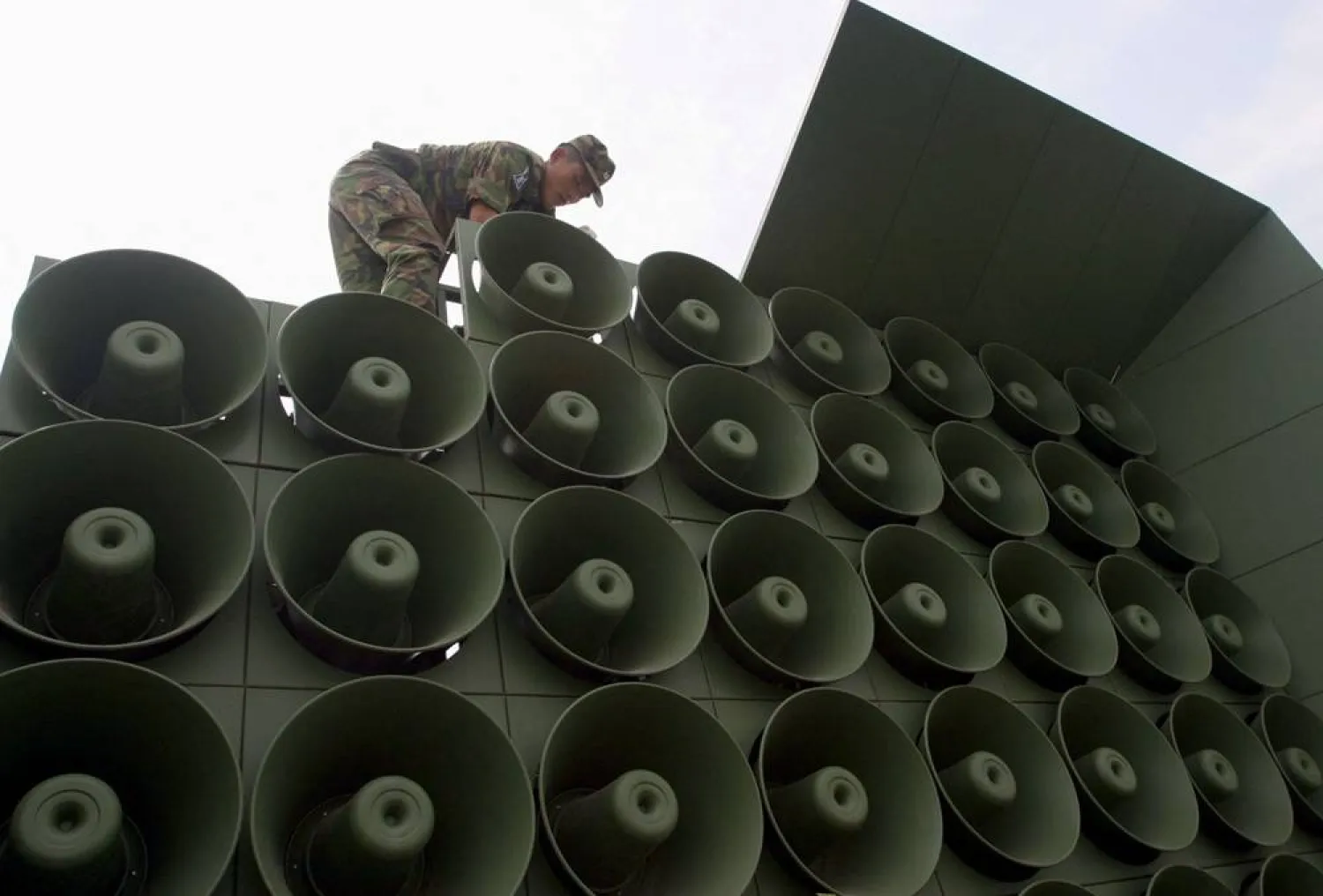
North Korea Starts Dismantling Some Border Loudspeakers, South Korea Says

A South Korean soldier works to remove loudspeakers set up for propaganda purposes near the demilitarized zone in Paju, about 55km (34 miles) north of Seoul June 16, 2004. (Reuters)
TT

North Korea Starts Dismantling Some Border Loudspeakers, South Korea Says

A South Korean soldier works to remove loudspeakers set up for propaganda purposes near the demilitarized zone in Paju, about 55km (34 miles) north of Seoul June 16, 2004. (Reuters)

South Korea's military said on Saturday it had detected North Korean military dismantling some propaganda loudspeakers aimed at the South in parts of the border area, following similar moves by the South.

This is the first time Seoul has made such a statement since President Lee Jae Myung became president two months ago and South Korea began dismantling its own speakers.

The military said further confirmation was needed on whether the dismantling was taking place across all areas, adding it would continue monitoring related activities.

Seeking to ease tensions with Pyongyang, Lee's liberal government, which replaced a conservative one, switched off propaganda broadcasts criticizing the North Korean regime soon after Lee took office.

On Monday, South Korean authorities began removing loudspeakers blaring anti-North Korea broadcasts along the country's border, as Lee revives stalled dialogue between the longtime arch-rivals.

The countries remain technically at war after the 1950-53 Korean War ended in a truce, and relations have deteriorated in the last few years.

Cross-border propaganda broadcasts through loudspeakers have been used by both sides as relations between South and North Korea have ebbed and flowed over the years.


Police Arrest Two over London Synagogue Arson Attempt

Police officers stand on duty at a cordon near to the Finchley Reform Synagogue, in the North Finchley area of north London, on April 15, 2026, following an attack on the synagogue in the early hours of the morning. (Photo by Toby Shepheard / AFP)
TT

Police Arrest Two over London Synagogue Arson Attempt

Police officers stand on duty at a cordon near to the Finchley Reform Synagogue, in the North Finchley area of north London, on April 15, 2026, following an attack on the synagogue in the early hours of the morning. (Photo by Toby Shepheard / AFP)

Police in London arrested two people on Wednesday over an attempted arson attack on a synagogue in the north of the city, amid an upsurge in “antisemitic” incidents in Britain.

The pair -- a 47-year-old woman and a 46-year-old man -- were detained in Watford, north of the capital, and are being held in custody, police said.

A little-known extremist group with possible links to Iran claimed responsibility for the attack, according to the SITE Intelligence Group, which monitors extremist activity, AFP said.

The attack shortly after midnight on Wednesday came after an arson attack on ambulances run by a Jewish charity in London last month and a deadly attack on a synagogue in Manchester in October 2025.

The latest incident, which police said was being treated as an "antisemitic hate crime", was being investigated with support from counter-terrorism detectives.

"I hope the swift action by officers today to identify and arrest two people provides some reassurance and demonstrates how seriously we take attacks of this nature," Detective Chief Superintendent Luke Williams, who leads policing in the area, said in a statement.

Describing the attack in an earlier statement, police said two people wearing dark clothing and balaclavas approached the synagogue in Finchley and "threw two bottles suspected to contain petrol" which did not ignite, the Metropolitan Police Force said.

- Surge in attacks -

Harakat Ashab al-Yamin (HAYI) group, claimed responsibility for the attack, SITE Intelligence Group reported.

The group previously claimed similar attacks in Belgium, Britain and the Netherlands.

The Community Security Trust recorded 3,700 instances of anti-Jewish hate across the UK last year, a four percent rise on 2024, but down on 2023.

Two men and a boy have been charged over the ambulance attack on March 23, in which four ambulances run by volunteer organization Hatzola were destroyed.

It provides free medical transportation and emergency response to those living in north London.

On October 2, 2025, during the Jewish holy day of Yom Kippur, the attack on the synagogue in Manchester killed two people and seriously injured three, prompting increased anxiety among Jewish communities.

In February, a court jailed two men for life after police foiled a separate plot to carry out an ISIS-inspired gun attack on a Jewish gathering in Manchester.

Two Iranians also appeared in court in London in March accused of spying on the Jewish community in London on behalf of Tehran.


Australia to Boost Defense Spending Citing Growing Threats

 This handout image taken on July 23, 2024 and released by the Australian Defense Force shows a Royal Australian Air Force (RAAF) E-7A Wedgetail airborne early warning and control aircraft (top R) in formation flight with an RAAF EA-18G Growler electronic warfare aircraft (bottom R), RAAF F/A-18F Super Hornet (top C), a Spanish Navy AV-8B Harrier II (bottom C), an F-35 Lightning II (top L), a Japan Air Self-Defense Force Mitsubishi F-2 (bottom 2nd L), and a Philippine Air Force FA-50 Golden Eagle (bottom L) over northern Australia during Exercise Pitch Black 2024.  Handout / AUSTRALIA DEFENCE FORCE/AFP
This handout image taken on July 23, 2024 and released by the Australian Defense Force shows a Royal Australian Air Force (RAAF) E-7A Wedgetail airborne early warning and control aircraft (top R) in formation flight with an RAAF EA-18G Growler electronic warfare aircraft (bottom R), RAAF F/A-18F Super Hornet (top C), a Spanish Navy AV-8B Harrier II (bottom C), an F-35 Lightning II (top L), a Japan Air Self-Defense Force Mitsubishi F-2 (bottom 2nd L), and a Philippine Air Force FA-50 Golden Eagle (bottom L) over northern Australia during Exercise Pitch Black 2024. Handout / AUSTRALIA DEFENCE FORCE/AFP
TT

Australia to Boost Defense Spending Citing Growing Threats

 This handout image taken on July 23, 2024 and released by the Australian Defense Force shows a Royal Australian Air Force (RAAF) E-7A Wedgetail airborne early warning and control aircraft (top R) in formation flight with an RAAF EA-18G Growler electronic warfare aircraft (bottom R), RAAF F/A-18F Super Hornet (top C), a Spanish Navy AV-8B Harrier II (bottom C), an F-35 Lightning II (top L), a Japan Air Self-Defense Force Mitsubishi F-2 (bottom 2nd L), and a Philippine Air Force FA-50 Golden Eagle (bottom L) over northern Australia during Exercise Pitch Black 2024.  Handout / AUSTRALIA DEFENCE FORCE/AFP
This handout image taken on July 23, 2024 and released by the Australian Defense Force shows a Royal Australian Air Force (RAAF) E-7A Wedgetail airborne early warning and control aircraft (top R) in formation flight with an RAAF EA-18G Growler electronic warfare aircraft (bottom R), RAAF F/A-18F Super Hornet (top C), a Spanish Navy AV-8B Harrier II (bottom C), an F-35 Lightning II (top L), a Japan Air Self-Defense Force Mitsubishi F-2 (bottom 2nd L), and a Philippine Air Force FA-50 Golden Eagle (bottom L) over northern Australia during Exercise Pitch Black 2024. Handout / AUSTRALIA DEFENCE FORCE/AFP

Australia will raise defense spending to 3.0 percent of GDP by 2033 as armed conflicts flare worldwide, Defense Minister Richard Marles said Thursday.

The new commitment follows pressure from US President Donald Trump's administration for Canberra to boost military expenditure as a share of total annual economic output.

"International norms that once constrained the use of force and military coercion continue to erode," Marles said in a speech in Canberra, outlining a boost to spending on missile defense, drones and guided weapon stockpiles.

"More countries are engaged in conflict today than at any time since the end of World War II, and this is occurring across every region of the world."

Australia's defense spending had previously been forecast to rise to 2.3 percent of GDP by 2033, AFP said.

But the country will spend an additional AU$53 billion ($38 billion) over the next decade when compared to its 2024 defense strategy, Marles said.

In the shorter term, spending would climb by an extra AU$14 billion over four years.

To reach the 3.0 percent figure, Australia changed how it calculates the defense budget to match a NATO definition that includes factors such as military pensions and defense intelligence.

Marles said Thursday this allowed better comparisons with other countries and put Australia ahead of comparable European and Asian nations with a defense spend this year of 2.8 percent.

- China build-up -

But the new spending still falls short of the 3.5 percent of GDP that US Defense Secretary Pete Hegseth demanded Australia shell out last year.

Wary of China's navy build-up, US ally Australia has reshaped its defense force in recent years to focus on its missile strike capability and deterring an adversary from its northern approaches.

It has also embarked on its largest-ever military spending project to build nuclear-powered submarines next decade under the AUKUS agreement with the United States and the UK.

Marles emphasized Australia would focus in 2026 on building greater military self-reliance but was not jettisoning its US security alliance, which he said remained "fundamental".

"There is no effective balance of power in the Indo-Pacific absent the continued presence of the United States," he said.

Spending to build a missile defense system will accelerate -- up to AU$30 billion over the next decade.

Another AU$36 billion will be spent to build guided missiles locally.

Australia's vast coastline and small population have also spurred a focus on developing large autonomous submarines and fighter jets, dubbed the Ghost Shark and Ghost Bat.

This week, Canberra said it would boost spending on drones by up to AU$5 billion in response to shifts in warfare tactics in the Middle East and Ukraine.

Under the AUKUS agreement, the United States will sell Australia two nuclear-powered submarines from 2032.

Australia and Britain will then build a new class of submarine in the 2040s.

Critics have alleged the deal does not guarantee that Australia will ever receive the submarines.



Türkiye Orders 83 Arrests Over Online Praise for School Shootings

Mortuary vans are parked in front of a hospital morgue, after a deadly shooting at a school, in Kahramanmaras, Turkey, April 16, 2026. REUTERS/Ensar Ozdemir
TT

Türkiye Orders 83 Arrests Over Online Praise for School Shootings

Mortuary vans are parked in front of a hospital morgue, after a deadly shooting at a school, in Kahramanmaras, Turkey, April 16, 2026. REUTERS/Ensar Ozdemir

Turkish police said on Thursday they had ordered dozens of arrests for people accused of posting controversial content on social media after two deadly school shootings this week.

"Arrest orders were issued for 83 individuals found to have engaged in posts and activities praising crime and criminals and negatively affecting public order, and legal action has been taken against them," the police said in a statement.

Funerals will be held on Thursday for nine people killed when a 14-year-old opened fire at a school in Türkiye, sending shock waves across the country.

The attack in the southern province of Kahramanmaras was Türkiye's second such incident this week in a country where such shootings have been rare.

The funerals will be for eight children aged 10 and 11 and a 55-year-old teacher, the local authorities said.

Police said Thursday that the teenager had referenced US mass killer Elliot Rodger in a photo on his WhatsApp profile.

"Initial findings from the investigation revealed that the perpetrator used an image on his WhatsApp profile referencing Elliot Rodger, who carried out an attack in the United States in 2014," the police said in a statement.

Rodger -- a 22-year-old American-- killed six people on the campus of the University of California, Santa Barbara, before taking his own life.

Rodger explained in a video released before his crime that the attack was "punishment" for the women who had rejected him.

The 14-year-old who carried out Wednesday's shooting died at the scene, officials said, though it was not clear how his death happened.

The father of teenager, identified as a former police inspector, was arrested on Wednesday and taken into custody, the police said.

"Digital media seized during searches of the perpetrator's home and his father's vehicle have been confiscated and are currently being analyzed," the police said.

"Based on initial findings, no link to terrorism has been established. This appears to be an isolated act."