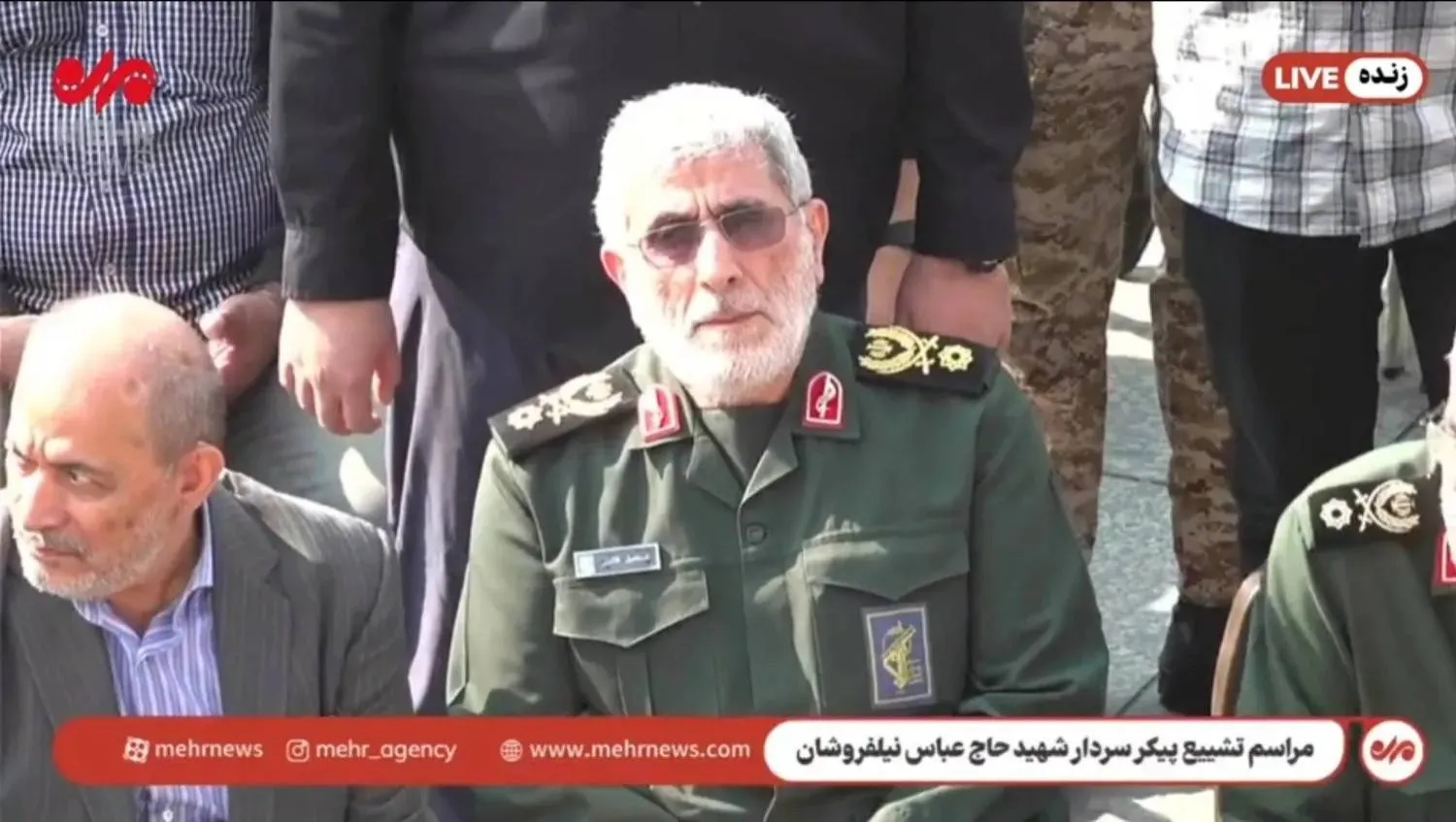

Iran’s Quds Force commander Esmail Qaani has disclosed new details about Hamas’ Oct. 7, 2023 assault on Israel, saying that even the group’s top leaders, including Ismail Haniyeh, were unaware of the exact timing of the operation.
In a televised interview broadcast by the Iranian Tasnim agency, Qaani said that when the Oct. 7 operation began, he was already on the way to Lebanon.
Qaani also revealed that he was thinking about how to raise the issue with Hezbollah’s then secretary-general, Hassan Nasrallah, and discuss what should or shouldn’t be done.
“Neither we, nor Nasrallah, nor even Hamas’ senior leadership knew the precise timing of the operation,” Qaani continued. “Ismail Haniyeh was on his way to the airport, heading to Iraq, and learned about the operation while returning.”
Qaani’s remarks, which add to the intrigue surrounding the planning of the attack, also suggested that “Nasrallah immediately began planning for the post-‘Al-Aqsa Flood’ phase.”
Haniyeh, who served as the head of Hamas’ political bureau and was among its most prominent figures, was assassinated in Tehran in July 2024 after an explosion targeted his residence in the Zafaraniyeh district. He was in the Iranian capital to attend the inauguration of President Masoud Pezeshkian.
Unlike other operations Israel has publicly claimed, it has not officially acknowledged responsibility for Haniyeh’s killing. Qaani’s name has also not appeared on any of Israel’s published target lists.
Qaani’s statements shed renewed light on the secrecy surrounding the Hamas-led assault launched from Gaza, which killed hundreds of people in Israel and triggered an unprecedented war.
Israel has long accused Iran of orchestrating or funding attacks from Gaza and Lebanon, while Tehran consistently denies direct involvement, insisting its support is political rather than military.
Commenting on Hezbollah’s position under growing pressure in Lebanon, Qaani said the group “continues to grow stronger despite the psychological and military warfare it faces.”
“Hezbollah remains a major regional power that is rising rapidly - it cannot be broken or weakened. The resistance grows more resilient every day, and none of the enemy’s weapons or psychological tactics have succeeded in undermining it,” he added.
“The resistance will persist, and Hezbollah will remain steadfast and strong, as always,” reaffirmed Qaani.
Qaani Denies Assassination Attempt Rumors
In the same interview, Qaani for the first time dismissed widespread reports that he had survived an assassination attempt, calling them “baseless rumors.”
“We acted in a way that prevented the enemy from easily detecting our communications,” he said.
In early October 2024, speculation about Qaani’s fate dominated media coverage amid reports he had been killed in Israeli strikes on Beirut’s southern suburbs or had gone into hiding for security reasons - claims that were never confirmed.
“I behaved in a way that made it difficult for the enemy to trace communications, and sometimes they spread rumors to expose them,” Qaani said, adding that senior commanders “move with extreme secrecy and their communications are protected.”
He noted that he had even hesitated to appear on television “because of the circulating rumors.”
Qaani said the Revolutionary Guards had doubled its security measures to protect senior commanders and respond to attempts targeting them.
Reports in October 2024 indicated that Qaani had traveled to Beirut to oversee Hezbollah’s situation following the killing of its secretary-general, Hassan Nasrallah. At the time, Reuters quoted Iranian officials as saying they had “lost contact with Qaani, who was in Lebanon after Nasrallah’s death,” before his deputy, Iraj Masjedi, later confirmed that Qaani was “alive and carrying out his duties.”