


India and Australia Sign a Security Deal that Includes Military Talks and Submarine Cooperation

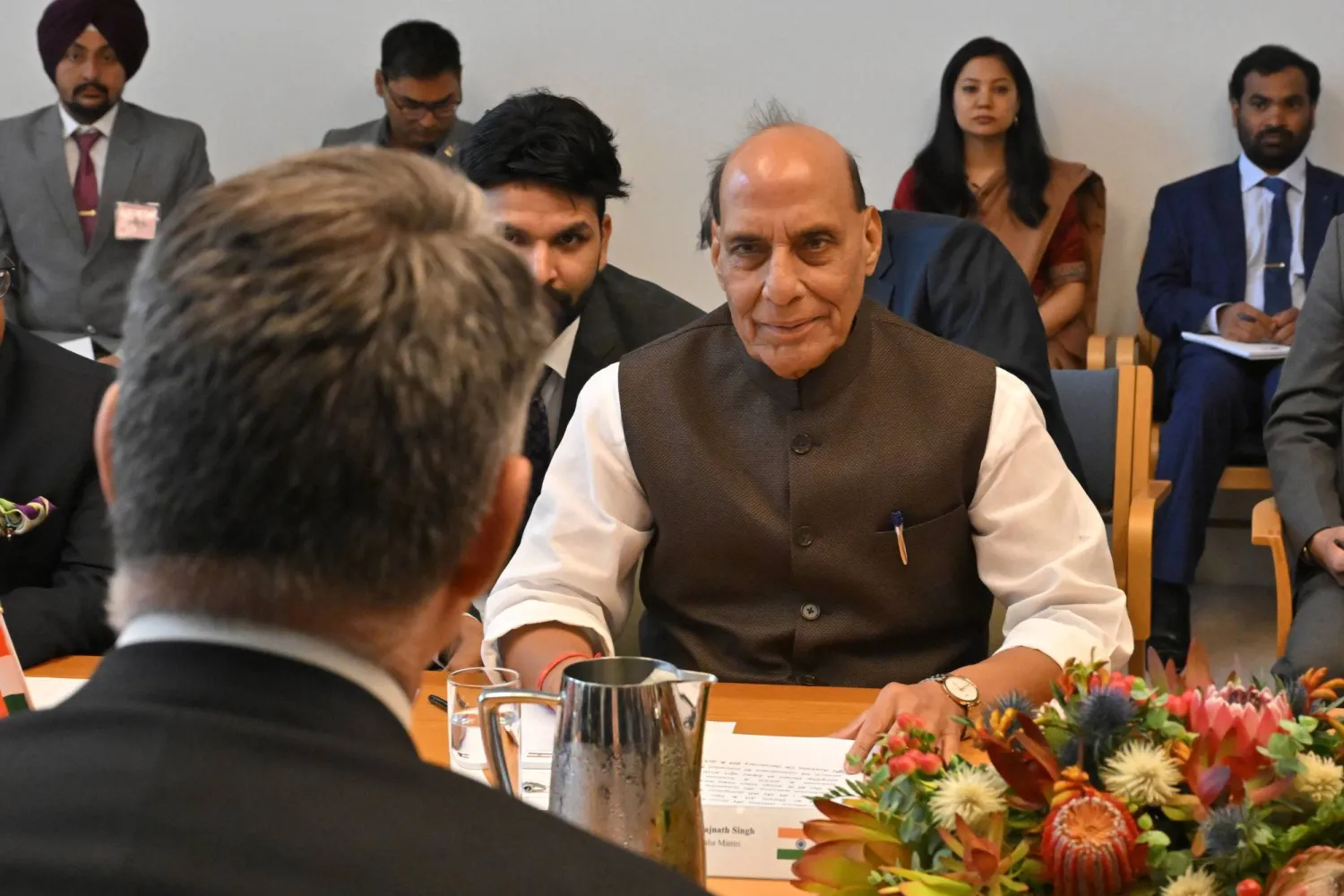
India's Defense Minister Rajnath Singh, right, sits with his Australian counterpart Richard Marles, back to camera, at Parliament House in Canberra, Australia, Thursday, Oct. 9, 2025. (Mick Tsikas/AAP Image via AP)
TT

India and Australia Sign a Security Deal that Includes Military Talks and Submarine Cooperation

India's Defense Minister Rajnath Singh, right, sits with his Australian counterpart Richard Marles, back to camera, at Parliament House in Canberra, Australia, Thursday, Oct. 9, 2025. (Mick Tsikas/AAP Image via AP)

Australian and Indian defense ministers signed a new bilateral security deal Thursday that Australia said upholds Indo-Pacific stability.

Rajnath Singh has become the first Indian defense minister to visit Australia since 2013, his Australian counterpart Richard Marles said.

“Australia and India are top-tier security partners and our defense cooperation delivers practical effects to uphold Indo-Pacific stability,” Marles’ office said in a statement.

Marles and Singh signed an agreement that included establishing a forum for joint staff talks between the two militaries and submarine rescue cooperation.

“The bilateral arrangements that will be signed today reflect the significant growth in our defense partnership and our shared ambition for its future,” Marles said before the signing.

Closer defense relations became evident in July when India for the first time participated in the biennial Talisman Sabre multination military exercises in Australia.

Talisman Sabre began in 2005 as a joint exercise between the United States and Australia. This year, more than 35,000 military personnel from 19 nations took part.

India and Australia are linked with the United States and Japan through an alliance known as the Quad.

The four countries’ foreign minister met in Washington in July and agreed to expand their cooperation on maritime security in the Indo-Pacific.

Raji Rajagopalan, a senior fellow at the Australian Strategic Policy Institute think tank, said Singh’s visit to Australia was “highly significant” both symbolically and in practical value.

While an Indian defense minister had not visited Australia in 12 years, Marles had visited India for high-level meetings several times, she said.

Rajagopalan said India used such bilateral relationships to play a part in the strategic struggle between China and the United States in the Indo-Pacific.

“There is a lot of historical hesitancy that continues to influence how far India wants to get close to the US But India is also pragmatic in recognizing that if China is India’s number one national security problem, it (India) also needs to work with the US to manage the China problem,” Rajagopalan said.

Australia has been building bilateral security ties with its South Pacific island neighbors. Australia on Monday signed a defense treaty with Papua New Guinea that will integrate the nations' defenses. It is Australia’s only alliance-level security pact other than the ANZUS Treaty signed with the United States and New Zealand in 1951.



Bus Crashes into a Bus Stop in Stockholm and Causes Fatalities, Police Say

Police technicians work on the site where a bus hit into a bus shelter in Östermalm in Stockholm, Sweden, November 14, 2025. (TT News Agency/Claudio Bresciani via Reuters)
TT

Bus Crashes into a Bus Stop in Stockholm and Causes Fatalities, Police Say

Police technicians work on the site where a bus hit into a bus shelter in Östermalm in Stockholm, Sweden, November 14, 2025. (TT News Agency/Claudio Bresciani via Reuters)

A double-decker bus crashed into a bus stop in Stockholm on Friday, causing fatalities and injuries, police said.

Police said that several people were hit but they weren't immediately giving information on their number, gender or ages.

Authorities were alerted to the crash at 3:23 p.m. on Friday. The vehicle rammed into the bus shelter on Valhallavägen, a street in the Swedish capital’s Östermalm district. The area is in the northern part of the city, near the Royal Institute of Technology.

Police were treating the crash as "involuntary manslaughter" but were still investigating. It wasn't immediately clear what the cause was.

Swedish news agency TT said police confirmed that the driver had been detained and would be questioned to determine what happened. The front of the bus appeared to be have been seriously damaged.

Emergency services said the vehicle — a regular city bus — was not in service and no passengers were on board, TT reported. It quoted a spokesperson for the Stockholm region, Michelle Marcher, as saying that "we currently have five victims, two of whom are seriously injured and have been taken to hospital."

Prime Minister Ulf Kristersson wrote on X he had "received the tragic news that several people have been killed and injured at a bus stop ... People who were perhaps on their way home to family, friends, or a quiet evening at home."

He said that "we do not yet know the cause of this, but right now my thoughts are primarily with those who have been affected and their families."


China Warns Japan of ‘Crushing’ Defeat, Tells Chinese Citizens to Shun Visits

Japan's Prime Minister Sanae Takaichi attends a session of the House of Councillors Budget Committee at the National Diet in Tokyo on November 14, 2025. (AFP)
TT

China Warns Japan of ‘Crushing’ Defeat, Tells Chinese Citizens to Shun Visits

Japan's Prime Minister Sanae Takaichi attends a session of the House of Councillors Budget Committee at the National Diet in Tokyo on November 14, 2025. (AFP)

China on Friday warned Japan of a "crushing" military defeat if it uses force to intervene over Taiwan, and even cautioned Chinese citizens against visits to Japan, angered by its prime minister's remarks about the island, which Beijing claims.

Tokyo on Friday summoned Beijing's ambassador to Japan to protest against a top Chinese diplomat's online post about Prime Minister Sanae Takaichi, continuing a tit-for-tat spat that has run for a week.

Takaichi sparked a diplomatic row with Beijing with comments in parliament last week that a Chinese attack on Taiwan could amount to a "survival-threatening situation" and trigger a military response from Tokyo.

Last Saturday, China's Consul General in Osaka, Xue Jian, shared a news article about Takaichi's remarks about Taiwan on X and commented "the dirty neck that sticks itself in must be cut off" in a now-deleted post.

The Japanese foreign ministry retaliated by summoning the Chinese ambassador to Japan for what it called "extremely inappropriate" statements made by Xue.

Some senior Japanese political figures have called for Xue's expulsion, but Tokyo has so far only asked Beijing to "take appropriate measures" without elaborating.

Chinese Defense Ministry spokesperson Jiang Bin said that Takaichi's words were extremely irresponsible and dangerous.

"Should the Japanese side fail to draw lessons from history and dare to take a risk, or even use force to interfere in the Taiwan question, it will only suffer a crushing defeat against the steel-willed People's Liberation Army and pay a heavy price," Jiang said in a statement.

On Thursday, the Chinese foreign ministry summoned Japan's ambassador to China to lodge a "strong protest" over Takaichi's remarks.

It was the first time in more than two years that Beijing has called in a Japanese ambassador. It last summoned the then-ambassador in August 2023 over Japan's decision to release wastewater from the Fukushima Daiichi nuclear power plant into the sea.

The ministry on Friday also expressed "serious concerns" about Japan's recent military and security moves, including ambiguity over its non-nuclear principles.

Ministry spokesperson Lin Jian said at a press conference that Japan's decision not to rule out acquiring nuclear submarines indicates a major "negative" policy shift.

Late on Friday the ministry asked Chinese citizens to avoid travelling to Japan in the near future, citing deteriorating ties over Takaichi's remarks and the "significant risks" its nationals would face there.

LINGERING GRIEVANCES

Chinese state media has weighed in with a series of vitriolic editorials and commentaries lambasting Takaichi, given lingering grievances about Japan's wartime past and China's extreme sensitivity over anything Taiwan-related, just two weeks after Chinese leader Xi Jinping met Takaichi in South Korea.

Takaichi's remarks were by no means an "isolated political rant," the Communist Party's People's Daily said earlier on Friday in a commentary.

Japan's right wing has been trying to loosen some of the constraints of the country's post-World War Two constitution and pursue the status of a military power, said the commentary published under the pen name "Zhong Sheng", meaning "Voice of China" and often used to give views on foreign policy.

"In recent years, Japan has been racing headlong down the path of military buildup," the paper added.

"From frequent visits to the Yasukuni Shrine, to denying the Nanjing Massacre, to vigorously hyping the 'China threat theory,' Takaichi's every step follows the old footprints of historical guilt, attempting to whitewash a history of aggression and revive militarism."

World War Two and the Japanese invasion of China which preceded it in 1931 remain a source of ongoing tension between Beijing and Tokyo.

Beijing claims democratically governed Taiwan as its own and has not ruled out using force to take control of the island. Taiwan's government rejects Beijing's claims and says only its people can decide the island's future.

Taiwan sits just over 110 km (68 miles) from Japanese territory and the waters around the island provide a vital sea route for trade that Tokyo depends on. Japan also hosts the largest contingent of US military overseas.

Japanese broadcaster NTV reported on Friday the Chinese embassy in Tokyo had instructed its staff to avoid going out due to concerns about rising anti-China sentiment.

In a regular news conference, Japan's top government spokesperson Minoru Kihara reiterated the country's position on Taiwan, telling reporters that Tokyo hopes for a peaceful resolution of the issue through dialogue.

'SELF-DIRECTED FARCE'

China has also cranked up its rhetoric against what it calls "diehard" Taiwan independence separatists.

On Friday, the State Council's Taiwan Affairs Office criticized Taiwan's ruling Democratic Progressive Party (DPP) lawmaker Puma Shen, who visited Berlin earlier this week. Shen said China was threatening to try to get him arrested while abroad, but that he was not frightened.

"Taiwan independence advocates are already at the dusk of their days and at a dead end," the office's spokesperson Chen Binhua said, according to state broadcaster CCTV.

A day earlier, Chinese police issued a wanted notice and offered a $35,000 reward for two Taiwanese social media influencers they accused of "separatism".

The two influencers took to social media to poke fun at the wanted notice.

One of them, the rapper Mannam PYC, posted a video on Friday where he tried to turn himself in to police in Taiwan.

"Why won't the Taiwan police arrest me? Does that mean everyone supports Taiwan independence?" he wrote, sarcastically.

China's legal system has no authority or jurisdiction in Taiwan.


Ukraine Begins Mass Production of Interceptor Drones to Bolster Air Defense

This handout photograph taken and released by the Ukrainian Emergency Service on November 14, 2025, shows a damaged residential building following an air strike in Kyiv, amid the Russian invasion of Ukraine. (Handout / Ukrainian Emergency Service / AFP)
TT

Ukraine Begins Mass Production of Interceptor Drones to Bolster Air Defense

This handout photograph taken and released by the Ukrainian Emergency Service on November 14, 2025, shows a damaged residential building following an air strike in Kyiv, amid the Russian invasion of Ukraine. (Handout / Ukrainian Emergency Service / AFP)

Ukraine has started mass production of its new domestically developed interceptor drones to strengthen air defenses, the Ukrainian defense ministry said on Friday.

As the war with Russia approaches the four-year mark, Ukrainian cities and towns far from the frontline are under nearly daily assault from hundreds of Russian drones.

In the latest attack on Ukraine, 430 drones were used, Ukrainian officials said.

The ministry said that the first three manufacturers have already started production, and 11 more were preparing to set up production lines.

The drones would be based on a domestically developed technology called "Octopus". The ministry said the technology to intercept Shahed drones was tested in combat and proved that it was working "at night, under jamming, and at low altitudes."

President Volodymyr Zelenskiy has said that the goal was to manufacture up to 1,000 of the interceptors a day.

Russia is investing heavily in long-range drones and has been steadily increasing the number of drones it uses in a single strike on Ukraine.

Interceptor drones, which cost a few thousand dollars each, are also important for Ukraine as it can save its more expensive missiles for faster, deadlier cruise and ballistic threats.