

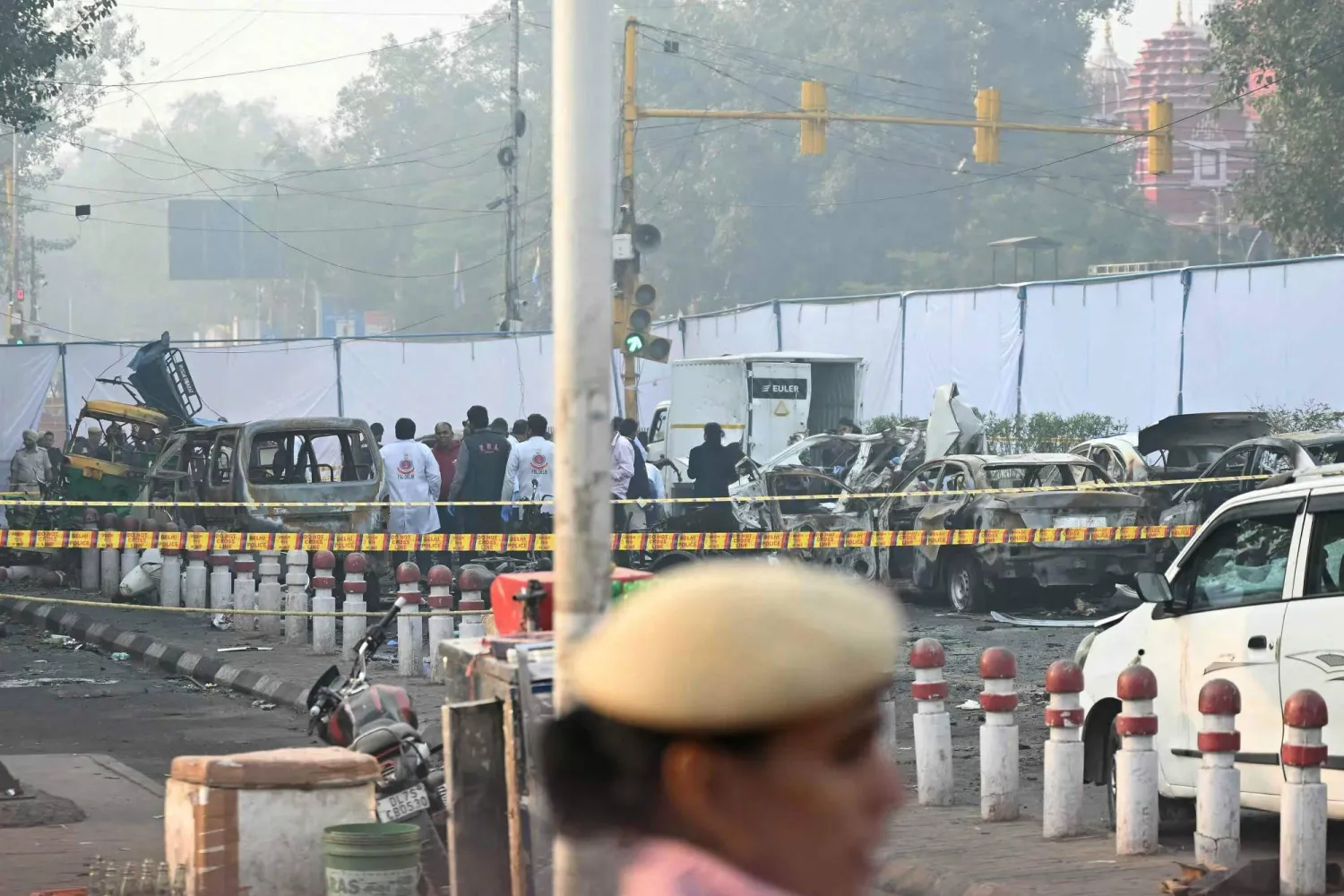

India’s Modi Vows Not to Spare Those Behind Delhi Car Blast 

 Forensic experts investigate at the blast site following an explosion near the Red Fort in the old quarters of Delhi on November 11, 2025. (AFP)
Forensic experts investigate at the blast site following an explosion near the Red Fort in the old quarters of Delhi on November 11, 2025. (AFP)
TT

India’s Modi Vows Not to Spare Those Behind Delhi Car Blast 

 Forensic experts investigate at the blast site following an explosion near the Red Fort in the old quarters of Delhi on November 11, 2025. (AFP)
Forensic experts investigate at the blast site following an explosion near the Red Fort in the old quarters of Delhi on November 11, 2025. (AFP)

Indian police are investigating a deadly car blast in the capital under a law used to fight "terrorism", an officer said on Tuesday, as Prime Minister Narendra Modi vowed to bring to justice all those responsible.

The explosion near the historic Red Fort on Monday evening killed at least eight people and injured 20. It was the first such blast in the heavily guarded city of more than 30 million since 2011.

"Today, I have come to Bhutan with a very heavy heart," Modi said in Thimphu, the capital of the neighboring Himalayan nation, as he arrived on Tuesday for a scheduled visit.

"The horrific incident that happened in Delhi last evening has deeply disturbed everyone," Modi told a public meeting.

"Our agencies will get to the very bottom of this conspiracy. The conspirators behind this will not be spared. All those responsible will be brought to justice."

ANTI-TERROR LAW

Deputy Commissioner of Police Raja Banthia said Delhi police had registered a case under the anti-terrorism law as well as the explosives act and other criminal laws.

The law, called the Unlawful Activities (Prevention) Act, is India's main anti-terrorism law. It is used to investigate and prosecute acts related to "terrorism" and activities that threaten the sovereignty and integrity of the country.

"Investigation is at a preliminary stage and any comment on it will be too premature," Banthia told reporters.

Near the site of the blast in the city's old quarters, a busy market and tourist area, most shops that shut soon after the explosion were yet to open in the early hours of Tuesday.

Forensic experts were seen scouring the site of the blast, which has been sealed since Monday night and enclosed in white cloth barriers.

Delhi Metro said the Red Fort station had been shut for security reasons.

Police said a slow-moving car which stopped at a traffic signal exploded just before 7 p.m. (1330 GMT). Nearby vehicles were also badly damaged.

The explosion left behind mangled bodies and the wreckage of several cars on a congested street near a metro station in the old quarter of Delhi.

There was no immediate information on the occupants of the car, who were presumed to have been killed. Police said they were tracing the owner of the car.

Defense Minister Rajnath Singh said agencies were carrying out a swift, thorough investigation with the findings to be made public soon.

Relatives of the victims gathered outside the nearby Lok Nayak hospital to identify the bodies of their loved ones.

"We at least know that my cousin is here, whether he is injured or not or the extent of his injury, we don't know anything," said a distressed relative who did not want to be named.

MODI IN BHUTAN

The Red Fort, popularly known as Lal Qila, is a sprawling, 17th-century Mughal-era edifice melding Persian and Indian architectural styles, thronged by tourists year-round.

The prime minister also addresses the nation from the fort's ramparts every year on August 15, India's independence day.

Modi is in Bhutan for the 70th birthday celebrations of its fourth king, Jigme Singye Wangchuck.

In April, Modi cut short a visit to Saudi Arabia and returned home after 26 men were killed in an attack on Hindu tourists in the Jammu and Kashmir territory.

New Delhi blamed that attack on what it called "terrorists" backed by Pakistan, a charge denied by Islamabad.

The crisis led to the worst military conflict between the nuclear-armed rivals in decades before they agreed to a ceasefire after four days.



Iran's Supreme Leader Says Protesters are 'Ruining their Own Streets' to Please Trump

FILE PHOTO: Iran's Supreme Leader Ali Khamenei speaks during a meeting in Tehran, Iran January 3, 2026. Office of the Iranian Supreme Leader/WANA (West Asia News Agency)/Handout via REUTERS
TT

Iran's Supreme Leader Says Protesters are 'Ruining their Own Streets' to Please Trump

FILE PHOTO: Iran's Supreme Leader Ali Khamenei speaks during a meeting in Tehran, Iran January 3, 2026. Office of the Iranian Supreme Leader/WANA (West Asia News Agency)/Handout via REUTERS

Iranian protesters shouted and marched through the streets into Friday morning after a call by the country’s exiled crown prince for demonstrations, despite Iran’s theocracy cutting off the nation from the internet and international telephone calls.

Short online videos shared by activists purported to show protesters chanting against Iran’s government around bonfires as debris littered the streets in the capital, Tehran, and other areas. Iranian state media broke its silence Friday over the protests, alleging “terrorist agents” of the US and Israel set fires and sparked violence. It also said there were “casualties,” without elaborating.

Iran's 86-year-old Supreme Leader Ali Khamenei, in a brief address aired by state television, signaled authorities would crack down on demonstrators as an audience shouted: “Death to America!”

Protesters are “ruining their own streets to make the president of another country happy,” Khamenei said, referring to US President Donald Trump.

The full scope of the demonstrations couldn’t be immediately determined due to the communications blackout, though it represented yet another escalation in protests that began over Iran’s ailing economy and that has morphed into the most significant challenge to the government in several years. The protests have intensified steadily since beginning Dec. 28.

The protests also represented the first test of whether the Iranian public could be swayed by Crown Prince Reza Pahlavi, whose fatally ill father fled Iran just before the country’s 1979 Iranian Revolution. Demonstrations have included cries in support of the shah, something that could bring a death sentence in the past but now underlines the anger fueling the protests that began over Iran’s ailing economy.

So far, violence around the demonstrations has killed at least 42 people while more than 2,270 others have been detained, said the US-based Human Rights Activists News Agency.

Pahlavi, who called for protests Thursday night, similarly has called for demonstrations at 8 p.m. Friday.

“What turned the tide of the protests was former Crown Prince Reza Pahlavi’s calls for Iranians to take to the streets at 8 p.m. on Thursday and Friday,” said Holly Dagres, a senior fellow at the Washington Institute for Near East Policy. “Per social media posts, it became clear that Iranians had delivered and were taking the call seriously to protest in order to oust the Islamic Republic.”

“This is exactly why the internet was shut down: to prevent the world from seeing the protests. Unfortunately, it also likely provided cover for security forces to kill protesters.”

Thursday night protests preceded internet shutdown

When the clock struck 8 p.m. Thursday, neighborhoods across Tehran erupted in chanting, witnesses said. The chants included “Death to the dictator!” and “Death to the Islamic Republic!” Others praised the shah, shouting: “This is the last battle! Pahlavi will return!” Thousands could be seen on the streets before all communication to Iran cut out.

“Iranians demanded their freedom tonight. In response, the regime in Iran has cut all lines of communication,” Pahlavi said. “It has shut down the Internet. It has cut landlines. It may even attempt to jam satellite signals.”

He went on to call for European leaders to join US President Donald Trump in promising to “hold the regime to account.”

“I call on them to use all technical, financial, and diplomatic resources available to restore communication to the Iranian people so that their voice and their will can be heard and seen,” he added. “Do not let the voices of my courageous compatriots be silenced.”

Pahlavi had said he would offer further plans depending on the response to his call. His support of and from Israel has drawn criticism in the past — particularly after the 12-day war Israel waged on Iran in June. Demonstrators have shouted in support of the shah in some demonstrations, but it isn’t clear whether that’s support for Pahlavi himself or a desire to return to a time before the 1979 Iranian Revolution.

The internet cut also appears to have taken Iran’s state-run and semiofficial news agencies offline as well. The state TV acknowledgment at 8 a.m. Friday represented the first official word about the demonstrations.

State TV claimed the protests saw violence that caused casualties but did not elaborate. It also said the protests saw “people’s private cars, motorcycles, public places such as the metro, fire trucks and buses set on fire.”

Trump renews threat over protester deaths Iran has faced rounds of nationwide protests in recent years. As sanctions tightened and Iran struggled after the 12-day war, its rial currency collapsed in December, reaching 1.4 million to $1. Protests began soon after, with demonstrators chanting against Iran’s theocracy.

It remains unclear why Iranian officials have yet to crack down harder on the demonstrators. Trump warned last week that if Tehran “violently kills peaceful protesters,” America “will come to their rescue.”

In an interview with talk show host Hugh Hewitt aired Thursday, Trump reiterated his pledge.

Iran has “been told very strongly, even more strongly than I’m speaking to you right now, that if they do that, they’re going to have to pay hell,” Trump said.

Trump demurred when asked if he’d meet with Pahlavi.

“I’m not sure that it would be appropriate at this point to do that as president,” Trump said. “I think that we should let everybody go out there, and we see who emerges.”

Speaking in an interview with Sean Hannity aired Thursday night on Fox News, Trump went as far as to suggest 86-year-old Supreme Leader Ali Khamenei may be looking to leave Iran.

“He's looking to go someplace,” Trump said. “It's getting very bad.”


US Announces Aid to Bolster Thailand, Cambodia Truce

This handout photograph taken and released by Agence Kampuchea Press (AKP) on January 2, 2026 shows a general view of damaged houses following clashes between Cambodian and Thai soldiers, in Chouk Chey village in Banteay Meanchey province. (Agence Kampuchea Press (AKP) / AFP)
TT

US Announces Aid to Bolster Thailand, Cambodia Truce

This handout photograph taken and released by Agence Kampuchea Press (AKP) on January 2, 2026 shows a general view of damaged houses following clashes between Cambodian and Thai soldiers, in Chouk Chey village in Banteay Meanchey province. (Agence Kampuchea Press (AKP) / AFP)

The United States on Friday announced some $45 million in aid as it tries to bolster a fragile truce between Thailand and Cambodia.

Michael DeSombre, the top State Department official for East Asia, was visiting Thailand and Cambodia to discuss ways to strengthen the ceasefire, which President Donald Trump has sought to highlight as an achievement.

DeSombre said the United States would offer $20 million to help both countries combat drug trafficking and cyber scams, which have become a major concern in Cambodia.

He also said the United States would give $15 million to help support people displaced by the recent fighting as well as $10 million for demining, AFP said.

"The United States will continue to support the Cambodian and Thai governments as they implement the Kuala Lumpur Peace Accords and pave the way for a return to peace, prosperity and stability for their people and the region," DeSombre said in a statement.

He was referring to an agreement signed between the two countries in the presence of Trump during an October visit to Malaysia, then head of the ASEAN regional bloc.

Major new clashes erupted last month. The two sides reached a truce on December 27 after three weeks of fighting, although Thailand accused Cambodia of violating in apparent accidental fire.

Cambodia has called on Thailand to pull out its forces from several border areas that Phnom Penh claims as its own.

The nations' long-standing conflict stems from a dispute over the colonial-era demarcation of their 800-kilometer (500-mile) border, where both sides claim territory and centuries-old temple ruins.

Trump has listed the conflict as one of a number of wars he says he has solved as he loudly insists he deserves the Nobel Peace Prize.

Trump on taking office drastically slashed foreign aid, including for months freezing longstanding assistance to Cambodia for demining, with the administration saying it will provide money only in support of narrow US interests.


Zelensky Calls for 'Clear Reaction' From World to Russian Attack

Ukraine's President Volodymyr Zelensky addresses a press conference upon the signing of the declaration on deploying post-ceasefire force in Ukraine during the Coalition of the Willing summit on security guarantees for Ukraine, at the Elysee Palace in Paris, France, 06 January 2026.  EPA/LUDOVIC MARIN / POOL  MAXPPP OUT
Ukraine's President Volodymyr Zelensky addresses a press conference upon the signing of the declaration on deploying post-ceasefire force in Ukraine during the Coalition of the Willing summit on security guarantees for Ukraine, at the Elysee Palace in Paris, France, 06 January 2026. EPA/LUDOVIC MARIN / POOL MAXPPP OUT
TT

Zelensky Calls for 'Clear Reaction' From World to Russian Attack

Ukraine's President Volodymyr Zelensky addresses a press conference upon the signing of the declaration on deploying post-ceasefire force in Ukraine during the Coalition of the Willing summit on security guarantees for Ukraine, at the Elysee Palace in Paris, France, 06 January 2026.  EPA/LUDOVIC MARIN / POOL  MAXPPP OUT
Ukraine's President Volodymyr Zelensky addresses a press conference upon the signing of the declaration on deploying post-ceasefire force in Ukraine during the Coalition of the Willing summit on security guarantees for Ukraine, at the Elysee Palace in Paris, France, 06 January 2026. EPA/LUDOVIC MARIN / POOL MAXPPP OUT

Ukrainian President Volodymyr Zelensky called for the world to act after Russia hit western Ukraine with its new Oreshnik ballistic missile in a massive overnight attack that killed four in the capital Kyiv.

"A clear reaction from the world is needed. Above all from the United States, whose signals Russia truly pays attention to," Zelensky said on social media.

"Russia must receive signals that it is its obligation to focus on diplomacy, and must feel consequences every time it again focuses on killings and the destruction of infrastructure," he added.