

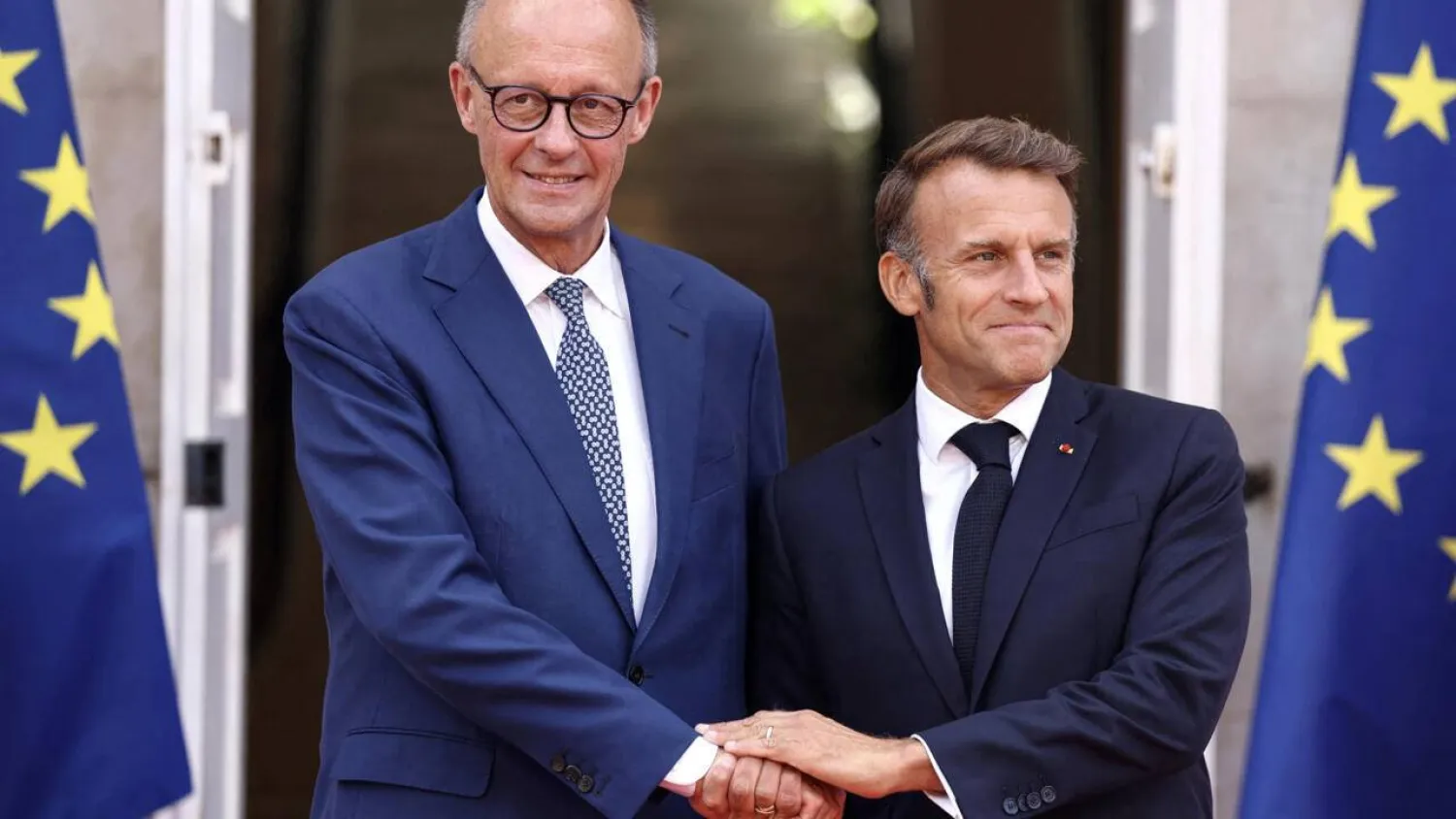

Merz, Macron to Push for European Digital 'Sovereignty'

France's President Emmanuel Macron and German Chancellor Friedrich Merz will address a digital summit in Berlin. Manon Cruz / POOL/AFP
TT

Merz, Macron to Push for European Digital 'Sovereignty'

France's President Emmanuel Macron and German Chancellor Friedrich Merz will address a digital summit in Berlin. Manon Cruz / POOL/AFP

German Chancellor Friedrich Merz and French President Emmanuel Macron will join forces Tuesday to push for greater European digital "sovereignty" and less dependence on US tech titans as the AI race gathers pace.

The leaders of Europe's biggest economies will make the call at a Berlin summit, which will also be attended by CEOs of top regional firms including French AI company Mistral and German software giant SAP, AFP reported.

With artificial intelligence set to play an increasingly important role in many sectors, Europe's leaders are responding to growing calls for the continent to take greater control of its own digital destiny.

Concerns about American tech dominance have also escalated since the return of US President Donald Trump, who has questioned long-standing ties between the continent and Washington in many areas.

German Digital Minister Karsten Wildberger said Monday that the summit's "core message" would be that "Europe is ready to shape its own digital future, to reduce dependence".

"We can make better progress by working together," he added while attending a ground-breaking ceremony for an 11-billion-euro ($12.8 billion) data center outside Berlin.

The European Union in particular has been criticized for moving too slowly in the battle for AI dominance against the United States and China.

The EU will propose a rollback of rules on AI and data protection later this week, a topic that is expected to feature prominently at the summit.

Both European businesses struggling to catch up and American tech giants have complained about the regulations, although the EU now stands accused of putting competitiveness before citizens' privacy.

Cloud computing concerns

Another topic of discussion in Berlin will be efforts to build up "sovereign" EU cloud computing capabilities. Proponents argue such facilities would better protect Europeans' data in a sector currently dominated by US firms like Google, AWS and Microsoft.

Fostering greater competition between industry and governments as well as creating "fair and efficient" digital markets will also be on the agenda.

Merz and Macron are due to give keynote addresses in the afternoon at the summit, which will also be attended by digital ministers from across Europe. Both leaders will then have dinner with British Prime Minister Keir Starmer, a German government spokesman said, without revealing what the trio will talk about.

Several announcements related to new digital initiatives are expected.

As well as worries about US dependence, Europe has more long-standing concerns about reliance on firms from Communist Party-ruled China and other parts of Asia for hardware, from semiconductors to laptop components.

According to a survey by digital business association Bitkom, about 90 percent of German companies that import digital goods or services consider themselves dependent on them.

'Europe must invest'

Bitkom President Ralf Wintergerst said that Europe needed to urgently invest more in the digital sector.

"Europe must not fall behind -- today's investments secure tomorrow's competitiveness and jobs," he told AFP. "If Europe does not want to become a museum of technology, we must ramp up investment significantly."

But Europe faces an uphill battle. The region is struggling after a period of prolonged economic weakness and its tech firms remain far smaller than their US rivals.

As of last year the continent's data centers -- crucial for AI -- had computing capacity of just 16 gigawatts, compared with 48 in the US and 38 in China, according to a recent Bitkom study.

And recent investment announcements in Germany -- billions of dollars from Google and a tie-up between US chip juggernaut Nvidia and Deutsche Telekom for an industrial AI hub -- have only highlighted the continued dependence on American tech, critics say.

Despite the US-Europe tensions, a senior official from the French presidency said the summit was not about "confrontation" with the United States or even China.

Rather it is about "how we protect our core sovereignty and what rules need to be established, especially at the European level", said the official.



‘He Probably Would’ve Survived’: Iran Targeting Hospitals in Crackdown

A bus burned during protests on a street in Tehran, Iran, January 16, 2026. Majid Asgaripour/WANA (West Asia News Agency) via Reuters
TT

‘He Probably Would’ve Survived’: Iran Targeting Hospitals in Crackdown

A bus burned during protests on a street in Tehran, Iran, January 16, 2026. Majid Asgaripour/WANA (West Asia News Agency) via Reuters

Hospitals are no longer places of safety as Iran's crackdown on anti-government protests impacts all aspects of life, rights groups say, with authorities arresting wounded protesters and even the medics who treat them.

Activists accuse security forces of killing thousands of people and wounding more by directly firing on protests, often with birdshot that can leave metal pellets lodged in the body until hygienically extracted by a professional.

But rights groups say authorities have raided hospitals searching for people with wounds that suggest they were involved in protests. At least five doctors have meanwhile been arrested for treating them, according to the World Health Organization.

Amnesty International said security forces had "arrested protesters receiving treatment in hospitals", adding it had received information that medical staff in central Isfahan province had been ordered to notify authorities about patients with injuries from gunshots and shotgun pellets.

The New York-based Center for Human Rights in Iran (CHRI) said it "has documented cases in which security forces raided hospitals to identify and arrest protesters injured during demonstrations".

In apparent response to the charges, Iran's health ministry this week urged those injured in the protests to go to hospital.

"Our advice to the public is that if they suffer any kind of injury, they should not try to treat it at home, and they should not worry about going to medical centers," the health ministry said, in a statement carried by state television.

- 'Raiding medical facilities' -

Sajad Rahimi, 36, from Iran's Gulf island of Qeshm, was badly wounded after security forces shot at him when he joined a protest in the southern province of Fars at the peak of the movement on January 9, according to Norway-based NGO Iran Human Rights.

But fearing he could be shot dead by security forces in a "coup de grace", he asked friends not to take him directly to hospital, said IHR, which has investigated this and several other cases and spoke to the man's brother.

Eventually, the family transferred him to hospital, but he died as a result of a deep wound caused by live ammunition and severe bleeding.

"The doctor said that if he had arrived at the hospital just ten minutes earlier, he would probably have survived," his brother told IHR.

The group said it had reports of "security forces raiding certain medical facilities and informal shelters for the wounded in order to arrest medical staff and volunteer first responders".

The Hengaw rights group, also based in Norway, highlighted the case of Dr Ali Reza Golchni, a physician from the city of Qazvin, northwest of Tehran, who it said had been arrested "for providing medical care to injured protesters".

- 'Grave violations' -

World Health Organization director general Tedros Adhanom Ghebreyesus said he was "deeply concerned by multiple reports of health personnel and medical facilities in Iran being impacted by the recent insecurity, and prevented from delivering their essential services to people requiring care".

He said there were reports of "at least five doctors detained, while treating injured patients".

The World Medical Association (WMA) said it had received reports that security forces arrested injured protesters in both the Isfahan and the southwestern province of Chaharmahal-and-Bakhtiari.

"Hospital staff have also been instructed to report patients suffering gunfire injuries to security authorities, with non-compliance exposing them to prosecution and other reprisals," it said, citing information received by the WMA.

Hengaw also cited the case of Taher Malekshahi, a 12-year-old Kurdish-Iranian boy from Qorveh in western Iran who was severely injured after being shot in the face and eyes with pellet ammunition.

It said he lost one eye and suffered serious damage to the other, publishing a picture of his face with the boy's entire forehead pock-marked with pellet wounds.

It said while he was currently receiving intensive medical treatment in Tehran, "authorities have pressured his family to falsely claim he was wounded by 'terrorists' in exchange for state recognition as a war-disabled victim."


Guterres Warns of UN’s ‘Imminent Financial Collapse’

 United Nations Secretary-General Antonio Guterres speaks during a press conference outlining his priorities for 2026 at UN headquarters in New York City, US, January 29, 2026. (Reuters)
United Nations Secretary-General Antonio Guterres speaks during a press conference outlining his priorities for 2026 at UN headquarters in New York City, US, January 29, 2026. (Reuters)
TT

Guterres Warns of UN’s ‘Imminent Financial Collapse’

 United Nations Secretary-General Antonio Guterres speaks during a press conference outlining his priorities for 2026 at UN headquarters in New York City, US, January 29, 2026. (Reuters)
United Nations Secretary-General Antonio Guterres speaks during a press conference outlining his priorities for 2026 at UN headquarters in New York City, US, January 29, 2026. (Reuters)

The UN chief has told member states that the organization is at risk of "imminent financial collapse", citing unpaid fees and a budget rule that forces the global body to return unspent money, a letter seen by Reuters on Friday showed.

UN Secretary-General Antonio Guterres has repeatedly spoken about the organization's worsening liquidity crisis, but this is his starkest warning yet, and it comes as its main contributor the United States is retreating from multilateralism on numerous fronts.

"The crisis is deepening, threatening program delivery and risking financial collapse. ‌And the situation ‌will deteriorate further in the near future," Guterres wrote ‌in ⁠a letter ‌to ambassadors dated January 28.

The US has slashed voluntary funding to UN agencies and refused to make mandatory payments to its regular and peacekeeping budgets. US President Donald Trump has described the UN as having "great potential" but said it is not fulfilling that, and he has launched a Board of Peace which some fear could undermine the older international body.

Founded in 1945, the UN has 193 member states and works to maintain ⁠international peace and security, promote human rights, foster social and economic development, and coordinate humanitarian aid.

In his letter, Guterres ‌said "decisions not to honor assessed contributions that finance a ‍significant share of the approved regular ‍budget have now been formally announced."

He did not say which state or ‍states he was referring to, and a UN spokesperson was not immediately available for comment.

'KAFKAESQUE CYCLE'

Under UN rules, contributions depend on the size of the economy of each member state. The US accounts for 22% of the core budget followed by China with 20%.

But by the end of 2025 there was a record $1.57 billion in outstanding dues, Guterres said, without naming them.

“Either all Member States honor their ⁠obligations to pay in full and on time – or Member States must fundamentally overhaul our financial rules to prevent an imminent financial collapse," he said.

Guterres launched a reform task force last year, known as UN80, which seeks to cut costs and improve efficiency. To that end, states agreed to cut the 2026 budget by around 7% to $3.45 billion.

Still, Guterres warned in the letter that the organization could run out of cash by July.

One of the problems is a rule now seen as antiquated whereby the global body has to credit back hundreds of millions of dollars in unspent dues to states each year.

"In other words, we are trapped in a Kafkaesque cycle expected ‌to give back cash that does not exist," said Guterres, referring to author Franz Kafka who wrote about oppressive bureaucratic processes.


New US Sanctions Against Iran Target Interior Minister Over Crackdown on Protesters

People light a fire during a protest over the death of Mahsa Amini, a woman who died after being arrested by the Islamic republic's "morality police", in Tehran, Iran September 21, 2022. WANA (West Asia News Agency) via REUTERS
TT

New US Sanctions Against Iran Target Interior Minister Over Crackdown on Protesters

People light a fire during a protest over the death of Mahsa Amini, a woman who died after being arrested by the Islamic republic's "morality police", in Tehran, Iran September 21, 2022. WANA (West Asia News Agency) via REUTERS

The Trump administration imposed sanctions Friday against Iran 's interior minister, accusing Eskandar Momeni of repressing nationwide protests that have challenged Tehran's theocratic government. The penalties are the latest by the United States and the European Union targeting high-ranking officials over the crackdown.

The administration says Momeni has overseen Iran's law enforcement forces that are responsible for the deaths of thousands of peaceful protesters.

Economic woes sparked the protests in late December before they broadened into a challenge to the Islamic Republic. The crackdown soon followed, which activists say has killed more than 6,000 people. Iranian officials and state media repeatedly refer to the demonstrators as “terrorists.”

The EU on Thursday imposed its own sanctions against Momeni, along with members of Iran's judicial system and other high-ranking officers.

“They were all involved in the violent repression of peaceful protests and the arbitrary arrest of political activists and human rights defenders,” according to the EU.

Also Friday, the Treasury Department's Office of Foreign Assets imposed sanctions on Babak Morteza Zanjani, an Iranian investor who is accused of embezzling billions of dollars in Iranian oil revenue for the benefit of the Iranian government. Two digital asset exchanges linked to Zanjani that have processed large volumes of funds were penalized, too.

The EU has agreed to list Iran’s paramilitary Revolutionary Guard as a terrorist organization, in a largely symbolic move that adds to pressure on Tehran.

Included in the latest set of US sanctions is the secretary of the Supreme Council for National Security, whom the Treasury Department accuses of being one of the first officials to call for violence against Iranian protesters. The sanctions also target a group of 18 people and companies accused of participating in laundering money from sales of Iranian oil to foreign markets as part of a shadow banking network of sanctioned Iranian financial institutions.

Treasury Secretary Scott Bessent said the department “will continue to target Iranian networks and corrupt elites that enrich themselves at the expense of the Iranian people.”

"Like rats on a sinking ship, the regime is frantically wiring funds stolen from Iranian families to banks and financial institutions around the world. Rest assured, Treasury will act,” he said in a statement.

Among other things, the sanctions deny the people and firms access to any property or financial assets held in the US, limit travel to America and prevent US companies and citizens from doing business with them.