
Hungary’s Orban Seeks More Russian Oil and Gas at Kremlin Talks with Putin

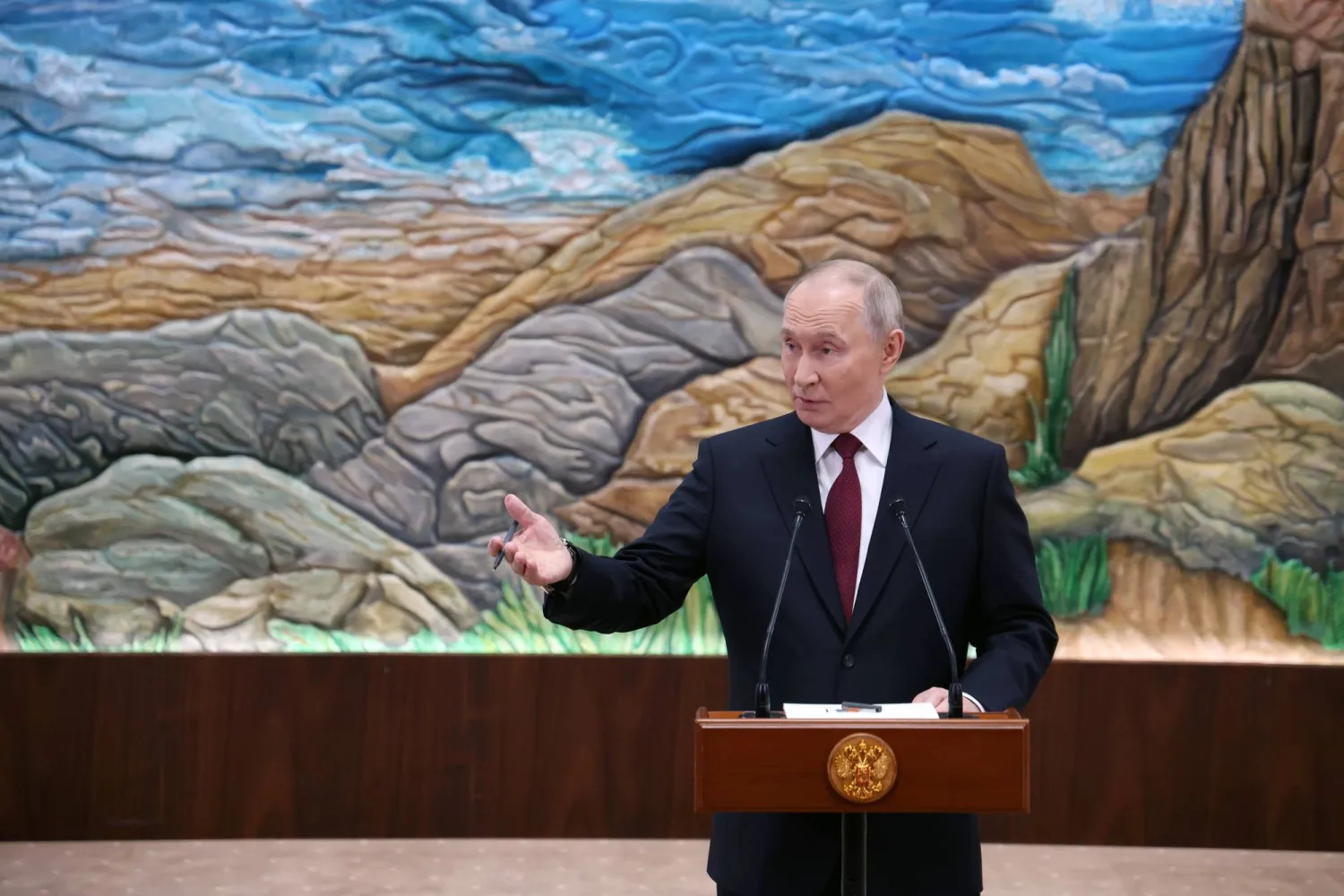
Russian President Vladimir Putin attends a press conference after the Collective Security Treaty Organization (CSTO) summit at the Yntymak Ordo Presidential Administration in Bishkek, Kyrgyzstan, 27 November 2025. EPA/ALEXANDER KAZAKOV/SPUTNIK/KREMLIN
TT

Hungary’s Orban Seeks More Russian Oil and Gas at Kremlin Talks with Putin

Russian President Vladimir Putin attends a press conference after the Collective Security Treaty Organization (CSTO) summit at the Yntymak Ordo Presidential Administration in Bishkek, Kyrgyzstan, 27 November 2025. EPA/ALEXANDER KAZAKOV/SPUTNIK/KREMLIN

Hungarian Prime Minister Viktor Orban held talks with Russian President Vladimir Putin at the Kremlin on Friday, once again shunning efforts by his European Union partners to isolate Moscow over its invasion of neighboring Ukraine nearly four years ago. 

The trip to Moscow is the second since last year for Orban, who is widely considered Putin’s closest partner among all EU leaders. Hungary is one of only a few EU countries to continue importing large quantities of Russian fossil fuels, and Orban has strongly opposed efforts by the bloc to wean its 27 member nations off Russian energy supplies. 

“We have important areas of cooperation, and we haven’t given up on any area of that cooperation, no matter the external pressure,” Orban said. “Russian energy forms the basis of Hungary’s energy supply, now and in the future.” 

Orban has long argued for a cessation of hostilities in Ukraine but without outlining what that might mean for the country’s territorial integrity or future security. That stance has dismayed Hungary’s EU and NATO allies, who accuse Russia of breaking international law and threatening the security of Eastern European countries. 

In his opening remarks at the Kremlin talks, Putin noted Orban’s “balanced position” on the war in Ukraine. A little less than four hours later, the Kremlin reported that the talks ended. 

Earlier this month, Orban traveled to Washington for a meeting with US President Donald Trump and succeeded in securing an exemption to sanctions the Trump administration placed on Russian energy companies Lukoil and Rosneft — an allowance Orban said ensured Hungary’s continued energy security. 

Orban said Friday that following Hungary's exemption from US sanctions, “now all we need is oil and gas, which we can buy from the Russians. I am going there to ensure Hungary’s energy supply at an affordable price both this winter and next year.” 

Orban has long argued Russian energy imports are indispensable for his country’s economy, and that switching to fossil fuels sourced from elsewhere would cause an immediate economic collapse — a claim some critics dispute. As the rest of Europe has gradually cut off Russian energy, Hungary has maintained and even increased its imports, and argued against an EU plan to eliminate all Russian fossil fuels by the end of 2027. 

Trump's envoy expected in Moscow 

The Trump administration has said it is seeing signs that its sanctions on major Russian oil producers are crimping the economic engine that has allowed Moscow to continue to fund its war in Ukraine. Prices for Russian oil have plunged as major Indian and Chinese buyers moved to comply with US sanctions before they went into effect last week, according to a senior Treasury Department official. 

Meanwhile, Trump last week released a plan for ending the nearly four-year war. The 28-point proposal heavily favored Russia, prompting Ukrainian President Volodymyr Zelenskyy to quickly engage with American negotiators. European leaders, fearing for their own future facing Russian aggression, scrambled to steer the negotiations toward accommodating their concerns. 

Trump said Tuesday that his plan to end the war had been “fine-tuned”, and that he’s sending envoy Steve Witkoff to Russia to meet with Putin and Army Secretary Dan Driscoll to meet with Ukrainian officials. He suggested he could eventually meet with Putin and Zelenskyy, but not until further progress has been made in negotiations. 

Putin said Thursday that US officials are expected in Moscow “in the first half of” next week, and that it “apparently” will be Witkoff. The Russian president himself will travel to India on Dec. 4-5 for talks with Indian Prime Minister Narendra Modi, the Kremlin said Friday. 

Kremlin spokesman Dmitry Peskov on Friday refused to announce a date for Witkoff's visit, saying only that the Kremlin will announce it “in due time.” He said that the “main parameters” of the peace plan, revised during Ukraine-US talks in Geneva last weekend, were relayed to Russia, and there will be “a discussion in Moscow” next week. 

In other developments, Russia’s Defense Ministry reported Friday that its air defenses intercepted 136 Ukrainian drones over a number of Russian regions and the annexed Crimea overnight. Damage to cars, residential buildings and houses was reported by authorities in the Rostov and Voronezh regions near the border with Ukraine. 

But the Ukrainian general staff said its forces struck an oil refinery in Saratov, Russia, the general staff wrote in a statement on Telegram. A series of explosions started a fire, the message said. 

Ukraine also conducted aerial strikes against Russian air defense units and drone storage and fuel depots in the occupied territories. 


NATO: Ukraine Still Receiving Arms Despite Mideast War

NATO Secretary General Mark Rutte via Reuters/File
TT

NATO: Ukraine Still Receiving Arms Despite Mideast War

NATO Secretary General Mark Rutte via Reuters/File

Ukraine is still getting essential defense equipment despite the war in the Middle East, which is depleting stockpiles in Europe and the United States, NATO Secretary General Mark Rutte said Thursday.

"The good news is that essential equipment into Ukraine continues to flow," he told reporters. That included American-made Patriot missile interceptors, which Ukraine desperately needs, he added, AFP reported.

The PURL program, launched last year, allows Ukraine to receive US equipment financed by European countries.

Some 75 percent of the missiles used by Patriot batteries in Ukraine have been supplied through the program, and 90 percent of the munitions used by other air-defense systems, Rutte added.

Rutte called on European countries to increase their own production capacity.

"They need to produce more extra production lines, extra shifts, opening new factories. The money is there," he said.


Germany FM Says 'Encouraging' if US Speaking Directly to Iran

German Foreign Minister Johann Wadephul. (Reuters: File Photo)
TT

Germany FM Says 'Encouraging' if US Speaking Directly to Iran

German Foreign Minister Johann Wadephul. (Reuters: File Photo)

Germany's foreign minister Thursday said it was encouraging if the United States was talking directly to Iran to end the war in the Middle East, but Washington should make its intentions clear.

"I hear that there are signs that the US is speaking directly to Iran. I think that this is encouraging and this is welcome," Johann Wadephul told reporters before heading into the meeting of G7 foreign ministers outside Paris, AFP reported.

With US Secretary of State Marco Rubio set to join the discussions from Friday, he added: "For the German government it is of great importance to know precisely what our American partners are intending."


US Envoy Witkoff Says Iran is Seeking an Off-ramp

US Special Envoy Steve Witkoff speaks during a cabinet meeting at the White House in Washington, DC, US, March 26, 2026. REUTERS/Evelyn Hockstein
TT

US Envoy Witkoff Says Iran is Seeking an Off-ramp

US Special Envoy Steve Witkoff speaks during a cabinet meeting at the White House in Washington, DC, US, March 26, 2026. REUTERS/Evelyn Hockstein

The United States has sent Iran a "15-point action list" as a basis for negotiations to end the current conflict, US Special Envoy Steve Witkoff said on Thursday, adding that there are signs that Tehran was interested in making a deal.


Witkoff, speaking during a cabinet meeting at the White House, said that the nascent talks could be successful if the Iranians realize there were no good alternatives - a realization Tehran might be coming to, he argued, Reuters reported.


"We will see where things lead, and if we can convince Iran that this is the inflection point with no good alternatives for them other than more death and destruction," Witkoff told reporters.


"We have strong signs that this is a possibility."


Witkoff said Pakistan had been acting as a mediator, confirming statements from Pakistani officials.