

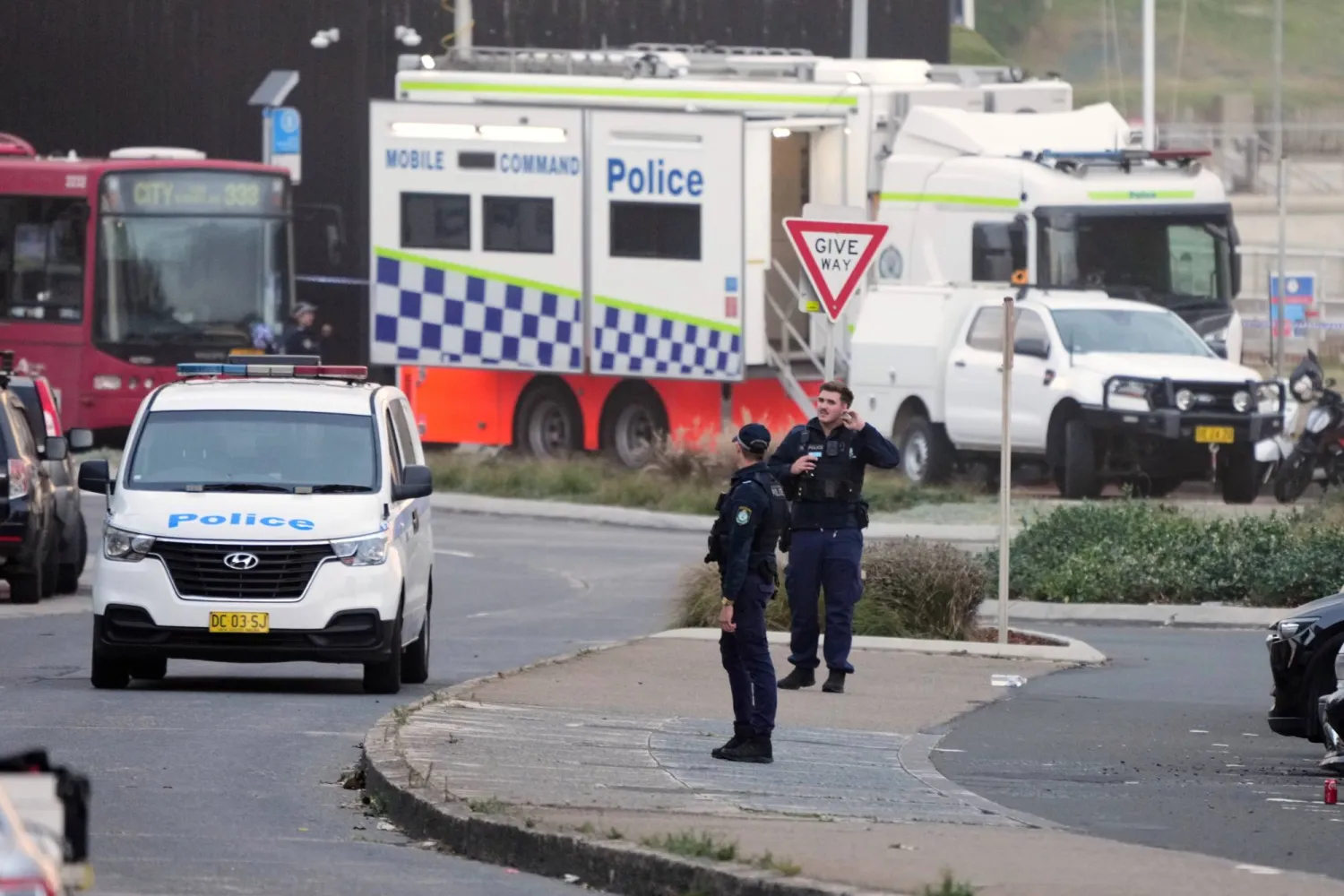

Australia to Toughen Gun Laws after Deadly Bondi Shootings

Police patrol in the early morning following a shooting Sunday at Sydney's Bondi Beach, Monday, Dec. 15, 2025. (AP Photo/Mark Baker)
TT

Australia to Toughen Gun Laws after Deadly Bondi Shootings

Police patrol in the early morning following a shooting Sunday at Sydney's Bondi Beach, Monday, Dec. 15, 2025. (AP Photo/Mark Baker)

Australia's leaders agreed on Monday to tougher gun laws after the country's worst mass shooting in almost three decades saw a father and son open fire on a Jewish festival at Bondi Beach, killing 15 people including a child.

The duo fired into crowds packing the Sydney beach for the start of Hanukkah on Sunday evening, sending people fleeing in panic across the tourist hotspot, said AFP.

A 10-year-old girl, a Holocaust survivor and a local rabbi were among those killed, while 42 more were rushed to hospital with gunshot wounds and other injuries.

Prime Minister Anthony Albanese convened a meeting of the leaders of Australia's states and territories in response, agreeing with them "to strengthen gun laws across the nation".

Albanese's office said they had agreed to look into ways to improve background checks for firearm owners, bar non-nationals from obtaining gun licenses and limit the types of weapons that are legal.

Mass shootings have been rare in Australia since a lone gunman killed 35 people in the tourist town of Port Arthur in 1996.

That massacre led to sweeping reforms that were long seen as a gold standard worldwide.

These included a gun buyback scheme, a national firearms register and a crackdown on the ownership of semi-automatic weapons.

But Sunday's shootings have raised fresh questions on how the father and son -- who public broadcaster ABC reported had possible links to the ISIS group -- obtained the weapons.

- 'We thought it was fireworks' -

Police are still unravelling what drove the shootings, although authorities have said it was clearly designed to sow terror among the nation's Jews.

Albanese called it "an act of pure evil, an act of antisemitism, an act of terrorism on our shores".

The gunmen targeted an annual celebration that drew more than 1,000 people to the beach to mark the Jewish festival.

They took aim from a raised boardwalk looking over the beach, which was packed with swimmers cooling off on a steamy summer evening.

Witness Beatrice was celebrating her birthday and had just blown out the candles when the shooting started.

"We thought it was fireworks," she told AFP.

"We're just feeling lucky we're all safe."

Carrying long-barreled guns, they peppered the beach with bullets for 10 minutes before police shot and killed the 50-year-old father.

The 24-year-old son was arrested and remained under guard in hospital with serious injuries.

Hours after the shooting, police found a homemade bomb in a car parked close to the beach, saying the "improvised explosive device" had likely been planted by the pair.

Rabbi Mendel Kastel said his brother-in-law was among the dead.

"It's unbelievable that this has happened here in Australia, but we need to hold strong. This is not the Australia that we know. This is not the Australia that we want."

Wary of reprisals, police have so far dodged questions about the attackers' religion or ideological motivations.

Misinformation spread quickly online in the wake of the attacks, some of it targeting immigrants and the Muslim community.

Police said they responded to reports on Monday of several pig heads left at a Muslim cemetery in southwestern Sydney.

- Panic and bravery -

A brave few dashed towards the beach as the shooting unfolded, wading through fleeing crowds to rescue children, treat the injured and confront the gunmen.

Footage showed one man, identified by local media as fruit seller Ahmed al Ahmed, grabbing one of the gunmen as he fired.

The 43-year-old wrestled the gun out of the attacker's hands, before pointing the weapon at him as he backed away.

A team of off-duty lifeguards sprinted across the sand to drag children to safety.

"The team ran out under fire to try and clear children from the playground while the gunmen were firing," said Steven Pearce from Surf Life Saving New South Wales.

Bleeding victims were carried across the beach atop surfboards turned into makeshift stretchers.

A grassy hill overlooking Bondi Beach was strewn with discarded items from people fleeing the killing, including a camping table and blankets.

People gathered flip-flops, sneakers and thermos flasks and lined them up in the sand for collection.

Australia mourned the dead by lowering flags to half-mast.

And at Bondi beach on Monday evening, a crowd gathered to mourn and sing in tribute to the victims.

- 'Oil on the fire' -

A string of antisemitic attacks has spread fear among Jewish communities in Australia following the October 7, 2023, Hamas attack on Israel and the ensuing war in Gaza.

Israeli Prime Minister Benjamin Netanyahu accused Australia's government of "pouring oil on the fire of antisemitism" in the months leading up to the shooting.

Other world leaders expressed revulsion and condemnation, including in the United States where President Donald Trump said it was a "purely antisemitic attack".

The Australian government this year accused Iran of orchestrating a recent wave of antisemitic attacks and expelled Tehran's ambassador nearly four months ago.

Tehran directed the torching of a kosher cafe in Sydney's Bondi suburb in October 2024, and a major arson attack on the Adass Israel Synagogue in Melbourne in December 2024, the government said in August citing intelligence findings.



Iran's Top Negotiator Threatens 'Faster, More Intense' Response to US Attacks

People walk past a large anti-US banner with reference to the dropping of the atomic bomb on the Japanese city of Hiroshima, in Tehran on September 2, 2026. (Photo by Atta KENARE / AFP) /
TT

Iran's Top Negotiator Threatens 'Faster, More Intense' Response to US Attacks

People walk past a large anti-US banner with reference to the dropping of the atomic bomb on the Japanese city of Hiroshima, in Tehran on September 2, 2026. (Photo by Atta KENARE / AFP) /

Iran's top negotiator Mohammad Bagher Ghalibaf threatened on Sunday to launch swifter and more forceful responses to US attacks, after Tehran targeted American warships in retaliation for US attacks on tankers.

"The Americans must have understood that the era of proportionate responses has come to an end," said Ghalibaf in a speech carried by state media, adding that "any aggression against Iran's interests and security will receive a faster, more intense and more painful response.”

Iran said Sunday that it struck an unmanned US military boat in the Strait of Hormuz.

US Central Command, which oversees the US military operations in the Middle East, did not confirm the claim or respond to request for comment. It comes one day after the US said it struck Iranian oil tankers in retaliation for Iran launching ballistic missiles at Navy warships.


A Fuel Tanker Explosion in West Iran Kills 11 and Injures 7

A fuel tanker exploded in western Iran, killing 11 people and injuring seven others, according to the state media.(AP)
TT

A Fuel Tanker Explosion in West Iran Kills 11 and Injures 7

A fuel tanker exploded in western Iran, killing 11 people and injuring seven others, according to the state media.(AP)

A fuel tanker exploded in western Iran, killing 11 people and injuring seven others, state media said.

IRNA reported late Saturday that the tanker hit other cars before bursting into flames near a traffic police station close to the Kurdish city of Sanandaj, some 400 kilometers (248 miles) west of the capital, Tehran. The report cited a faulty brake system, The Associated Press said.

The injured were transferred to hospitals.

In 2018, a similar road accident between a fuel tanker and an intercity passenger bus near Sanandaj killed 15 people and injured four.

Road and traffic accidents annually leave more than 17,000 dead in Iran. Experts blame the high fatality rate on unsafe vehicles, disregard for traffic rules, and inadequate emergency services.


Nepali Rescuers Buoyed by Miracle Finds but Tough Conditions Persist

Nepal Army personnel work to build an iron bridge across Tadi Khola river following the deadly flash floods and mudslide, in Devighat, Nuwakot district, Nepal, September 4, 2026. REUTERS/Adnan Abidi
TT

Nepali Rescuers Buoyed by Miracle Finds but Tough Conditions Persist

Nepal Army personnel work to build an iron bridge across Tadi Khola river following the deadly flash floods and mudslide, in Devighat, Nuwakot district, Nepal, September 4, 2026. REUTERS/Adnan Abidi

Nepali rescuers faced challenging conditions on Sunday as search operations after catastrophic floods entered their 12th day, buoyed by the extraordinary rescues of four survivors.

The glacial and mountain collapse on the China-Nepal border has killed at least 1,372 people and left more than 5,500 missing across the two countries, AFP said.

Rescuers found two more people alive on Saturday, joining two saved the day before in what have been described as miraculous tales of survival.

Three of those have been found in hydropower tunnels where the government initially said it believed more than 100 workers could be alive.

"Search and rescue is going on at the tunnels despite geography, adverse weather and lack of connectivity," Energy Minister Biraj Bhakta Shrestha told AFP.

Rescue workers were experiencing "multiple challenges", he said.

The wall of icy water and debris tore through mountain districts on August 26, destroying roads, bridges and other infrastructure.

On Saturday, rescuers pulled a Chinese man alive from deep inside a hydropower tunnel, and a 64-year-old Nepali woman, Chandrika Shrestha, from her mud-covered home.

Prime Minister Balendra Shah said the latter rescue had "given hope to the entire nation".

A day earlier, two Nepali hydropower workers were rescued at the Trishuli 3A tunnel, where searches continue alongside multiple other sites, with at least 12 hydropower projects affected.

Biraj Bhakta Shrestha said work was continuing to restore electricity in several areas.

"Places that have unreachable, we've tried to restore power with solar," he told AFP.

Foreign Minister Shisir Khanal has called the disaster a "Himalayan tsunami" and has warned reconstruction costs could run into the billions of dollars.

The United Nations has said the magnitude of the destruction makes delivering aid an immense challenge, and has launched a $50 million appeal to help more than 84,000 people.

With mortuaries overflowing, Nepal has buried hundreds of bodies in mass graves, after taking DNA samples for future identification, according to the police.

Only around 100 bodies have been identified and handed over to families.

Nepal will hold a national day of mourning on Monday, the 13th day since the disaster, in line with a traditional period of mourning in Hindu rituals.

While the exact cause of the glacial collapse is unclear, climate change is accelerating glacial melting worldwide, increasing the risk of such disasters.

In Nepal, rescuers have retrieved 1,341 bodies, while around 4,996 people remain missing, according to the disaster agency.

Chinese state media report that 31 people have been killed and 531 are missing in Tibet.

The combined toll is 1,372 dead and more than 5,500 missing, including around 800 foreigners, among them tourists and pilgrims.