


Search Teams in Türkiye Recover Recorders after Plane Crash that Killed Libyan Military Officials

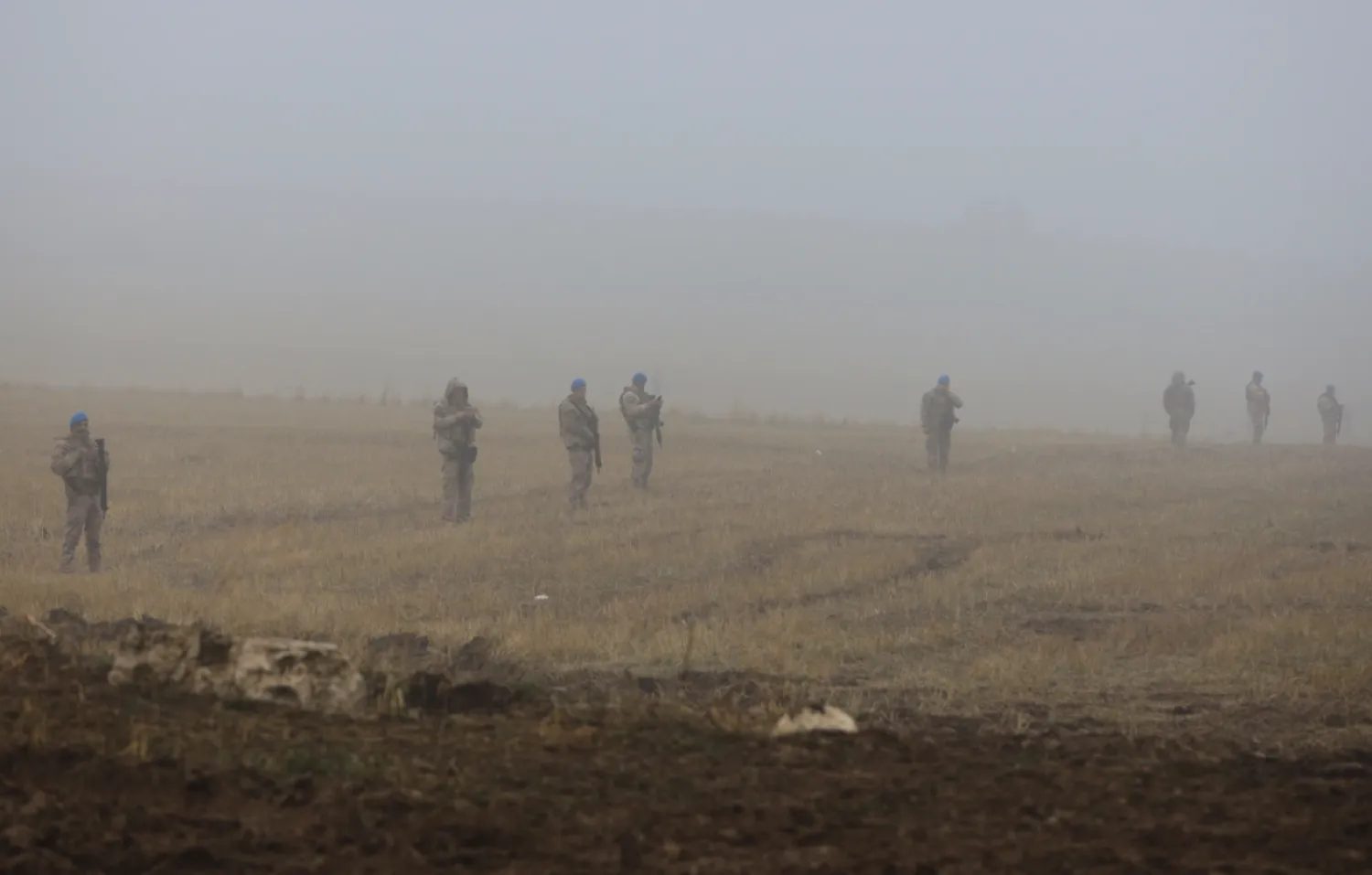
Turkish army soldiers stand guard as rescue teams search for the remains of a private jet carrying Libya's military chief and four others that crashed after taking off from Ankara, killing everyone on board, in Ankara, Turkey, early Wednesday, Dec. 24, 2025. (AP Photo/Efekan Akyuz)
TT

Search Teams in Türkiye Recover Recorders after Plane Crash that Killed Libyan Military Officials

Turkish army soldiers stand guard as rescue teams search for the remains of a private jet carrying Libya's military chief and four others that crashed after taking off from Ankara, killing everyone on board, in Ankara, Turkey, early Wednesday, Dec. 24, 2025. (AP Photo/Efekan Akyuz)

Search teams in Türkiye on Wednesday recovered the cockpit voice and flight data recorders from a jet crash that killed eight people, including western Libya’s military chief, while efforts to retrieve the victims' remains were still underway, Türkiye's interior minister said.

The private jet carrying Gen. Muhammad Ali Ahmad al-Haddad, four other military officials and three crew members crashed on Tuesday, after taking off from Türkiye's capital, Ankara, killing everyone on board. Libyan officials said that the cause of the crash was a technical malfunction on the plane.

The high-level Libyan delegation was on its way back to Tripoli after holding defense talks in Ankara aimed at boosting military cooperation between the two countries.

Turkish Interior Minister Ali Yerlikaya told journalists at the site of the crash that wreckage was scattered across an area covering three square kilometers (more than a square mile), complicating recovery efforts. Authorities from the Turkish forensic medicine authority were working to recover and identify the remains, he said.

A 22-person delegation — including five family members — arrived from Libya early on Wednesday to assist in the investigation, he said.

Tripoli-based Libyan Prime Minister Abdul-Hamid Dbeibah confirmed the deaths on Tuesday, describing the crash on Facebook as a “tragic accident” and a “great loss” for Libya.

Turkish President Recep Tayyip Erdogan held a telephone call with Dbeibah, during which he conveyed his condolences and expressed his sorrow over the deaths, his office said.

The Turkish leader later also offered his condolences during a televised speech, voicing solidarity with Libya.

"An investigation has been launched into this tragic incident that has deeply saddened us, and our ministries will provide information about its progress,” Erdogan said.

Al-Hadad was the top military commander in western Libya and played a crucial role in the ongoing, UN-brokered efforts to unify Libya’s military, which has split, much like the nation's other institutions.

The four other military officials who died in the crash were Gen. Al-Fitouri Ghraibil, the head of Libya’s ground forces, Brig. Gen. Mahmoud Al-Qatawi, who led the military manufacturing authority, Mohammed Al-Asawi Diab, adviser to the chief of staff, and Mohammed Omar Ahmed Mahjoub, a military photographer with the chief of staff’s office.

The identities of the three crew members weren't immediately released.

Turkish officials said that the Falcon 50-type business jet took off from Ankara’s Esenboga airport at 8:30 p.m. and that contact was lost around 40 minutes later. The plane notified air traffic control of an electrical fault and requested an emergency landing. The aircraft was redirected back to Esenboga, where preparations for its landing began.

The plane, however, disappeared from radar while descending for the emergency landing, the Turkish presidential communications office said.

The Libyan government declared a three-day period of national mourning. Flags would be flown half-staff at all state institutions, according to the government’s announcement on Facebook.

The wreckage was found near the village of Kesikkavak, in Haymana, a district about 70 kilometers (45 miles) south of Ankara.

At the crash site, search and recovery teams intensified their operations on Wednesday after a night of heavy rain and fog, the state-run Anadolu Agency reported. Gendarmerie police sealed off the area while the Turkish disaster management agency, AFAD, set up a mobile coordination center. Specialized vehicles, such as tracked ambulances, were deployed because of the muddy terrain.

Türkiye has assigned four prosecutors to lead the investigation, and Yerlikaya that said the Turkish search and recovery teams included 408 personnel.

While in Ankara, al-Haddad had met with Turkish Defense Minister Yasar Guler and other officials.



France PM Survives No-Confidence Vote Over Forced Budget

France's Prime Minister Sebastien Lecornu reacts after the second of the two votes on a no-confidence motion at the Assemblee Nationale, France's Parliament lower house in Paris on January 23, 2026. (AFP)
TT

France PM Survives No-Confidence Vote Over Forced Budget

France's Prime Minister Sebastien Lecornu reacts after the second of the two votes on a no-confidence motion at the Assemblee Nationale, France's Parliament lower house in Paris on January 23, 2026. (AFP)

French Prime Minister Sebastien Lecornu survived a no-confidence vote Friday following his move to force his budget through parliament, in a symbolic victory with more such challenges expected.

Lecornu on Tuesday used a constitutional power to ram part of the 2026 budget through parliament without a vote, after making concessions to gain the backing of the Socialists.

The key swing group showed their support Friday by blocking the no-confidence motion filed by the hard left from passing.

A second no-confidence motion filed by the far right was also blocked.

Lecornu will have to use the same constitutional power twice more to enact the full budget into law, exposing Lecornu to further no-confidence motions.

"Things are now at an impasse. The text can no longer be voted on. And we believe France must have a budget," the prime minister said on Tuesday.

The move marked a rowback for Lecornu who pledged last year to seek parliament's approval, in a bid to avoid the fate of his two predecessors who were ousted over budget negotiations.

But on Monday, Lecornu conceded with "a certain degree of regret and a bit of bitterness" that he had to invoke the power to push the budget through.

Ahead of Friday's vote, the Socialists signaled that the use of the measure was "the least bad solution" and the latest draft showed "progress" with concessions including an increase in a top-up benefit for the lowest-paid employees and the rollout of one-euro meals for students.

After the second part of the budget is rammed through on Friday, likely triggering another no-confidence motion, the budget text must then be reviewed by the upper-house Senate before returning to the National Assembly for final adoption.


Iran Lambasts Zelensky after Davos 'Bully' Warning

Ukrainian President Volodymyr Zelenskyy delivers a speech at the annual meeting of the World Economic Forum in Davos, Switzerland, January 22, 2026 (AP)
TT

Iran Lambasts Zelensky after Davos 'Bully' Warning

Ukrainian President Volodymyr Zelenskyy delivers a speech at the annual meeting of the World Economic Forum in Davos, Switzerland, January 22, 2026 (AP)

Iran's foreign minister on Friday launched a furious tirade against Volodymyr Zelensky after the Ukrainian president commented in Davos that the deadly crackdown on protests in Iran showed that if authorities "kill enough people" they stay in power.

Zelensky, whose country has been fighting the full-scale Russian invasion for almost four years, said in a speech at the World Economic Forum on Thursday that if Iran's clerical leadership was able to remain in power, it was a "clear signal to every bully".

Russian President Vladimir Putin is an ally of Iran’s leadership under Ali Khamenei and last week held telephone talks with President Masoud Pezeshkian, with both sides agreeing to ramp up bilateral ties.

Foreign Minister Abbas Araghchi responded to Zelensky's comments with a broadside of accusations and claims in an English-language post on X, saying the Ukrainian leader had been "rinsing American and European taxpayers to fill the pockets of his corrupt generals".

"The world has had enough of Confused Clowns, Mr Zelensky," he said, in apparent reference to the Ukrainian leader's previous career as a wildly-successful comedian and comic actor.

"Unlike your foreign-backed and mercenary-infested military, we Iranians know how to defend ourselves and have no need to beg foreigners for help," he added.

Foreigners are fighting in the Ukrainian army but make up only a tiny percentage of the armed forces.

- 'Drowned in blood' -

Kyiv and the West accuse Iran of providing drones and ballistic missiles to Russia for use in Ukraine. Tehran has repeatedly denied sending any weapons to Russia.

In his speech in Davos, Zelensky appeared to cite the response to the protests as another example of Western inaction in the face of aggression.

"There was so much talk about the protests in Iran -- but they drowned in blood. The world has not helped enough the Iranian people, it has stood aside," he said, speaking in English.

Zelensky noted that the start of the protests coincided with the Christmas and New Year holidays in Europe.

"What will Iran become after this bloodshed? If the regime survives, it sends a clear signal to every bully -- kill enough people, and you stay in power," he said.

Iranian authorities have said well over 3,000 people were killed in the protests but have blamed the violence on "rioters" backed by the United States and Israel.

Rights groups however say the toll is far higher and could be as much as 20,000, adding that confirming the numbers is hugely impeded by the now two-week shutdown of the internet in Iran.

NGOs, including Amnesty International, have accused security forces of deliberately firing on protesters to suppress the demonstrations, which have now petered out.


Iranian Prosecutor Denies Trump’s Claim 800 Prisoners Were Spared Execution

This photograph taken during a tour for foreign media shows a media representative walking past the parked buses that were burned at a depot during recent public protests, in Tehran on January 21, 2026. (AFP)
TT

Iranian Prosecutor Denies Trump’s Claim 800 Prisoners Were Spared Execution

This photograph taken during a tour for foreign media shows a media representative walking past the parked buses that were burned at a depot during recent public protests, in Tehran on January 21, 2026. (AFP)

Iran’s top prosecutor on Friday called US President Donald Trump’s repeated claims that he halted the hangings of 800 detained protesters there “completely false.” Meanwhile, the overall death toll from a bloody crackdown on nationwide demonstrations rose to at least 5,002, activists said.

Activists fear many more are dead. They struggle to confirm information as the most comprehensive internet blackout in Iran's history has crossed the two-week mark.

Tensions remain high between the United States and Iran as an American aircraft carrier group moves closer to the Middle East, something Trump likened to an “armada” in comments to journalists late Thursday.

Analysts say a military buildup could give Trump the option to carry out strikes, though so far he's avoided that despite repeated warnings to Tehran. The mass execution of prisoners had been one of his red lines for military force — the other being the killing of peaceful demonstrators.

“While President Trump now appears to have backtracked, likely under pressure from regional leaders and cognizant that airstrikes alone would be insufficient to implode the regime, military assets continue to be moved into the region, indicating kinetic action may still happen,” New York-based think tank the Soufan Center said in an analysis Friday.

Prosecutor denies Trump claim

Trump has repeatedly said Iran halted the execution of 800 people detained in the protests, without elaborating on the source of the claim. On Friday, Iran’s top prosecutor Mohammad Movahedi strongly denied that in comments carried by the judiciary’s Mizan news agency.

“This claim is completely false; no such number exists, nor has the judiciary made any such decision,” Movahedi said.

His remarks suggested that Iran’s Foreign Ministry, led by Abbas Araghchi, may have offered that figure to Trump. Araghchi has had a direct line to US envoy Steve Witkoff and conducted multiple rounds of negotiations over Iran’s nuclear program with him.

“We have a separation of powers, the responsibilities of each institution are clearly defined, and we do not, under any circumstances, take instructions from foreign powers,” Movahedi said.

Judiciary officials have called some of those being held “mohareb” — or “enemies of God.” That charge carries the death penalty. It had been used along with others to carry out mass executions in 1988 that reportedly killed at least 5,000 people.

Meanwhile, Mohammad Javad Haji Ali Akbari, the Friday prayer leader in Tehran, mocked Trump as a “yellow-faced, yellow-haired and disgraced man".

“That foolish man has resorted to threatening the nation, especially over what he said about Iran’s leader,” the cleric said in comments aired by Iranian state radio. ”If any harm were to occur, all your interests and bases in the region would become clear and precise targets of Iranian forces.”

Death toll rises 

The latest death toll was given by the US-based Human Rights Activists News Agency, which reported that 4,716 of the dead were demonstrators, 203 were government-affiliated, 43 were children and 40 were civilians not taking part in the protests. It added that more than 26,800 people had been detained in a widening arrest campaign by authorities.

The group's figures have been accurate in previous unrest in Iran and rely on a network of activists in Iran to verify deaths. That death toll exceeds that of any other round of protest or unrest in Iran in decades, and recalls the chaos surrounding Iran's 1979 revolution.

Iran’s government offered its first death toll Wednesday, saying 3,117 people were killed. It added that 2,427 of the dead in the demonstrations that began Dec. 28 were civilians and security forces, with the rest being “terrorists.” In the past, Iran’s theocracy has undercounted or not reported fatalities from unrest.

The Associated Press has been unable to independently assess the death toll, in part because of authorities cutting access to the internet and blocking international calls into the country.

US warships on the move 

The American military meanwhile has moved more military assets toward the Mideast, including the aircraft carrier USS Abraham Lincoln and associated warships traveling with it from the South China Sea.

A US Navy official, who spoke on condition of anonymity to discuss military movements, said Thursday that the Lincoln strike group is in the Indian Ocean.

Trump said Thursday aboard Air Force One that the US is moving the ships toward Iran “just in case” he wants to take action.

“We have a massive fleet heading in that direction and maybe we won’t have to use it,” Trump said.

Trump also mentioned the multiple rounds of talks that American officials had with Iran over its nuclear program prior to Israel launching a 12-day war against the country in June, which saw US warplanes bomb Iranian nuclear sites. He threatened Iran with military action that would make earlier US strikes against its uranium enrichment sites “look like peanuts.”

“They should have made a deal before we hit them,” Trump said.

The UK Defense Ministry separately said that its joint Eurofighter Typhoon fighter jet squadron with Qatar, 12 Squadron, “deployed to the Gulf for defensive purposes noting regional tensions.”

Iran shows off drones in Israel threat

Iran commemorated “the Day of the Guardian” on Friday, an annual event for its paramilitary Revolutionary Guard, which was key in putting down the nationwide protests.

To mark the day, an Iranian state television channel aired a typically religious talk show Thursday night that instead saw its cleric and prayer singers look at Iranian military drones. They fired up the engines of several of the Shahed drones, one version of which has been used extensively by Russia in its war on Ukraine.

A man identified as a member of the security forces, who wore a surgical mask and sunglasses during the telecast to hide his identity, also made a threat in mangled Hebrew toward Israel, trying to say: “We are closer to you than you think.”