


How Cocaine and Corruption Led to the Indictment of Maduro

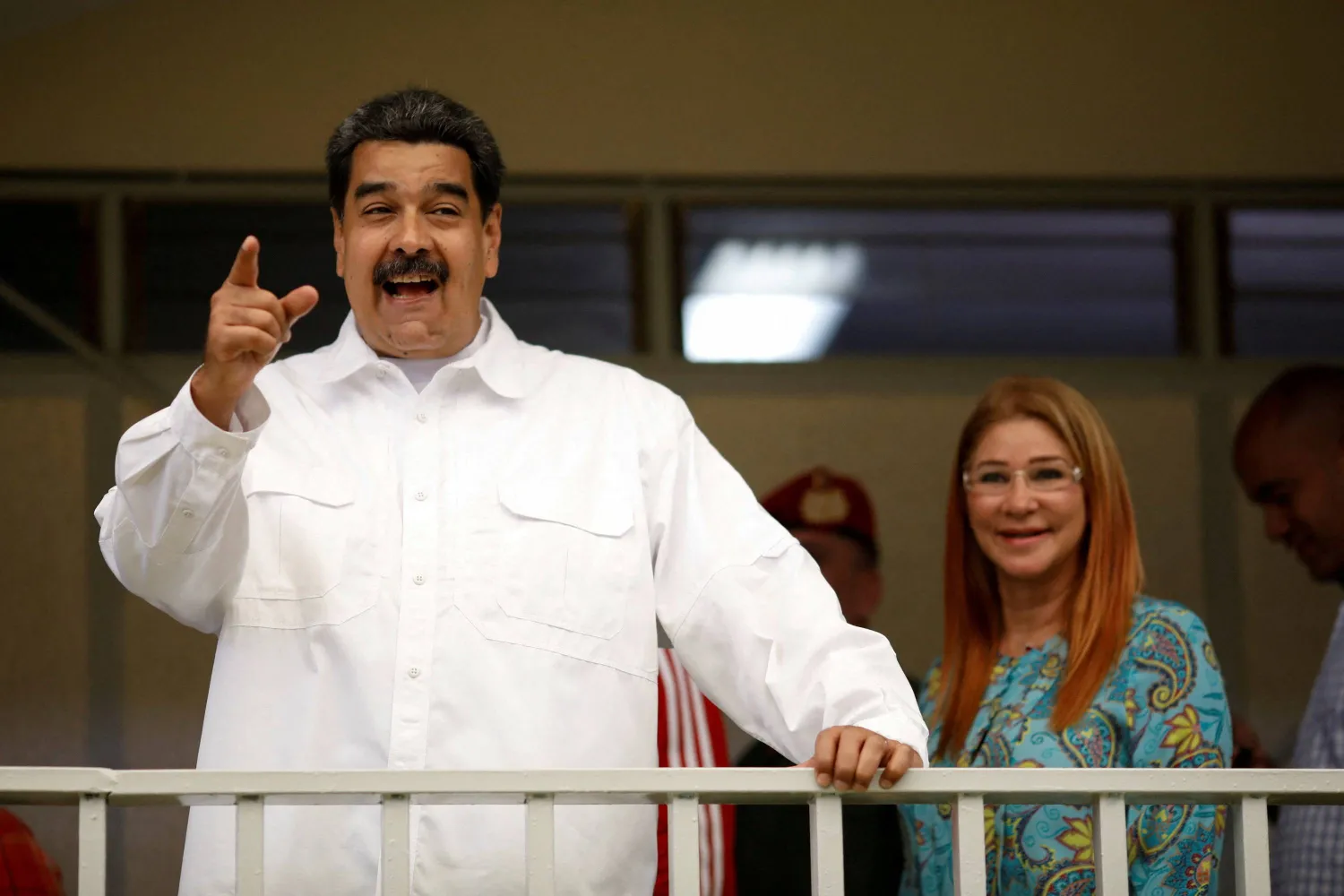
FILE PHOTO: Venezuela's President Nicolas Maduro talks to the media next to his wife Cilia Flores after taking part in a voting drill, ahead of May 20 presidential election, in Caracas, Venezuela May 6, 2018. REUTERS/Carlos Garcia Rawlins/File Photo
TT

How Cocaine and Corruption Led to the Indictment of Maduro

FILE PHOTO: Venezuela's President Nicolas Maduro talks to the media next to his wife Cilia Flores after taking part in a voting drill, ahead of May 20 presidential election, in Caracas, Venezuela May 6, 2018. REUTERS/Carlos Garcia Rawlins/File Photo

A newly unsealed US Justice Department indictment accuses captured Venezuelan President Nicolás Maduro of running a “corrupt, illegitimate government” fueled by an extensive drug-trafficking operation that flooded the US with thousands of tons of cocaine.

The arrest of Maduro and his wife in a stunning military operation early Saturday in Venezuela sets the stage for a major test for US prosecutors as they seek to secure a conviction in a Manhattan courtroom against the longtime leader of the oil-rich South American nation.

Attorney General Pam Bondi said in a post on X that Maduro and his wife “will soon face the full wrath of American justice on American soil in American courts.”

Here's a look at the accusations against Maduro and the charges he faces.

Maduro faces drugs and weapons charges

Maduro is charged alongside his wife, his son and three others. Maduro is indicted on four counts: narco-terrorism conspiracy, cocaine importation conspiracy, possession of machine guns and destructive devices and conspiracy to possess machine guns and destructive devices.

Maduro is facing the same charges as in an earlier indictment brought against him in Manhattan federal court in 2020, during the first Trump presidency. The new indictment unsealed on Saturday, which adds charges against Maduro's wife, was filed under seal in the Southern District of New York just before Christmas.

It was not immediately clear when Maduro and his wife, Cilia Flores, would make their first appearance at the courthouse in Manhattan. A video posted Saturday night on social media by a White House account showed Maduro, smiling, as he was escorted through a US Drug Enforcement Administration office in New York by two federal agents grasping his arms. He was expected to be detained while awaiting trial at a federal jail in Brooklyn.

Maduro allowed ‘cocaine-fueled corruption to flourish,' US says

The indictment accuses Maduro of partnering with “some of the most violent and prolific drug traffickers and narco-terrorists in the world” to allow for the shipment of thousands of tons of cocaine into the US Authorities allege powerful and violent drug-trafficking organizations, such as the Sinaloa Cartel and Tren de Aragua gang, worked directly with the Venezuelan government and then sent profits to high-ranking officials who helped and protected them in exchange.

Maduro allowed “cocaine-fueled corruption to flourish for his own benefit, for the benefit of members of his ruling regime, and for the benefit of his family members,” the indictment alleges.

US authorities allege that Maduro and his family “provided law enforcement cover and logistical support” to cartels moving drugs throughout the region, resulting in as much as 250 tons of cocaine trafficked through Venezuela annually by 2020, according to the indictment. Drugs were moved on go-fast vessels, fishing boats and container ships or on planes from clandestine airstrips, the indictment says.

“This cycle of narcotics-based corruption lines the pockets of Venezuelan officials and their families while also benefiting violent narco-terrorists who operate with impunity on Venezuelan soil and who help produce, protect, and transport tons of cocaine to the United States,” the indictment says.

Allegations of bribes and orders of kidnappings and murders

The US accuses Maduro and his wife of ordering kidnappings, beatings and murders “against those who owed them drug money or otherwise undermined their drug trafficking operation.” That includes the killing of a local drug boss in Caracas, according to the indictment.

Maduro’s wife is also accused of accepting hundreds of thousands of dollars in bribes in 2007 to arrange a meeting between “a large-scale drug trafficker” and the director of Venezuela’s National Anti-Drug Office. In a corrupt deal, the drug trafficker then agreed to pay a monthly bribe to the director of the anti-drug office as well as about $100,000 for each cocaine-carrying flight “to ensure the flight’s safe passage.” Some of that money then went to Maduro’s wife, the indictment says.

Nephews of Maduro's wife were heard during recorded meetings with confidential US government sources in 2015 agreeing to send “multi-hundred-kilogram cocaine shipments” from Maduro's “presidential hanger” at a Venezuelan airport. The nephews during the recorded meetings explained “that they were at ‘war’ with the United States,” the indictment alleges. They were both sentenced in 2017 to 18 years in prison for conspiring to send tons of cocaine into the US before being released in 2022 as part of a prisoner swap in exchange for seven imprisoned Americans.

Operation to capture Maduro was a ‘law enforcement function,' Rubio says

During a news conference, Secretary of State Marco Rubio and Dan Caine, the chairman of the Joint Chiefs of Staff, cast the military raid that captured Maduro and his wife as an action carried out on behalf of the Department of Justice. Caine said the operation was made “at the request of the Justice Department.”

Rubio, as he responded to a question about whether Congress had been notified, said the US raid to get the couple was “basically a law enforcement function," adding that it was an instance in which the “Department of War supported the Department of Justice." He called Maduro “a fugitive of American justice with a $50 million reward” over his head.



Iranians to Receive Monthly Payment Amid Economic Woes, Protests

A customer shops at a supermarket at a shopping mall in northern Tehran, on Sept. 28, 2025. (AP)
TT

Iranians to Receive Monthly Payment Amid Economic Woes, Protests

A customer shops at a supermarket at a shopping mall in northern Tehran, on Sept. 28, 2025. (AP)

Iranian authorities on Sunday announced they will give a monthly allowance to every citizen in the country to alleviate economic pressure, after a week of protests.

"Individuals can receive an amount equivalent to one million Tomans (approximately $7) per person per month, which is credited to their accounts for four months," government spokeswoman Fatemeh Mohajerani told state TV.

She said the amount will be given to every Iranian for four months in the form of credit that can be used to purchase certain goods and is intended to "reduce the economic pressure on the people."

In Iran, which has a population of more than 85 million people, the minimum wage is roughly $100 (85 euros) and average monthly salaries are around $200.

Iranians mostly use mobile phones and debit cards for their daily purchases instead of cash.

Iran's economy has been grappling with biting US and international sanctions over Tehran's nuclear program for years, and December saw a 52 percent year-on-year inflation rate.

The national currency has lost more than a third of its value against the US dollar over the past year, causing a sharp decrease in people's purchasing power and broad discontent in the country.

Sunday marked the eighth day of sporadic protests in the country over economic uncertainty in the wake of the depreciation.

The protests have touched, to varying degrees, at least 40 different cities, mostly medium-sized and in the country's west, according to an AFP tally based on official announcements and media reports.

At least 12 people have been killed, including members of the security forces, according to a toll based on official reports.


Rubio Says US Won’t Govern Venezuela but Will Press for Changes Through Oil Blockade

US Secretary of State Marco Rubio (C) speaks during a news conference at the Mar-a-Lago Club in Palm Beach, Florida, USA, 03 January 2026. (EPA)
TT

Rubio Says US Won’t Govern Venezuela but Will Press for Changes Through Oil Blockade

US Secretary of State Marco Rubio (C) speaks during a news conference at the Mar-a-Lago Club in Palm Beach, Florida, USA, 03 January 2026. (EPA)

Secretary of State Marco Rubio suggested Sunday that the United States would not take a day-to-day role in governing Venezuela other than enforcing an existing "oil quarantine" on the country, a turnaround after President Donald Trump announced a day earlier that the US would be running Venezuela following its ouster of leader Nicolas Maduro.

Rubio's statements on TV talk shows seemed designed to temper concerns about whether the assertive American action to achieve regime change might again produce a prolonged foreign intervention or failed attempt at nation-building. They stood in contrast to Trump’s broad but vague claims that the US would at least temporarily "run" the oil-rich nation, comments that suggested some sort of governing structure under which Caracas would be controlled by Washington.

But Rubio offered a more nuanced take, saying the US would continue to enforce an oil quarantine that was already in place on sanctioned tankers before Maduro was removed from power early Saturday and using that leverage as a means to press policy changes in Venezuela.

"And so that’s the sort of control the president is pointing to when he says that," Rubio said on CBS’ "Face the Nation.We continue with that quarantine, and we expect to see that there will be changes, not just in the way the oil industry is run for the benefit of the people, but also so that they stop the drug trafficking."

The blockade on sanctioned oil tankers — some of which have been seized by the US — "remains in place, and that’s a tremendous amount of leverage that will continue to be in place until we see changes that not just further the national interest of the United States, which is number one, but also that lead to a better future for the people of Venezuela," he added.

Trump repeated vow US would ‘run’ Venezuela

Trump's vow to "run" Venezuela, repeated more than half a dozen times at a news conference in Florida on Saturday, sparked concerns among some Democrats. It also drew unease from parts of his own Republican coalition, including an "America First" base that is opposed to foreign interventions, and also from observers who recalled past nation-building efforts in Iraq and Afghanistan.

Rubio dismissed such criticism, saying that Trump’s intent had been misunderstood by a "foreign policy establishment" that was fixated on the Middle East.

"The whole foreign policy apparatus thinks everything is Libya, everything is Iraq, everything is Afghanistan," Rubio said. "This is not the Middle East. And our mission here is very different. This is the Western Hemisphere."

Rubio also suggested that the US would give Maduro’s subordinates who are now in charge time to govern, saying, "We’re going to judge everything by what they do, and we’re going to see what they do." And though he did not rule out a US military presence in Venezuela, Rubio said the current US "force posture" was capable of stopping drug boats and sanctioned tankers.

A day earlier, Trump told reporters, "We’re going to run the country until such time as we can do a safe, proper and judicious transition." He later pointed to his national security team with him, including Rubio and Defense Secretary Pete Hegseth, and said it would be done for a period of time by "the people that are standing right behind me. We’re gonna be running it we’re gonna be bringing it back."

The White House declined to comment beyond what Trump said Saturday.

Maduro's arrival

Maduro landed late Saturday afternoon at a small airport in New York City's northern suburbs following the middle-of-the-night operation that extracted him and his wife, Cilia Flores, from their home in a military base in the capital, Caracas — an act that Maduro’s government called "imperialist." The couple faces US charges of participating in a narco-terrorism conspiracy.

The dramatic seizure of the Maduros capped an intensive Trump administration pressure campaign on Venezuela’s autocratic leader and months of secret planning, resulting in the most assertive American action to achieve regime change since the 2003 invasion of Iraq. Legal experts raised questions about the lawfulness of the operation, which was done without congressional approval.

Venezuela’s vice president, Delcy Rodriguez, meanwhile, demanded that the US free Maduro and called him the country’s rightful leader as her nation’s high court named her interim president.

After arriving at the airport, Maduro was flown by helicopter to Manhattan, where a convoy of law enforcement vehicles, including an armored car, was waiting to whisk him to a nearby US Drug Enforcement Administration office. A video posted on social media by a White House account showed Maduro, smiling, as he was escorted through that office by two DEA agents grasping his arms.

He is due to make his first appearance Monday in Manhattan's federal court.

Maduro and other Venezuelan officials were indicted in 2020 on narco-terrorism conspiracy charges, and the Justice Department released a new indictment Saturday of Maduro and his wife that painted his administration as a "corrupt, illegitimate government" fueled by a drug-trafficking operation that flooded the US with cocaine. The US government does not recognize Maduro as the country’s leader.

The Trump administration spent months building up American forces in the region and carrying out attacks on boats in the Caribbean Sea and eastern Pacific Ocean for allegedly ferrying drugs. Last week, the CIA was behind a drone strike at a docking area believed to have been used by Venezuelan drug cartels — the first known direct operation on Venezuelan soil since the US campaign began in September.

Quiet falls in Venezuela after US operation

Venezuela’s capital remained unusually quiet Sunday with few vehicles moving around and convenience stores, gas stations and other businesses closed. A road typically filled with runners, cyclists and other fitness enthusiasts on Sundays only had a handful of people working out the day after Maduro was deposed.

The presidential palace was guarded by armed civilians and members of the military. At a nearby plaza, only a street sweeper and a soldier stood, and across the street, a church remained close for a second day in a row.

Caracas resident David Leal arrived to the lot where he parks vehicles for a living only to quickly realize that he would likely not see any clients for a second day.

"People are still shaken," said Leal, 77.


Venezuela Military Recognizes Maduro’s VP as Acting President

Venezuela's Vice-President and Oil Minister Delcy Rodriguez addresses the media in Caracas, Venezuela, March 10, 2025. (Reuters)
TT

Venezuela Military Recognizes Maduro’s VP as Acting President

Venezuela's Vice-President and Oil Minister Delcy Rodriguez addresses the media in Caracas, Venezuela, March 10, 2025. (Reuters)

Venezuela's military on Sunday recognized Delcy Rodriguez, deputy to ousted President Nicolas Maduro, as the country's acting leader, after US forces extracted the former head of state to face trial.

Amid uncertainty following the leftist president's dramatic capture, Defense Minister Vladimir Padrino Lopez appeared to throw his weight behind Rodriguez, who US President Donald Trump had earlier indicated was a figure Washington could work with.

Padrino read out a statement on television endorsing a Supreme Court ruling that appointed Rodriguez as acting president for 90 days.

He also called on Venezuelans to get back to their daily life, speaking less than two days after the US strikes shook the capital Caracas and special forces seized Maduro and his wife.

Padrino denounced it as a "cowardly kidnapping" and said that some of Maduro's bodyguards were killed "in cold blood," as well as military personnel and civilians on the Venezuelan side.

Venezuelan authorities have not yet given an official toll for people hurt or killed in the US operations.

The streets of Caracas were deserted and quiet on Sunday, with many businesses closed and moderate queues at some markets and pharmacies.

"I call on the people of Venezuela to resume their activities of all kinds, economic, work and education, in the coming days," Padrino said.

"The homeland must follow its constitutional course."