


Iran Foreign Minister Says Progress Made in Nuclear Talks with US in Geneva

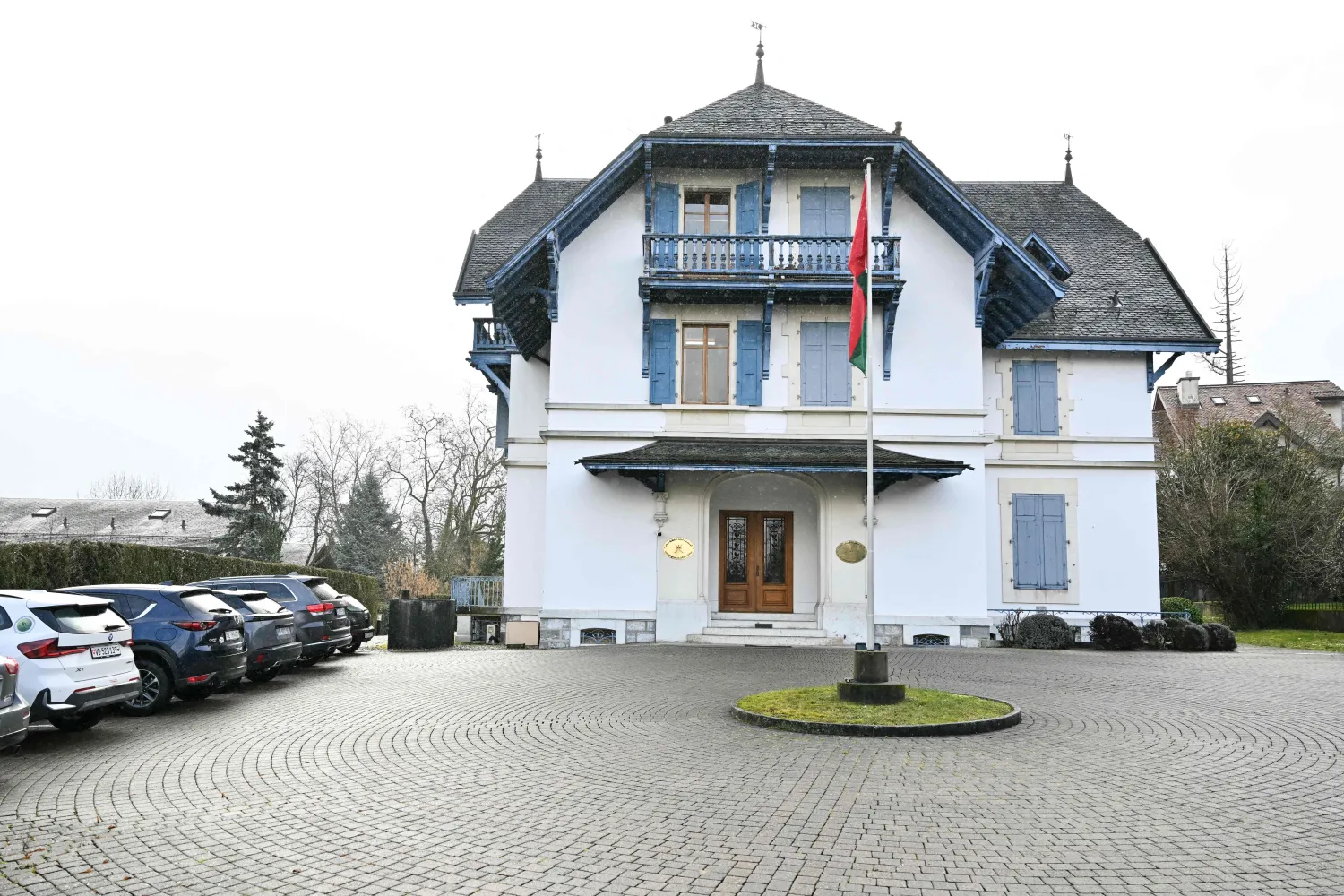
This photograph shows the Omani consulate general ahead of indirect nuclear talks between the United States and Iran in Geneva on February 17, 2026. (AFP)
TT

Iran Foreign Minister Says Progress Made in Nuclear Talks with US in Geneva

This photograph shows the Omani consulate general ahead of indirect nuclear talks between the United States and Iran in Geneva on February 17, 2026. (AFP)

Iran and the United States reached an understanding on Tuesday on main "guiding principles" in talks aimed at resolving their longstanding nuclear dispute, but that does not mean a deal is imminent, Iranian Foreign Minister Abbas Araqchi said. 

Oil futures fell and the benchmark Brent crude contract tumbled more than 1% after Araqchi's comments, which helped ease fears of conflict in the region, where the US has deployed a battle force to press Tehran for concessions. 

"Different ideas have been presented, these ideas have been seriously discussed, ultimately we've been able to reach a general agreement on some guiding principles," Araqchi told Iranian media after the talks concluded in Geneva. 

BOTH SIDES HAVE 'CLEAR NEXT STEPS' 

The indirect discussions between US Special Envoy Steve Witkoff and US President Donald Trump's son-in-law Jared Kushner, alongside Araqchi, were mediated by Oman. The White House did not respond to emailed questions about the meeting. 

Oman's Foreign Minister Badr al-Busaidi said in a post on X "much work is yet to be done" but Iran and the US were leaving with "clear ‌next steps" . 

Just as ‌talks began on Tuesday, Iranian state media said Iran would temporarily shut part of the Strait ‌of ⁠Hormuz, a vital global ⁠oil supply route, due to "security precautions" while Iran's elite Revolutionary Guards conducted military drills there. 

Tehran has in the past threatened to shut down the strait to commercial shipping if it is attacked, a move that would choke off a fifth of global oil flows and drive up crude prices. 

Responding to comments by Trump that "regime change" in Iran might be the best course, the country's Supreme Leader Ali Khamenei, 86, warned that any US attempts to depose his government would fail. 

"The US President says their army is the world's strongest, but the strongest army in the world can sometimes be slapped so hard it cannot get up," he said, in comments published by Iranian media. 

Speaking at a disarmament conference in Geneva after the talks, Araqchi said ⁠that a "new window of opportunity" had opened and that he hoped discussions would lead to a "sustainable" solution ‌that ensured the full recognition of Iran's legitimate rights. 

Earlier, Trump said he himself would ‌be involved "indirectly" in the Geneva talks and that he believed Tehran wanted to make a deal. 

"I don't think they want the consequences of not making ‌a deal," Trump told reporters aboard Air Force One on Monday. "We could have had a deal instead of sending the B-2s in ‌to knock out their nuclear potential. And we had to send the B-2s." 

The US joined Israel last June in bombing Iranian nuclear facilities. The US and Israel believe Iran aspires to build a nuclear weapon that could threaten Israel's existence. Iran says its nuclear program is purely peaceful, even though it has enriched uranium far beyond the purity needed for power generation, and close to what is required for a bomb. 

IRAN SAYS IT WILL ONLY DISCUSS NUCLEAR PROGRAM 

Since those ‌strikes, Iran's Islamic rulers have been weakened by street protests, suppressed at a cost of thousands of lives, against a cost-of-living crisis driven in part by international sanctions that have strangled Iran's oil ⁠income. 

Washington has sought to expand ⁠the scope of talks to non-nuclear issues such as Iran's missile stockpile. Tehran says it is willing only to discuss curbs on its nuclear program - in exchange for sanctions relief - and that it will not give up uranium enrichment completely or discuss its missile program. 

Khamenei reiterated Iran's position that its large missile stockpile is non-negotiable and missile type and range have nothing to do with the United States. 

A senior Iranian official told Reuters on Tuesday the success of the Geneva talks hinged on the US not making unrealistic demands and on its seriousness on lifting the crippling sanctions on Iran. 

US B-2 BOMBERS STRUCK NUCLEAR TARGETS 

Tehran and Washington were scheduled to hold a sixth round of talks in June last year when Washington's ally Israel launched a bombing campaign against Iran, and was then joined by US B-2 bombers that struck nuclear targets. Tehran has since said it has halted uranium enrichment activity. 

Iran has joined the nuclear Non-Proliferation Treaty, which guarantees countries the right to pursue civilian nuclear power in return for requiring them to forgo atomic weapons and cooperate with the UN nuclear watchdog, the International Atomic Energy Agency. 

Israel, which has not signed the NPT, neither confirms nor denies having nuclear weapons, under a decades-old ambiguity policy designed to deter surrounding enemies. Scholars believe it does. 


Russia Evacuates 198 Workers from Iran Nuclear Plant Amid Airstrike

Rosatom State Atomic Energy Corporation Director General Alexey Likhachev arrives to attend the talks between Russian President Vladimir Putin and Armenian Prime Minister Nikol Pashinyan at the Kremlin in Moscow, Russia, 01 April 2026. (EPA/Pavel Bednyakov/AP Pool)
TT

Russia Evacuates 198 Workers from Iran Nuclear Plant Amid Airstrike

Rosatom State Atomic Energy Corporation Director General Alexey Likhachev arrives to attend the talks between Russian President Vladimir Putin and Armenian Prime Minister Nikol Pashinyan at the Kremlin in Moscow, Russia, 01 April 2026. (EPA/Pavel Bednyakov/AP Pool)

Russia started a planned evacuation of 198 workers from Iran's Bushehr atomic plant shortly after a US-Israeli projectile hit near the facility, Russian state media said on Saturday.

This was a third evacuation from the facility in southern Iran on the Gulf coast, which was built with Moscow's help, with about 100 Russian staff remaining there by now.

The area around Bushehr has been struck four times during this war. The latest attack on Saturday saw one person -- a guard at the facility -- killed, but did not damage the plant itself, according to Iranian state media.

"As planned, we began the main phase of the evacuation today," Russia's nuclear agency Rosatom head Alexey Likhachev was quoted as saying by Russia's TASS news agency.

"About 20 minutes after that ill-fated strike, buses set off from Bushehr station towards the Iranian-Armenian border (with) 198 people, to be precise -- this is the largest evacuation," he added.

Likhachev also said that Russia informed the US and Israel about the evacuation.

"The likelihood of a risk of damage or a potential nuclear incident is, unfortunately, only increasing, as has been confirmed by this morning's events," the Rosatom CEO said.

The agency plans to keep only a skeleton staff at Bushehr amid the threat of further strikes.

The Russian foreign ministry slammed the "evil" US-Israeli attack and urged a cessation of hostilities on Iranian nuclear facilities immediately.


Erdogan Says Middle East War Has Caused ‘Geostrategic Impasse’

This handout photograph taken and released by the Turkish presidential press service on April 4, 2026, shows Türkiye's President Recep Tayyip Erdogan (R) welcoming and shaking hands Ukraine's President Volodymyr Zelensky (L) upon arrival for a bilateral meeting on security at Dolmabahce Presidential Office, in Istanbul. (Turkish Presidential Press Service / AFP)
TT

Erdogan Says Middle East War Has Caused ‘Geostrategic Impasse’

This handout photograph taken and released by the Turkish presidential press service on April 4, 2026, shows Türkiye's President Recep Tayyip Erdogan (R) welcoming and shaking hands Ukraine's President Volodymyr Zelensky (L) upon arrival for a bilateral meeting on security at Dolmabahce Presidential Office, in Istanbul. (Turkish Presidential Press Service / AFP)

Türkiye's President Recep Tayyip Erdogan said the war in the Middle East had led to a "geostrategic impasse", during a telephone conversation with NATO chief Mark Rutte, his office said Saturday.

"President Erdogan said the process started by the intervention against Iran had led to a geostrategic impasse and that the international community had to redouble its efforts to bring an end to this war," said the statement.

Türkiye has attempted to mediate an end to the hostilities, notably through negotiations conducted with Pakistan and Egypt.

Erdogan said his country was also continuing efforts "to reach a peaceful outcome" to the conflict between Russia and Ukraine.

Ukrainian President Volodymyr Zelensky arrived in Istanbul Saturday for talks with Erdogan.

A senior Ukrainian official told AFP that the talks would not only be about drone interceptors but also about security cooperation in general.

The Turkish presidency said on X that the talks would focus "efforts towards a ceasefire and a lasting solution."


Several Injured in Israel by Iran Missile Fire

A picture shows the damage at a factory that got hit by a missile in Petah Tikva, east of Tel Aviv, on April 3, 2026. (AFP)
TT

Several Injured in Israel by Iran Missile Fire

A picture shows the damage at a factory that got hit by a missile in Petah Tikva, east of Tel Aviv, on April 3, 2026. (AFP)

Israeli emergency services said its crew treated five people who were injured Saturday in Tel Aviv and surrounding areas after Iran fired several rounds of missiles toward Israel.

Since midnight, seven waves of Iranian missiles have been launched towards Israel, according to the Israeli military.

Israel's Magen David Adom emergency services said a 45-year-old man was treated for minor injuries from glass shrapnel in the central city of Bnei Brak and taken to hospital.

As the day progressed, rescue teams said they had treated three additional casualties -- two men in their 20s hit by glass fragments and one injured by blast.

A 52-year-old man "lightly injured by the blast wave" was also transferred to a hospital in Ramat Gan, in central Israel, the emergency service said.

In a residential neighborhood of Ramat Gan, AFP images showed the top floor of a house completely blown out, exposing its gutted interior, with a crushed bookcase and an exercise bike amid the debris.

Numerous impact marks were visible on the walls.

Nearby, another home was largely destroyed, stripped of its outer walls, according to AFP photographs.

"All this is from shrapnel," Joy Frankel, a social worker told AFP near one of the impacted sites.

According to several local media outlets, including The Times of Israel, a cluster munition missile fired from Iran on Saturday morning landed near the Kirya military base in Tel Aviv, not far from the defense ministry.

The military said its air defenses were working to down missiles fired from Iran, each a time it announced incoming projectiles.

Since February 28, the United States and Israel have conducted joint strikes against Iran, prompting the Tehran to retaliate with daily missile barrages targeting Israel and several neighboring countries across the region.
