

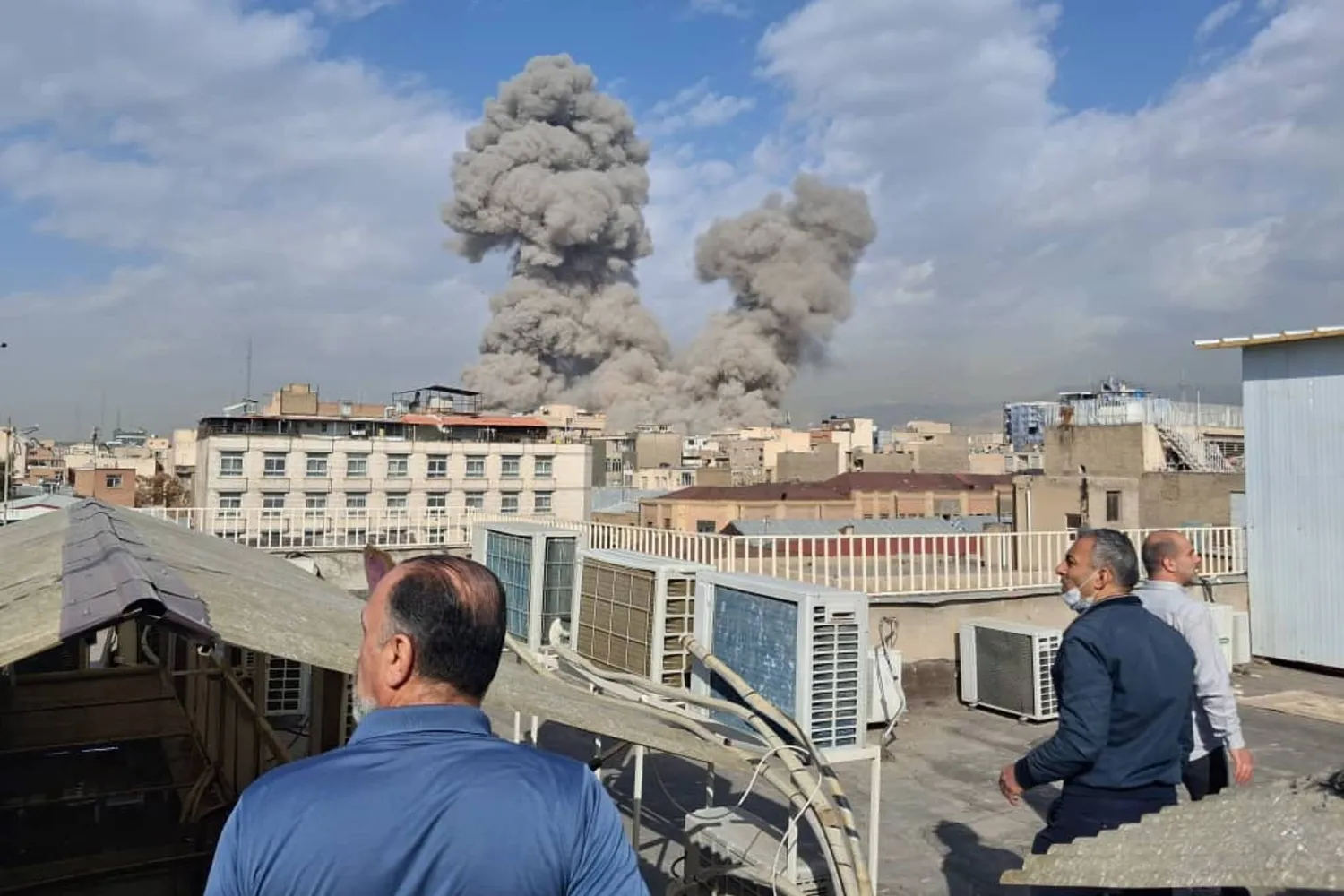

Hackers Hit Iranian Apps, Websites After US-Israeli Strikes

People watch as smoke rises on the skyline after an explosion in Tehran, Iran, Feb. 28, 2026. (AP)
TT

Hackers Hit Iranian Apps, Websites After US-Israeli Strikes

People watch as smoke rises on the skyline after an explosion in Tehran, Iran, Feb. 28, 2026. (AP)

A wave of cyber-enabled operations took place early Saturday morning alongside the joint US-Israeli attack on targets across Iran, according to cybersecurity experts and observers.

The operations included the hacking of multiple news websites to display various messages and the hack of BadeSaba, a religious calendar app with more than 5 million downloads, which displayed messages telling users “It’s time for reckoning” and urging armed forces to give up weapons and join the people.

Reuters could not establish contact with BadeSaba’s chief executive.

A spokesperson for US Cyber Command did not immediately respond to a request for comment.

Internet connectivity ‌in Iran dropped ‌precipitously at 0706 GMT, and then again at 1147 GMT, ‌with ⁠only minimal connectivity remaining, ⁠Doug Madory, director of internet analysis at Kentik, said in a post on X.

The cyberattack on BadeSaba was a smart move because government supporters use it and they tend to be more religious, said Hamid Kashfi, a security researcher and founder of cybersecurity firm DarkCell.

Cyber operations also struck a variety of Iranian government services and military targets to limit a coordinated Iranian response, the Jerusalem Post reported on Saturday. Reuters has not been able to ⁠independently verify the claims.

“As Iran considers its options, the likelihood ‌increases that proxy groups and hacktivists may take ‌action, including cyberattacks, against Israeli and US-affiliated military, commercial, or civilian targets,” said Rafe Pilling, the director of ‌threat intelligence with cybersecurity firm Sophos.

The attacks could include the amplification of ‌old data breaches presented as new, unsophisticated attempts to compromise internet-exposed industrial systems, and potentially direct offensive cyber operations, Pilling said.

Activity in the Middle East has increased, said Cynthia Kaiser, a former top FBI cyber official and current senior vice president at anti-ransomware firm Halcyon.

Kaiser said the firm has ‌also seen calls to action from known pro-Iranian cyber personas who in the past have carried out hack-and-leak operations, ransomware attacks ⁠and distributed denial-of-service attacks (DDoS), ⁠which flood internet services rendering them inaccessible.

The current cyber activity may precede more aggressive operations, said Adam Meyers, senior vice president of counter adversary operations with CrowdStrike.

"CrowdStrike is already seeing activity consistent with Iranian-aligned threat actors and hacktivist groups conducting reconnaissance and initiating DDoS attacks," he said.

Cybersecurity firm Anomali said in an analysis shared with Reuters on Saturday that state-backed Iranian hacking groups were already carrying out "wiper" attacks that erase data on Israeli targets ahead of the strikes.

Although Iran is often mentioned by US cyber officials alongside Russia and China as a threat to American networks, Tehran's previous responses to attacks on its soil have been muted.

In June, after the US struck Iranian nuclear targets, there was little sign of the disruptive cyberattacks often invoked during discussions of Iran’s digital capabilities beyond a short-lived interruption of services in Tirana, Albania's capital, according to media reports.



Iranian Leaders Want to Talk, Says Trump

US President Donald Trump delivers remarks during an event at the Port of Corpus Christi in Corpus Christi, Texas, US, February 27, 2026. (Reuters)
TT

Iranian Leaders Want to Talk, Says Trump

US President Donald Trump delivers remarks during an event at the Port of Corpus Christi in Corpus Christi, Texas, US, February 27, 2026. (Reuters)

US President Donald Trump said on Sunday that Iran's new leadership wants to talk to him and that he has agreed, according to an interview with the Atlantic magazine.

"They want to talk, and I have agreed to talk, so I will be talking to ‌them. They ‌should have done it ‌sooner. ⁠They should have given what ⁠was very practical and easy to do sooner. They waited too long," Trump said in the interview from his Florida residence.

Trump did not specify who he would be speaking with or say whether ⁠it would occur on Sunday ‌or Monday.

Iranian ‌President Masoud Pezeshkian said a leadership council composed of ‌himself, the judiciary head and a ‌member of the powerful Guardians Council had temporarily assumed the duties of supreme leader following the death of Ali Khamenei.

Trump said some ‌of the people who were involved in recent talks with the ⁠US are ⁠no longer alive.

"Most of those people are gone. Some of the people we were dealing with are gone, because that was a big - that was a big hit," he was quoted as saying in the interview with Atlantic staff writer Michael Scherer.

"They should have done it sooner, Michael. They could have made a deal. They should've done it sooner. They played too cute."


Iran Insists ‘No Limit’ Its Right to Self-Defense, Says FM

Iran's Foreign Minister Abbas Araghchi addresses a special session of the Conference on Disarmament at the United Nations, aside of US-Iran talks in Geneva, Switzerland, February 17, 2026. (Reuters)
TT

Iran Insists ‘No Limit’ Its Right to Self-Defense, Says FM

Iran's Foreign Minister Abbas Araghchi addresses a special session of the Conference on Disarmament at the United Nations, aside of US-Iran talks in Geneva, Switzerland, February 17, 2026. (Reuters)

A top Iranian official on Sunday rejected President Donald Trump's warning not to retaliate against massive US-Israel bombardments, saying there would be "no limit" to the country's self-defense.

"Nobody can tell us that you don't have any right to defend yourselves. We are defending ourselves whatever it takes, and we see no limit for ourselves to defend our people, to protect our people," Foreign Minister Abbas Araghchi told ABC News.

"What the United States is doing is an act of aggression. What we are doing is the act of self-defense. There are huge differences between these two," he said.


Three US Military Members Killed in Iran Operation

Aircraft attached to Carrier Air Wing (CVW) 9 sit on the flight deck of the US Navy Nimitz-class aircraft carrier USS Abraham Lincoln in support of the Operation Epic Fury attack on Iran, February 28, 2026. (US Navy/Handout via Reuters)
TT

Three US Military Members Killed in Iran Operation

Aircraft attached to Carrier Air Wing (CVW) 9 sit on the flight deck of the US Navy Nimitz-class aircraft carrier USS Abraham Lincoln in support of the Operation Epic Fury attack on Iran, February 28, 2026. (US Navy/Handout via Reuters)

The US military Sunday said three service members have been killed and five seriously wounded in the operation against Iran -- the first casualties of any kind announced on the US side.

The United States launched massive bombardments against Iran and killed its supreme leader Saturday, with attacks ongoing Sunday.

"Three US service members have been killed in action and five are seriously wounded as part of Operation Epic Fury. Several others sustained minor shrapnel injuries and concussions -- and are in the process of being returned to duty," US Central Command (CENTCOM) said in a statement.

"Major combat operations continue and our response effort is ongoing. The situation is fluid, so out of respect for the families, we will withhold additional information, including the identities of our fallen warriors, until 24 hours after next of kin have been notified."

US air and naval forces, together with Israeli forces, are heavily bombarding Iran and President Donald Trump has said the goal is to destroy the country's military capacity.

In response, Iran has fired missiles at targets in Israel and at US military facilities around the region.

Earlier Sunday, Iran's Revolutionary Guards said they had successfully hit the aircraft carrier USS Abraham Lincoln in the Gulf with four ballistic missiles.

However, CENTCOM said the aircraft carrier "was not hit."

"The missiles launched didn't even come close. The Lincoln continues to launch aircraft in support of CENTCOM's relentless campaign to defend the American people by eliminating threats from the Iranian regime," a statement said.