


Report: US, Kurds Discuss Potential Iran Military Operation

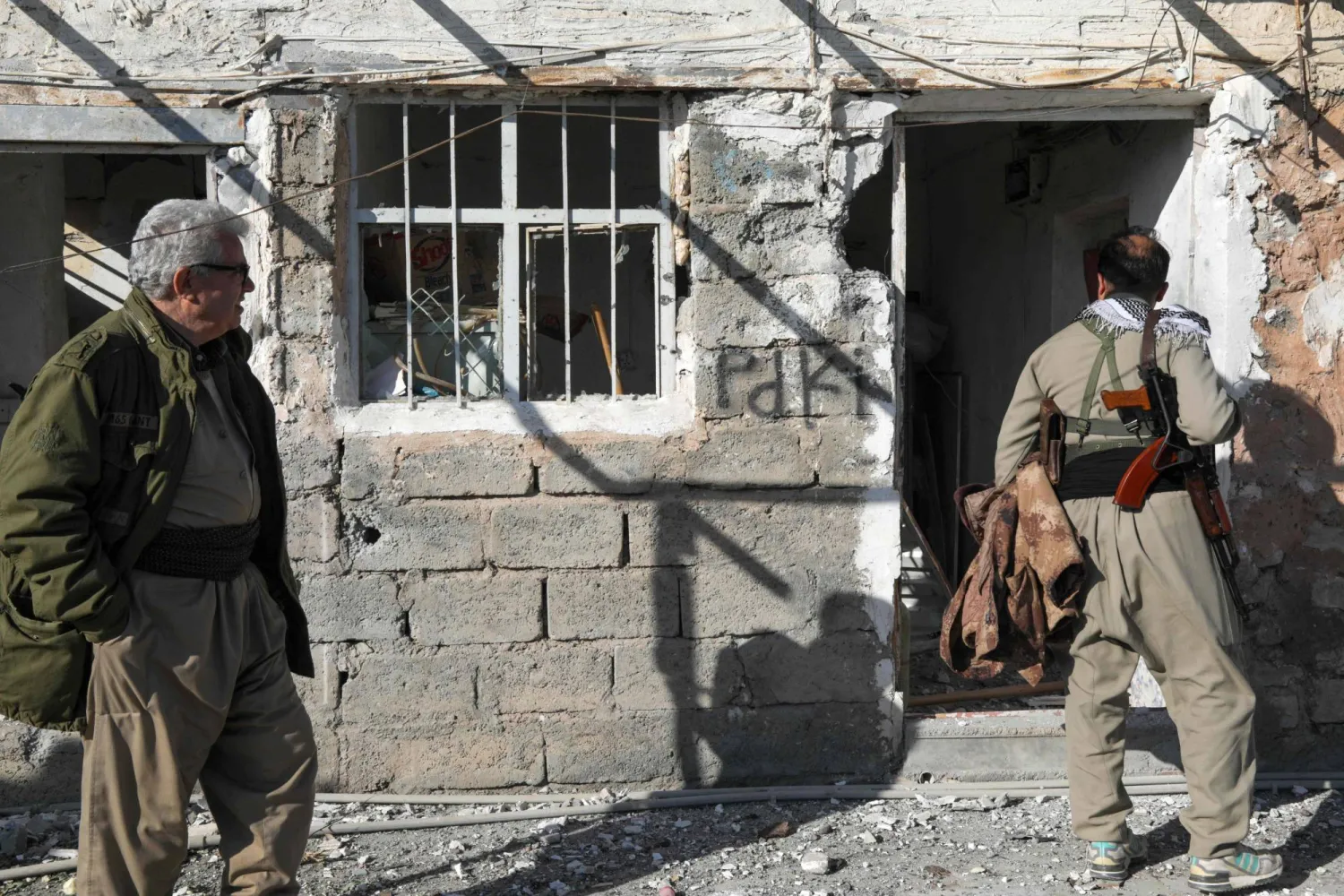
An Iranian Kurdish Peshmerga member of the Kurdistan Democratic Party of Iran (KDPI) inspects damage sustained at the Azadi Camp of the Kurdistan Democratic Party of Iran (KDPI) following an Iranian cross-border attack in the town of Koye (Koysinjaq), in the east of Erbil district in the autonomous Kurdish region of northern Iraq on March 3, 2026. (AFP)
TT

Report: US, Kurds Discuss Potential Iran Military Operation

An Iranian Kurdish Peshmerga member of the Kurdistan Democratic Party of Iran (KDPI) inspects damage sustained at the Azadi Camp of the Kurdistan Democratic Party of Iran (KDPI) following an Iranian cross-border attack in the town of Koye (Koysinjaq), in the east of Erbil district in the autonomous Kurdish region of northern Iraq on March 3, 2026. (AFP)

Iranian Kurdish militias have consulted with the United States in recent days about whether, and how, to attack Iran's security forces in the western part of the country, according to three sources with knowledge of the matter.

The Iranian Kurdish coalition of groups based on the Iran-Iraq border in the semi-autonomous region of Iraqi Kurdistan has been training to mount such an attack in hopes of weakening the country's military, as the United States and Israel pound Iranian targets with bombs and missiles.

The goal would be to create room for Iranians opposed to the regime to rise up now that Supreme Leader Ali Khamenei and other top officials have been killed since the US-Israeli attack began on Saturday, two of the sources said.

A final decision has not yet been made on the operation and its possible timing, added the sources, ‌who spoke on ‌condition of anonymity to talk freely about sensitive military planning.

The groups have requested ‌US ⁠military support and ⁠Iraqi leaders in Erbil and Baghdad have also been in touch with the Trump administration in recent days, they said.

The forces are in talks with the United States about CIA help to provide weapons, two of the sources said.

CNN was the first to report on the CIA's involvement with the groups and the potential ground operation. Axios said this week that President Trump held a telephone call with two of Iraqi Kurdistan’s top leaders.

Reuters could not independently confirm the extent of the CIA’s involvement in the planning of the operation, if it had facilitated the weapons or if any ⁠US forces planned to go into Iran with the Kurdish groups.

The CIA declined ‌to comment. The White House and the Pentagon did not immediately respond ‌to a request for comment.

The Kurdish Regional Government did not immediately respond to a request for comment.

KURDISH OPERATION WOULD ‌REQUIRE US SUPPORT

Any operation from Iraq would probably require significant US military and intelligence support.

The Pentagon says the ‌two US bases in Erbil have supported the international coalition fighting ISIS militants.

Kurdish groups in Iraqi Kurdistan have a long history of working with the US but their shifting allegiances and ideologies have at times strained ties with Washington.

The United States worked with some of the Kurdish groups in Iraq both during the Iraq War and the battle against ISIS.

But ‌it is unclear how successful the Iranian Kurdish groups would be in their fight inside Iran. The groups’ fighters have varying degrees of experience on the ⁠battlefield.

A source cited by CNN ⁠said the plan would be for Kurdish armed forces to take on Iranian security forces to make it easier for an uprising of unarmed Iranians in the country’s cities.

It is not clear exactly how such an operation in Iran by the Kurds will be received by other countries in the region.

An armed uprising by the Iranian Kurds could have serious consequences for Iran's stability.

It could add fuel to an armed separatist movement among the country's ethnic Baluch minority that keeps close ties with separatists in Pakistan's neighboring restive province of Baluchistan.

It is unlikely that Islamabad would tolerate any move toward Baluch independence.

Türkiye, a strong supporter of Syrian President Ahmed al-Sharaa, has seen the integration deal between Damascus and Kurdish forces as critical to restoring state authority across Syria.

It had threatened its own military operation against the Syrian Kurdish Democratic Forces (SDF) in the north, if the group did not agree to come under central government control.

Ankara has been working to advance its long-running efforts towards securing peace with the outlawed Kurdistan Workers Party (PKK) and is unlikely to be sympathetic towards the arming of Kurdish groups close to its borders.



UN Watchdog Says No Damage to Iran Sites Housing Nuclear Material

A satellite image shows a closer view of the Natanz Nuclear Facility with new building damage, amid the US-Israeli conflict with Iran, near Natanz, Iran, March 2, 2026. (Vantor/Handout via Reuters)
TT

UN Watchdog Says No Damage to Iran Sites Housing Nuclear Material

A satellite image shows a closer view of the Natanz Nuclear Facility with new building damage, amid the US-Israeli conflict with Iran, near Natanz, Iran, March 2, 2026. (Vantor/Handout via Reuters)

The UN nuclear watchdog IAEA said Wednesday facilities housing nuclear material in Iran suffered no damage in the recent US-Israeli strikes and there was no risk of a radiation leak.

"Based on analysis of latest available satellite imagery, IAEA sees no damage to facilities containing nuclear material in Iran and therefore no radiological release risk at this time," the agency said on X.

Near the Natanz site near the central city of Isfahan, "damage is visible at two buildings" and there was "no additional impact detected" after "damage at entrances" reported on Tuesday, it said.

IAEA inspectors have had no access to the key Natanz site since it was targeted by bombings in June during the 12?day war triggered by an Israeli attack.

The IAEA reported "no impact at other nuclear sites, including Bushehr" in the southeast.

IAEA Director General Rafael Grossi repeated his call for "utmost restraint" in the conflict to avoid a radiation threat.


Iranian Govt Making Case for Demise with Indiscriminate Attacks, EU’s Kallas Says

European Union High Representative for Foreign Affairs and Security Policy Kaja Kallas attends a press conference after an informal meeting of Council of the Baltic Sea States in Warsaw, Poland, 04 March 2026. (EPA)
TT

Iranian Govt Making Case for Demise with Indiscriminate Attacks, EU’s Kallas Says

European Union High Representative for Foreign Affairs and Security Policy Kaja Kallas attends a press conference after an informal meeting of Council of the Baltic Sea States in Warsaw, Poland, 04 March 2026. (EPA)

Iran's government is making a strong case for its demise by indiscriminately attacking its neighbors, EU's top diplomat Kaja Kallas told reporters on Wednesday.

"Iran's strategy is to sow chaos and set the region on fire," ‌Kallas said.

Türkiye ‌said earlier on ‌Wednesday that ⁠NATO air defenses destroyed ⁠an Iranian ballistic missile headed into Turkish airspace.

Asked about the incident, Polish Foreign Minister Radosław Sikorski said: "Iran is broadening the war ⁠to countries that did not ‌attack ‌it ... there is a well-known ‌saying it's worse than ‌a crime, it's a mistake."

Kallas said the war in the Middle East is diverting attention from ‌Ukraine, but it was important not to let ⁠the ⁠war in Ukraine recede into the background.

She added that the conflict in Iran has cost Russia an ally, but cautioned that Russia could benefit from a spike in oil prices stemming from the crisis.


Israel Initially Planned to Strike Iran in Mid-2026, Reveals Minister

Israeli Defense Minister Israel Katz makes statements with his Greek counterpart Nikos Dendias after their meeting in Athens, Greece, Tuesday, Jan. 20, 2026. (AP)
TT

Israel Initially Planned to Strike Iran in Mid-2026, Reveals Minister

Israeli Defense Minister Israel Katz makes statements with his Greek counterpart Nikos Dendias after their meeting in Athens, Greece, Tuesday, Jan. 20, 2026. (AP)

Israel had initially planned to strike Iran in mid-2026, but developments inside the country and shifting regional dynamics brought the timetable forward to February, Defense Minister Israel Katz said on Wednesday.

"An operation was planned for the middle of the year with the same target set," Katz said in an address to military intelligence officials, according to a statement issued by his office.

"But due to developments and circumstances -- mainly what happened inside Iran, the position of the US president and the possibility of creating a combined operation -- it became necessary to move everything up to February."

During mass anti-government protests in Iran in January, which were suppressed in a violent crackdown by security forces, Trump pledged support for demonstrators, declaring that the United States stood with the people of Iran.

Top Israeli officials, including Prime Minister Benjamin Netanyahu, made similar remarks, urging Iranians to rise up against the country's clerical leadership.

The United States and Israel jointly launched strikes on Iran on Saturday, and in the initial wave of attacks, they killed supreme leader Ali Khamenei.

Iran retaliated swiftly with missile fire targeting Israel and also launched strikes against several countries in the region, saying it was aiming at US assets.

Iran's official IRNA news agency said Wednesday that US-Israeli strikes had killed 1,045 military personnel and civilians since the start of the war. AFP was not in a position to independently verify the toll.

Iranian strikes on Israel have killed 10 people and injured scores more, according to Israeli authorities.