


Intense Israeli Strikes Hit Iran and Lebanon as US Warns Bombardment Will ‘Surge Dramatically’

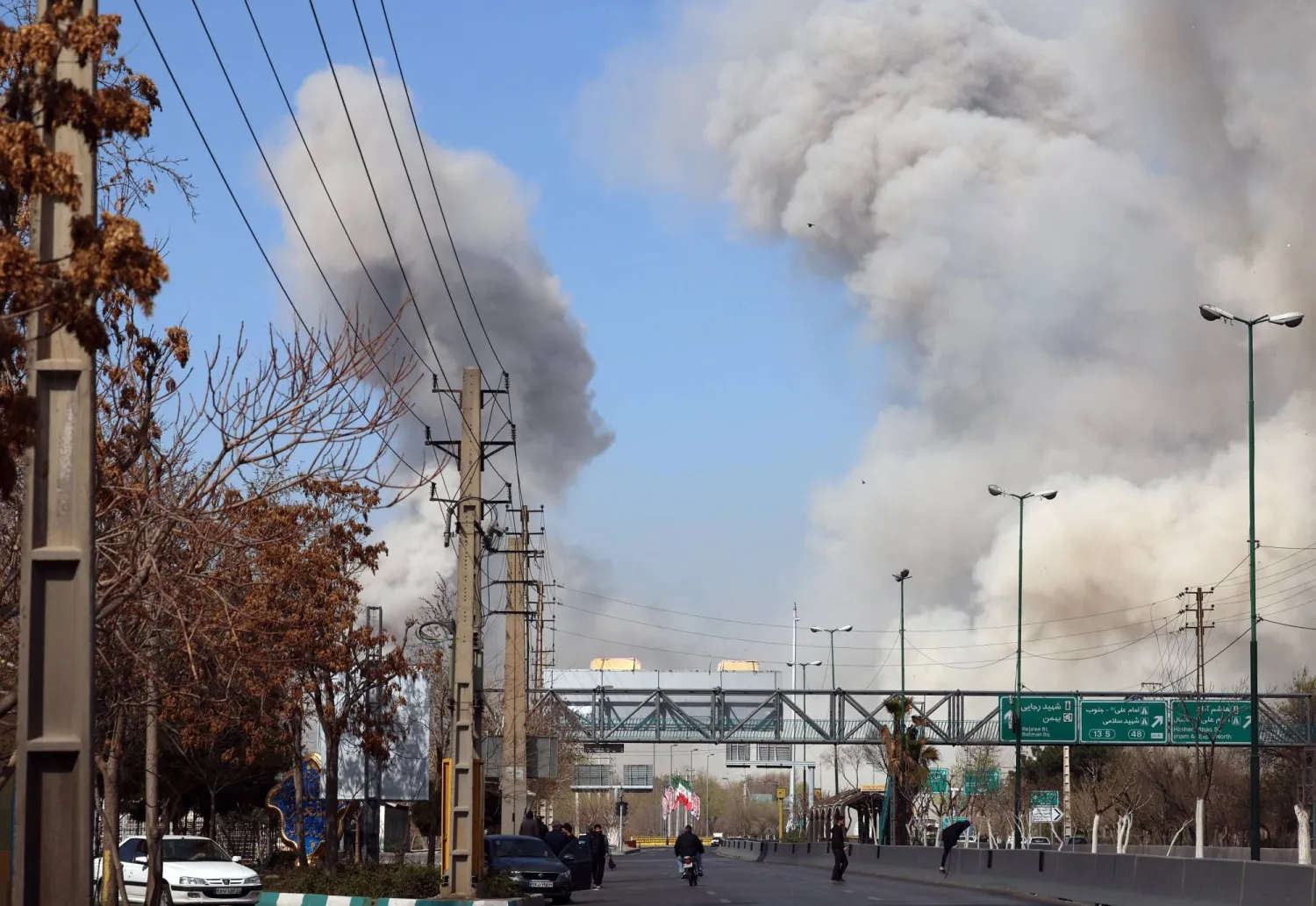
People run for safety as smoke rises after an airstrike in central Tehran, Iran, 05 March 2026. (EPA)
TT

Intense Israeli Strikes Hit Iran and Lebanon as US Warns Bombardment Will ‘Surge Dramatically’

People run for safety as smoke rises after an airstrike in central Tehran, Iran, 05 March 2026. (EPA)

Intense Israeli airstrikes pounded the capitals of Iran and Lebanon early Friday as the US apparently struck an Iranian drone carrier at sea in its unrelenting campaign against the country’s fleet of warships.

Iran launched new retaliatory attacks in the Middle East at the end of a full week of bombardment, which US Defense Secretary Pete Hegseth warned was “about to surge dramatically.”

Israel’s military said Friday morning it had begun “a broad-scale wave of strikes” on Tehran, Iran’s capital. Witnesses described the Israeli airstrikes as particularly intense, shaking homes in the area. Others reported explosions around the Iranian city of Kermanshah in an area that is home to multiple missile bases.

The Israeli military said strikes have already destroyed most of Iran’s air defenses and missile launchers.

The war has escalated to affect countries across the Middle East and beyond. Early Friday, Iran fired missile and drone attacks into Kuwait, Qatar, Saudi Arabia and Bahrain, all countries that host US forces. There were no immediate reports of casualties.

In Lebanon, where the war has rekindled fighting between Israel and Iran-allied Hezbollah, Israel struck on Friday a building on a main thoroughfare of the southern Lebanese city of Sidon, state media said, without prior warning. 

The strike targeted the tenth floor of an office building near two shelters for displaced people, an AFP photographer said. 

Rescuers removed at least one body and were gathering human remains, the photographer said. 

Also, Israel launched a series of airstrikes late Thursday into Friday in the southern suburbs of Beirut and other areas. Motorists jammed roads trying to flee or seek shelter.

The US and Israel have battered Iran with nationwide strikes, targeting their military capabilities, leadership and nuclear program.

In addition to Israel, Iran’s attacks have targeted their Arab neighbors, disrupted oil supplies and snarled global air travel. The war has killed at least 1,230 people in Iran, more than 120 in Lebanon and around a dozen in Israel, according to officials in those countries. Six US troops have been killed.

US says it struck an Iranian drone carrier

The US military said early Friday that it struck an Iranian drone carrier, setting it ablaze.

The US military’s Central Command released black-and-white footage of the burning carrier. The Iranian military did not immediately acknowledge the attack.

The drone carrier, the IRIS Shahid Bagheri, is a converted container ship with a 180-meter-long (yard) runway for drones. The vessel can travel up to 22,000 nautical miles without needing to refuel in ports, reports said at the time of its 2025 inauguration.

Adm. Brad Cooper, head of US Central Command, described the carrier as “roughly the size of a World War II aircraft carrier.”

“And as we speak, it’s on fire,” Cooper told reporters.

Earlier in the week, an American submarine sank an Iranian frigate off the coast of Sri Lanka as it was returning from an exercise hosted by the Indian navy that the US also joined. The sinking killed at least 87 sailors.

Under cover of darkness Friday morning, B-2 stealth bombers dropped dozens of 2,000 pound “penetrator” bombs on deeply buried ballistic missile launchers inside Iran, Cooper said.

“We've also struck Iran's equivalent of Space Command, which degrades their ability to threaten Americans,” Cooper said.

Speaking alongside Cooper, Hegseth gave few details when he promised an upcoming surge.

“It’s more fighter squadrons, it’s more capabilities, it’s more defensive capabilities,” Hegseth said. “And it’s more bomber pulses more frequently.”

Iran targets Gulf

Qatar’s Defense Ministry reported early Friday it intercepted a drone attack targeting Al Udeid Air Base, which hosts the forward headquarters of the US Central Command.

Saudi Arabia intercepted and destroyed three ballistic missiles fired early Friday toward Prince Sultan Air Base south of Riyadh, said a spokesperson for Saudi Arabia’s Ministry of Defense.

Air raid sirens sounded in Bahrain, where the Interior Ministry said Iranian strikes targeted two hotels and a residential building. It said there were no casualties. In Kuwait, where the six US soldiers were killed Sunday, the Kuwaiti army said its air defenses were activated when missile and drone attacks breached Kuwait’s airspace.

Cooper said Iranian attacks had now hit a dozen countries, who would be welcome to play a more active role in the conflict.

“Those 12 countries are none too happy and I look forward to working with all the partners who are willing to join us,” he said.

Trump again urges Iranians to ‘take back’ their country

In brief remarks at the White House, US President Donald Trump again urged the Iranian people to “help take back your country.” This time he promised the US would grant them “immunity” amid the war and ongoing dangers under the current Iranian regime.

“So you’ll be perfectly safe with total immunity,” Trump said, without giving any details about what that meant. “Or you’ll face absolutely guaranteed death.”

Cooper and Hegseth cautioned Iranians not to take to the streets while the conflict is still raging, however.

“It's common sense, don't go out and protest while bombs are dropping,” Hegseth said.

“The best thing for them to do now is just to lay low,” Cooper added.

In an interview with the news website Axios, Trump said he should be involved in choosing Iran's new supreme leader to replace Ali Khamenei, who was killed in the opening strikes of the war. Trump spoke dismissively of Khamenei's son, Mojtaba Khamenei, being a front-runner to replace his father, calling him “a lightweight.”

“We want someone that will bring harmony and peace to Iran,” Trump said.

Iranian officials meet to discuss new leadership

Iranian state television reported Friday that a leadership council had started discussing how to convene the country’s Assembly of Experts, which will select the new supreme leader.

The leadership council includes President Masoud Pezeshkian, judiciary chief Gholam Hossein Mohseni Ejehi and cleric Ali Reza Arafi.

The statement provided no timeline on the selection of the supreme leader, nor information on whether the Assembly of Experts would meet in person or remotely for the vote.

Buildings associated with the Assembly of Experts, a 88-member clerical panel, have been attacked during the Israeli-US airstrike campaign.

Israel hits Lebanon with multiple airstrikes around Beirut

Israel carried out at least 11 airstrikes late Thursday and early Friday, targeting the southern suburbs of Beirut. Fires broke out near a gas station.

The Israeli army issued a warning Thursday evening, urging residents to “save your lives and evacuate your homes immediately.” Two hospitals evacuated patients and staff. No casualties were immediately reported.

The Lebanese health ministry said the death toll has risen to 123 since the resurgence of hostilities between Israel and Hezbollah, which struck Israel in the opening days of the war.

A spokesperson for the UN peacekeeping force in southern Lebanon, Tilak Pokharel, said Thursday that peacekeepers had seen and heard clashes, including ground combat, in southern Lebanon as more Israeli forces have moved across the border.



Israel Army Says Iran Using Cluster Munitions

An Iranian missile with cluster munitions flies towards Israel, amid the US-Israeli conflict with Iran, in central Israel, March 5, 2026. (Reuters)
TT

Israel Army Says Iran Using Cluster Munitions

An Iranian missile with cluster munitions flies towards Israel, amid the US-Israeli conflict with Iran, in central Israel, March 5, 2026. (Reuters)

Israel's military Friday said that Iran had launched cluster bombs "multiple times" since the start of the war that began with a US-Israeli attack on the country last week.

"They (the Iranians) are using cluster munitions", military spokesman Lieutenant Colonel Nadav Shoshani said during a press briefing, without providing details on when and where those munitions were launched.

"They've used it multiple times, which is a war crime when it's directed towards civilians and we're tracking that situation," Shoshani added.

Neither Iran nor Israel are among more than a hundred countries that are party to the 2008 Convention on Cluster Munitions, which prohibits the use, transfer, production and storage of cluster bombs.

AFP footage from Thursday evening showed a swarm of flaming projectiles falling in the darkened sky over central Israel.

Police did not comment on the sighting, but a military expert who reviewed the footage for AFP identified them as a part of a cluster bomb.

Israel's police had said Wednesday that bomb disposal experts found evidence of cluster munitions after incoming missiles from Iran were detected.

Due to military censorship rules in place in Israel since the start of its war with Iran, impact sites are generally closed to the public including journalists until they are cleared of Iranian missile debris and unexploded ordnances.

Police on Friday also published a public service announcement in which one of its bomb disposal technicians explained the dangers of cluster bombs.

"During the current war, the home front is facing a variety of threats, whether missiles, UAVs (drones), or rockets. I will talk to you about a threat that is a bit less known, but no less dangerous: the cluster munition threat," the technician said in the video.

During Israel's 12-day war with Iran in June 2025, the NGO Amnesty International reported Tehran’s use of widely banned cluster munitions.

The organization had said it analyzed photos and videos showing cluster munitions that, according to media reports, struck inside the Gush Dan metropolitan area around Tel Aviv on June 19.

The southern city of Beersheva on June 20 and Rishon LeZion to the south of Tel Aviv on June 22 were also "struck with ordnance that left multiple impact craters consistent with the submunitions seen in Gush Dan", Amnesty said.

Cluster munitions explode in mid-air and scatter bomblets.

Some of them may not explode on impact and can cause casualties over time, particularly among children.


Zelensky Visits Frontline Donetsk Region in East Ukraine

This handout photograph taken and released by the Ukrainian Presidential Press Service on March 6, 2026, shows Ukrainian President Volodymyr Zelensky (C) posing for a photo with Ukrainian servicemen while visiting the command post of the 3rd Battalion of the 28th Separate Mechanized Brigade named after the Knights of the Winter Campaign near Druzhkivka, Donetsk region, amid the Russian invasion of Ukraine. (Handout / Ukrainian Presidential Press Service / AFP)
TT

Zelensky Visits Frontline Donetsk Region in East Ukraine

This handout photograph taken and released by the Ukrainian Presidential Press Service on March 6, 2026, shows Ukrainian President Volodymyr Zelensky (C) posing for a photo with Ukrainian servicemen while visiting the command post of the 3rd Battalion of the 28th Separate Mechanized Brigade named after the Knights of the Winter Campaign near Druzhkivka, Donetsk region, amid the Russian invasion of Ukraine. (Handout / Ukrainian Presidential Press Service / AFP)

Ukrainian President Volodymyr Zelensky visited the frontline region of Donetsk in east Ukraine, where his forces are fighting against a grinding Russian assault, he said Friday.

The visit comes as Ukraine seeks to strengthen its frontline defenses.

The Russian army recorded its slowest advance on the front in nearly two years in February, as Kyiv successfully pushed back in some areas, according to data from the Institute for the Study of War.

"The Russians are not abandoning the war, and here, in the Donetsk region, they are preparing an offensive for the spring," Zelensky said in a post on X.

"It is important that our positions are strong," he added.

He posted a video that appeared to show him in Druzhkivka -- a town that lies about 15 kilometers (nine miles) from the front with Russia's troops, which has come under regular Russian shelling.

During the visit he also handed out awards to soldiers, he said in a separate Facebook post.

"The stronger we are here, the stronger we are in the negotiation process," he said.

Zelensky has made frequent visits to the front since Russia invaded in February 2022.


Merz Warns Against Iran State Collapse, Refugee Flows

German Chancellor Friedrich Merz delivers a speech during a campaign event of the Christian Democratic Union (CDU) party for the state election of Baden-Wuerttemberg in Stockach, Germany, 06 March 2026. (EPA)
TT

Merz Warns Against Iran State Collapse, Refugee Flows

German Chancellor Friedrich Merz delivers a speech during a campaign event of the Christian Democratic Union (CDU) party for the state election of Baden-Wuerttemberg in Stockach, Germany, 06 March 2026. (EPA)

German Chancellor Friedrich Merz said Friday the Middle East war must not lead to the collapse of the Iranian state, warning of the impact this would have on migration to Europe.

"An endless war is not in our interest. The same applies to a collapse of Iranian statehood or proxy conflicts fought on Iranian soil," he said in a statement.

"Such scenarios could have far-reaching consequences for Europe, including for security, energy supply and migration."

He added that "we share the goals of the United States and Israel regarding the Iranian nuclear and missile program, Tehran's threats against Israel, and its support for terrorism and proxies.

"The Iranian people have the right to freely decide their own destiny."

He warned against chaos, a point he also stressed speaking at a trade fair in Munich.

Germany and its European allies were "pushing hard for Iran's sovereignty to be preserved", he said there.

"We do not want to see a Syrian scenario here," he added.

"I am appealing both in Washington and in all talks with the Israeli government to create the conditions for this country to be stabilized as quickly as possible."

Merz said that "we naturally have a strong interest in this ourselves in order to avoid new waves of refugees from the region".

The United Nations refugee agency on Friday declared the Middle East war a major humanitarian emergency and insisted all fleeing civilians should be granted safe passage.

UNHCR said the war -- which began on Saturday when Israel and the United States launched strikes on Iran and has spread across the region since -- had already caused large numbers of people to flee their homes.

German Foreign Minister Johann Wadephul said Berlin would provide 100 million euros ($116 million) in humanitarian aid for Lebanon, which became engulfed in the war after the Iran-backed group Hezbollah on Monday fired missiles at Israel to avenge the death of Iranian supreme leader Ali Khamenei.

"We are currently seeing a new dynamic and a dramatic situation in Lebanon with many internally displaced persons, and we want to help throughout the region in order to provide assistance on the ground," Wadephul said.