

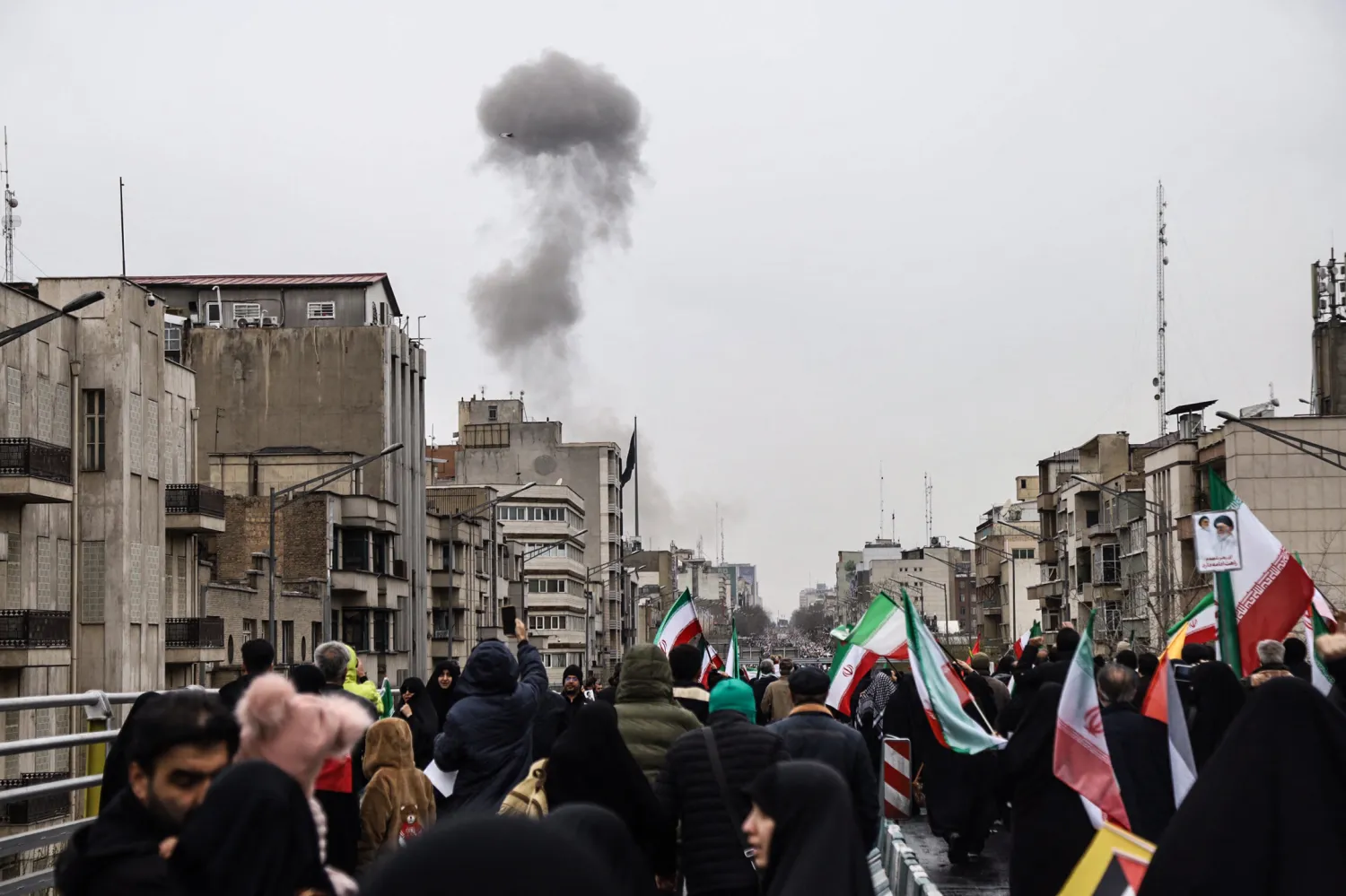

Iran Defiant, US Vows Even Heavier Bombing

Black smoke rises following an airstrike, as Iranians take part in the Al-Quds (Jerusalem) Day rally, a commemoration in support of the Palestinian people on the last Friday of the Islamic holy month of Ramadan, in Tehran on March 13, 2026. (AFP)
TT

Iran Defiant, US Vows Even Heavier Bombing

Black smoke rises following an airstrike, as Iranians take part in the Al-Quds (Jerusalem) Day rally, a commemoration in support of the Palestinian people on the last Friday of the Islamic holy month of Ramadan, in Tehran on March 13, 2026. (AFP)

Iranian officials led a pro-government rally in Tehran as explosions rocked the city on Friday, while the United States vowed it would intensify strikes in the coming hours and days. 

The hardline stances and renewed strikes unleashed by Israel and Iran presaged no let-up in the conflict engulfing the Middle East and roiling the global energy market. 

AFP journalists in Tehran reported loud blasts over the city as Israel's military said it had carried out 7,600 strikes in Iran since the war started on February 28, with most targeting the country's missile program. 

US Defense Secretary Pete Hegseth told a news conference the US military would bombard Iran more heavily on Friday than any other day so far in the war. 

He also said Iran's new supreme leader, Mojtaba Khamenei, was "wounded and likely disfigured" in the attack that killed his father and predecessor Ali Khamenei at the start of the US-Israeli campaign. 

President Donald Trump said on social media that he viewed it "a great honor" to be killing Iran's rulers, calling them "deranged scumbags". 

He later said in an interview on Fox News Radio that the United States would be hitting Iran hard over the "over the next week". 

- Fresh strikes - 

While Mojtaba Khamanei has not appeared since being named supreme leader, other officials walked in the open in Tehran with pro-government demonstrators who waved flags and brandished banners reading "Death to America" and "Death to Israel". 

Iran's state media said at least one woman was killed when blasts hit an area near the demonstration. 

"These attacks are out of fear, out of desperation," said Ali Larijani, secretary of the Supreme National Security Council, who attended the rally to mark Quds Day, the last Friday of Ramadan and a day of support for the Palestinian cause. 

"It's clear that it (the enemy) has failed," said Larijani in a speech broadcast on state TV. 

President Masoud Pezeshkian and Foreign Minister Abbas Araghchi also attended the rally, while images on Iranian media showed the head of the judiciary being interviewed just as a blast occurred. 

Shortly afterwards, state television said Iran had launched a fresh salvo of missiles at Israel. Explosions were later heard on the outskirts of Tel Aviv, but Israeli paramedics reported no casualties. 

Earlier, a strike on the Israeli town of Zarzir wounded around 60 people, according to police, with AFP images showing burnt-out vehicles and craters in the ground. 

Iran also kept up launches of drone and missile strikes against neighboring states hosting US military assets. 

Saudi Arabia's defense ministry said on Friday its forces had intercepted dozens of drones, while an AFP journalist reported an explosion heard over Dubai that rattled buildings. 

Türkiye said NATO forces shot down a ballistic missile launched from Iran -- the third such interception in the war. 

- Oil worries - 

The conflict has sparked chaos in global markets and sent oil prices soaring. 

Iran's Revolutionary Guards have all but closed the Gulf's strategic Strait of Hormuz through which 20 percent of global oil supplies pass. 

Oil stayed at over $100 a barrel on Friday, leaving markets and governments everywhere skittish about the consequences of higher inflation. 

"Every day on the ship, I can see missile launches and hear explosions, making me feel like I was in danger," a sailor stuck on one of the ships unable to pass through the strait, Wang Shang, told AFP. 

The US government has said that the US Navy would likely not be able to escort ships through the strait until the end of the month. 

On Friday, the White House and Pentagon lashed out at CNN for a report suggesting that Washington had underestimated Iran's ability to disrupt oil traffic through the strait. 

"The Pentagon has been planning for Iran's desperate and reckless closure of the Strait of Hormuz for DECADES," White House press secretary Karoline Leavitt said on X. 

- Bread rationed - 

Within Iran, the Revolutionary Guards have warned of an even stronger response to any anti-government protests, after ones in January in which several thousand people were killed. 

Iranian authorities have maintained an internet blackout since the war started. 

Iranians speaking to AFP under cover of anonymity have described a grim picture of cities in ruins and cash running short. 

"Bread is now rationed. The population is extremely tense and outraged," one 30-year-old woman in Kermanshah, western Iran, told AFP. 

Another woman in the city said "countless" people from Tehran had come to seek refuge from the airstrikes, adding to demand for food and scarce medicine, with prices "nearly doubling". 

"As a result, locals face serious shortfalls... the situation is extremely tough," she said. 

The UN refugee agency has estimated that up to 3.2 million people have been displaced inside Iran since the war started. 

Iran's health ministry said on March 8 that more than 1,200 people have been killed, a figure AFP has not been able to verify independently. 

The US military has lost 13 personnel since the war started -- including all six members of a refueling aircraft that crashed in Iraq after an incident officials said was not caused by hostile fire. 

Pentagon chief Hegseth said the US and Israel have so far struck more than 15,000 targets. 

In another sign of the war's spread, President Emmanuel Macron announced the death of France's first soldier, in an attack in the Erbil region of Iraq. 

The conflict has also battered Lebanon, with authorities reporting at least 687 people killed by Israeli attacks. 

Israel's military said it has conducted 1,100 strikes in Lebanon, including 200 it said hit 200 "missile and launcher targets" and 35 command-and-control sites of the Iran-backed Hezbollah armed group. It said it had killed more than 380 members of Hezbollah. 

UN chief Antonio Guterres, at the start of a visit to Beirut, called on Israel and Hezbollah to "stop the war". 


Nepal Warns of Climate Threat After Deadly Floods

A disaster rescue personnel looks on at the site of damaged buildings in the aftermath of flash floods at Trishuli Bazar in Nepal's Nuwakot district on August 29, 2026. (AFP)
TT

Nepal Warns of Climate Threat After Deadly Floods

A disaster rescue personnel looks on at the site of damaged buildings in the aftermath of flash floods at Trishuli Bazar in Nepal's Nuwakot district on August 29, 2026. (AFP)

Nepal's foreign minister warned on Saturday of the growing threat from climate change in the Himalayas, as China offered water and satellite data after devastating floods on their shared border killed hundreds.

The US Geological Survey said the disaster on Wednesday near the high-altitude China-Nepal border was caused by a glacial collapse that sent a torrent of debris downstream, with nearly 3,000 people missing and 682 confirmed dead.

While the exact cause of the collapse is unclear, climate change is causing glaciers to melt worldwide, increasing the risks of such disasters.

Foreign Minister Shisir Khanal said he had spoken by phone with his Chinese counterpart Wang Yi, agreeing to increase the sharing of "real-time hydrological data", according to a statement.

Wang, in a Chinese foreign ministry statement, said Beijing had "shared crucial information with Nepal, including disaster area imagery, satellite and hydrological data, as well as early warnings about upstream barrier lakes".

Wang added that "China and Nepal are bound by mountains and rivers, sharing a common destiny".

Khanal had earlier told reporters on Saturday that Nepal needed greater research to "understand the changing dynamics of the Himalayan ecosystem" and the risks they pose to the landlocked country, encircled by India and China.

That includes not only risks "to Nepal and the downstream community, but also to our northern neighbor, to China, as well," Khanal said.

Himalayan glaciers, which provide critical water to nearly two billion people, are melting faster as the planet heats, exposing communities to unpredictable, costly disasters.

Khanal said climate change required international action.

"We always highlight that Nepal contributes less than or just about 0.01 percent of greenhouse gases but we, the people of Nepal, are one of the major victims of the changing climate and its impact," he added.

"So we request the global community also to come together to preserve the Himalayan ecosystem."

Melting glaciers and thawing permafrost can also destabilize mountain slopes, increasing the risk of landslides and other hazards.


Türkiye Summons Ukraine Ambassador Over Black Sea Attacks

Smoke rises from a civilian vessel on fire, amid Russia's attack on Ukraine, in Odesa, Ukraine July 19, 2026. (Reuters)
TT

Türkiye Summons Ukraine Ambassador Over Black Sea Attacks

Smoke rises from a civilian vessel on fire, amid Russia's attack on Ukraine, in Odesa, Ukraine July 19, 2026. (Reuters)

Türkiye summoned Ukraine's ambassador over attacks this week in the Black Sea against a Turkish vessel, and against a second ship that came to tow the first, the country's foreign ministry said Saturday.

The attacks happened on Wednesday and Thursday, the ministry told AFP.

"During the meeting, Türkiye warned about the absolute need to ensure the safety of people, of assets, of navigation and of the environment in the Black Sea," the ministry said in a statement.

It said the Turkish container ship Lider Bordo Mavi was hit on Wednesday while it was off the Russian coast on the Black Sea. The next day, the ship Lider Kocatepe sent to tow the cargo vessel was also targeted, the ministry said.

The ministry did not say whether there were any casualties in the attacks.

According to local Turkish media, the container ship was towed to the Turkish port of Samsun.

Ankara has been calling for weeks on Ukraine and Russia to suspend their attacks on civilian vessels in the Black Sea. Each of the warring countries has been seeking to damage the other's sources of export revenues as part of their conflict, which Russia started in 2022 with its full-scale invasion of Ukraine.

Turkish commercial ships are active in the Black Sea, sailing under various countries' flags, and several have been hit by drones suspected to be launched by Ukraine.

Türkiye, a NATO member country that maintains relations with both Kyiv and Moscow, has not joined Western sanctions levelled against Russia.

On August 8, Turkish Foreign Minister Hakan Fidan called for a "moratorium" on Black Sea attacks.

"The conflict has spread across the whole Black Sea," he said at the time, complaining that "they are attacking all commercial shipping without distinction".


French Far-Right Accuses Left of Threatening ‘Civil Peace’ if Le Pen Wins

French far-right leader and member of parliament Marine Le Pen, President of the French far-right National Rally (Rassemblement National - RN) party parliamentary group, attends a debate with other candidates for the 2027 French presidential election during the MEDEF summer forum "La Rencontre des Entrepreneurs de France, La REF" in Paris, France, August 27, 2026. (Reuters)
TT

French Far-Right Accuses Left of Threatening ‘Civil Peace’ if Le Pen Wins

French far-right leader and member of parliament Marine Le Pen, President of the French far-right National Rally (Rassemblement National - RN) party parliamentary group, attends a debate with other candidates for the 2027 French presidential election during the MEDEF summer forum "La Rencontre des Entrepreneurs de France, La REF" in Paris, France, August 27, 2026. (Reuters)

The French far-right on Saturday accused the left of seeking to "undermine civil peace" should Marine Le Pen win the presidential election next spring, underscoring the increasingly confrontational tone of the campaign.

With less than eight months to go before France's presidential election, far-right leader Le Pen, 58, remains the front-runner in the polls.

Analysts say that the appeal of political extremes is growing in France, and recent surveys show that hard-left presidential candidate Jean-Luc Melenchon, 75, may have the best chance of reaching the run-off against Le Pen.

Speaking at an agricultural fair in the northeastern town of Chalons-en-Champagne, Jordan Bardella, president of the National Rally (RN) party and Le Pen's prospective prime minister in the event of her victory, said he was concerned by calls from the left for "civil disobedience" if the RN comes to power.

Bardella, 30, said they amounted to "an admission of weakness from the left, which hates democracy and is calling into question the fundamental principles of the rule of law and the electoral process."

"The attitude of France Unbowed at the start of this campaign is deeply worrying," said Bardella.

"They are already seeking to undermine civil peace in our country."

Mathilde Panot, leader of the LFI parliamentary group in parliament's lower house, and Greens leader Marine Tondelier have recently said they would support "civil disobedience" in the event of an RN victory.

Some observers say the election campaign is increasingly at risk of becoming a contest dominated by populist anti-establishment forces, raising concern among investors about the prospect of a presidential runoff between the far right and the hard left.

Bardella said he was concerned about Melenchon's "true intentions."

During a first presidential debate on Thursday, Melenchon vowed to "disobey" European decisions that contradict the wishes of French voters and pressed ahead with his proposals to cancel a chunk of France's public debt.

"France Unbowed and Monsieur Melenchon do not want to win this presidential election," said Bardella.

"They do not want to protect institutions, they want to destroy them."
