


Israel to Help US Manage Strait of Hormuz Crisis Through Intelligence

Israel to Help US Manage Strait of Hormuz Crisis Through Intelligence
TT

Israel to Help US Manage Strait of Hormuz Crisis Through Intelligence

Israel to Help US Manage Strait of Hormuz Crisis Through Intelligence

Israel is helping the United States manage the crisis around the Strait of Hormuz through intelligence, a senior Israeli security official told the Yedioth Ahronoth newspaper on Monday, without addressing the issue of an Israeli involvement in any possible ground operations in Iran.

The official said the Israeli army had been tasked with creating conditions that could enable the fall of the regime and that Israel was “very close” to achieving the objectives it had set for itself in Iran, with assessments of the campaign’s gains being updated constantly.

“Israel is helping the United States manage the crisis around the Strait of Hormuz, primarily through intelligence,” the senior security official said.

He noted that the Israeli strikes on Iranian steel plants earlier this week had caused damage worth billions of dollars and had become a major preoccupation for Tehran.

The remarks came after Israeli sources affirmed that Tel Aviv supports a ground military operation in Iran, but that its troops are not expected to join.

Last Sunday, US Central Command chief Adm. Brad Cooper was in Israel and met with Israeli Army Chief of Staff Lt. Gen. Eyal Zamir and other top Israeli generals. According to Channel 12, they discussed US-Israeli coordination in the war on Iran, as well as efforts to stop Iranian weapons production.

Israel wants to continue the war and is pushing for a ground operation in Iran. However, it fears surprises from US President Donald Trump, who could still declare a temporary ceasefire.

On Monday, Yedioth Ahronoth said the assessment in Israel is that a ground operation could create a chance to break Iranian resistance or force a surrender.

Meanwhile, it wrote, preparations are underway in Pakistan for possible US-Iran negotiations, and there is also growing attention to the possibility that Washington could announce a ceasefire as early as this week to allow talks to proceed.

The newspaper said that although Trump has warned Tehran to reopen the strategic waterway or face broader US attacks on Iranian energy infrastructure, his comments are contradictory with reports saying US is on advanced talks with Iran.

Control Iran’s Oil

Last Sunday, Trump said he could “take the oil in Iran” and seize Iran’s export hub of Kharg Island.

In an interview with the Financial Times, the US President said his “preference would be to take the oil,” comparing it with the US military operation in Venezuela earlier this year.

An Israeli source cited by Channel 12 last week said that ending the war without removing Iran's enriched uranium stockpile is considered akin to “leaving smoldering embers” and a failure to address the core threat.

The source added that Israel is not willing to end the war now before reaching an absolute victory after eliminating Iran's missile and nuclear capabilities.

Researcher Udi Dekel of the Institute for National Security Studies wrote on Monday that since October 7, Israel has been trapped in a conception of “absolute security” that drives it toward continuous war.

“If security is defined as the complete removal of every threat already in its earliest stages of emergence, and even more so when it is clear and tangible—rather than its reduction or the construction of a stabilizing political framework—then almost any other outcome of conflict will be perceived as insufficient, any arrangement as surrender, and any achievement as partial and therefore a failure,” he said.

Dekel considered that Israel faces two traps: a ceasefire without an effective settlement mechanism linked to a war-termination mechanism regarding the nuclear issue and ballistic missiles, which would leave it needing a continuous follow-up campaign and repeated rounds of strikes, and a “war of attrition” with no exit point.

Mechanism for Cooperation with Washington

According to Dekel, in order to leverage the military success against Iran into a strategic achievement—blocking Iran’s path to rebuilding its nuclear and missile capabilities, and ensuring regional stability—a mechanism for cooperation with the United States and moderate Arab states is required.

Its purpose would be to advance four overlapping interests: weakening the regional radical camp and significantly reducing the Iranian threat; maintaining the US military presence in the region; expanding security cooperation with the United States and regional states; and promoting regional stability while preserving freedom of navigation, which is vital for economic development and strengthening the moderate camp.

The researcher offered possible scenarios for ending the war, including a termination mechanism based on understandings between the United States and the surviving regime in Iran in exchange for reopening the Strait of Hormuz and ensuring freedom of navigation, alongside continued negotiations on arrangements concerning the nuclear issue and missiles.

A dangerous scenario, he said, would be a prolonged attrition of Iran and internal destabilization that lead to broader regional chaos.

Dekel said the end of the war will not mean the end of the conflict. In conclusion, he wrote, Israel may find itself in a situation of operational victory against Iran alongside strategic failure.

Doubling Interceptor Missile Production

On Monday, Haaretz wrote that Israel's arms industry has ramped up production of interceptor missiles and other munitions in response to the country's continued wars on Iran and Hezbollah in southern Lebanon.

According to the report, Israel brought in massive stockpiles of munitions since last June. Its initial operational planning assumed the active, heavy-fire phase would last only about three weeks.

But as the war intensifies, Haaretz’ military correspondent Amos Harel, wrote that the Israeli defense industry has recently tripled the pace at which it produces interceptor missiles and other aerial munitions, in an attempt to respond to the army's needs during the war.

Production is expected to increase to four times the usual rate and continue through the Jewish holiday of Pesach, he said.

Meanwhile, US military cargo planes continue to deliver munitions to Israel as over 200 aircraft and ships have arrived in Israel carrying approximately 8,000 tons of military equipment, weaponry, and munitions since the start of the war.


Japan Deploys Long-Range Missiles Near China

 The Type-12 land-to-ship missile launcher is shown at the Camp Kengun in the Kumamoto prefecture, western Japan, on March 17, 2026. (Kyodo News via AP)
The Type-12 land-to-ship missile launcher is shown at the Camp Kengun in the Kumamoto prefecture, western Japan, on March 17, 2026. (Kyodo News via AP)
TT

Japan Deploys Long-Range Missiles Near China

 The Type-12 land-to-ship missile launcher is shown at the Camp Kengun in the Kumamoto prefecture, western Japan, on March 17, 2026. (Kyodo News via AP)
The Type-12 land-to-ship missile launcher is shown at the Camp Kengun in the Kumamoto prefecture, western Japan, on March 17, 2026. (Kyodo News via AP)

Japan has deployed long-range missiles in a southwest region near China, its defense minister said Tuesday, at a time when ties with Beijing are at their lowest in recent years.

The missiles were installed in Kumamoto in the southern region of Kyushu, as Japan is attempting to shore up its military capacity as China steps up naval activity in the East China Sea.

"Standoff defense capabilities enable us to counter the threat of enemy forces attempting to invade our country... while ensuring the safety of our personnel," said Defense Minister Shinjiro Koizumi.

"This is an extremely important initiative for strengthening Japan's deterrence and response capabilities," he added.

The surface-to-ship guided missile system has a range of around 1,000 kilometers (620 miles), putting parts of the Chinese mainland within reach -- Shanghai lies about 900 kilometers from Kumamoto.

Koizumi also said a "hyper velocity gliding projectile", designed to defend remote islands from enemy forces, had been deployed in Shizuoka, another coastal area closer to Tokyo which faces the Pacific.

Japan has long had a policy to use its military only for self-defense in its most strict meaning.

But in recent years Tokyo has steadily built its defense capacity as regional neighbors including China, Russia and North Korea increase their military activities in the region.

In 2022 it approved a plan to deploy missiles with counter-attack capability.

"If we continue to rely solely on ballistic missile defense... it will become increasingly difficult to fully address the threat" of missiles with advanced technologies, a defense white paper issued last year said.

China is beefing up its military and is engaged in a number of territorial disputes with other countries in the region, including Japan over the Senkaku Islands, known as the Diaoyu in China.

Japan's ties with Beijing have soured in recent months after Prime Minister Sanae Takaichi hinted in November that Tokyo could intervene militarily in any attack on self-ruled Taiwan.

China views Taiwan as its territory and has not ruled out taking it by force.

Critics of Tokyo's move to deploy missiles could make the area a target of possible enemy attacks.

Earlier this month, local media reported that Japan's ground force delivered a launcher for the missiles to Kumamoto without warning local communities, prompting dozens of opponents to stage a protest in front of a local military base.


Eight Injured in Israel After Iran Missile Fire

A photograph shows the damage at the site of an Iranian strike in a residential neighborhood of Bnei Brak on March 31, 2026. (AFP)
TT

Eight Injured in Israel After Iran Missile Fire

A photograph shows the damage at the site of an Iranian strike in a residential neighborhood of Bnei Brak on March 31, 2026. (AFP)

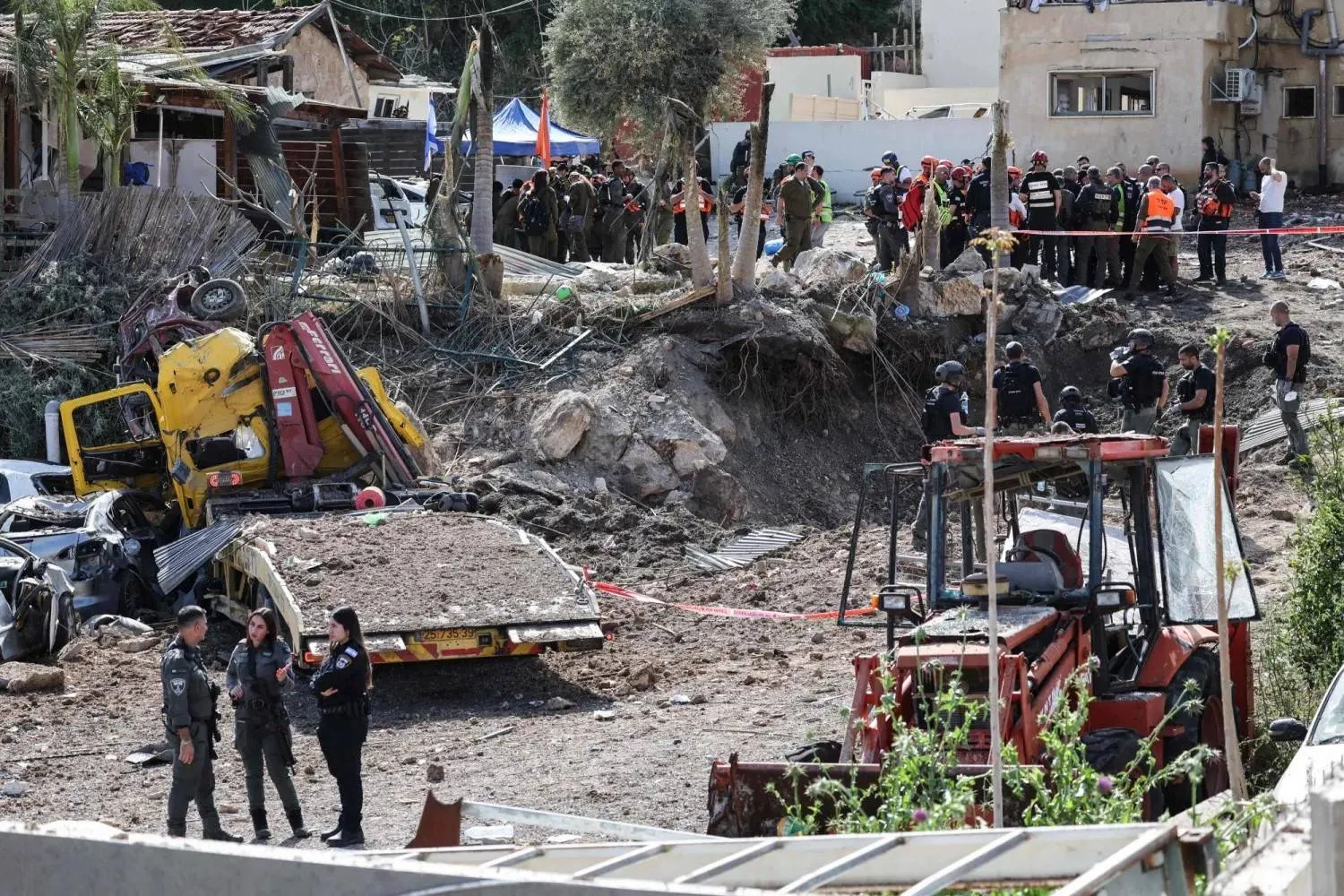
Israel's emergency services said Tuesday that eight people with minor injuries were evacuated to hospitals in the Tel Aviv area, where police reported falling munitions fragments after an alert for incoming Iranian missiles.

Six of the injured were treated in the city of Bnei Brak, which is largely populated by ultra-Orthodox Jews, according to Magen David Adom, Israel's equivalent of the Red Cross.

It specified that they were in mild condition with blast injuries.

The military's Home Front Command said it had received "reports of damage" in the central parts of the country.

Earlier on Tuesday, at least 10 blasts were heard in the Jerusalem area after missile launches from Iran were detected though no injuries were subsequently reported.


Jailed PKK Founder Ocalan Asks to Address Turks Directly

FILE - Youngsters hold a photograph of Abdullah Ocalan, the jailed PKK leader in Diyarbakir, Türkiye, Feb. 27, 2025. (AP Photo/Metin Yoksu, File)
TT

Jailed PKK Founder Ocalan Asks to Address Turks Directly

FILE - Youngsters hold a photograph of Abdullah Ocalan, the jailed PKK leader in Diyarbakir, Türkiye, Feb. 27, 2025. (AP Photo/Metin Yoksu, File)

Jailed PKK founder Abdullah Ocalan, who is being held in solitary confinement, said on Tuesday he wanted to be able to speak freely to the Turkish public.

Last year, the Kurdistan Workers' Party (PKK) formally renounced its armed struggle against the Turkish state after four decades of violence that has killed at least 50,000 people on both sides.

In a message published by a delegation of lawmakers from the pro-Kurdish DEM party, who were authorized to visit him on Friday, Ocalan reaffirmed his commitment to the peace process.

"The period of armed struggle is over. There is no going back," he said.

"I think it is important for me to be able to reach a wider public so my views on this process are properly understood."

"The government must acknowledge that no destructive activity is being carried out and there is no threat to the country's security," said the 76-year-old Ocalan, who has spent the last 27 years in detention.

He urged the parliamentary commission set up to define the future status of the PKK and its former fighters to establish "without delay, a comprehensive and inclusive legal framework".
