



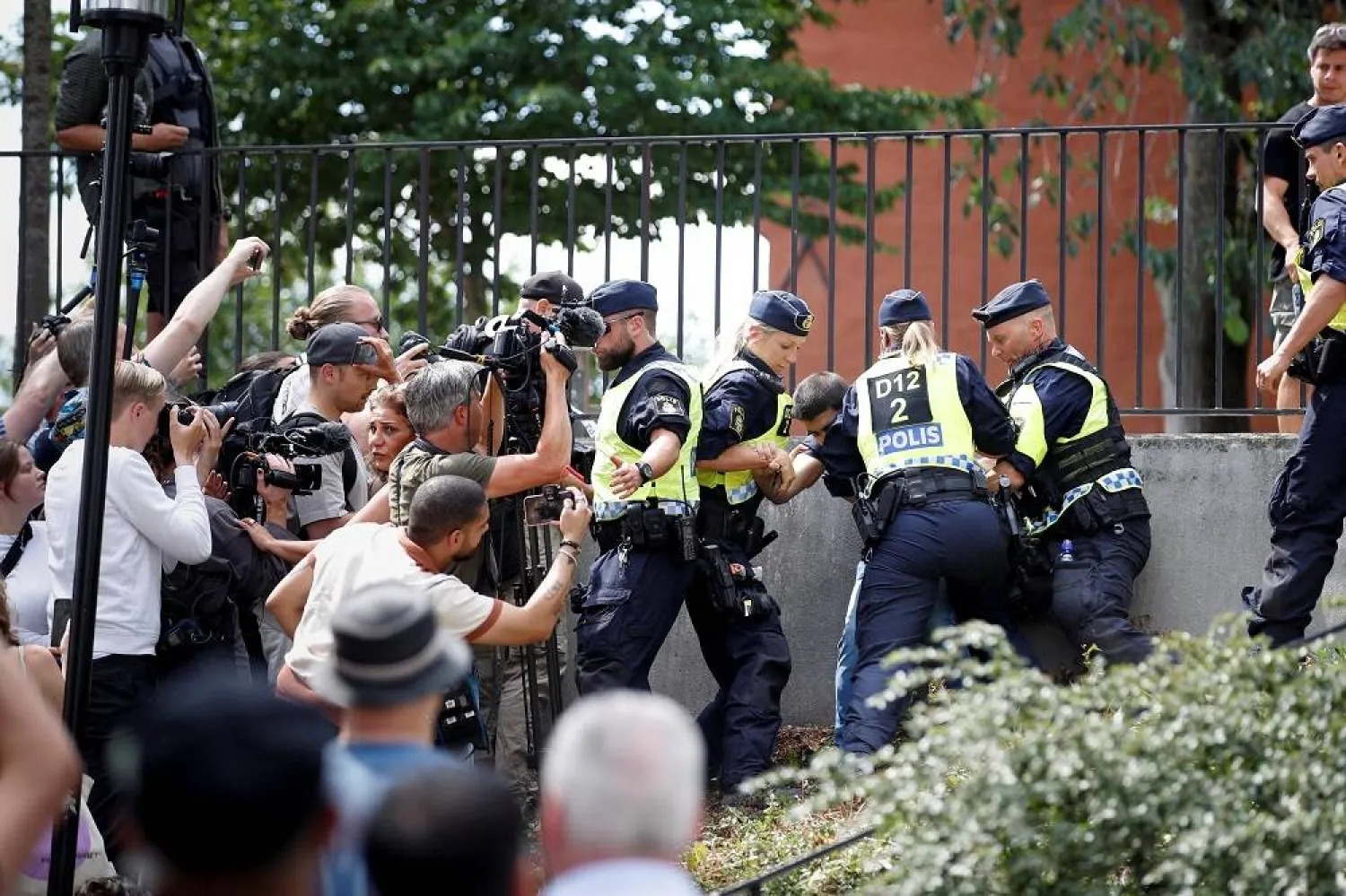

Arab and western countries condemned on Thursday the burning of the holy Quran by an extremist at Stockholm Central Mosque in the Swedish capital following Eid al-Adha prayer, saying it was act of hatred that provokes Muslims across the globe.
The Organization of Islamic Cooperation said it will hold an emergency meeting next week to address the issue and its fallout. The meeting was called for by Saudi Arabia and will be held in Jeddah.
The Saudi Ministry of Foreign Affairs voiced the Kingdom’s strong condemnation of Wednesday’s burning of the Quran.
"These hateful and repeated acts cannot be accepted with any justification, as they clearly incite hatred, exclusion, and racism, and directly contradict international efforts seeking to spread the values of tolerance, moderation, and rejection of extremism," the Foreign Ministry said in a statement.
The statement added that similar acts only "undermine the necessary mutual respect for relations between peoples and states."
Kuwait described the act a "dangerous provocation" of Muslims across the world. It called on the international community and concerned governments to assume their responsibility and immediately towards such acts of hatred, extremism and intolerance.
It urged them to stand against such acts that target religious symbols and sanctities and for the perpetrators to be brought to justice.
United Arab Emirates Presidential Advisor Dr. Anwar Gargash tweeted on Thursday that the "flagrant and repeated attacks on our Islamic beliefs under the pretext of freedom of expression only fuels hatred and conflict."
The UAE foreign ministry summoned the Swedish ambassador to file a complaint.
Qatar slammed the Quran burning, saying it was an act of incitement and dangerous provocation of over two billion Muslims around the world, most notably on Eid al-Adha.
Egypt expressed its "deep alarm" over the rising Islamophobia. Its foreign ministry voiced its complete rejection of such "hateful acts that infringe on Muslim religious beliefs."
It said countries have the responsibility to stand against such acts of incitement and hate crimes that could undermine security and stability in societies.
Dozens of Iraqis protested on Thursday in front of the Swedish Embassy in Baghdad. Iraq's Foreign Ministry summoned Sweden's ambassador.
Morocco recalled its ambassador to Sweden for an indefinite period following the Stockholm incident, the state news agency said.
Morocco's foreign ministry also summoned Sweden's chargé d'affaires in Rabat on Wednesday and expressed the kingdom's "strong condemnation of this attack and its rejection of this unacceptable act", the state news agency said.
Iran's foreign ministry summoned Sweden's charge d'affaires in Tehran over the incident, condemning what it said was an insult to the most sacred Islamic sanctities.
"While Muslims are performing the Hajj, ... insulting their sanctities merely serves the path of spreading hatred and violence, exploiting the principle of freedom of expression," Iranian state media said, citing a statement by the ministry.
Turkish President Recep Tayyip Erdogan on Thursday condemned the Quran-burning, signaling that this would pose another obstacle to the country's bid for NATO membership.
Speaking to members of his Justice and Development Party, Erdogan equated "those who permitted the crime" to those who perpetrated it.
Swedish police had granted permission for the anti-Quran protest to take place. But after the burning, police charged the man who carried it out with agitation against an ethnic or national group.
"We will eventually teach Western monuments of hubris that insulting Muslims’ sacred values is not freedom of thought," Erdogan said.
Erdogan implied that Türkiye wasn’t ready to lift its objections that are holding up Sweden joining NATO. "We will put forward our reaction in the strongest possible way until there is a concerted effort to combat the enemies of Islam as well as terrorist organizations."
Sweden applied to join NATO last year following Russia's invasion of Ukraine and the military alliance had hoped the road to membership would be smoothed out ahead of a key July 6 summit.
The United States on Thursday said it condemned the burning of the Quran, but added that issuing the permit for the demonstration supported freedom of expression and was not an endorsement of the action.
Speaking at a daily press briefing, State Department spokesperson Matt Miller said Washington believes the demonstration created "an environment of fear" that effectively curbs the ability of Muslims to practice their religion freely.
"I will say that we do condemn it," Miller said.
"We believe the demonstration created an environment of fear that will impact the ability of Muslims and members of other religious minority groups from freely exercising their right to freedom of religion or belief in Sweden," he added.
"We also believe that issuing the permit for this demonstration supports freedom of expression and is not an endorsement of the demonstration’s actions."
Miller declined to say whether the demonstration and its fallout would have an impact on Türkiye-Sweden ties and therefore the latter's NATO bid, but reiterated Washington's position that the Nordic country was ready to join the alliance.
"It is time to move to full accession to NATO for Sweden," he said.


