


Yemen: Alimi Warns Int’l Community of Laxity towards Houthis, UN Envoy Calls for United Efforts

The Houthis threaten military escalation and use their weapons of Iranian origin (Reuters)
TT

Yemen: Alimi Warns Int’l Community of Laxity towards Houthis, UN Envoy Calls for United Efforts

The Houthis threaten military escalation and use their weapons of Iranian origin (Reuters)

Head of Yemen's Presidential Leadership Council, Rashad al-Alimi, issued a stern warning on Thursday to the international community against any laxity towards the Houthi's “approach” and refusal of renewing a humanitarian truce in Yemen.

Alimi accused the Houthis of obstinacy and warned against "any laxity on the part of the international community towards Houthi militias”. He said it would encourage them to continue with their threats to international peace and security.

The Yemeni official’s remarks came during a meeting with US Ambassador to Yemen, Steven Fagin, in Riyadh. The talks between the two officials touched on bilateral relations, the developments in Yemen, and the mediation efforts led by Saudi Arabia and Oman to renew the truce.

Yemen’s Saba news agency reported that Alimi praised the distinguished bilateral relations between Yemen and the United States, highly appreciating the US humanitarian aid that aims to alleviate the Yemeni people's suffering, exacerbated by the Houthi militia attacks on oil facilities and international navigation lines.

Yemeni sources mentioned that Alimi reiterated the Council and government's openness to all initiatives aiming for a comprehensive and sustainable peace based on nationally, regionally, and internationally agreed references.

Alimi pointed out that Houthis reject all peace efforts to alleviate Yemeni suffering while they continue their military escalation, cross-border hostile operations, and threats to target navigation lines in the Red Sea, Bab al-Mandab, and the Gulf of Aden.

He also mentioned their "arbitrary measures" against Yemenia Airways and the significant human rights violations against thousands celebrating the anniversary of the September 26 revolution.

- US support

Ambassador Fagin affirmed Washington's support for the Presidential Leadership Council, the government, and their economic and institutional reforms in various fields.

He praised the positive engagement at the presidential and government levels with efforts aimed at alleviating humanitarian suffering and reviving the peace process in Yemen.

- Call for uniting efforts

The Special Envoy of the Secretary-General for Yemen, Hans Grundberg, continues his regional tours to garner support for his initiatives to restore peace in Yemen, visiting Qatar and Oman.

Grundberg visited Muscat and met Omani Foreign Minister Badr al-Busaidi and other officials to discuss developments and progress in the UN peace mediation efforts in Yemen.

The Office of the Special Envoy (OSESGY) expressed gratitude for Oman's support.

It stressed the importance of concerted regional and international actions to help the parties agree on measures to improve living conditions in Yemen, a sustainable nationwide ceasefire, and the resumption of an inclusive political process under UN auspices.

Earlier, Grundberg visited Qatar and met the Minister of State for International Cooperation, Lolwah Al Khater, and other Qatari officials to discuss further consolidating regional and international support to UN mediation efforts in Yemen.

According to the office, they discussed the progress to support the parties to agree on measures to improve living conditions in Yemen, commit and implement a nationwide ceasefire, and resume an inclusive political process under UN auspices.

"While the solution to the conflict must be negotiated by Yemenis, greater regional cohesion undoubtedly gives greater hope of resolving the situation in Yemen. The region will have a great role in accompanying Yemen on a path for peace, reconstruction, and recovery," Grundberg said.

He lauded the support of the Emir of Qatar, Sheikh Tamim Bin Hamad Al-Thani, for a peaceful resolution to the conflict during his General Assembly speech.



Israeli Army Advances into Lebanon on Four Axes

Israeli artillery fires toward Lebanese territory as forces attempt deeper incursions (AFP)
TT

Israeli Army Advances into Lebanon on Four Axes

Israeli artillery fires toward Lebanese territory as forces attempt deeper incursions (AFP)

Israeli troops advanced from four directions on Friday into Lebanese territory, as attacks resumed along the Khiam and Taybeh axes, operations restarted on the Maroun al-Ras front, and a new axis was opened in the western sector toward the town of Naqoura.

The push appears aimed at dispersing defending forces confronting the incursions by widening the scope of the assault and diversifying its axes. The move follows a two-day lull in the offensive on Khiam and a lack of progress on the Taybeh front on Thursday, when tanks came under anti-tank missile fire.

Sources in southern Lebanon told Asharq Al-Awsat that heavy strikes on the towns of Yohmor, Arnoun and Zawtar, elevated areas on the western bank of the Litani River overlooking Taybeh, suggest Israeli forces are seeking to neutralize fire directed from those heights at tanks advancing in Taybeh.

They said the Israeli army is trying to reach the Litani bank and Wadi al-Hujair, in a bid to isolate the area from its southern extensions, making it easier to advance into the Hujair and Saluki valleys from the south and southwest, from the outskirts of Mays al-Jabal and Houla.

Hezbollah said in a series of statements that it fired artillery at Israeli troop concentrations in Taybeh and the Taybeh project area, and detonated explosive devices targeting troop gatherings and a bulldozer, indicating its fighters remain present in the town.

On the Khiam front, local sources in Marjayoun said Israeli forces renewed their attacks on the town, where Hezbollah fighters are still holding pockets in its center and north. They said Israeli ground units pushed toward central Khiam in an attempt to tighten control, alongside artillery shelling and airstrikes focused on its northern areas.

The sources said the attack on Khiam unfolded along three axes, from the south toward the north, from the west toward the edge of the plain, and from the east and northeast along the administrative border of Ibl al-Saqi, adding that the attempted advances were accompanied by heavy firepower.

In the central sector, Israeli forces resumed attacks toward Maroun al-Ras and Aita al-Shaab, alongside airstrikes targeting the city of Bint Jbeil and artillery shelling of Maroun al-Ras. This indicates the incursion aims to reach Bint Jbeil from the east and north, a front where Israeli forces had halted their advance last week.

Hezbollah said it detonated explosive devices in Aitaroun and targeted Israeli troop concentrations in Maroun al-Ras and its public garden.

For the first time since the war began, the Israeli army opened an incursion axis in Naqoura, days after expanding operations in the Labbouneh area east of the coastal border town.

The advance was accompanied by intense airstrikes on towns deeper inside Lebanon in the Tyre district, between 15 and 25 km away, in an apparent attempt to prevent supporting fire for defending forces and to stop attacks on advancing troop concentrations.

Since the morning, Israeli warplanes have carried out a series of airstrikes and artillery bombardments targeting at least 12 towns in the Tyre district, and around 25 towns across the Nabatieh, Marjayoun and Bint Jbeil districts.

The Israeli military said on Friday it had struck 2,000 targets in Lebanon since the war with Hezbollah began on March 2. In a statement, it said Israeli forces continue “limited, targeted ground operations” in southern Lebanon as part of what it described as advanced defensive efforts against Hezbollah.

It said that more than 2,000 targets had been hit so far, including 120 command centers, more than 110 weapons depots and more than 130 rocket launchers.

The military added that more than 570 Hezbollah fighters had been killed, including 220 from the Radwan Force, around 150 operators of surface-to-surface missiles, and more than 30 commanders of various ranks.


'Resistance' Axis without Voice as It Loses Narrative, Psychological Warfare Architects

Yemenis watch a speech by “Abu Ubaida,” spokesman for the Qassam Brigades, whom Israel said it killed in August 2024 (file photo, EPA)
TT

'Resistance' Axis without Voice as It Loses Narrative, Psychological Warfare Architects

Yemenis watch a speech by “Abu Ubaida,” spokesman for the Qassam Brigades, whom Israel said it killed in August 2024 (file photo, EPA)

Since the Oct. 7, 2023 attacks, the confrontation in the Middle East has not been limited to missiles and drones, but has expanded to a parallel front no less dangerous: the architects of narratives and psychological warfare.

Military spokesmen and media figures emerged, some masked, some officers, others operating in the shadows. Together, they formed the backbone of the “resistance” narrative, shaping the battle over narrative, imagery, and public perception under the broad umbrella of forces allied with Iran.

They were not merely voices for their factions or armies. They acted as architects of an integrated discourse, waging a war that targeted adversaries and audiences alike. Beneath them operated sprawling networks of platforms, activists, and media arms that reproduced and amplified messaging across digital and traditional media, reinforcing the narratives of Iran’s regional allies.

As military operations escalated, from Gaza to Lebanon and on to the latest war involving Iran, this apparatus came under concentrated strikes. Some of its most prominent figures were removed, leaving the axis narrative without many of its key voices.

Naeini, architect of “cognitive warfare”

Ali Mohammad Naini, spokesman for Iran’s Revolutionary Guards, was killed at dawn on Friday, March 20, 2026, in a US-Israeli strike, removing one of the most prominent figures behind the force’s messaging during one of the war’s most sensitive phases.

Naini, 69, had served as the Guards’ official spokesman and deputy for public relations since July 2024, a role that extended beyond traditional media duties to managing political messaging and consolidating the institution’s narrative at home and abroad.

Hours before his death was announced, Fars, the news agency affiliated with the Revolutionary Guards, attributed remarks to him saying the missile industry deserved “full marks.”

Naini stood out during the 12-day war in June 2025 and in the current conflict as a key architect of “psychological warfare” in Iran’s official discourse.

In his media appearances, he framed the confrontation as a multi-layered war, psychological, cognitive, technological, and military, stressing the importance of narrative, imagery, and public perception in shaping battlefield outcomes.

He repeatedly highlighted the media's role in “telling the story of the battlefield” and countering the adversary’s “cognitive warfare,” arguing that the opposing side aimed not only to strike military capabilities but also to dismantle the state and weaken internal cohesion.

Before his death, Naini continued to warn of “surprises” and emphasized Iran’s capacity for deterrence. His killing, therefore, marked not only a media loss, but also a blow to a figure who managed the battle of messaging and psychological influence alongside the military campaign.

“Askari,” the shadow envoy

“Abu Ali al-Askari” was less an individual than a complex media and security function. He acted as a conduit between battlefield decision-making and media messaging, and as a tool for setting the political tempo in line with Iran’s vision in Iraq.

His death was announced on March 16, 2026, after rocket attacks targeted sites in Baghdad, including a house in the Karrada district believed to be hosting a meeting of armed faction leaders. There were also indications he may have been targeted in other strikes east of the capital.

Even so, his identity and the circumstances of his death remained shrouded in the ambiguity that underpinned his influence.

His role extended to setting rules of engagement, defining the political weight of local Sunni and Kurdish actors, and signaling pressure on Iraq’s external alignments, including ties with the Arab world, the Gulf, and the broader international environment.

In that sense, he functioned as an effective instrument guiding Iraq’s political process toward outcomes aligned with Iran’s approach.

Abu Ubaida, the masked voice

Abu Ubaida became a prominent media symbol through his masked appearances and rhetoric that blended threat with psychological mobilization. Over two decades, he led the Qassam media apparatus and helped establish a distinct visual and vocal identity that resonated widely.

His prominence grew sharply during Israel’s 2014 war on the Gaza Strip, which lasted about 55 days. During that conflict, he served as a key link between fighters in tunnels and various combat units, as well as between Gaza’s population and the outside world.

He gained broad popularity within Palestine and across the Arab world for his credibility. He was not prone to exaggeration in describing military operations and was noted for his eloquence and command of Arabic.

Abu Ubaida’s first recorded appearances date back to 2002 and 2003, when he was introduced as a field official in the Qassam Brigades. He later held his first news conference on Oct. 2, 2004, at al-Nour mosque in northern Gaza, where he announced a series of operations carried out against Israeli forces and tanks under the banner “Days of Rage.”

He was killed on Aug. 30, 2025, in an Israeli airstrike targeting a building in Gaza City’s Rimal neighborhood, where he was present, according to the Israeli account.

Mohammad Afif, the message craftsman

Mohammad Afif was among Hezbollah’s leading media strategists, overseeing media relations and shaping political messaging over many years, and maintaining close ties to the group’s leadership.

His role became particularly prominent after the killing of Hezbollah leaders in 2024, when he stepped in to fill a sensitive media vacuum.

Some commentators likened him to former Iraqi Information Minister Mohammed Saeed al-Sahhaf, arguing that he projected “illusory heroics” and that his messaging diverged from reality.

Researchers say Afif held media responsibilities within Hezbollah for more than 30 years, served as a media adviser to Hassan Nasrallah, built extensive ties with Lebanese and Arab journalists, helped develop the group’s media operations, and at one stage managed Al Manar television.

His assassination, they said, marked a significant escalation in Israeli efforts to pressure the resistance in Lebanon.

Afif was killed on Nov. 17, 2024, in an Israeli strike on a building in Beirut’s Ras al Nabaa district, one of several attacks targeting Hezbollah’s media infrastructure.

Abu Hamza, Saraya’s masked spokesman

Abu Hamza was one of the most prominent media figures among Palestinian factions, serving as the military spokesman for Saraya al-Quds since 2014.

He adopted a direct, tightly focused rhetoric linking military operations to psychological impact, particularly in relation to the issue of prisoners.

His real name, Naji Maher Abu Saif, was revealed only after his death, following years in which he was known simply as “the masked man” to protect his identity.

He was killed on March 18, 2025, in an Israeli airstrike targeting his home in central Gaza, which also killed several members of his family.ch


Lebanon: 350 Hezbollah Members Killed Since Start of New Round of War

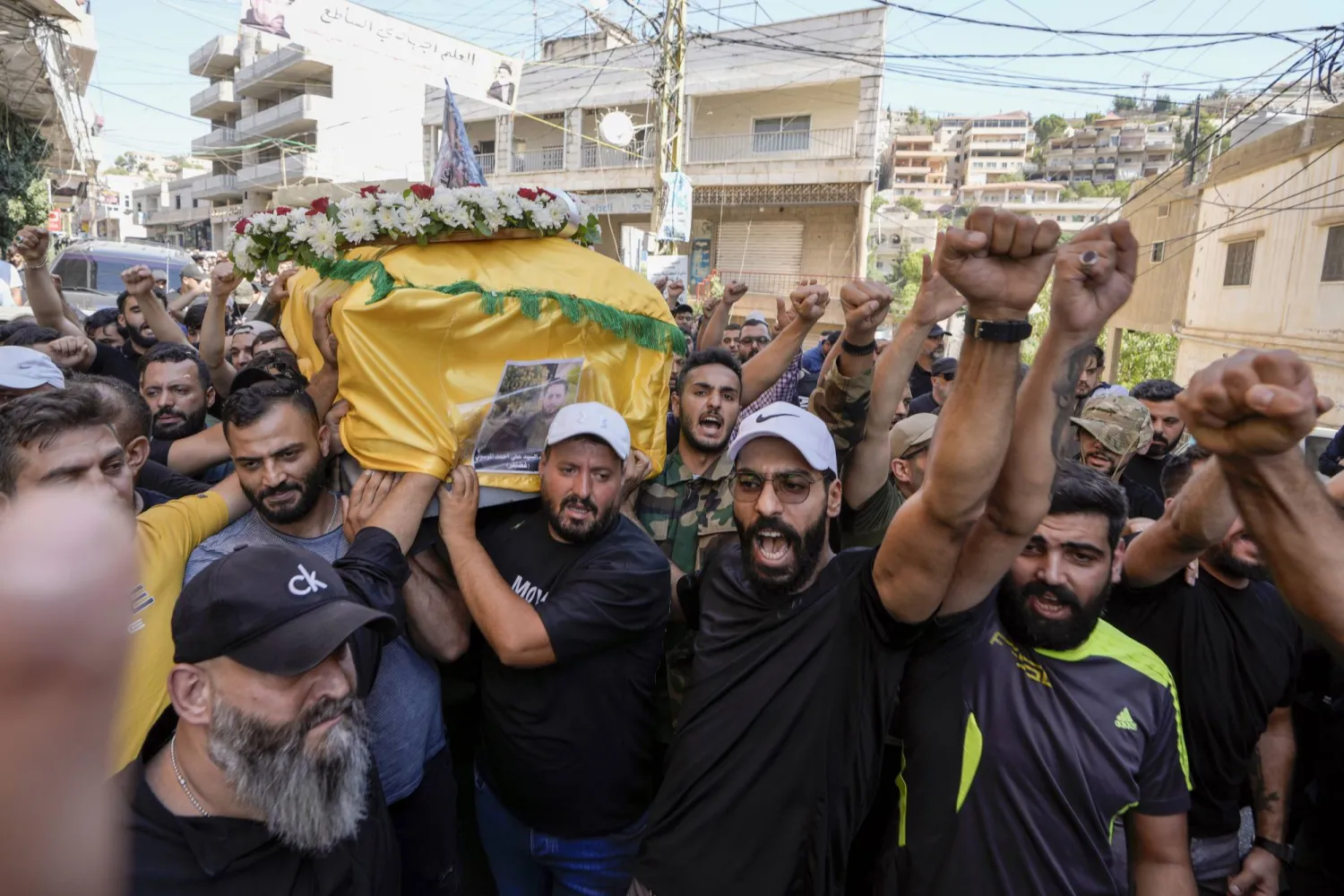
Mourners chant slogans as they carry the coffin of Ali Ahmad Mousawi, who was killed early Wednesday by an Israeli strike, during his funeral procession in Nabi Sheet village, in Lebanon's eastern Bekaa Valley, Wednesday, Aug. 21, 2024.   (AP Photo/Bilal Hussein)
Mourners chant slogans as they carry the coffin of Ali Ahmad Mousawi, who was killed early Wednesday by an Israeli strike, during his funeral procession in Nabi Sheet village, in Lebanon's eastern Bekaa Valley, Wednesday, Aug. 21, 2024. (AP Photo/Bilal Hussein)
TT

Lebanon: 350 Hezbollah Members Killed Since Start of New Round of War

Mourners chant slogans as they carry the coffin of Ali Ahmad Mousawi, who was killed early Wednesday by an Israeli strike, during his funeral procession in Nabi Sheet village, in Lebanon's eastern Bekaa Valley, Wednesday, Aug. 21, 2024.   (AP Photo/Bilal Hussein)
Mourners chant slogans as they carry the coffin of Ali Ahmad Mousawi, who was killed early Wednesday by an Israeli strike, during his funeral procession in Nabi Sheet village, in Lebanon's eastern Bekaa Valley, Wednesday, Aug. 21, 2024. (AP Photo/Bilal Hussein)

The war between Hezbollah and Israel has seen a shift in media handling, particularly regarding announcements of casualties. After initially adopting, at the start of the 2024 war, a policy of near-daily announcements, the group later gradually reduced such statements before halting them altogether. This approach continues in the current fighting, with obituary notices largely absent or confined to a limited local scope in the villages and towns from which the members originate, for security, psychological and political reasons.

From public obituaries to limited disclosure

In the first weeks of the 2024 war, Hezbollah issued successive statements naming those killed, publishing their photos and hometowns, alongside public funeral ceremonies. This approach later receded, with fewer statements issued before they nearly stopped entirely by late September 2024, when the announced toll stood at 450.

By the end of the war in November 2024, estimates put the death toll at about 4,000, including those killed in what is referred to as the “pager operation,” according to estimates rather than official figures from Hezbollah.

On Thursday, Israeli military spokesman Avichay Adraee said on X that forces from the 36th Division and the air force had “eliminated more than 20 Hezbollah members within 24 hours in southern Lebanon.”

350 members killed since start of war

Researcher Mohammad Chamseddine, from the International Information organization, told Asharq Al-Awsat the number of Hezbollah members killed so far was estimated at around 350, out of 1,001 deaths announced by Lebanon’s health ministry.

He said most were killed in the “Nabi Sheet landing” on March 7 and in clashes along the border, particularly in Khiam, where 53 members were killed. The estimates are based on the number of bodies transferred to hospitals across regions, excluding a very small number buried immediately, he added.

He said the majority of those killed were civilians or supporters rather than members, amid Israeli strikes targeting areas close to the group, while it has adopted strict measures to protect its members. Since September 2024, Hezbollah’s announcements have been limited to “senior figures,” as part of a policy aimed at reducing the impact on its support base as the toll rises.

Reducing security exposure

Retired brigadier general and military expert Hassan Jouni said Hezbollah’s decision not to announce the deaths of its members during the war was due to overlapping factors.

“The first is morale. Daily announcements, with rising casualties, have a negative impact on the support base and reflect losses that may be interpreted as an indicator of the enemy’s superiority,” he told Asharq Al-Awsat.

He also cited security considerations, saying such statements could reveal sensitive information about identities, family ties and places of residence that could be exploited using modern technology to identify and target specific communities.

“Missing without a trace”

Jouni also pointed to those classified as “missing without a trace,” whose fate remains unknown and whose deaths are not announced due to the uncertainty surrounding their status.

He said the nature and intensity of the fighting, along with Hezbollah’s decentralized structure, made it difficult to determine the fate of some individuals. Loss of contact does not necessarily indicate death, as individuals may still be alive or captured, he said, requiring caution before any official announcement.

After a ceasefire took effect on Nov. 27, 2024, estimates indicated around 1,500 individuals were classified by Hezbollah as of “unknown fate,” with families informed of lost contact. This was followed by the recovery of bodies and DNA testing to confirm identities before announcements were made.

Most bodies were returned and buried, while some families were informed their relatives remained “missing without a trace,” meaning no remains had been found or recovery was unlikely due to destruction caused by strikes on homes and villages. Their number is estimated at about 45.