
Dozens Killed Seeking Aid in Gaza as Israel Weighs Further Military Action

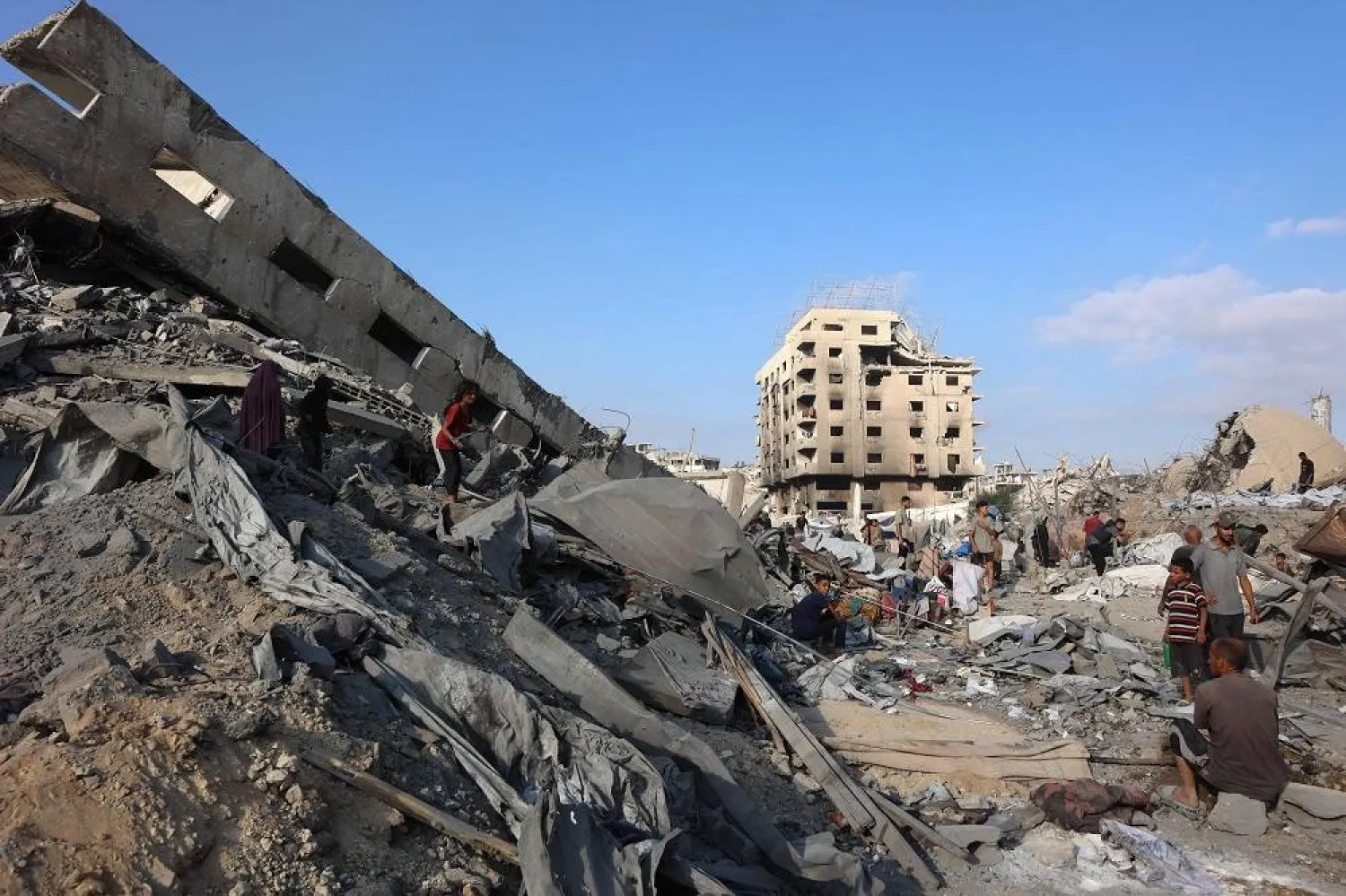
Palestinians inspect the damage after an overnight strike on the Sheikh Radwan Health Center in the north of Gaza City on August 6, 2025. (AFP)
TT

Dozens Killed Seeking Aid in Gaza as Israel Weighs Further Military Action

Palestinians inspect the damage after an overnight strike on the Sheikh Radwan Health Center in the north of Gaza City on August 6, 2025. (AFP)

At least 38 Palestinians were killed overnight and into Wednesday in the Gaza Strip while seeking aid from United Nations convoys and sites run by an Israeli-backed American contractor, according to local health officials. The Israeli military said it had fired warning shots when crowds approached its forces. 

Another 25 people were killed in Israeli airstrikes, according to local hospitals in Gaza. There was no comment from the Israeli military on the strikes. 

The latest deaths came as Prime Minister Benjamin Netanyahu was expected to announce further military action and possibly plans for Israel to fully reoccupy Gaza. Experts say Israel's ongoing military offensive and blockade are already pushing the territory of some 2 million Palestinians into famine. 

Another escalation of the nearly 22-month war could put the lives of countless Palestinians and around 20 living Israeli hostages at risk, and would draw fierce opposition both internationally and within Israel. Netanyahu's far-right coalition allies have long called for the war to be expanded, and for Israel to eventually take over Gaza, relocate much of its population and rebuild Jewish settlements there. 

US President Donald Trump, asked by a reporter Tuesday whether he supported the reoccupation of Gaza, said he wasn’t aware of the “suggestion” but that “it’s going to be pretty much up to Israel.” 

More Palestinians killed in scramble for food  

Of the 38 Palestinians killed while seeking aid, at least 28 died in the Morag Corridor, an Israeli military zone in southern Gaza where UN convoys have been repeatedly overwhelmed by looters and desperate crowds in recent days, and where witnesses say Israeli forces have repeatedly opened fire. 

The Israeli military said troops fired warning shots as Palestinians advanced toward them, and that it was not aware of any casualties. 

Nasser Hospital, which received the bodies, said another four people were killed in the Teina area, on a route leading to a site in southern Gaza run by the Israeli-backed Gaza Humanitarian Foundation, an American contractor. The Al-Awda Hospital said it received the bodies of six people killed near a GHF site in central Gaza. GHF said there were no violent incidents at or near its sites. 

Two of the Israeli airstrikes hit Gaza City, in the north of the territory, killing 13 people there, including six children and five women, according to the Al-Ahli Hospital, which received the bodies. 

The Israeli military says it only targets gunmen and blames civilian deaths on Hamas because its fighters are entrenched in heavily populated areas. 

UN experts say Israeli-backed aid group should be dismantled  

Israel facilitated the establishment of four GHF sites in May after blocking the entry of all food, medicine and other goods for 2 1/2 months. Israeli and US officials said a new system was needed to prevent Hamas from siphoning off humanitarian aid. 

The United Nations, which has delivered aid to hundreds of distribution points across Gaza throughout the war when conditions allow, has rejected the new system, saying it forces Palestinians to travel long distances and risk their lives for food, and that it allows Israel to control who gets aid, potentially using it to advance plans for further mass displacement. 

The UN human rights office said last week that some 1,400 Palestinians have been killed seeking aid since May, mostly near GHF sites but also along UN convoy routes where trucks have been overwhelmed by crowds. It says nearly all were killed by Israeli fire. 

This week, a group of UN special rapporteurs and independent human rights experts called for the GHF to be disbanded, saying it is “an utterly disturbing example of how humanitarian relief can be exploited for covert military and geopolitical agendas in serious breach of international law.” 

The experts work with the UN but do not represent the world body. 

The GHF did not immediately respond to a request for comment. The Israeli military says it has only fired warning shots when crowds threatened its forces, and GHF says its armed contractors have only used pepper spray and fired into the air on some occasions to prevent deadly crowding at its sites. 

Israel’s blockade and military offensive have made it nearly impossible for anyone to safely deliver aid, and aid groups say recent Israeli measures to facilitate more assistance are far from sufficient. 

Hospitals recorded four more malnutrition-related deaths over the last 24 hours, bringing the total to 193 people, including 96 children, since the war began in October 2023, according to the Gaza Health Ministry. 

Jordan says aid convoy attacked by Israeli settlers  

Jordan said Israeli settlers blocked roads and hurled stones at a convoy of four trucks carrying aid bound for Gaza after they drove across the border into the Israeli-occupied West Bank. Israeli far-right activists have repeatedly sought to halt aid from entering Gaza. 

Jordanian government spokesperson Mohammed al-Momani condemned the attack, which he said had shattered the windshields of the trucks, according to the Jordanian state-run Petra News Agency. 

The Israeli military said security forces went to the scene to disperse the gathering and accompanied the trucks to their destination. 

Hamas-led fighters killed some 1,200 people, mostly civilians, in the Oct. 7 attack and abducted another 251. Most of the hostages have been released in ceasefires or other deals. Of the 50 still held in Gaza, around 20 are believed to be alive. 

Israel's retaliatory offensive has killed over 61,000 Palestinians, according to Gaza's Health Ministry, which does not say how many were fighters or civilians but says around half were women and children. It is part of the now largely defunct Hamas-run government and staffed by medical professionals. The UN and independent experts consider it the most reliable source for the number of war casualties. 


Netanyahu Denies Contacts with Syria Have Led to Final Agreement

Israeli tanks deployed near the buffer zone on the Syrian Golan, Dec. 8, 2024. (AFP)
TT

Netanyahu Denies Contacts with Syria Have Led to Final Agreement

Israeli tanks deployed near the buffer zone on the Syrian Golan, Dec. 8, 2024. (AFP)

Contacts and meetings held between Israel and Syria have not reached any final understanding or agreement between both sides, the office of Israeli Prime Minister Benjamin Netanyahu said on Tuesday in response to a report published by Asharq Al-Awsat.

Asharq Al-Awsat had quoted unnamed sources saying US mediation brought Netanyahu and Syrian President Ahmed al-Sharaa together for a meeting during September’s UN General Assembly in New York.

Those talks advanced far enough that Netanyahu declined to endorse a draft security arrangement with Damascus, it wrote.

The Prime Minister’s Office said in statement: “There were contacts and meetings organized by the US, but no agreements and understandings with Syria were ever reached.”

Amid the controversy, a Syrian source familiar with the details told Channel 12: “The final draft of the agreement is almost ready and in its last stages. A breakthrough could happen very soon.”

The source added: “The agreement’s terms are largely agreed upon, with many clauses symbolically signed and written, waiting for US officials to approach Israel and say: ‘This is the final formula, and we want to move forward.’”

He said the pause is currently on Israel’s side, not Syria’s. “So far, the formula is acceptable to Syria and largely acceptable to Israel.”

Israeli media outlets recalled what happened between both sides last September.

The i24 News channel said that at the time, Sharaa had affirmed Damascus and Jerusalem will soon share a new security agreement. His comments came shortly after Reuters said Washington is pushing for enough progress to be made by the time world leaders gather in New York for the UN General Assembly at the end of the month to allow Trump to announce a breakthrough.

The Israeli channel said the deal was obstructed after Syria presented territorial demands that Israel cannot accept, including a withdrawal from the strategically sensitive Mount Hermon and areas in Syria’s buffer zone.

Later, the Times of Israel newspaper confirmed the reports saying that while there was optimism in September that a deal could be signed, Reuters reported at the time of the assembly that contacts between Israel and Syria regarding the deal had reached a dead end due to Israel’s demand to open a “humanitarian corridor” into the Sweida province in southern Syria – where sectarian violence has killed hundreds of people from the Druze community, which Israel has vowed to protect.

The newspaper also cited an Axios report saying Israel has reportedly presented Syria with a detailed proposal for a new security agreement regarding southwest Syria, demanding a no-fly zone and demilitarized zone over its border in Syria, with no limits on Israeli deployment on its own territory.

In return, Israel would withdraw in stages from the buffer zone it established after Syrian leader Bashar al-Assad fell last December, but would remain on the peak of Mount Hermon.

The Israeli army has been deployed to nine posts inside southern Syria for nearly a year, since the Assad regime was brought down, mostly within a UN-patrolled buffer zone on the border between the countries. Two posts are on the Syrian side of Mount Hermon.

Israel said it seized the areas in southern Syria last December due to fears they would fall into the wrong hands after the regime collapsed and said it would hold on to them until a new security deal was signed.

The Walla website reported that Netanyahu was present at the UN General Assembly meeting and was planning to meet with the Syrian leader and sign a security deal with Syria.

But Damascus insisted on Israel’s withdrawal from territory seized in the Golan Heights since Assad’s fall. Tel Aviv refused, saying its troops need to remain in the area to protect its residents in the north.


Le Drian Holds Talks in Lebanon to Consolidate Ceasefire with Israel

A photograph released by the Lebanese Presidency Press Office on December 8, 2025, shows Lebanese President Joseph Aoun (R) meeting with French Envoy Jean-Yves Le Drian (L) at the Presidential Palace in Baabda, east of Beirut. (Lebanese Presidency)
TT

Le Drian Holds Talks in Lebanon to Consolidate Ceasefire with Israel

A photograph released by the Lebanese Presidency Press Office on December 8, 2025, shows Lebanese President Joseph Aoun (R) meeting with French Envoy Jean-Yves Le Drian (L) at the Presidential Palace in Baabda, east of Beirut. (Lebanese Presidency)

French presidential envoy Jean-Yves Le Drian continued his meetings with Lebanese officials on Tuesday over consolidating the ceasefire between Israel and Hezbollah.

Le Drian held talks on Monday with President Joseph Aoun and parliament Speaker Nabih Berri, Prime Minister Nawaf Salam, Foreign Minister Youssef Rajji, Army Commander Rodolphe Haykal and former Progressive Socialist Party leader Walid Jumblatt and his son MP Taymur Jumblatt on Tuesday.

Aoun told Le Drian that Lebanon welcomes any role France can play within the Mechanism committee overseeing the ceasefire, rejecting accusations that the Lebanese army was not doing enough to meet its end of the agreement.

The committee aims to end the hostilities, ensure Israel’s withdrawal from regions it is occupying in southern Lebanon and release Lebanese detainees held by Israel.

A Lebanese presidency statement said Aoun welcomed French President Emmanuel’s constant support for Lebanon, stressing that they reflect the depth of Lebanese-French ties.

Aoun revealed to Le Drian that the Mechanism will meet again on December 19.

“Our desire to activate the Mechanism meetings reflects our willingness to negotiate to reach diplomatic solutions because we never want to adopt war rhetoric,” Aoun added.

Lebanese and Israeli civilian representatives held their first direct talks in decades last week under the auspices of a year-old ceasefire monitoring mechanism.

The two sides met at the UN peacekeeping force's headquarters in Lebanon's Naqoura near the border with Israel, where the guarantors of the November 2024 ceasefire between Israel and Hezbollah regularly convene.

Former Lebanese ambassador to the US Simon Karam and Israeli National Security Council official Uri Resnick were included as civilian representatives in the ceasefire mechanism for the first time.

Aoun told Le Drian that “the positive stances from fraternal and friendly states that followed last week’s meeting reflect their support for this step and will inevitably ease the pressure” that Lebanon was under.

He reiterated his rejection of criticism that the army was not doing enough to enforce the ceasefire agreement.

He instead accused Israel of continuing its attacks against Lebanon in violation of the ceasefire. He said it has destroyed homes and properties, preventing the army, United Nations Interim Force in Lebanon (UNIFIL) and Mechanism from completing their duties.

He stressed that the army and UNIFIL were acting in complete coordination, while urging the need to provide the military with the necessary equipment to allow it to fulfill its mission in full.

The mission, he remarked, is not limited to regions south of the Litani River, but includes all of Lebanon.

Le Drian, for his part, conveyed to Aoun Macron’s support for Karam’s appointment to the Lebanon’s negotiating team, adding that Paris “will always stand by Beirut’s national choices.”

Talks between Berri and the envoy, which lasted over an hour, tackled the situation in Lebanon and the region, especially Israel’s ongoing violations of the ceasefire.

Paris is set to hold next week a meeting between France, the United States and Saudi Arabia in preparation for a conference aimed at backing the Lebanese army and support a roadmap for a long-term ceasefire.


Shells of Unknown Origin Land Near Military Airport in Damascus, Syrian State TV Says

Smoke billows following an Israeli strike on Damascus over the summer. (Reuters file)
TT

Shells of Unknown Origin Land Near Military Airport in Damascus, Syrian State TV Says

Smoke billows following an Israeli strike on Damascus over the summer. (Reuters file)

Shells of unknown origin fell in the vicinity of Syria's Mezzah military airport in the capital Damascus on Tuesday, the state-run Al Ekhbariya TV reported.

Syria's state news agency earlier reported the sound of an explosion in the vicinity of Damascus and said the matter was under investigation.

The airbase sits at the gateway to parts of southern Syria.