


US Presses for Clear Timetable to Withdraw UNIFIL from South Lebanon

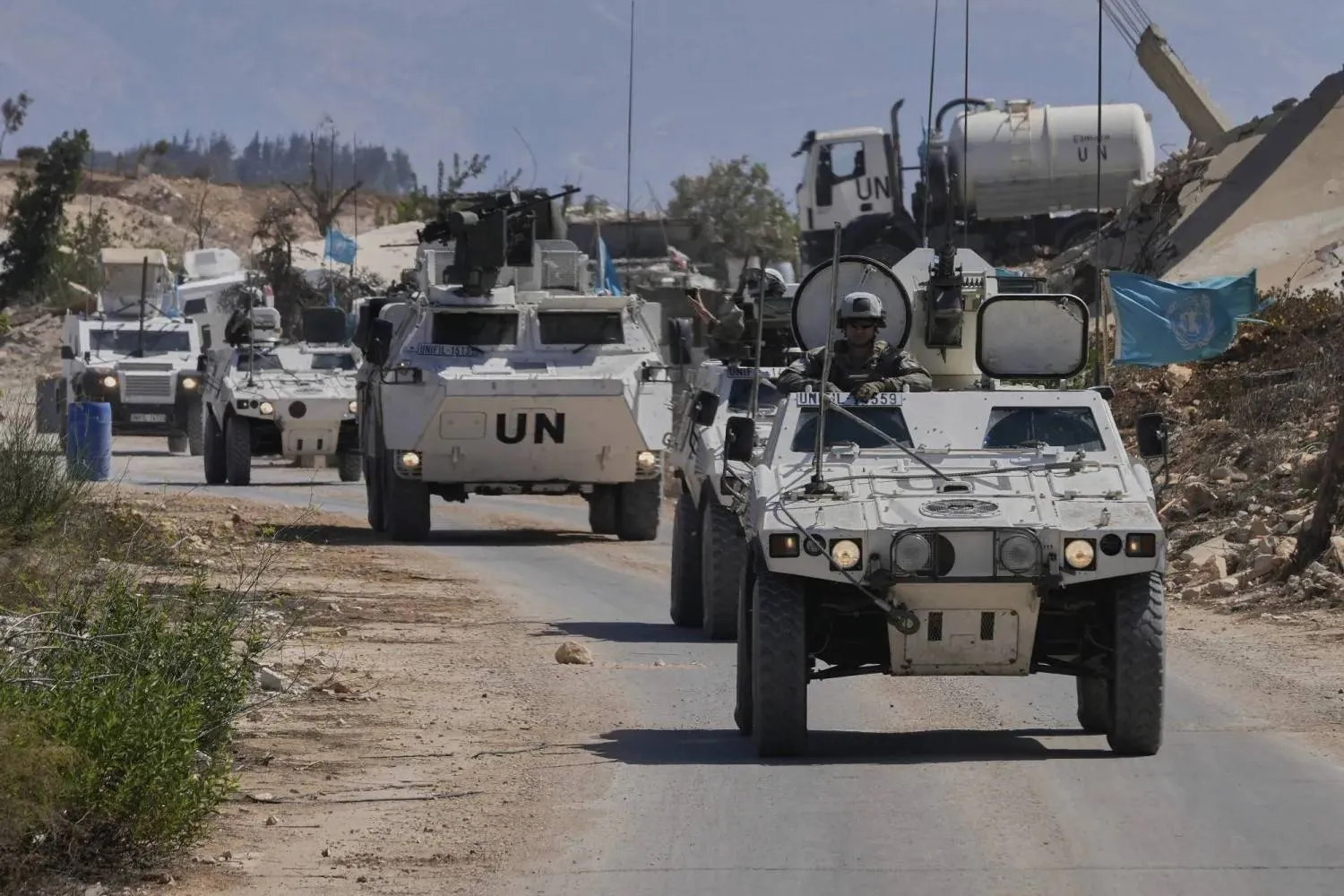
French UN peacekeepers patrol the Lebanese-Israeli border in the village of Houla, southern Lebanon, Wednesday, Aug. 20, 2025. (AP Photo/Hussein Malla)
TT

US Presses for Clear Timetable to Withdraw UNIFIL from South Lebanon

French UN peacekeepers patrol the Lebanese-Israeli border in the village of Houla, southern Lebanon, Wednesday, Aug. 20, 2025. (AP Photo/Hussein Malla)

Western diplomats said they expect an imminent call between French Foreign Minister Jean-Noël Barrot and US Secretary of State Marco Rubio aimed at clearing what one described as the “final hurdle” before the UN Security Council votes to renew the mandate of UN peacekeepers in southern Lebanon (UNIFIL) for another year.

The move follows Washington’s decision on Friday to break the “silence procedure” on an amended draft resolution prepared by France.

Paris had circulated a revised text after a week of negotiations with US diplomats in New York to bridge differences over language addressing UNIFIL’s eventual withdrawal from southern Lebanon.

US officials have signaled readiness to back a full 12-month renewal. But if Rubio and Barrot fail to finalize the wording, Russia, which holds the Council presidency in August, could delay Monday morning’s planned session until later this week, before the current mandate expires on Aug. 31, a diplomat familiar with the talks said, speaking on condition of anonymity.

Diplomats said Israeli pressure was shaping the dispute. One European envoy linked it to Europe’s broader policies in the region, including France’s recent recognition of a Palestinian state. Another said Washington’s insistence on a clear timetable for UNIFIL’s exit reflected Israeli demands to “end Europe’s role in the Middle East.”

European troops, notably from France, Italy, Spain and Norway, make up the backbone of UNIFIL, which was first deployed after Israel’s 1978 invasion of Lebanon and expanded after the 2006 war between Israel and Hezbollah. 

Israeli Prime Minister Benjamin Netanyahu’s government, diplomats added, is also benefiting from senior Trump administration officials’ reluctance to support UN peace operations worldwide.

France’s latest draft, seen by Asharq al-Awsat, includes concessions to Washington.
 
The preamble now welcomes Lebanese government efforts to assert sovereignty through its armed forces, rejects recognition of any authority other than the state, and notes “positive progress” by UNIFIL since November 27, 2024, in uncovering weapons caches and expanding patrols alongside the Lebanese army.

The operative clauses were also revised. The first extends UNIFIL’s mandate until Aug. 31, 2026, “with a plan for withdrawal” in line with paragraph five – the crux of the current negotiations.

That clause states the Council intends to work toward UNIFIL’s exit so the Lebanese state alone is responsible for security in the south, provided Beirut establishes full control nationwide through its armed forces and institutions, and both parties agree on a comprehensive political arrangement.

Two new clauses were added. One directs UN Secretary-General Antonio Guterres to conduct by March 1, 2026, a strategic review assessing conditions for UNIFIL’s withdrawal, with a view to starting a phased exit no later than Aug. 31, 2026, and to explore options for supporting Lebanese army redeployment south of the Litani River.

The second calls on Lebanon to fully comply with its 1995 status-of-forces agreement, particularly UNIFIL’s freedom of movement and immunities, and to ensure the mission’s security until its last personnel depart. It also tasks the mission with safeguarding its assets during withdrawal and instructs Guterres to keep the Council regularly informed.

US negotiators argue the wording could allow UNIFIL to remain beyond 2026, a prospect Netanyahu’s government and pro-Israel US officials strongly oppose.



US Transfers ISIS Detainees from Syria to Iraq

 US soldiers at a military base north of Baghdad (Reuters – archive photo) 
 US soldiers at a military base north of Baghdad (Reuters – archive photo) 
TT

US Transfers ISIS Detainees from Syria to Iraq

 US soldiers at a military base north of Baghdad (Reuters – archive photo) 
 US soldiers at a military base north of Baghdad (Reuters – archive photo) 

US Central Command has launched a new operation to transfer ISIS detainees from northeastern Syria to Iraq, aiming to ensure that they remain in secure detention facilities and to reduce the risk of instability.

The operation began with the transfer of 150 ISIS militants from a detention facility in Hasakah, Syria, to a secure site in Iraq. US officials say the number of detainees moved from Syria to Iraqi-controlled prisons could eventually reach about 7,000.

Admiral Brad Cooper, the head of US Central Command, said: “We are closely coordinating with regional partners, including the Iraqi government, and we sincerely appreciate their role in ensuring the enduring defeat of ISIS.

“Facilitating the orderly and secure transfer of ISIS detainees is critical to preventing a breakout that would pose a direct threat to the United States and regional security.”

According to Reuters, the move follows the rapid collapse of the Kurdish-led Syrian Democratic Forces in northeastern Syria, which raised doubts about the security of roughly a dozen prisons and detention camps previously guarded by the group.

US officials also discussed the situation with Syrian President Ahmed al-Sharaa, focusing on ongoing tensions in Syria, the need for government forces to respect ceasefire arrangements with the Syrian Democratic Forces, and support for the coordinated transfer of ISIS detainees to Iraq.

The US side outlined plans to relocate thousands of detainees in a controlled manner and urged all parties to avoid actions that could disrupt the process.

An Iraqi official told Asharq Al-Awsat that the transfer would help ease growing concerns about possible escapes. He added that holding the detainees in prisons supervised by the Iraqi government, in direct coordination with the United States, would significantly reduce the chances of ISIS rebuilding its capabilities.

Syrian media reported that security forces recently arrested 90 group members who had escaped from al-Shaddadi prison south of Hasakah. The Syrian army later announced it had taken control of the city, imposed a curfew, and launched operations to secure the area and capture fugitives.

Recent government advances, combined with what appears to be a reduction in US support for the SDF, mark the most significant shift in territorial control since the fall of Bashar al-Assad 13 months ago.

The United States said this week that the main objectives of its partnership with the SDF have largely been achieved after years of fighting ISIS.


Tunisia Flood Death Toll Rises to Five

 A man removes water from his flooded home in La Goulette, near the Tunisian capital Tunis. AFP 
 A man removes water from his flooded home in La Goulette, near the Tunisian capital Tunis. AFP 
TT

Tunisia Flood Death Toll Rises to Five

 A man removes water from his flooded home in La Goulette, near the Tunisian capital Tunis. AFP 
 A man removes water from his flooded home in La Goulette, near the Tunisian capital Tunis. AFP 

Authorities in Tunisia said flooding caused by three days of exceptional rainfall has killed five people, causing property damage in several provinces and leaving schools and businesses shut and transportation disrupted after parts of the country experienced their heaviest rainfall in years.

The death toll rose to five, Khalil Mechri, a civil defense spokesman told AFP. “Two people swept away by floodwaters, while a woman drowned in her home,” he said.

Mechri said since the flooding started, the emergency services pumped water from 466 inundated homes and have rescued 350 people trapped by floodwaters.

Tunisian media said four fishermen were missing on Wednesday. A fifth was rescued in Teboulba, south of Monastir, while authorities are searching for the remaining crew.

Mechri said while the bad weather was now less intense, “the level of alert remains high.”

President Kais Saied visited several affected areas on Tuesday, including Moknine and Teboulba, local media said.

Footage and videos widely circulated on social media showed significant flooding to homes and roads, with cars stranded in water, particularly in the capital, Tunis.

Authorities suspended classes on Wednesday in public and private schools and universities in 15 of the country's 24 governorates because of the weather. Transportation was also disrupted in several areas.

Abderazak Rahal, head of forecasting at the National Institute of Meteorology (INM), told AFP some Tunisian regions had not seen so much rain since 1950.

“We have recorded exceptional amounts of rainfall for the month of January,” Rahal said, with the regions of Monastir, Nabeul and greater Tunis the hardest hit.

The latest rainfall has proved record-breaking, but Tunisian streets often flood after heavy downpours, largely because of the state of the country's infrastructure.

Drainage and stormwater networks are often old and poorly maintained, particularly in rapidly expanding urban areas, with waste sometimes clogging the system.

Rapid urbanization of some areas has also led to less rainwater being absorbed into the ground, increasing runoff.

The dramatic deluge comes as Tunisia grapples with a seven-year drought, worsened by climate change and marked by a sharp decline in water reserves in dams nationwide.

In neighboring Algeria, several regions have also been hit by massive downpours and floods.

Algerian civil defense authorities said they had recovered the body of a man in his sixties who died in flooding in the northwestern province of Relizane.


Lebanon: Israel Launches New Phase of Escalation in the South

Lebanese residents flee after an Israeli air strike on the town of Qennarit in the South on Wednesday (AP). 
TT

Lebanon: Israel Launches New Phase of Escalation in the South

Lebanese residents flee after an Israeli air strike on the town of Qennarit in the South on Wednesday (AP). 

Israel has intensified its military campaign in areas north of the Litani River in South Lebanon over the past two weeks, carrying out air strikes at least twice a week—well above the tempo seen before the start of the year.

The intensified moves have been accompanied by near-daily surveillance and pursuit operations, signaling a sharper escalation as the Lebanese army prepares to launch the second phase of its plan to place weapons under state control north of the Litani.

After heavy strikes on Monday targeting areas north of the river, the Israeli army issued evacuation warnings on Wednesday afternoon for residents of five towns in southern Lebanon. The alerts came hours after Israeli strikes that killed two people, whom Israel said were Hezbollah members.

Local sources monitoring the developments told Asharq Al-Awsat that Israeli air raids now occur every two to three days — at least twice weekly — double the frequency recorded last year.

Previously, strikes were largely confined to areas south of the Litani and its banks at a rate of about once a week, often on Thursdays. The current campaign includes strikes on valleys and village outskirts, alongside repeated evacuation warnings in several towns north of the river. The warnings increasingly target large buildings and entire neighborhoods, with heavy munitions causing widespread damage to property and surrounding areas.

On Wednesday afternoon, the Israeli army issued evacuation orders in two phases for five villages north of the Litani, triggering the displacement of hundreds of residents. Israeli army Arabic-language spokesperson Avichay Adraee said the military would strike Hezbollah infrastructure to counter what he described as attempts to rebuild its activities in the region.

He identified targets in Jarjoua and Kfar Kila in Nabatieh district and Qennarit in Sidon district, about 40 kilometers from the border, and urged residents to evacuate immediately. After strikes destroyed the targeted buildings and damaged nearby structures, further evacuation orders were issued for Ansar and Zrariyeh, around 30 kilometers from the Israeli border.

The Lebanese army is expected next month to submit a plan to the government outlining mechanisms for disarming Hezbollah north of the Litani, following its announcement that it had dismantled the group’s weapons in border areas south of the river.

Earlier in January, the army said it had completed the first phase of the plan, aimed at placing weapons exclusively under state control, and asserted that it had established operational control over areas south of the Litani — roughly 30 kilometers from the Israeli border — except for territories still under Israeli occupation.

Israel has questioned the adequacy of these measures, describing them as insufficient. Under the ceasefire agreement, Israel was expected to withdraw from South Lebanon but has maintained its presence at five strategic positions, which Lebanon continues to demand it vacate.