



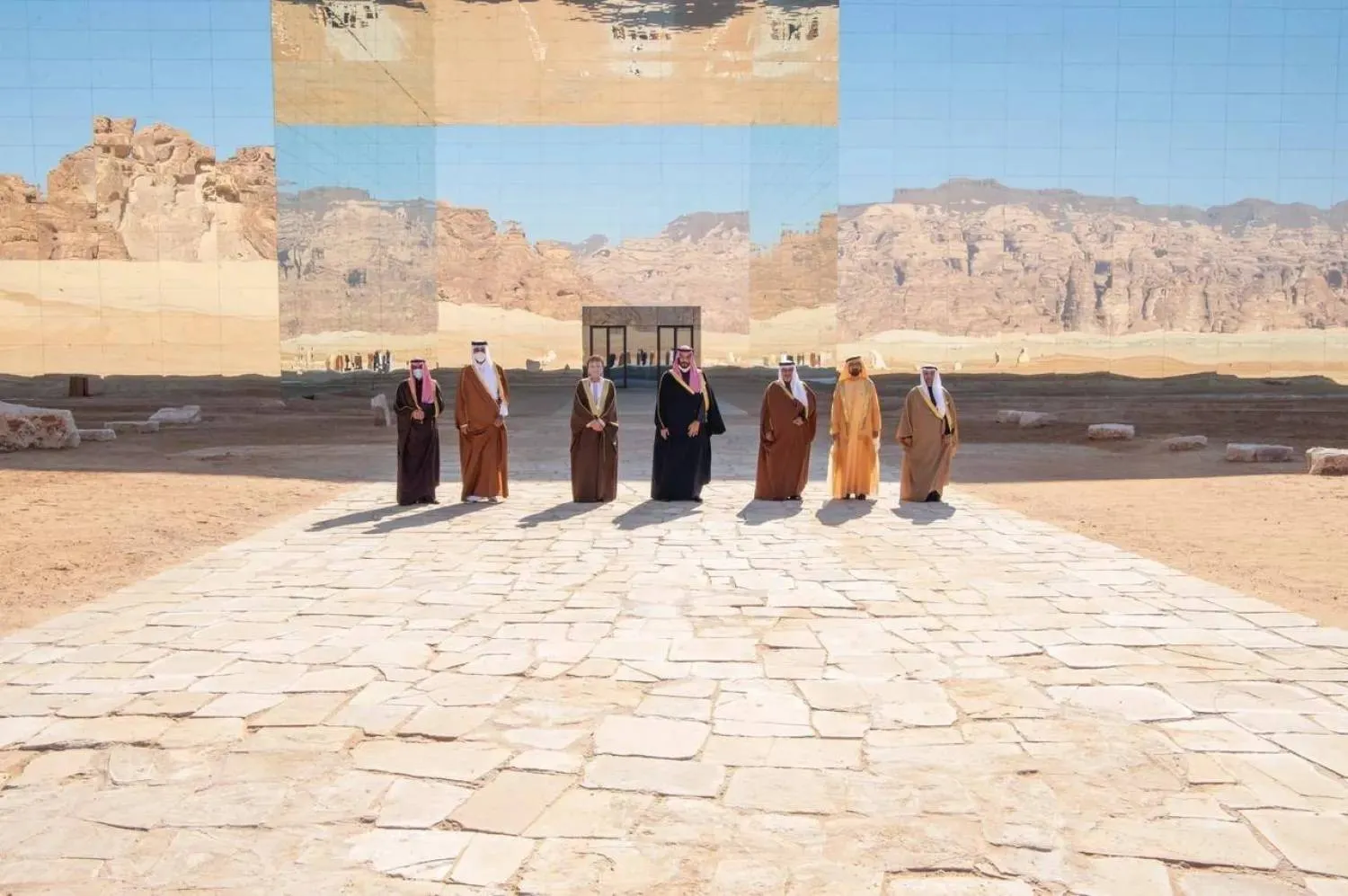

In a move laden with symbolism, Saudi Arabia’s AlUla hosted the Munich Security Conference Leaders’ Meeting this year for the first time, shifting a gathering long tied to the Bavarian capital into the heart of the Arabian desert.
For decades, Munich was the annual stage where world leaders and policymakers debated the most pressing political and security challenges.
This year, around 100 senior officials and decision-makers convened in AlUla’s Maraya concert hall, a mirrored structure set among sandstone mountains, drawing a line of continuity between two distant yet resonant cities - Munich with its European legacy, and AlUla with its ancient Arab heritage.
Munich has long witnessed Europe’s political transformations and served as a cradle of culture, art and thought. AlUla, once a crossroads for civilizations from the Lihyanites to the Nabataeans, carries a record of human passage etched in rock inscriptions that still speak to visitors today.
Speaking to Asharq Al-Awsat, Benedikt Franke, the Vice-Chairman and Chief Executive Officer of the Munich Security Conference (MSC), said Saudi Arabia today is one of the biggest regional players, and it has become one of the most important actors in international diplomacy.
He highlighted the symbolism of AlUla’s Elephant Rock, which he said aligns with the conference’s theme of addressing the “elephant in the room.”
Franke praised Crown Prince Mohammed bin Salman’s efforts to create stability so that the government can focus on long-term and sustainable prosperity.
The setting of AlUla stood in stark contrast to Munich’s Alpine greenery and rivers, but both landscapes offered a striking backdrop for dialogue between humanity, history and nature.
Abdulaziz Sager, chairman of the Gulf Research Center, called the MSC “one of the most important global security conferences,” drawing ministers of foreign affairs, defense and intelligence as well as experts from think tanks and academic centers.
He noted that while the MSC has been held annually in Munich since its founding in the 1960s as a transatlantic forum, it has also taken its debates abroad, most recently to the US.
“This year’s meeting in AlUla underscores Saudi Arabia’s political, security and international role, making it the key stop after the US for the conference of leaders,” Sager told Asharq Al-Awsat.
“The MSC has evolved into a laboratory for strategic decision-making in international politics,” Sager added. “Its convening in the kingdom is recognition of Saudi Arabia’s growing weight in global affairs.”
Munich earned its reputation as an unofficial capital for security debates by acting as a bridge between Europe and the US. AlUla, with its mix of archaeological depth and modern ambition, now seeks to play a similar role, bridging continents and cultures.
If Munich is famed for Oktoberfest, AlUla is carving its own profile through cultural festivals such as Winter at Tantora, alongside high-profile summits, including the 2021 Gulf Cooperation Council meeting that marked a turning point in regional diplomacy.
The relocation of the MSC gathering was more than a choice of venue; it was a message that Saudi Arabia, with its political and economic weight, is now an indispensable partner in shaping global security debates.
As Munich grew beyond its local boundaries to become a global stage for security, AlUla is stepping from its deep history into an international spotlight, where diplomacy, culture, and dialogue converge.


