


Lebanon: Israel Launches New Phase of Escalation in the South

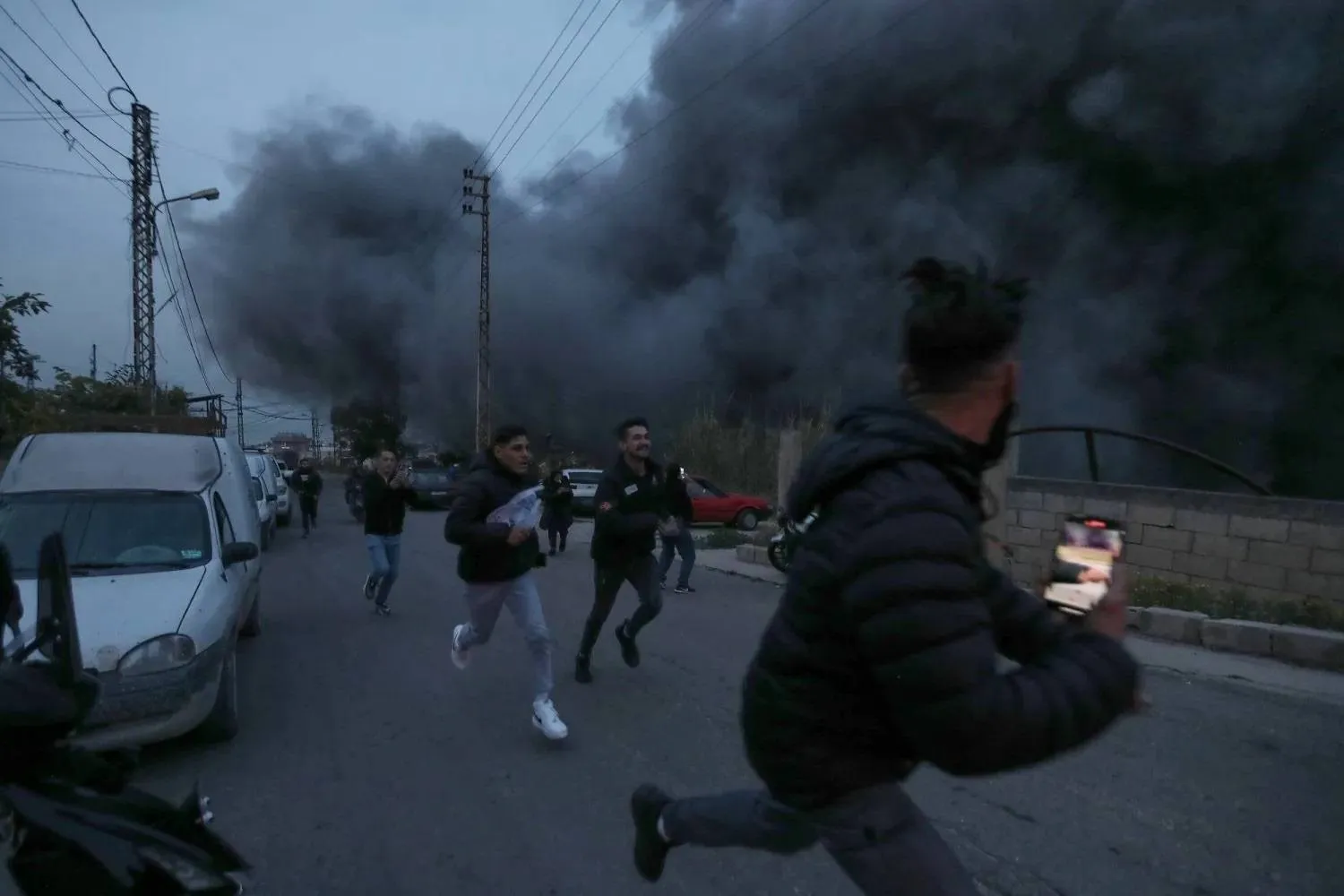
Lebanese residents flee after an Israeli air strike on the town of Qennarit in the South on Wednesday (AP). 
TT

Lebanon: Israel Launches New Phase of Escalation in the South

Lebanese residents flee after an Israeli air strike on the town of Qennarit in the South on Wednesday (AP). 

Israel has intensified its military campaign in areas north of the Litani River in South Lebanon over the past two weeks, carrying out air strikes at least twice a week—well above the tempo seen before the start of the year.

The intensified moves have been accompanied by near-daily surveillance and pursuit operations, signaling a sharper escalation as the Lebanese army prepares to launch the second phase of its plan to place weapons under state control north of the Litani.

After heavy strikes on Monday targeting areas north of the river, the Israeli army issued evacuation warnings on Wednesday afternoon for residents of five towns in southern Lebanon. The alerts came hours after Israeli strikes that killed two people, whom Israel said were Hezbollah members.

Local sources monitoring the developments told Asharq Al-Awsat that Israeli air raids now occur every two to three days — at least twice weekly — double the frequency recorded last year.

Previously, strikes were largely confined to areas south of the Litani and its banks at a rate of about once a week, often on Thursdays. The current campaign includes strikes on valleys and village outskirts, alongside repeated evacuation warnings in several towns north of the river. The warnings increasingly target large buildings and entire neighborhoods, with heavy munitions causing widespread damage to property and surrounding areas.

On Wednesday afternoon, the Israeli army issued evacuation orders in two phases for five villages north of the Litani, triggering the displacement of hundreds of residents. Israeli army Arabic-language spokesperson Avichay Adraee said the military would strike Hezbollah infrastructure to counter what he described as attempts to rebuild its activities in the region.

He identified targets in Jarjoua and Kfar Kila in Nabatieh district and Qennarit in Sidon district, about 40 kilometers from the border, and urged residents to evacuate immediately. After strikes destroyed the targeted buildings and damaged nearby structures, further evacuation orders were issued for Ansar and Zrariyeh, around 30 kilometers from the Israeli border.

The Lebanese army is expected next month to submit a plan to the government outlining mechanisms for disarming Hezbollah north of the Litani, following its announcement that it had dismantled the group’s weapons in border areas south of the river.

Earlier in January, the army said it had completed the first phase of the plan, aimed at placing weapons exclusively under state control, and asserted that it had established operational control over areas south of the Litani — roughly 30 kilometers from the Israeli border — except for territories still under Israeli occupation.

Israel has questioned the adequacy of these measures, describing them as insufficient. Under the ceasefire agreement, Israel was expected to withdraw from South Lebanon but has maintained its presence at five strategic positions, which Lebanon continues to demand it vacate.



Israel Destroys Zrariyeh Bridge in South Lebanon, Carries Out Deadly Strikes

13 March 2026, Lebanon, Beirut: A view of a building damaged by an Israeli air strike on Beirut. Photo: Sally Hayden/SOPA Images via ZUMA Press Wire/dpa
TT

Israel Destroys Zrariyeh Bridge in South Lebanon, Carries Out Deadly Strikes

13 March 2026, Lebanon, Beirut: A view of a building damaged by an Israeli air strike on Beirut. Photo: Sally Hayden/SOPA Images via ZUMA Press Wire/dpa

The Israeli military has destroyed a key bridge on the Litani River in south Lebanon.

The military’s Arabic spokesman posted on X that the bridge destroyed in the village of Zrariyeh was used by Hezbollah fighters to move between the areas south and north of the river.

The military added that Hezbollah forces near the bridge fired rockets into Israel during the current Israel-Hezbollah war.

It appeared to be the first time in ⁠the ⁠current campaign against Hezbollah that the Israeli military acknowledged it had targeted civilian infrastructure.

Meanwhile, an Israeli strike early Friday hit a car in Jnah, a coastal neighborhood in southwestern Beirut, and killed one person, the Lebanese health ministry said.

Separately, an Israeli strike hit an apartment in the Nabaa neighborhood, leaving it engulfed in flames, local media reported.

Nabaa lies on Beirut’s northern outskirts within the densely populated Burj Hammoud district. No casualties were immediately reported.

It was the first time such an area has been struck in this conflict or during the 2024 war between Hezbollah and Israel.

Following the strikes, the Israeli army said it had targeted a Hezbollah member in Beirut. Both neighborhoods are far from the southern suburbs of Beirut, which the Israeli military has declared unsafe and issued evacuation notices for.

Authorities in Lebanon say 800,000 have been forced from their homes. More than 600 have been killed.

Hezbollah said early Friday that it had fired several rocket salvos toward northern Israel and Israeli troops in southern Lebanon.


Lebanon Prepares for Possible Negotiations with Israel: Forming Delegation and Coordinating with Syria

A plume of smoke billows following reported Israeli strikes in the southern suburbs of Beirut, after an escalation between Hezbollah and Israel, amid the US-Israeli conflict with Iran, Lebanon, March 13, 2026. (Reuters)
TT

Lebanon Prepares for Possible Negotiations with Israel: Forming Delegation and Coordinating with Syria

A plume of smoke billows following reported Israeli strikes in the southern suburbs of Beirut, after an escalation between Hezbollah and Israel, amid the US-Israeli conflict with Iran, Lebanon, March 13, 2026. (Reuters)

Lebanon has started to make preparations ahead of the possibility of holding direct negotiations with Israel, based on an initiative proposed by President Joseph Aoun to end Israel’s war on Lebanon.

Diplomatic and political contacts have also been intensifying amid the rapid developments in Lebanon and the region.

Aoun held a joint telephone call with his Syrian President Ahmed al-Sharaa and French President Emmanuel Macron on Wednesday to address the developments. They agreed to keep channels of communication open to follow up on issues, said the Lebanese presidency.

For his part, Macron underscored the importance of coordination launched by the Lebanese and Syrian leaderships, saying France will continue to support it. Sharaa backs the Lebanese authorities’ efforts to reclaim full control of its territories.

Macron called on Israel to cease its attacks on Lebanon, while accusing Hezbollah of making a “major mistake in dragging Lebanon into a confrontation with Israel.”

Ministerial sources close to the presidency told Asharq Al-Awsat that the call was made at Macron’s request, who believes that negotiations should cover various paths and should not be limited to just talks between Lebanon and Israel.

They should also include negotiations between Syria and Israel, border issues and pending affairs between them. Negotiations between Lebanon and Israel, Syria and Israel and between all three could lead to connected results, especially over the border, notably the Shebaa Farms.

Lebanon has yet to receive a receptive response from the concerned parties, particularly Israel and the United States, which should sponsor any possible talks.

Regardless, the sources told Asharq Al-Awsat that Lebanon has kicked off steps to engage in negotiations with Israel. It has started to form a delegation that will head to Cyprus should negotiations get a green light.

The delegation will include Ambassador Abdel Sattar Issa, who was chosen by Prime Minister Nawaf Salam to represent Sunnis, former Ambassador Simon Karam, who will represent Maronites, Shawki Abou Nassar, who will represent the Druze. Discussions are underway to name an Orthodox representative.

No Shiite has been named to the delegation, said the sources, with parliament Speaker Nabih Berri refusing to name one. He instead said that the Mechanism committee should handle talks until a ceasefire is reached.

On the diplomatic level, Foreign Minister Youssef Raggi received a telephone call from Hamish Faulkner, Minister for the Middle East and North Africa at the British Foreign and Commonwealth Office, to discuss the situation in Lebanon.

Faulkner expressed his country’s solidarity with Lebanon, saying it was ready to offer humanitarian support and work with the concerned parties towards a ceasefire.

Raggi also received a similar phone call from his Spanish counterpart Jose Manuel Albares.


US Military Refueling Plane Crashes in Iraq

An F-16 fighter jet being refueled in the air by a US Air Force KC-135 Stratotanker (CENTCOM)
TT

US Military Refueling Plane Crashes in Iraq

An F-16 fighter jet being refueled in the air by a US Air Force KC-135 Stratotanker (CENTCOM)

An American military refueling plane taking part in the operation against Iran crashed in Iraq and rescue efforts were underway, US Central Command said Thursday.

It was not immediately clear if there were any casualties. A US official, who spoke to The Associated Press on condition of anonymity to discuss the developing situation, said the KC-135 aircraft that crashed had at least five crew members aboard.

The crash was not due to hostile fire or friendly fire, the military said in a statement, which described the plane as “a loss.”

US Central Command, which oversees the Middle East, said that two aircraft were involved and that one landed safely and the other went down in western Iraq.

A second US official, who similarly spoke on condition of anonymity, said the other plane involved also was a KC-135 tanker.

“More information will be made available as the situation develops,” Central Command said. “We ask for continued patience to gather additional details and provide clarity for the families of service members.”

The tanker is the fourth publicly acknowledged aircraft to crash as part of the US military’s operations against Iran. Last week, three American fighter jets were mistakenly downed by friendly Kuwaiti fire.

All six crew members safely ejected from the F-15E Strike Eagles and were in stable condition after being recovered, the US said.

Seven American troops have been killed in combat during the Iran war so far, while about 140 US service members have been injured, including eight severely, the Pentagon said earlier this week.

Both President Donald Trump and Defense Secretary Pete Hegseth have warned that the Iran war would likely claim more American lives before it ends.