

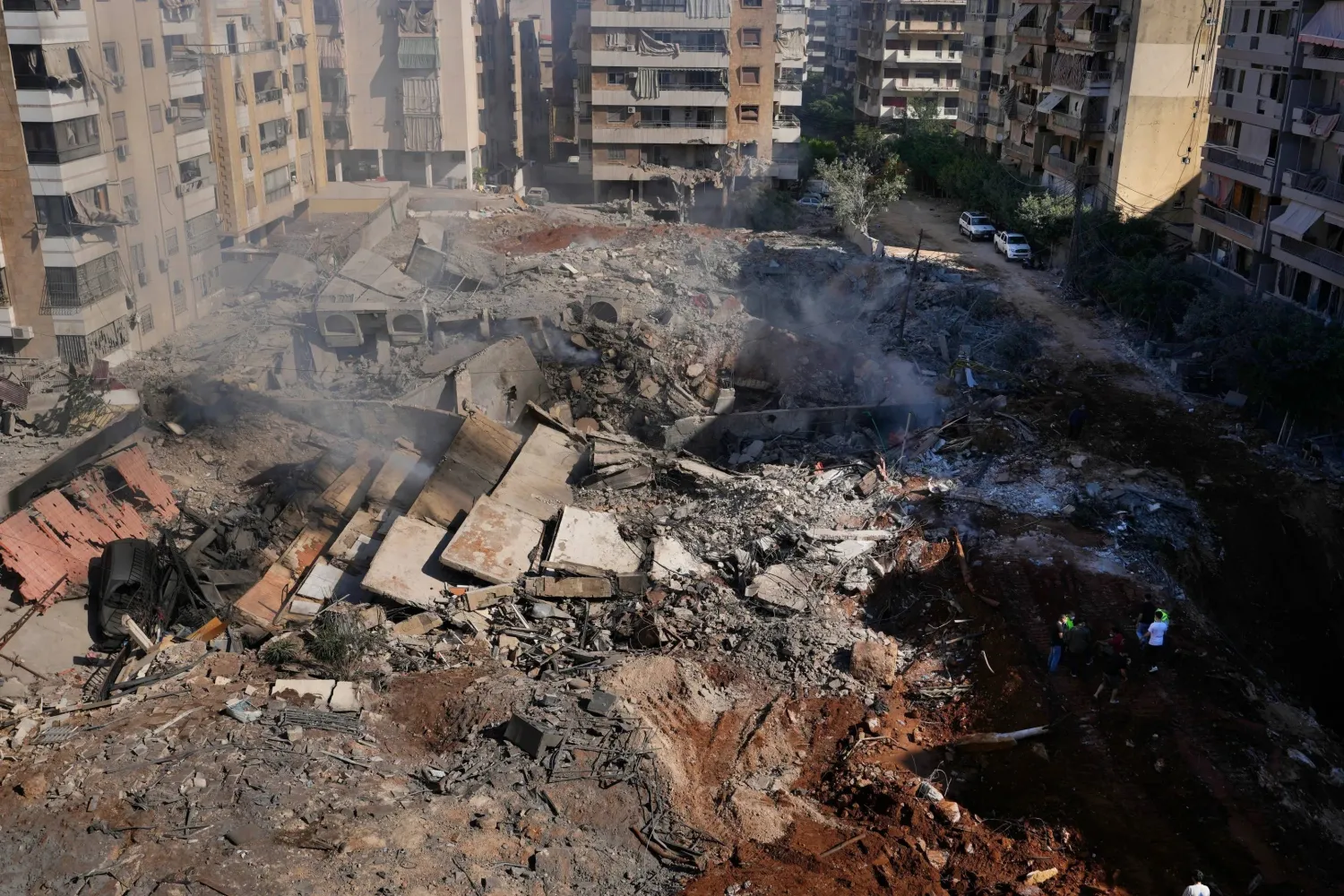

Report: Alleged Spy’s Escape in Lebanon Exposes Israel’s Shadow War on Hezbollah

People gather at the site of the assassination of Hezbollah leader Hassan Nasrallah in Beirut’s Southern Suburbs, Sept. 29, 2024 (AP/File photo)
TT

Report: Alleged Spy’s Escape in Lebanon Exposes Israel’s Shadow War on Hezbollah

People gather at the site of the assassination of Hezbollah leader Hassan Nasrallah in Beirut’s Southern Suburbs, Sept. 29, 2024 (AP/File photo)

As Israeli warplanes pounded Beirut’s southern suburbs last March and residents fled in panic, one man found his opportunity.

Amid the chaos, he slipped out of his imprisonment in a Hezbollah cell and made his way to Baabda, the green, upscale diplomatic district overlooking the Lebanese capital, where he disappeared behind the gates of the Ukrainian Embassy.

His whereabouts remain unclear, according to The Associated Press, in a case that has become part of a broader intelligence battle as Hezbollah tries to identify alleged Israeli operatives they believe are linked to Israel.

The man identified by Lebanese officials as Khaled al-Aydi is said to be a Palestinian refugee from Syria who also holds Ukrainian citizenship.

He had been detained by Hezbollah in the Beirut suburbs and accused by Lebanese officials of being part of a thwarted Israeli intelligence plot to carry out bombings and assassinations.

Details of al-Aydi's escape and a Lebanese military court's case against him were provided by three judicial officials and two senior security officials in Lebanon who spoke on condition of anonymity because they were not authorized to comment publicly. A senior political official in Hezbollah also provided details.

Al-Aydi's disappearance could have political implications for the Lebanese government, which has largely remained silent about the case.

If evidence were to emerge that al-Aydi escaped Lebanon with help from the government, it could inflame tensions with Hezbollah's base. The government already faces scrutiny for directly negotiating with Israel, which has been engaged in fierce fighting with Hezbollah since the early days of the Iran war.

The Ukrainian Embassy asked Lebanese authorities in March to facilitate al-Aydi’s departure from the country after he escaped Hezbollah detention, according to a Lebanese official document obtained by The Associated Press. But Lebanon’s General Security agency refused, saying a judicial warrant for his arrest had been issued earlier, according to the document.

A Ukrainian official with knowledge of the case said al-Aydi is not in the Ukrainian Embassy or its compound in Lebanon. The official, who spoke on condition of anonymity because of the sensitivity of the situation, would not say where al-Aydi is — and out of concern for the security of the embassy and its personnel, would not say whether al-Aydi was ever in the embassy, or whether Ukraine helped him escape.

Using human and high-tech surveillance, Israel has cultivated far-reaching intelligence networks in Lebanon. That has helped it carry out dramatic operations against Hezbollah.

In the most elaborate example, Israel infiltrated Hezbollah’s supply chain and sent the party thousands of booby-trapped pagers and walkie-talkies. Israel remotely detonated the devices in September 2024, killing tens of people. Also, Israel's intelligence within Hezbollah allowed it to hit the group's senior leaders and field commanders “with relative ease,” analysts said.

In return, Hezbollah and Lebanese authorities have stepped up efforts against alleged spy networks.

Lebanese judicial officials said dozens of suspects have been convicted and are serving sentences, while others remain under investigation.

Cases filed in Lebanon’s military court describe operatives being paid to provide intelligence on Hezbollah weapons depots and political offices. Many of the alleged agents were recruited by Israeli handlers through social media, judicial officials said.

Other suspects are charged with providing the Mossad with maps and coordinates of key Hezbollah sites later struck in Israeli operations.

“It’s ironic that they (Hezbollah) were spending a lot of time accusing their opponents of being Israeli spies, and it turns out that the spies were actually from within the organization and its support base,” said Mohanad Hage Ali, a senior fellow at the Malcolm H. Kerr Carnegie Middle East Center in Beirut.

Al-Aydi’s Disappearance Complicates Situation

Conflicting reports emerged about the whereabouts of al-Aydi. Some security officials said the man is believed to have left Lebanon. It remains unclear whether he crossed into Syria or any other country.

The disappearance comes as relations between the Lebanese government and Hezbollah are at a low point.

The government was angered by Hezbollah’s unilateral decision to enter another war with Israel, while the party is furious the government has chosen to negotiate a ceasefire and potentially wider security and political agreement directly with Israel.

Al-Aydi’s escape could exacerbate tensions and put the Lebanese state in a difficult situation.
If Lebanese authorities refused to let al-Aydi leave the country, the US and Ukraine were “well-positioned to exert significant pressure” to secure his release, said Hage Ali.

On the other hand, if the state is seen to have let al-Aydi escape, it would inflame internal tensions, he said.



Israel Defense Minister Says Troops to Stay ‘Indefinitely’ in Lebanon, Syria, Gaza

 Israeli soldiers drive in southern Lebanon as seen from northern Israel, Wednesday, July 1, 2026. (AP)
Israeli soldiers drive in southern Lebanon as seen from northern Israel, Wednesday, July 1, 2026. (AP)
TT

Israel Defense Minister Says Troops to Stay ‘Indefinitely’ in Lebanon, Syria, Gaza

 Israeli soldiers drive in southern Lebanon as seen from northern Israel, Wednesday, July 1, 2026. (AP)
Israeli soldiers drive in southern Lebanon as seen from northern Israel, Wednesday, July 1, 2026. (AP)

Israel's defense minister said Wednesday that Israeli forces would remain in self-proclaimed "security zones" established in Lebanon, Syria and Gaza, without any timeline for withdrawal.

"The Israeli army will remain in the security zones in Lebanon, Syria and Gaza indefinitely in order to protect our residents and communities from jihadist elements," Israel Katz said.

"We will not withdraw from the security zones," Katz said at function held in honor of Israeli soldiers killed during the 2006 war in Lebanon.

Katz also reiterated an earlier warning to Iran, saying Tehran would be struck with "full force" if it attacked Israel over its operations in Lebanon.

Israel and Lebanon signed a US-sponsored framework agreement under US sponsorship on Friday to pave the way for peace between the two countries and disarm Iran-backed group Hezbollah.

Israeli officials, including Prime Minister Benjamin Netanyahu, have repeatedly ruled out withdrawing troops from southern Lebanon, where Israeli forces continue to clash with Hezbollah fighters.

They maintain that any troop withdrawal would happen only after Hezbollah has been disarmed across Lebanon.

Hezbollah drew Lebanon into the Middle East war in early March with rocket fire aimed at Israel to avenge the killing of Iran's supreme leader in US-Israeli strikes.

Israel responded with massive airstrikes and a ground invasion of southern Lebanon.

According to Lebanon's health ministry, nearly 4,300 people have been killed in Israeli attacks since the war erupted.

The Israeli military says it has lost 38 soldiers and one civilian contractor in Lebanon since fighting began in early March.

Israel has also carried out repeated incursions and bombings in Syria since the overthrow of longtime ruler Bashar al-Assad, saying it seeks to establish a demilitarized zone in the country's south.

In Gaza, Israeli forces occupy nearly 70 percent of the territory.

Both the Palestinian movement Hamas and the Israeli military accuse each other of violating the ceasefire, which has been in effect since October last year.


Syria’s Sharaa Appoints Lawmakers, Paving Way for New Parliament to Convene

24 June 2026, Syria, Damascus: Syrian President Ahmed al-Sharaa receives Dutch Foreign Minister Caspar Veldkamp and Deputy Prime Minister David van Weel at the People's Palace in Damascus. (Syrian Presidency)
TT

Syria’s Sharaa Appoints Lawmakers, Paving Way for New Parliament to Convene

24 June 2026, Syria, Damascus: Syrian President Ahmed al-Sharaa receives Dutch Foreign Minister Caspar Veldkamp and Deputy Prime Minister David van Weel at the People's Palace in Damascus. (Syrian Presidency)

Syrian authorities announced the names of 70 lawmakers on Wednesday appointed to a transitional parliament by President Ahmed al-Sharaa, paving the way to convene the body next week more than eight months after the process of forming it began.

The 210-member chamber, two-thirds of which was chosen by regional electoral colleges last year, will wield limited power under a presidential ruling system established under Sharaa since he ousted Bashar al-Assad in 2024.

The People's Assembly will hold its first session on Monday, Mohamed Taha al-Ahmed, head of the Higher Judicial Committee for Parliamentary Elections, said during a news conference.

The formation of the new ‌parliament has been ‌seen as a test of Sharaa's promises of political inclusivity in ‌post-Assad Syria.

His ⁠appointees included 15 ⁠women, boosting to 21 the number of female lawmakers after last year's selection process resulted in only six being chosen.

Sharaa has previously said he ⁠would use his nominations to address imbalances in political representation that ‌emerged from last year's selection process, notably in the ‌representation of women.

Ahmed said the selection of lawmakers for the predominantly Druze province of Sweida had been postponed ‌until "conditions become suitable".

The area has remained outside state control since clashes with Druze there last July.

The overthrow of Assad ended more than five decades of iron-fisted rule by his family, during which parliament was seen as little more than a rubber stamp.

UN Deputy Special Envoy for Syria Claudio Cordone had told ‌the Security Council last week that the delay in forming the parliament was "generating anxiety".

The two-thirds of lawmakers chosen last year were ⁠selected by electoral bodies ⁠formed under a committee appointed by Sharaa.

Officials have said this system was necessary because years of war had left millions of Syrians displaced and made it impossible to rely on accurate population records or voter rolls for nationwide elections.

Critics of the process, including some Syrian political figures and civil society groups, say the electoral framework concentrates influence over the legislature in the presidency.

A temporary constitution introduced in March 2025 granted parliament limited powers. There is no requirement for the government to win a parliamentary vote of confidence.

The Assembly can propose and approve laws. Its term is 30 months, renewable. It assumes legislative authority until a permanent constitution is adopted and elections are organized.


Amnesty Says RSF Committed Ethnic Cleansing in Sudan

Abubakr Alsawi, right, waits during the exhumation of his brother Mohammed Alsawi, 73, who was killed in 2023 by the paramilitary group Rapid Support Forces in Omdurman, on the outskirts of Khartoum, Sudan, Monday, April 20, 2026. (AP)
TT

Amnesty Says RSF Committed Ethnic Cleansing in Sudan

Abubakr Alsawi, right, waits during the exhumation of his brother Mohammed Alsawi, 73, who was killed in 2023 by the paramilitary group Rapid Support Forces in Omdurman, on the outskirts of Khartoum, Sudan, Monday, April 20, 2026. (AP)

The Sudanese paramilitary Rapid Support Forces (RSF) committed crimes against humanity and ethnic cleansing during their attack on el-Fashir city between 2024 and 2025, Amnesty International alleged Wednesday.

Sudan has been mired since April 2023 in a brutal war between the army and the RSF, which has killed tens of thousands and forced millions to flee, according to the United Nations.

Both sides have been accused of atrocities, with a UN independent fact-finding mission in February concluding that the 2025 assault on el-Fashir bore the "hallmarks of genocide".

Amnesty's wide-ranging report found that the RSF "committed crimes against humanity and ethnic cleansing during its campaign to seize el-Fashir".

The NGO interviewed 247 victims or witnesses between early 2024 and October 2025 in North Darfur.

It said the RSF systematically attacked settlements around el-Fashir which housed the Zaghawa people, an ethnic group in western Darfur.

The report alleged widespread and deliberate violence against children including killing, abductions, forced recruitment, and rape.

"It is a stain on the conscience of humanity," said Amnesty chief Agnes Callamard in a statement.

RSF fighters burned homes long after residents had fled, the report said, "suggesting an intent to render the areas uninhabitable", consistent with "ethnic cleansing".

During the final RSF offensive on el-Fashir in October 2025, Amnesty said "hundreds were executed, and many others were tortured or detained" as they attempted to flee.

The report also noted violations happened "repeatedly and on a large scale", and suggested "those in positions of authority knew, or should have known, what was occurring, and failed to stop it or hold anyone accountable".

Amnesty International -- which stressed that its investigation into the incidents was ongoing -- also said such acts "may be relevant to the crime of genocide".

The international NGO urged an immediate ceasefire and deployment of an international force to protect civilians.

The report comes as the UN Human Rights Council held a debate over El-Obeid city in North Kordofan, where there are fears of an imminent RSF assault after weeks of intense attacks.