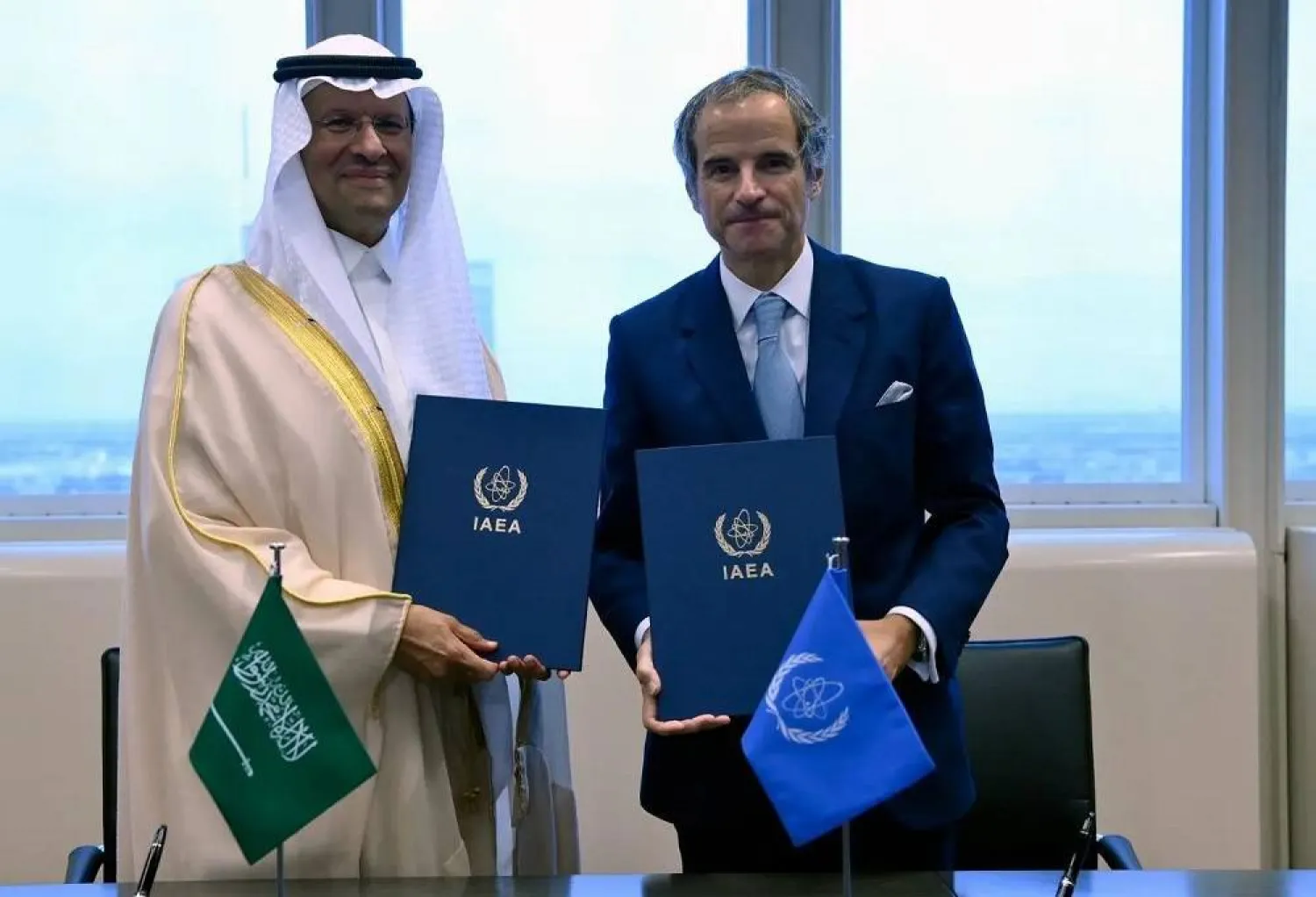
Saudi Arabia, IAEA Sign 'Junior Professionals Program Agreement' 

Saudi Minister of Energy Prince Abdulaziz bin Salman bin Abdulaziz and IAEA Director Genera Rafael Grossi during the signing ceremony. (SPA)
TT

Saudi Arabia, IAEA Sign 'Junior Professionals Program Agreement' 

Saudi Minister of Energy Prince Abdulaziz bin Salman bin Abdulaziz and IAEA Director Genera Rafael Grossi during the signing ceremony. (SPA)

Saudi Minister of Energy and Chairman of the Board of Directors of King Abdullah City for Atomic and Renewable Energy (KACARE) Prince Abdulaziz bin Salman bin Abdulaziz signed on Monday the "Junior Professionals Program Agreement" with Director General of the International Atomic Energy Agency (IAEA) Rafael Grossi.

The agreement aims to train and develop young national human resources in various fields related to the technical aspects of the IAEA and beyond, enabling them to acquire expertise in areas that support the UN agency and address international issues discussed on its premises.

The signing ceremony was held on the sidelines of the 67th Regular Session of the IAEA General Conference in the Austrian capital, Vienna.


IBM CEO to Asharq Al-Awsat: Saudi Arabia Enters AI Implementation Phase

IBM: Saudi Arabia should use digital technologies to boost productivity and make them part of the workforce, not just an added technology layer.
TT

IBM CEO to Asharq Al-Awsat: Saudi Arabia Enters AI Implementation Phase

IBM: Saudi Arabia should use digital technologies to boost productivity and make them part of the workforce, not just an added technology layer.

At IBM Think 2026 in Boston, IBM’s bet on Saudi Arabia went beyond expanding its role in AI infrastructure. The US technology company sought to position itself as a partner in a tougher phase, turning that investment into large-scale industrial and institutional execution.

That message came through in remarks by IBM Chief Executive Arvind Krishna to Asharq Al-Awsat. Speaking about the kingdom and the challenge it now faces, Krishna said infrastructure is not the problem in itself, adding that what needs to be done on that front is already largely clear.

It is now closer to a matter of spending and execution than a strategic dilemma.

But Krishna quickly shifted to what he sees as the more important question: how these technologies can improve citizens’ lives and help new industries emerge faster.

Krishna linked Saudi Arabia’s AI path to broader economic and operational needs. He said the kingdom, given its population size and development ambitions, needs digital tools that raise operational capacity and productivity. Digital technologies and AI, he said, should become “part of the workforce” and help lift productivity over the long term.

Beyond infrastructure

To make his point, Krishna did not use a purely technical example. He turned instead to a Saudi case tied to Hajj, tourism, and related services.

He said that if Saudi Arabia wants to receive tens of millions of visitors, it cannot simply bring in millions more workers to run hospitality, logistics, and services.

Digitalization and AI must become part of the solution, he said, allowing those sectors to scale within five years rather than twenty.

The discussion, in other words, moved beyond energy and major government projects. It extended into services, the daily economy, and how they can grow faster. Krishna said he sees little disagreement over the kingdom’s vision.

The challenge now, he added, is the cultural and operational adoption of technology across industries.

A new operating model

That Saudi reading fit the broader message Krishna pressed throughout the conference.

In his keynote, he presented AI not as a tool to improve certain functions or speed up tasks, but as the start of a new “operating model” for institutions.

The question, he said, is no longer about budget size or computing investment. It is about how deeply AI is embedded in business operations, and whether it becomes part of the institution itself or remains on the margins.

Krishna supported that argument with figures meant to show that the debate has moved beyond promises. He spoke of the potential to achieve productivity gains of around 40% by 2030.

He said more than two-thirds of organizations plan to reinvest those gains in innovation and growth, rather than treating them only as cost cuts.

He also said IBM itself has achieved $4.5 billion in annual productivity gains from using AI and automation inside its own operations.

With that message, IBM seemed to tell the market that AI is no longer just a technology upgrade or a new tool. It is becoming a business model issue.

Redesigning the enterprise

In an “Ask Me Anything” session, Krishna compared many current AI uses to the “light bulb” phase of the electricity era. They are useful and convenient, he said, but they do not fundamentally change how a company operates.

Speaking to Asharq Al-Awsat, he said real transformation begins when AI is used to rebuild processes from end to end, across procurement, human resources, accounts payable, compliance, and other functions.

Only then does the real impact appear, and productivity in some areas can rise sharply.

IBM is no longer framing AI as an assistant for some employees. It is presenting it as an operating layer that must move into the heart of the institution.

The Saudi market moves to scale

IBM’s view of the Saudi market follows the same logic.

In a separate interview with Asharq Al-Awsat, Ayman AlRashed, IBM’s regional vice president in Saudi Arabia, said companies in the kingdom are moving from “isolated experiments” to “deployment at scale.” AI, he said, is no longer a side addition, but “a core part of how companies operate and compete.”

AlRashed said computing power is no longer the main bottleneck. The bigger challenges are now “AI-ready data, governance, and enterprise execution.”

He said the sectors closest to moving AI from pilots to large-scale production are banking and financial services, telecommunications, energy, and government. Progress in those sectors, he said, depends on data maturity, clear regulatory frameworks, and operational scale.

AlRashed added that the sovereignty debate in Saudi Arabia is no longer limited to where data is stored. It now includes how workloads are governed while running, especially as AI moves into more sensitive and regulated environments.

Saudi clients, he said, are asking sharper questions about return on investment, ranging from cost savings and higher productivity to lower risk and measurable outcomes, rather than merely focusing on launching new pilots.

In that sense, IBM’s local reading echoed Krishna’s message on stage in Boston. The Saudi market lacks neither ambition nor infrastructure. It is entering a phase in which AI will be measured by its ability to deliver real operational impact within institutions.

Sovereignty as operating power

Other parts of IBM’s message made its Saudi positioning more coherent.

This year, the company presented hybrid infrastructure, digital sovereignty, live data, automation, and governance as connected elements, not separate products.

Krishna repeatedly said countries and institutions need infrastructure they can control, systems that cannot be shut down, tampered with, or exposed to geopolitical risk, including disruptions to undersea cables.

In Saudi Arabia, that message carries added weight. Sovereignty over infrastructure is not an end in itself. It is part of the ability to run AI across strategic sectors with flexibility and stability over the long term.

Aramco takes the stage

Saudi Aramco’s Senior Vice President for Digital and Information Technology, Sami Al-Ajmi, appeared on the opening stage at IBM Think 2026 as the practical example IBM wanted to highlight.

IBM did not put Aramco in the spotlight simply to present it as a major client or longtime partner. It used Aramco as proof that the move from pilots to industrial execution is no longer theoretical.

Krishna recalled that the relationship between the two companies dates back to 1947, when IBM helped install Aramco’s first information processing system, the first of its kind in Saudi Arabia. But the conference was not focused only on that history. It was focused on what the relationship looks like today.

Al-Ajmi said the relationship is no longer one between a vendor and a buyer. It has become “a strategic alliance around joint innovation.” He said IBM’s opening in Saudi Arabia brought the company closer to Aramco and helped “localize some expertise.”

He summed up the shift in a phrase that captured IBM’s message: “Eighty years ago we were buying machines from IBM, today we are working together to build the future of digital technologies.”

In that sense, IBM is no longer presenting itself only as a technology seller. It is presenting itself as a partner that wants to help build the kingdom’s next industrial AI use cases.

From pilots to the field

The strongest part of Al-Ajmi’s remarks was his definition of what Aramco wants from AI.

He said the company is “not interested in proofs of concept or early experiments.” It wants to “move ideas from the lab into the field.”

That statement placed Aramco at the center of IBM’s message this year. The next phase, IBM argues, will not be won by the number of experiments a company launches. It will be won by the ability to build a real and operational AI model.

Al-Ajmi said the two sides can “close the loop from idea to impact” by identifying real problems, designing solutions, testing them, and scaling them when they work.

His figures gave weight to that argument. Aramco generates nearly 10 billion data points a day from its assets, he said, describing data as “the fuel of the AI journey.”

He also said Aramco has trained more than 6,000 AI specialists, speeding up idea generation and deployment and bringing the technology closer to field operations.

Al-Ajmi said digital technology initiatives created $5.2 billion in value last year, with “more than 50%” of that coming from AI deployments.

With those numbers, Aramco was not talking about AI’s theoretical promise. It was talking about direct financial and operational impact.

AI and energy

Al-Ajmi added another important dimension. AI, he said, is changing the energy sector in two ways at once. It raises efficiency and reliability while lowering costs, but it also increases energy demand.

He pointed to practical applications within Aramco, including petrophysical models that address rock formations and fluids, enhancing reserve value, reducing drilling time, and lowering costs. He also cited global optimization tools that provide a full view of assets and help improve refinery and petrochemical margins, an “engineering adviser” that supports engineers in the field, and AI applications in finance and supply chains.

AI at Aramco, in other words, is no longer a limited office tool or a digital assistant. It is spreading across the value chain.

IBM’s Saudi bet

In Boston, IBM was not making a conventional technology pitch to Saudi Arabia. It was offering a full narrative.

Infrastructure matters, but the real challenge begins after it is built. The vision exists, but adoption and execution will decide the outcome. AI will not prove its value in the kingdom through demonstrations, but by entering energy, tourism, services, government, and finance as part of how those sectors operate.

IBM’s message from Boston was not that Saudi Arabia simply needs more computing power. It is that the kingdom is entering a phase in which AI will be judged by its ability to change how institutions and industries operate on the ground.


Aramco and Solutions by stc Collaborate to Deploy Next-generation Supercomputer

An engineer seen at an Aramco facility. Photo: Aramco website
TT

Aramco and Solutions by stc Collaborate to Deploy Next-generation Supercomputer

An engineer seen at an Aramco facility. Photo: Aramco website

Saudi Aramco and solutions by stc, a leading enabler in digital transformation in the Kingdom and the region, are collaborating to deploy a next-generation high-performance supercomputer, as part of Aramco’s ongoing digital transformation efforts, the two companies said in a joint statement.

“The initiative aims to boost Aramco’s Upstream computing capabilities in hydrocarbon discovery and recovery and will be the largest deployment of computing infrastructure in Aramco’s history. This collaboration marks a major leap in Aramco’s digital transformation, positioning the company at the forefront of computational power in the energy sector,” said the statement.

The new supercomputer will serve as a critical enabler for Aramco’s Upstream operations, enabling advanced seismic data processing and large-scale reservoir modeling and simulation.

Designed to handle immense data volumes with high speed and precision, this powerful system will have seven times more compute capacity than is currently available for Aramco’s Upstream operations.

By significantly enhancing seismic imaging and reservoir simulation capabilities, the new supercomputer aims to redefine the speed and accuracy of hydrocarbon discovery and recovery, maximize recovery rates from existing fields across Saudi Arabia, and extend field longevity.

“Aramco’s digital evolution is redefining what is possible for hydrocarbon exploration and reservoir management. With this next-generation supercomputer, being deployed through our strategic collaboration with solutions by stc, we aim to set a new standard in computational excellence,” said Abdul Hameed A. Al-Dughaither, Aramco Executive Vice President of EXPEC & Drilling.

“This milestone underscores our focus on harnessing advanced technologies to drive performance by unlocking new reserves, optimizing recovery rates, and identifying new ways to capture value,” he added.

solutions by stc Chief Executive Officer Omer Alnomany described the new collaboration as a strategic step toward empowering the energy sector.

“It supports the acceleration of seismic data processing and improves the efficiency of exploration and production operations. Through this partnership, solutions by stc continues to strengthen its role in developing advanced digital infrastructure that enhances operational reliability, supports digital transformation goals, and increases the operational value of the Kingdom's energy sector,” Alnomany added.

The $372.5 million (SAR1.4 bn) project includes the deployment of a supercomputer tailored to support both seismic interpretation and reservoir modeling activities.

Leveraging advanced technologies from global leaders in high-performance computing, the project aims to provide Aramco with a competitive advantage in data-intensive Upstream operations.

The system is planned to be delivered by early 2027 and is expected to be a cornerstone of Aramco’s digital leadership in the global energy sector.

solutions by stc will deploy this infrastructure and provide software support and managed services. This project showcases collaboration with solutions by stc to advance Aramco’s high-performance computing capabilities, ultimately helping to meet growing global energy demands and reinforcing the company’s position as one of the world's most reliable energy providers.


Lucid Group to Asharq Al-Awsat: Saudi EV Market Gaining Strong Momentum

Lucid studio in Al Khobar city. (Lucid)
TT

Lucid Group to Asharq Al-Awsat: Saudi EV Market Gaining Strong Momentum

Lucid studio in Al Khobar city. (Lucid)

Current geopolitical tensions and disruptions in global oil markets are driving a sharp rise in electric vehicle sales across much of the world.

Brent crude’s rise above $120 a barrel has prompted consumers to rethink their purchasing habits, turning to electric vehicles as a more stable and efficient alternative to fuel price volatility.

In March, during the first four weeks since the start of the war on Iran, major European markets, France, Germany, and the United Kingdom, saw purchases of about 206,200 electric vehicles, up 44% year on year. Sales doubled in South Korea, while Italy recorded 67% growth, according to Bloomberg data.

President of Lucid Motors in the Middle East Faisal Sultan told Asharq Al-Awsat that Saudi Arabia’s electric vehicle market, “although still in its early stages, is witnessing strong and accelerating momentum.”

He said Lucid continues to expand its presence in the Kingdom, alongside gradual growth plans in other Gulf Cooperation Council countries, as the market takes shape quickly, driven by government support, expanding charging infrastructure and growing consumer awareness of the importance of shifting toward sustainable transport.

Sultan said EV adoption continues to rise globally and regionally, including in Saudi Arabia, where the sector’s operating foundations are being strengthened. Structural drivers supporting the shift include Vision 2030 and the Saudi Green Initiative.

This path is backed by a clear national commitment to building an integrated mobility ecosystem, including major investments in local manufacturing and the expansion of charging infrastructure, providing a solid base for long-term demand, he remarked.

The shift toward electric vehicles is not only tied to demand dynamics, but also to changing consumer awareness of “the long-term value of owning these vehicles, including total cost of ownership and the ease of home charging,” he added.

Lucid has installed more than 100 AC chargers across the Kingdom, available free of charge, and continues to expand fast-charging services, he revealed.

Strategic investments

Against this backdrop, Lucid raised its total liquidity to about $4.7 billion, giving it financial runway into the second half of 2027, according to financial results announced on Monday.

The company said the capital raise included $550 million in convertible preferred stock from Ayar Third Investment Company, a Saudi Public Investment Fund affiliate, and a $200 million equity investment from Uber, increasing Uber’s total investment in Lucid to $500 million.

The sovereign-backed support comes as Lucid reported quarterly revenue of $282.5 million, below analysts’ estimates, due to an unexpected supplier-related technical issue involving seats in the Gravity model.

The issue temporarily disrupted deliveries before momentum resumed in March, while net losses stood at about $1.13 billion.

Production growth in Saudi Arabia

Operationally in Saudi Arabia, Lucid’s first-quarter 2025 results showed production of 2,212 vehicles across its plants in the Kingdom, in addition to more than 600 vehicles in transit. The company delivered 3,109 vehicles during the same period, up 58.1% from the corresponding period in 2024.

Revenue reached $235 million, while GAAP net loss stood at about $0.20 per share, compared with an adjusted loss of $0.24 per share. The company ended the first quarter with total liquidity of $5.76 billion.

Operational challenges

On deliveries, Lucid recorded about 3,093 vehicle deliveries as of March 31, compared with production of nearly 5,500 units, reflecting a temporary operational gap between production and deliveries.

Lucid said Gravity deliveries were disrupted for 29 days because of a supplier quality issue with second-row seats, which has since been addressed.

Sultan attributed the gap to a temporary disruption in one of the supply lines for the Lucid Gravity, caused by the second-row seat quality issue, and stressed that the problem had been fully contained and that operations had resumed normally.

He told Asharq Al-Awsat that supply chains remain dynamic, and that dealing with such challenges has become an essential part of developing the automotive business.

He added that Lucid’s strategy is based on strengthening resilience and adaptability by diversifying global supply sources, reducing costs and relying on a flexible, vertically integrated platform capable of responding to supply chain fluctuations.

He said the company faced three consecutive industry-wide crises last year involving magnetic materials, aluminum and semiconductors, and handled them quickly thanks to the flexibility of its engineering teams and manufacturing capabilities.

Sultan stressed that these challenges were operational and supply-chain related, and did not reflect weaker demand. Rather, they came within a framework of proactive management aimed at strengthening operational stability and ensuring continuity in production and deliveries.