
Sudani Launches $450 Billion Investment Opportunities in Iraq

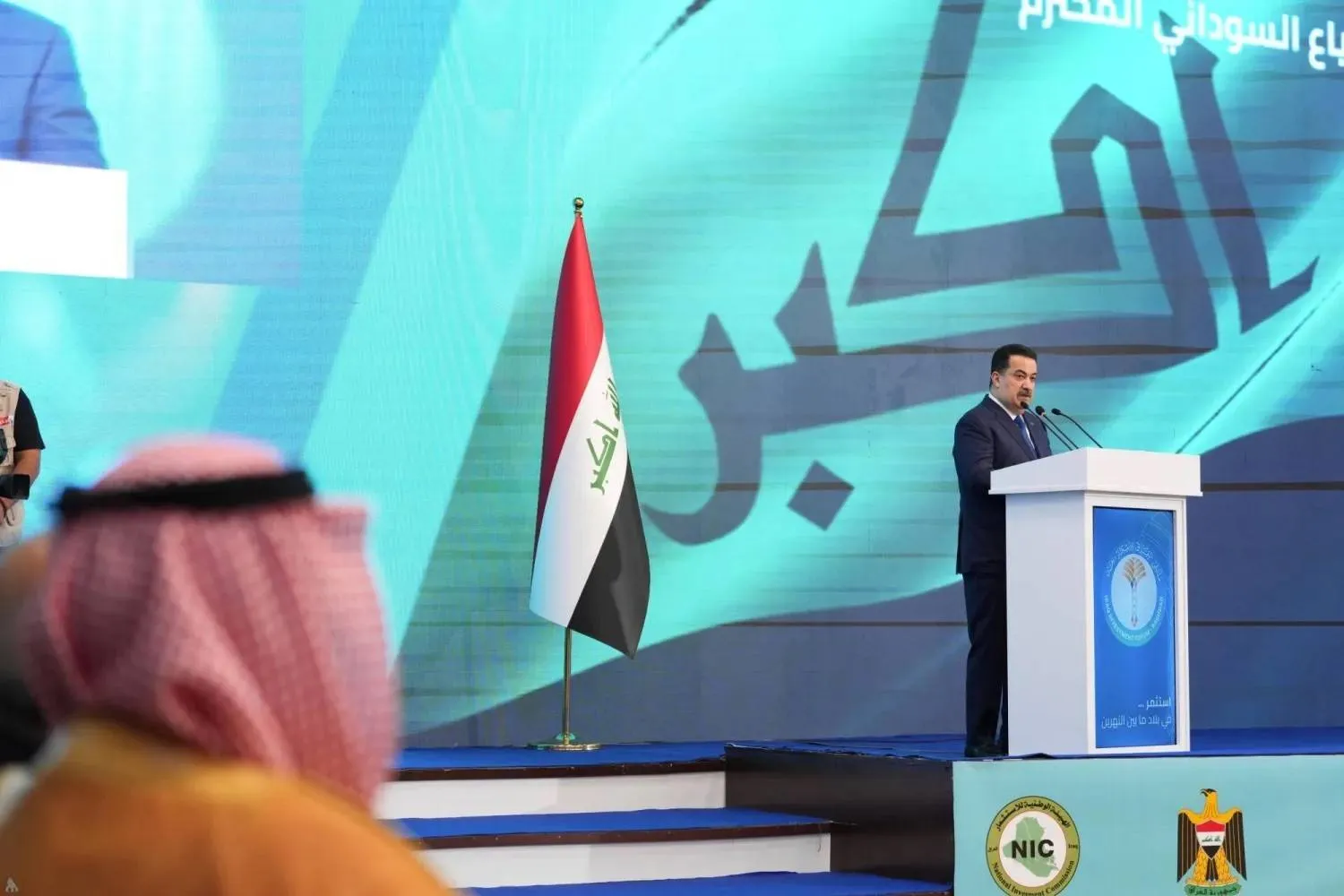
Sudani delivers his speech at the opening of the Iraq Investment Forum (Iraqi News Agency). 
TT

Sudani Launches $450 Billion Investment Opportunities in Iraq

Sudani delivers his speech at the opening of the Iraq Investment Forum (Iraqi News Agency). 

Iraqi Prime Minister Mohammed Shia al-Sudani unveiled investment opportunities worth $450 billion across multiple sectors, signaling an ambitious drive to diversify the country’s economy and attract global capital.

Speaking at the opening of the Iraq Investment Forum in Baghdad on Saturday, which drew wide Arab and international participation, Sudani highlighted progress in integrating Iraq with the global economy, expanding electronic payment systems, and improving financial governance.

The two-day forum, attended by around 600 business leaders and investors from 32 countries, features panel discussions with ministers from Iraq and the wider Arab region.

Sudani said a dedicated conference will be held to showcase opportunities linked to the Development Road project, describing it as the most extensive in the region. He noted that current investment volumes have already surpassed $100 billion, underscoring what he called the soundness of Iraq’s strategy to diversify its investment environment.

The prime minister pointed to the Riyada initiative, which has engaged more than half a million young Iraqis, trained 92,000 participants, and produced 12,000 projects and 20,000 jobs. He cited successful partnerships with international firms in fertilizers, sulfur, phosphates, steel, and construction, as well as in the food industry.

Sudani described Iraq’s growing pharmaceutical sector as unprecedented in the country’s history, noting that 54 Iraqi factories are now exporting to regional and global markets. He also emphasized major housing projects under way, representing more than one million units across 60 planned new cities, seven of which have already been awarded and three more pending.

Haider Makkieh, head of the National Investment Commission, told the forum that projects valued at over $100 billion have created nearly one million jobs. He said the commission has targeted underdeveloped sectors such as renewable energy, waste management, and gas processing, advancing Iraq’s shift toward a green economy.

For his part, Ibrahim al-Baghdadi, president of the Iraqi Economic Council, confirmed the government’s backing for strategic and medium-sized projects. He said the forum would present more than 160 opportunities through 20 ministry-led workshops and 14 sessions, alongside networking between Iraqi, Arab, and foreign business leaders.

In remarks to Asharq Al-Awsat, Economist Kamal al-Kubaisi described the event as a pivotal step in reducing Iraq’s reliance on oil. He noted that the forum represents a real chance to advance agriculture, industry, tourism, and renewable energy, but stressed the need for a stable, transparent investment environment and stronger public-private partnerships.

Kubaisi added that Iraq was now positioning itself on the regional and international investment map, a move that could serve sustainable development and provide the Iraqi people with a vital new economic path.



Saudi Arabia Underlines Commitment to Responsible Mineral Sourcing at Paris Peace Forum

Saudi Arabia Underlines Commitment to Responsible Mineral Sourcing at Paris Peace Forum
TT

Saudi Arabia Underlines Commitment to Responsible Mineral Sourcing at Paris Peace Forum

Saudi Arabia Underlines Commitment to Responsible Mineral Sourcing at Paris Peace Forum

The Saudi Ministry of Industry and Mineral Resources reaffirmed the Kingdom’s commitment to responsible mineral sourcing and sustainable resource governance at the 8th Paris Peace Forum, held at the Palais de Chaillot under the theme “New Coalitions for Peace, People, and the Planet.”

Deputy Minister of Industry and Mineral Resources for Mining Development Eng. Turki Al-Babtain represented the ministry in a high-level panel session titled “Security vs. Sustainability: The Hidden Costs of a Geopolitical Race for Minerals.” The panel featured President of the National Assembly of Serbia Ana Brnabić and former European Union Commissioner for Energy Kadri Simson.

Al-Babtain emphasized that advancement in the mineral sector requires collaboration rather than competition, said a Ministry of Industry and Mineral Resources statement on Sunday.

“The world’s energy transition depends on a coordinated global effort,” he added. “The world today faces not only a shortage of minerals but also a shortage of coordination. To avoid fragmentation and ensure stability, we must build a new compact of collaboration — one that links transparency, finance, and technology under shared responsibility.”

Saudi Arabia’s mining transformation under Vision 2030 seeks to balance economic diversification with environmental and social responsibility, he went on to say. The Kingdom is unlocking an estimated $2.5 trillion in mineral resources through the Regional Geological Survey Program, one of the region’s most extensive geochemical and geophysical mapping efforts of the Arabian Shield, covering 600,000 square kilometers.

To date, more than 33,000 square kilometers have been tendered for exploration, with an estimated 50,000 square kilometers of mineralized investment opportunity expected by 2025.

Al-Babtain stated that the transformation is guided by a reformed Mining Investment Law that enforces strict ESG standards, mandates community engagement, and requires comprehensive environmental rehabilitation by investors.

These measures, along with other competitive incentives, have attracted leading global mining companies, including Ivanhoe Electric, Vedanta, Hancock Prospecting, Zijin Mining, Discovery Group, and Kuya Silver, into the Kingdom’s mining sector, he stressed.

The sector has witnessed significant growth in exploration spending, which increased from $133.5 million in 2023 to $280.5 million in 2024. The number of active mining companies also rose from six in 2020 to 226 in 2024.

Al-Babtain highlighted the Future Minerals Forum (FMF), hosted annually in Riyadh, as one of Saudi Arabia’s key platforms for advancing global cooperation in the minerals sector. The forum convenes over 90 senior government officials from Africa, Asia, Europe, and the Americas to promote responsible mineral development, strengthen supply chains, and foster dialogue on policy and sustainability.

He noted that the FMF and its government-led Ministerial Roundtable have advanced three flagship initiatives: establishing a network of Centers of Excellence across Africa and Asia to drive capacity-building, developing harmonized regulatory frameworks, and enhancing sustainable investment in critical minerals.


Venezuela Says ‘Extraordinary’ Opportunities Available for Tourism Cooperation with Saudi Arabia

A view of Riyadh during Riyadh Season. (SPA)
TT

Venezuela Says ‘Extraordinary’ Opportunities Available for Tourism Cooperation with Saudi Arabia

A view of Riyadh during Riyadh Season. (SPA)

Venezuela’s Minister of Tourism Leticia Gomez said “extraordinary” opportunities for bolstering tourism cooperation with Saudi Arabia were available in line with the joint economic vision aimed diversifying sources of income and ending reliance on oil.

In remarks to Asharq Al-Awsat, she said the Kingdom was a strategic partner to Venezuela, especially given the alignment of their visions on investment and tourism development.

The minister is in Riyadh to attend the UN Tourism General Assembly.

“Our inbound tourism is an undeniable success story. The indicators reveal sustained growth of over 71% year-on-year average variation in the flow of international visitors,” Gomez told Asharq Al-Awsat.

“We project to go from 62,000 visitors in 2019 to a goal of almost three million (3,048,759) by the end of 2025, which is a testament to international confidence in our safe and peaceful environment,” she added.

On her participation in the General Assembly, she stated: “Our main purpose is twofold: first, to reaffirm Venezuela's commitment to positioning itself as a destination with great potential due to its natural beauty, sustainability, and excellent service; and second, as a destination of peace, megadiversity, and hospitality, open to investment and the future, in line with the 2030 Agenda.”

Venezuela’s Minister of Tourism Leticia Gomez. (Asharq Al-Awsat)

“The central theme of this Assembly, ‘The Impact of Artificial Intelligence and Innovation on the Future of Global Tourism,’ is our top priority for discussion,” she went on to say. “In Venezuela, we are promoting the intelligent use of Artificial Intelligence and technology to modernize the tourism experience with a focus on sustainability.”

“Technology should serve to improve efficiency and traveler satisfaction, allowing people to focus on what is essential: relaxation, healthy recreation, intimacy, and contact with other cultures,” she stressed.

“The fundamental challenge is maintaining stability and security while embracing global innovations,” continued the minister. “In this regard, we have attended various specialized tourism fairs showcasing the authentic and true face of Venezuela, dismantling a negative media campaign.”

“Regarding technological and human integration, the greatest challenge is how AI and innovation can enhance the experience without diminishing the value of intimacy and cultural connection that travelers seek. We overcome this by applying technology with a focus on sustainability that prioritizes human satisfaction,” added Gomez.

“Similarly, we want to consolidate Venezuela as a gateway to and from other countries in the region. We are actively seeking to develop multi-destination packages with sister nations so that tourists can combine our sun and beaches, mountains, plains, rainforest, snow, nature, and cultural experiences with other Caribbean and Latin American destinations,” she said.


US Airlines Brace for Third Day of Government-mandated Flight Cuts

DENVER, COLORADO - NOVEMBER 8: A display board shows canceled flights at Denver International Airport on November 6, 2025 in Denver, Colorado. Michael Ciaglo/Getty Images/AFP
TT

US Airlines Brace for Third Day of Government-mandated Flight Cuts

DENVER, COLORADO - NOVEMBER 8: A display board shows canceled flights at Denver International Airport on November 6, 2025 in Denver, Colorado. Michael Ciaglo/Getty Images/AFP

Major airlines braced for a third day of government-mandated flight cuts Sunday after rising air traffic control staffing shortages snarled thousands of flights on Saturday.

The Federal Aviation Administration instructed airlines to cut 4% of daily flights starting on Friday at 40 major airports because of air traffic control safety concerns. The shutdown, which has reached a record 40 days, has led to shortages of air traffic controllers who, like other federal employees, have not been paid for weeks.

Reductions in flights are mandated to reach to 6% on Tuesday and then hit 10% by November 14, Reuters said.

The FAA said on Saturday there were air traffic control staffing shortages impacting 42 airport towers and other centers and delaying flights in at least 12 major US cities including Atlanta, Newark, San Francisco, Chicago and New York.

Some 1,550 flights were canceled and 6,700 flights were delayed on Saturday, compared with Friday when 1,025 were canceled and 7,000 were delayed.

Airline officials privately said the number of delay programs made it nearly impossible to schedule and plan many flights and expressed alarm about how the system would function if staffing issues worsen.

The cuts, which began on Friday morning, include about 700 flights from the four largest carriers: American Airlines , Delta Air Lines, Southwest Airlines and United Airlines. The airlines are due to cancel about the same number of flights Sunday.

During the government shutdown, 13,000 air traffic controllers and 50,000 security screeners have been forced to work without pay.

US Transportation Secretary Sean Duffy said it was possible he could require 20% cuts in air traffic if more controllers stop showing up for work. "I assess the data," Duffy said. "We're going to make decisions based on what we see in the airspace."

Republican Senator Ted Cruz said he was told by the FAA that since the shutdown started pilots have filed more than 500 safety reports about mistakes made by air traffic controllers because of fatigue.