


Refiners in India, Elsewhere in Asia Look to Buy Iranian Oil after US Waives Sanctions

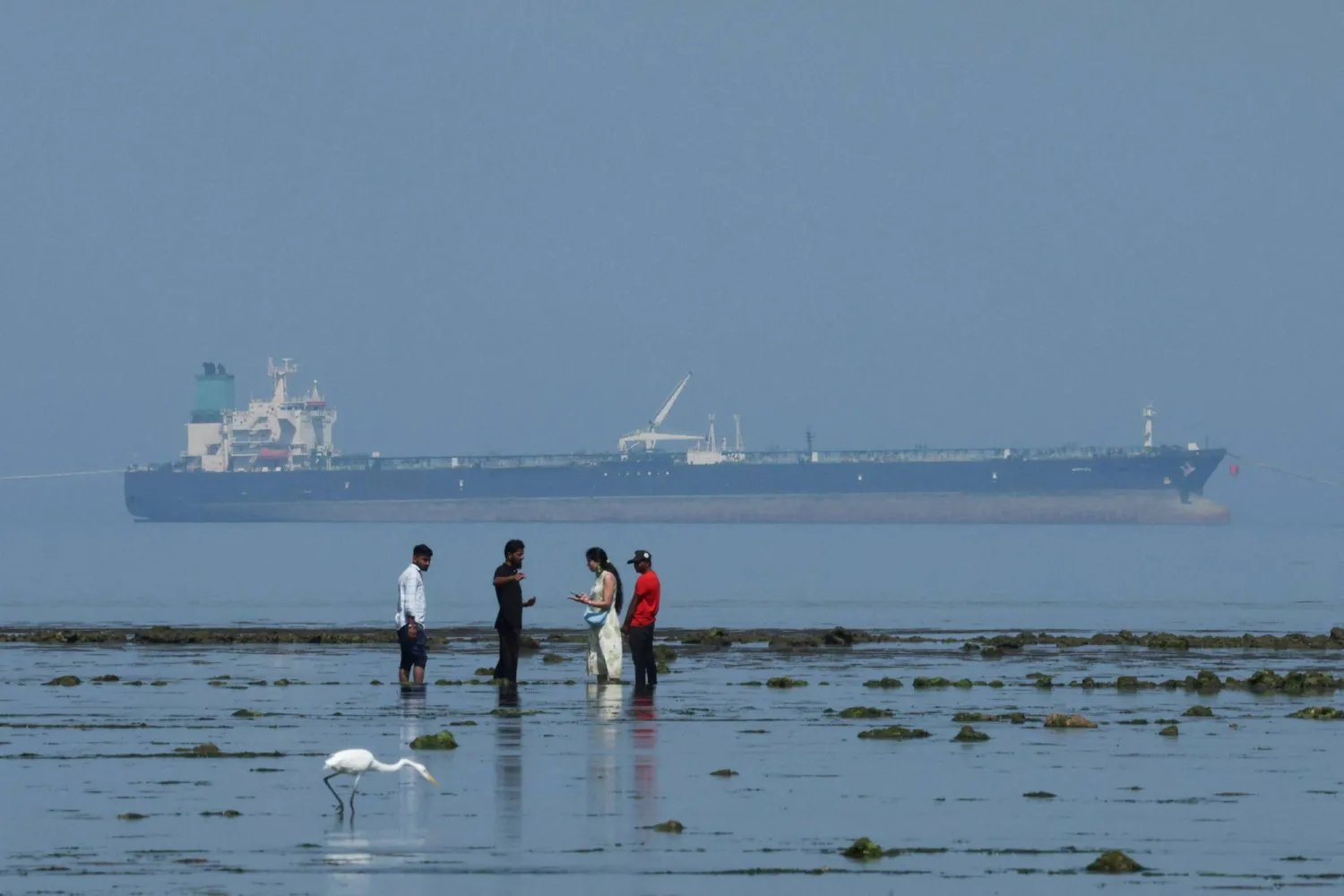
FILE PHOTO: Tourists watch marine life, with the MT Desert Kite oil tanker carrying Russian oil in the background, at Narara Marine National Park in the Arabian Sea, Gujarat, India March 11 , 2026. REUTERS/Amit Dave/File Photo
TT

Refiners in India, Elsewhere in Asia Look to Buy Iranian Oil after US Waives Sanctions

FILE PHOTO: Tourists watch marine life, with the MT Desert Kite oil tanker carrying Russian oil in the background, at Narara Marine National Park in the Arabian Sea, Gujarat, India March 11 , 2026. REUTERS/Amit Dave/File Photo

Indian refiners plan to resume buying Iranian oil while refiners elsewhere in Asia are examining such a move after Washington temporarily removed sanctions to alleviate an energy crunch caused by the US-Israeli war on Iran, traders said on Saturday.

Three Indian refining sources said they will buy Iranian oil and are awaiting government directions and clarity from Washington on details such as payment terms.

Refiners in India, which has much smaller crude stockpiles than other big Asian oil importers, rushed to book Russian oil after the US recently lifted sanctions temporarily. The Indian government could not be immediately reached for comment outside office hours.

Other Asian refiners are making checks to see if they can purchase the oil, several ⁠people with knowledge ⁠of the matter said.

The Trump administration on Friday issued a 30-day sanctions waiver for the purchase of Iranian oil already at sea, US Treasury Secretary Scott Bessent said.

The waiver applies to oil loaded on any vessel, including sanctioned tankers, on or before March 20 and discharged by April 19, according to the Office of Foreign Assets Control. It is the third time the US has temporarily waived sanctions on oil since the start of the war.

About ⁠170 million barrels of Iranian crude are at sea, said Emmanuel Belostrino, Kpler’s senior manager for crude oil market data, on ships scattered from the Middle East Gulf to the waters near China.

Consultancy Energy Aspects on March 19 estimated 130 million to 140 million barrels of Iranian oil on water, equivalent to less than 14 days of current Middle East production losses.

Asia relies on the Middle East for 60% of its crude supply and the near-closure of the Strait of Hormuz this month is forcing refineries across the region to run at lower rates and cut fuel exports.

Trump re-imposed sanctions on Iran in 2018 over its nuclear program. Since then, China has become Iran's main client with its independent refiners buying 1.38 million barrels per day (bpd) ⁠last year, Kpler ⁠data showed, attracted by deep discounts as most countries shunned the crude due to the sanctions.

Potential complications for buying Iranian oil include uncertainty over how to pay for it and the fact that a large share of it is aboard aging shadow fleet ships, traders said.

Also, some former purchasers of Iranian oil were contractually obligated to buy from National Iranian Oil Co., two refining sources said. However, since the US re-imposed sanctions in late 2018, Iranian oil has been sold in significant part by third-party traders.

"It usually takes some time to work through compliance, administration and banking, etc., but I guess people will try to work ASAP," a Singapore-based trader said.

According to Reuters, the sources declined to be named due to company policy.

Other than China, major buyers of Iranian crude before sanctions were re-imposed included India, South Korea, Japan, Italy, Greece, Taiwan and Türkiye.



China's Sinopec Posts 36.8% Drop in 2025 Net Profit

People walk past SINOPEC petrol station, in Shanghai, China, 19 March 2026.  EPA/ALEX PLAVEVSKI
People walk past SINOPEC petrol station, in Shanghai, China, 19 March 2026. EPA/ALEX PLAVEVSKI
TT

China's Sinopec Posts 36.8% Drop in 2025 Net Profit

People walk past SINOPEC petrol station, in Shanghai, China, 19 March 2026.  EPA/ALEX PLAVEVSKI
People walk past SINOPEC petrol station, in Shanghai, China, 19 March 2026. EPA/ALEX PLAVEVSKI

China Petroleum & Chemical Corp, known as Sinopec, reported a 36.8% decline in 2025 net profit on Sunday, citing rising substitution by new energy sources, and weak petrochemical margins, according to the company's filing.

The world's largest oil refiner by capacity posted net income attributable to shareholders of 31.8 billion yuan ($4.62 billion), based on Chinese accounting standards, in a filing to the Shanghai stock exchange.

Refinery throughput fell 0.8% last year to 250.33 million metric tons, equivalent to 5 million barrels per day. The company forecast refinery throughput would remain stable at about 250 million tons in 2026.

Gasoline and diesel production fell 2.4% and 9.1%, respectively, to 62.61 million tons and 52.64 million tons, while kerosene production rose 7.3% year-on-year to 33.71 million tons.

Annual refining ⁠gross margin was ⁠330 yuan ($47.93) per ton, up 27 yuan year-on-year, mainly due to sharply improved margins for refining by-products such as sulfur and petroleum coke, which offset the impact of high import crude premiums and freight costs.

The company's gasoline sales fell 2.5% year-on-year to 61.1 million tons, with the average price falling 7.7%, while diesel sales fell 9.1% to 51.2 million tons, and the average price fell 8% in ⁠2025, Reuters reported.

Kerosene sales were 24.2 million tons, up 4% year-on-year, while the average price was down 9.9% from 2024.

In 2025, the company's domestic crude oil output reached 255.75 million barrels, up 0.7% year-on-year, while overseas crude oil output was 26.65 million barrels.

Sinopec expects domestic crude oil output to reach 255.6 million barrels in 2026, remaining largely stable, while overseas output is expected to drop to 25.31 million barrels.

Natural gas production rose 4% year-on-year to 1,456.6 billion cubic feet in 2025 and is expected to reach 1,471.7 billion cubic feet in 2026.

The company's ethylene production rose 13.5% year-on-year to 15.28 million tons in 2025.

In 2025, the ⁠company's external sales ⁠revenue from chemical products totaled 378.0 billion yuan, down 9.6% year-on-year, mainly because of lower product prices.

Sinopec's capital spending was 147.2 billion yuan in 2025 with 70.9 billion yuan on exploration and development.

Sinopec said it plans capital spending from 131.6 billion to 148.6 billion yuan this year, including 72.3 billion yuan for exploration and development, mainly for crude oil capacity expansion at Jiyang and Tahe, natural gas capacity projects in western and southern Sichuan, and oil and gas storage and transport facilities.

Sinopec's Hong Kong-listed shares have risen 0.21% year-to-date, outperforming a 1.38% drop in the Hang Seng Index , while lagging behind its peers PetroChina and CNOOC, which have posted 17.58% and 42.63% gains year-to-date, respectively.


Egypt Says it Will Pay $1.3 Billion in Arrears to Oil Companies by June

Egypt had accumulated about $6.1 billion in arrears to foreign oil companies by June 30, 2024  (Ministry of Petroleum)
Egypt had accumulated about $6.1 billion in arrears to foreign oil companies by June 30, 2024 (Ministry of Petroleum)
TT

Egypt Says it Will Pay $1.3 Billion in Arrears to Oil Companies by June

Egypt had accumulated about $6.1 billion in arrears to foreign oil companies by June 30, 2024  (Ministry of Petroleum)
Egypt had accumulated about $6.1 billion in arrears to foreign oil companies by June 30, 2024 (Ministry of Petroleum)

Egypt will settle $1.3 billion in arrears to international oil companies by June, the petroleum ministry said on Saturday, accelerating its previous timetable for repayments.

Egypt had accumulated about $6.1 billion in arrears to foreign oil companies by June 30, 2024 due to a prolonged foreign currency shortage that delayed payments and weighed on investment and gas output. The shortage has since eased, ⁠though some companies have ⁠said that arrears have been once again accumulating.

Under its prior timetable, announced in January this year, the government had expected to still have arrears of some $1.2 billion by June.

Clearing debt may encourage ⁠foreign oil and gas companies to resume drilling, which would boost local production that has been steadily falling since peaking in 2021.

More local production would help the country to reduce its energy imports.


China's Premier Vows to Expand Global 'Trade Pie'

Chinese Premier Li Qiang is seen on a big screen live broadcasting his speech at the opening of the China Development Forum 2026 held at the Diaoyutai State Guesthouse in Beijing on March 22, 2026. (Photo by Ng Han Guan / POOL / AFP)
TT

China's Premier Vows to Expand Global 'Trade Pie'

Chinese Premier Li Qiang is seen on a big screen live broadcasting his speech at the opening of the China Development Forum 2026 held at the Diaoyutai State Guesthouse in Beijing on March 22, 2026. (Photo by Ng Han Guan / POOL / AFP)

China's number two leader Li Qiang said Sunday that his country was willing to help expand the global "trade pie" by further opening up, state media reported, while he slammed unilateralism from certain countries.

Many of China's key trading partners have increasingly called on Beijing to reduce its soaring trade surplus owing to its impact on local competition.

Its trade surged by a fifth in the first two months of the year, official data showed earlier this month, significantly outpacing forecasts.

China "will steadfastly advance high-level opening up, import more high-quality foreign goods, and work alongside all parties to promote the optimized and balanced development of trade", Premier Li Qiang told business executives in Beijing on Sunday, according to Xinhua.

Li was speaking at the opening of the annual China Development Forum, attended this year by prominent business leaders including Apple CEO Tim Cook, AFP reported.

The Chinese premier added that Beijing would work with other countries to "join forces to make the global economic and trade pie larger for everyone".

He slammed growing unilateralism and protectionism, which he said was "no panacea for resolving problems".

Beijing has been seeking to steer a shaky economy onto a more stable path since the end of the pandemic, particularly by boosting consumption.

It had been locked in a blistering trade war last year with Washington after President Donald Trump imposed tariffs on countries including China.

The recent trade boost is a lifeline for China, the world's second-largest economy, as domestic consumer activity has slumped, and adds to the record surplus achieved last year.

The China Development Forum convenes as the Middle East war, triggered by US and Israeli strikes on Iran, rages on.

Tehran has retaliated with strikes across the region and beyond in a conflict that has threatened global energy security as well as China's oil supplies.

Li told the Chinese officials and global business executives the international rules-based order was suffering "severe disruption" with power politics "running rampant".

Chinese Vice Premier He Lifeng met with senior representatives of multinational companies including HSBC, UBS, Schneider Electric and Standard Chartered on Saturday, Xinhua reported.